You've probably watched gold make a slow, steady climb while silver suddenly spikes 5% in a single session. We see traders get caught off guard by this erratic price action constantly. Silver moves differently than other assets, and it requires a specific set of rules and risk management protocols. In this guide, we'll show you exactly how to trade silver using futures, exchange-traded funds, and ratio strategies. By the end, you'll understand how to structure a trade based on industrial demand, execute a gold-silver ratio strategy, and protect your capital from sudden price swings.
What Drives Silver Prices and Why Is It So Volatile?
Bottom Line: Silver rewards traders who understand its dual identity: part industrial commodity, part safe-haven asset. That split personality creates volatility that punishes oversized positions but offers real opportunity when you trade with a defined structure. Respect the wider price swings, size down relative to gold, and use the ratio and industrial demand signals to time entries with an edge.
Silver acts as both a safe-haven asset and an essential industrial component, making it uniquely sensitive to economic fear and manufacturing demand. Unlike gold, which is primarily a monetary asset, silver has heavy industrial applications that drive a significant portion of its price behavior.
More than half of the global silver supply goes toward industrial use. The production of solar panels, electronics, and electric vehicles heavily dictates physical demand. When manufacturing data shows expansion, industrial demand for silver typically rises.
Because of its industrial applications, silver often shows a positive correlation with traditional equity markets during periods of economic growth. When the stock market rallies on strong manufacturing data, silver usually follows suit.
Because the silver market is smaller and less liquid than the gold market, it experiences much higher volatility. This volatility creates the price swings that short-term traders look for.
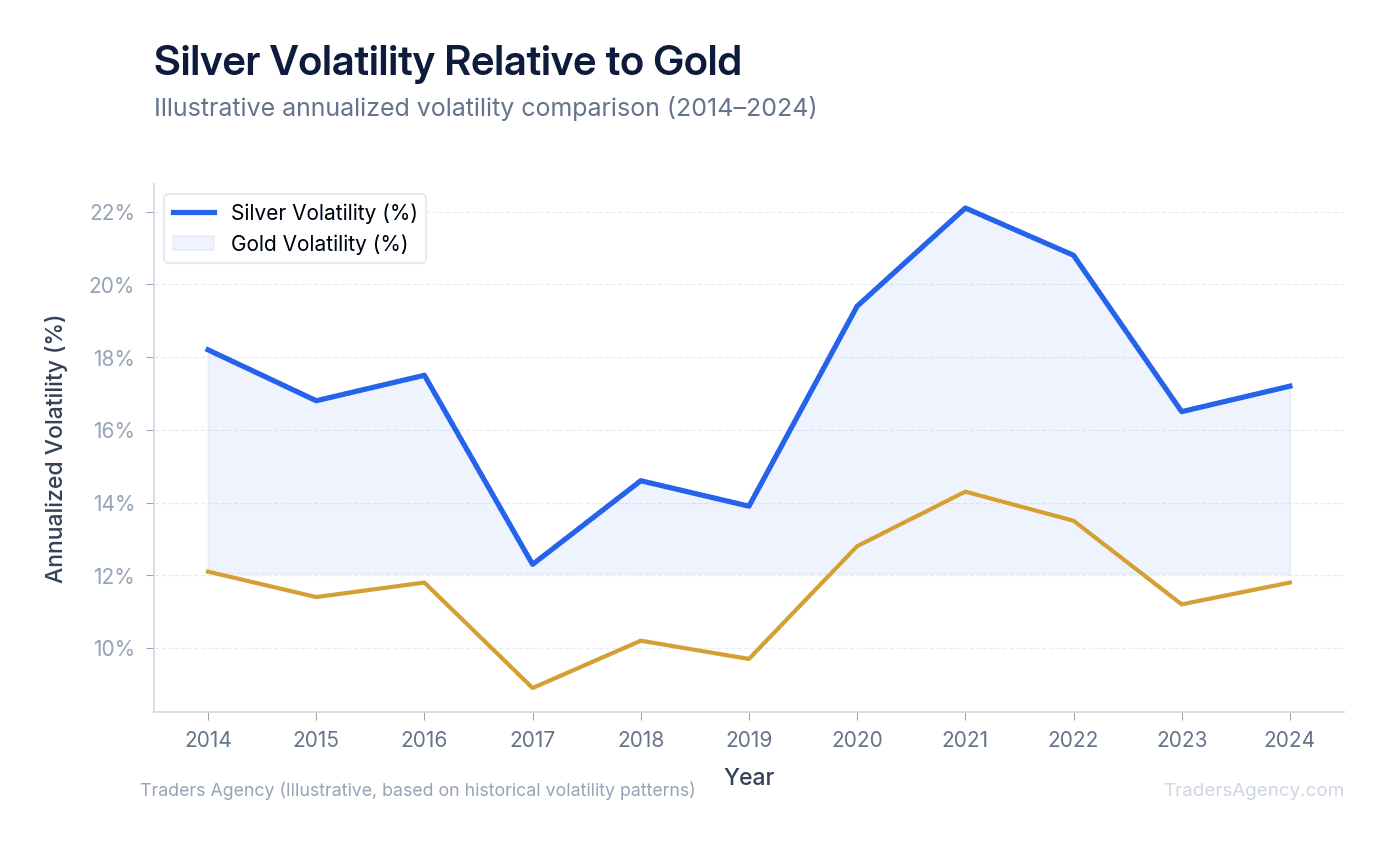
Key Concept: Silver's dual identity as both an industrial metal and a precious metal means you need to track manufacturing indices alongside traditional inflation metrics. If you ignore the industrial side of the equation, you're missing half the picture.
What Is the Best Strategy for Trading Silver?
The best strategy for trading silver depends on market conditions, but we prefer trading the gold-silver ratio for long-term setups and using range trading for short-term futures contracts. These methods allow traders to capitalize on silver's historical price boundaries and industrial demand cycles without predicting outright directional moves.
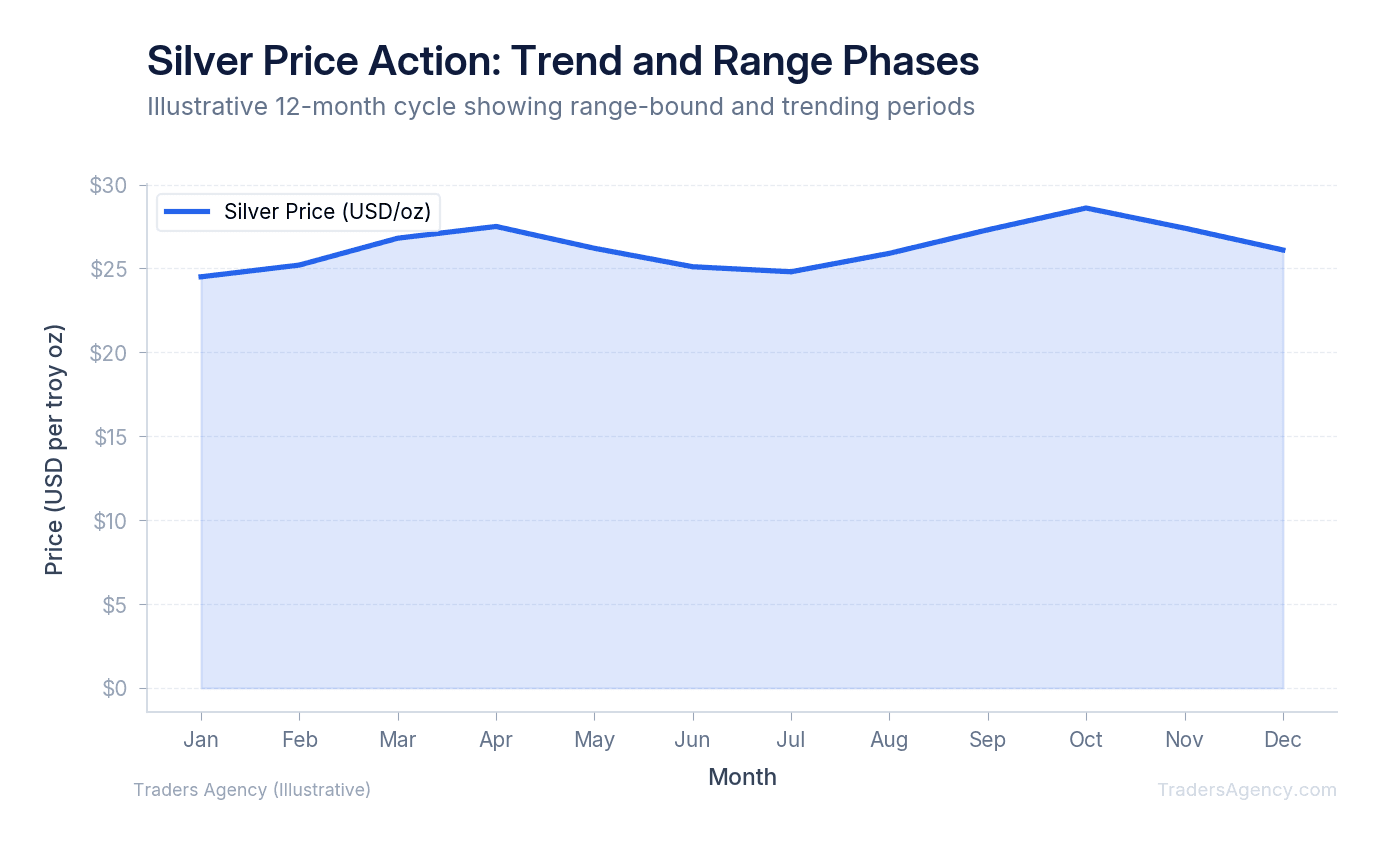
When the market establishes clear support and resistance levels, silver range trading becomes highly effective. Silver often consolidates for months at a time before a major breakout.
Conversely, when macroeconomic factors drive a clear directional move, silver trend trading takes over. During these periods, we look for pullbacks to moving averages to enter positions in the direction of the primary trend.
How Do You Trade the Gold-Silver Ratio?
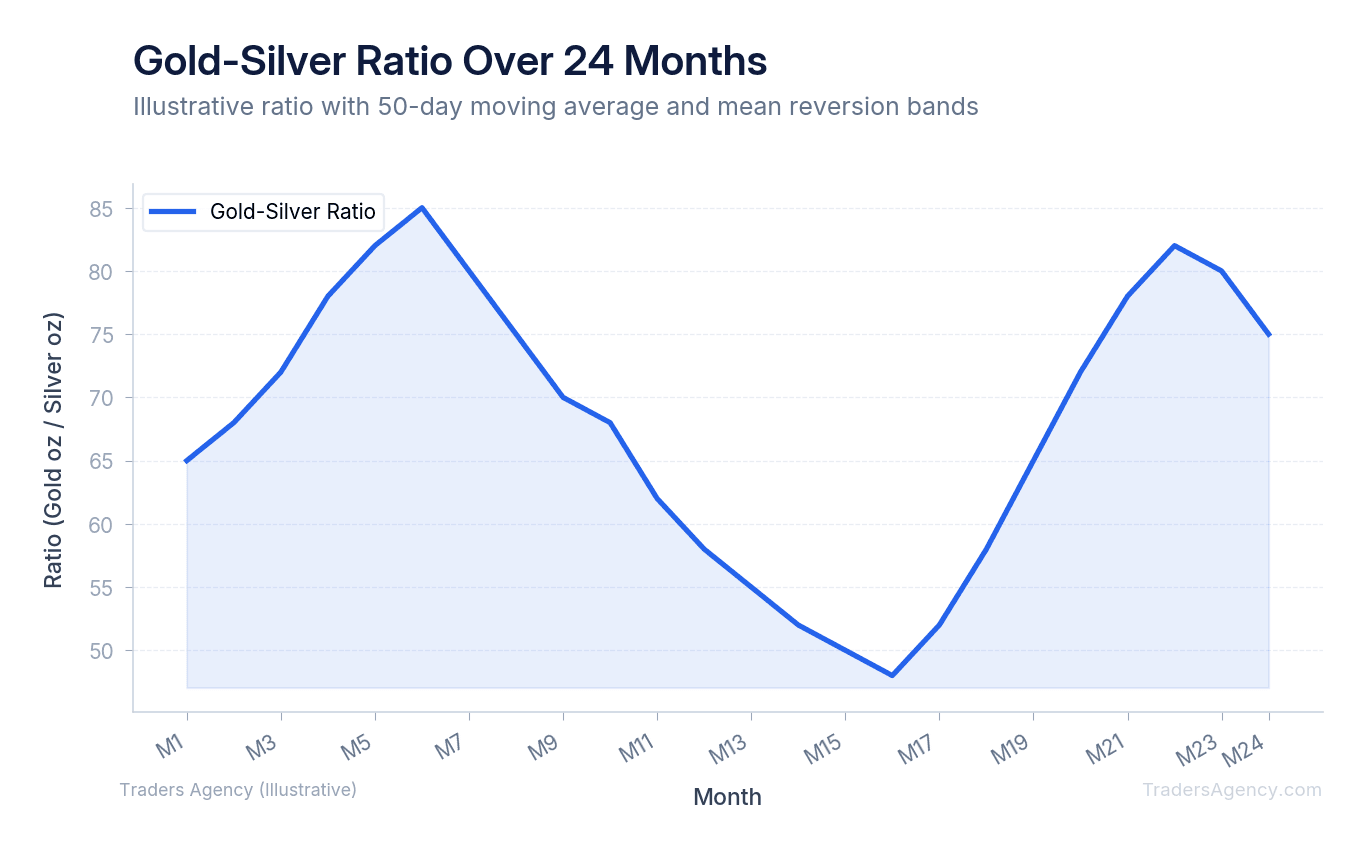
You trade the gold-silver ratio by dividing the current price of gold by the price of silver to determine relative value. When the ratio hits historical extremes, traders sell the expensive metal and buy the cheap metal, anticipating a reversion to the historical average.
Gold-silver ratio trading is one of the most reliable methods for precious metals investors. Historically, the ratio averages around 60:1 to 65:1. When the ratio climbs above 80:1, silver is historically cheap compared to gold.
Here's how we execute this strategy step by step:
- Identify the Extreme: We monitor the ratio daily. Say gold is trading at $2,000 per ounce and silver is at $22.22. The ratio is exactly 90:1. This signals that silver is severely undervalued relative to gold.
- Execute the Trade: To capitalize on this, we buy silver and short gold. You can do this using futures contracts or exchange-traded funds. The goal is not to predict the outright direction of either metal, but to bet that the price gap between them will narrow.
- Take Profits at the Mean: We set our profit target near the historical average. If the ratio drops back to 70:1, the trade is closed for a profit. This strategy works regardless of whether both metals go up or both go down, as long as silver outperforms gold.
Key Concept: The gold-silver ratio strategy is a relative value trade. You're not betting on the direction of precious metals. You're betting that the spread between gold and silver will return to its historical norm.
Want expert trading insights delivered daily?
Join thousands of traders who rely on Traders Agency for market analysis and trade ideas.
Join Traders AgencyWhat Is the Best Way to Trade Silver: Futures, Options, or ETFs?
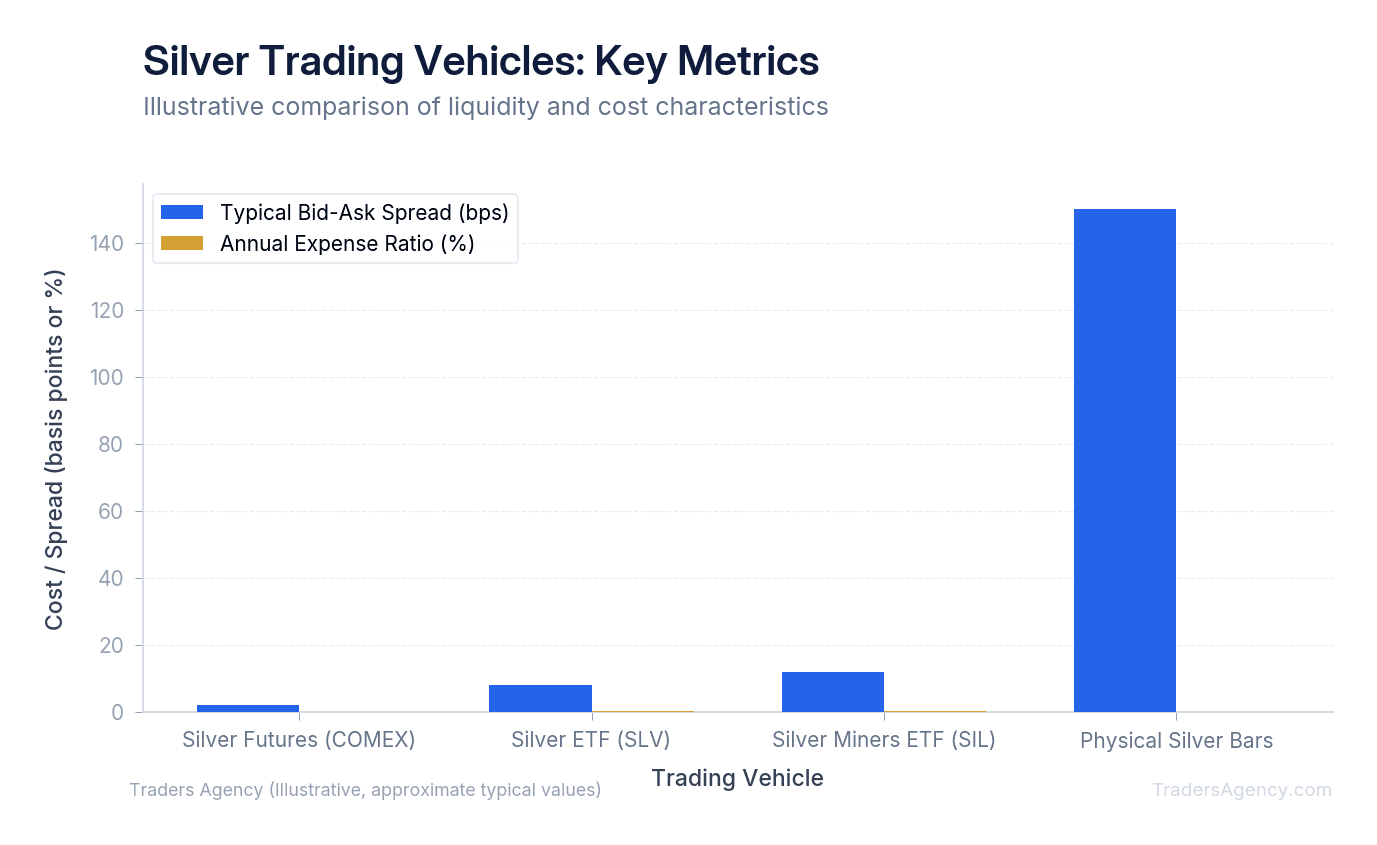
Before executing any setup, you need to choose the right vehicle. Not every trader has the capital requirements for futures, and that's perfectly fine.
Silver Futures
For active short-term traders, silver futures trading offers the best liquidity and capital efficiency. The standard COMEX silver futures contract (ticker SI) controls 5,000 ounces of silver. A one-dollar move in the price of silver equals a $5,000 change in the contract value. We require our members to review the CME Group's contract specifications before trading these instruments.
Silver Options on Futures
If you want to hedge a physical silver portfolio, silver options on futures are highly effective. You can buy put options to protect against a price drop without selling your core position. For instance, if you own physical silver at $23.00 per ounce, you might buy a put option with a $22.00 strike price expiring in 60 days. This limits your downside risk to $1.00 per ounce plus the cost of the put premium.
Silver ETFs
For traders who want exposure without a margin account, silver ETFs provide a simple alternative. The iShares Silver Trust (SLV) tracks the physical price of the metal. Alternatively, you can trade mining stocks using the Global X Silver Miners ETF (SIL). Mining stocks often provide a leveraged return compared to the physical metal, meaning they move faster in both directions.
| Vehicle | Best For | Key Consideration |
|---|---|---|
| COMEX Futures (SI) | Active short-term trading | $5,000 per $1 move; requires margin account |
| Options on Futures | Hedging physical holdings | Defined risk; time decay works against buyers |
| SLV (ETF) | Physical price tracking | No margin needed; expense ratio applies |
| SIL (Mining ETF) | Leveraged exposure to silver | Moves faster in both directions; company-specific risk |
Step-by-Step: Executing a Silver Range Trade
Here's exactly how we trade silver using a basic range-bound setup. We look for a market that has established clear boundaries over a four-hour or daily timeframe.
- Identify the Setup: Assume silver has been trading between a support level of $22.00 and a resistance level of $24.00 for six weeks. The price drops to $22.15 and begins to show buying pressure on the hourly chart.
- Execute the Trade: We enter a long position at $22.20. Because silver is prone to sudden spikes, we place a hard stop loss immediately. Our stop goes below the support zone at $21.70. This creates a defined risk of $0.50 per ounce.
- Manage the Position: Our profit target is placed just below resistance at $23.80. This gives us a potential reward of $1.60 per ounce, creating a 3.2-to-1 reward-to-risk ratio.
| Scenario | Price Action | Result |
|---|---|---|
| Best Case | Price rallies to $23.80 | +$1.60 per ounce profit (3.2:1 R/R) |
| Most Likely | Price chops around $23.00 | Trail stop to breakeven; manage for partial profit |
| Worst Case | Price breaks support at $21.70 | -$0.50 per ounce loss (strict, defined risk) |
When Should You NOT Trade Silver?
You should avoid silver trading strategies during major central bank announcements or when industrial supply chain data is pending. Silver's dual nature makes it highly reactive to both interest rate changes and manufacturing reports, creating unpredictable price spikes that easily trigger stop losses.
One of the most common mistakes we see intermediate traders make is treating silver exactly like gold. Silver has a lower trading volume, which means institutional orders can push the price around violently.
We tell our members to avoid trading silver breakouts on low-volume days. A breakout that occurs during a holiday week or outside of regular market hours is often a trap. Wait for confirmation during peak trading hours when liquidity is highest.
Watch Out: Never trade silver without strict position sizing. Because silver is more volatile than gold, you must trade smaller position sizes to maintain the same level of portfolio risk. If you normally risk 2% of your account on a gold trade, we recommend risking only 1% on a silver trade to account for the wider price swings.
Our education team publishes new strategy guides and market analysis every week. Silver's unique blend of industrial demand and safe-haven appeal makes it one of the most rewarding markets to trade, but only if you respect its volatility and follow a disciplined approach.
Want expert trading insights delivered daily?
Join thousands of traders who rely on Traders Agency for market analysis and trade ideas.
Join Traders AgencyKey Takeaways
- More than half of global silver supply goes toward industrial use, meaning manufacturing data and sectors like solar, electronics, and EVs directly move the price.
- Silver correlates positively with equity markets during economic expansions because industrial demand rises alongside growth, unlike gold which trades primarily as a monetary asset.
- Silver's smaller market size makes it more volatile than gold, so traders should cut position sizing accordingly: if you risk 2% of capital on a gold trade, risk only 1% on a silver trade.
- The gold-silver ratio is a tradable strategy, not just a metric. Extreme ratio readings signal when silver is historically cheap or expensive relative to gold.
- Silver can be traded through futures, ETFs, or options, each with different leverage profiles and risk characteristics that suit different account sizes and strategies.
DISCLAIMER: Traders Agency does not offer financial advice. The information provided is for educational purposes only and should not be considered financial advice. Traders Agency is not responsible for any financial losses or consequences resulting from the use of the information provided. Trading carries inherent risks and may not be suitable for all individuals. You are advised to conduct your own research and seek personalized advice before making any investment decisions, recognizing the potential risks and rewards involved.
See more from Traders Agency on Google
Make us a preferred source and our market analysis will appear more prominently in your Google Search, Top Stories, and AI results.
Add to Preferred Sources