
A gold safe haven strategy is a defensive approach where traders buy precious metals to protect their portfolios during financial crises, high inflation, or geopolitical uncertainty. Because gold holds intrinsic value and operates independently of corporate earnings, it often retains or increases its purchasing power when traditional stock markets decline. We'll walk you through exactly how this asset class fits into a broader portfolio, the key drivers behind price movement, and how to execute trades using different vehicles like exchange-traded funds or physical bullion.
What Makes Gold a Safe Haven Asset?
Bottom Line: Gold works as a safe haven because of scarcity, zero credit risk, and its independence from the corporate earnings cycle that drives equities. The strategy is most effective when used as a defensive layer during crises or inflationary periods, not as a permanent core holding. Choosing the right vehicle matters: GLD and IAU offer clean spot exposure, while mining stocks introduce the corporate risk you are trying to avoid.
You've probably seen this play out before. The stock market takes a sudden dive, panic sets in, and financial news anchors start talking about a rush to precious metals. It sounds great in theory, but executing this strategy requires specific timing and risk management.
Gold acts as a safe haven asset because it has a limited physical supply and carries no credit risk. Unlike fiat currencies that central banks can print in unlimited quantities, gold maintains a relatively stable global supply. This scarcity creates a natural floor for its long-term value.
Our team teaches that gold operates outside the traditional financial system. If a company goes bankrupt, its stock goes to zero. Gold cannot go bankrupt because it is a physical element, not a corporate entity with debt obligations.
Think of it like a financial insurance policy. You don't buy insurance hoping your house catches fire. You buy it so you have protection if a disaster happens.
Key Concept: Gold is classified as a commodity that can offer diversification benefits. It historically moves independently from traditional equity markets, meaning it often zigs when the S&P 500 zags.
When Does Gold Actually Work as a Safe Haven?
Gold works best as a safe haven during periods of high inflation, falling interest rates, and severe geopolitical uncertainty. When real yields on government bonds turn negative, investors flock to precious metals because holding cash or low-yielding debt actively loses purchasing power compared to holding gold.
Let's look at specific historical episodes to see this in action.
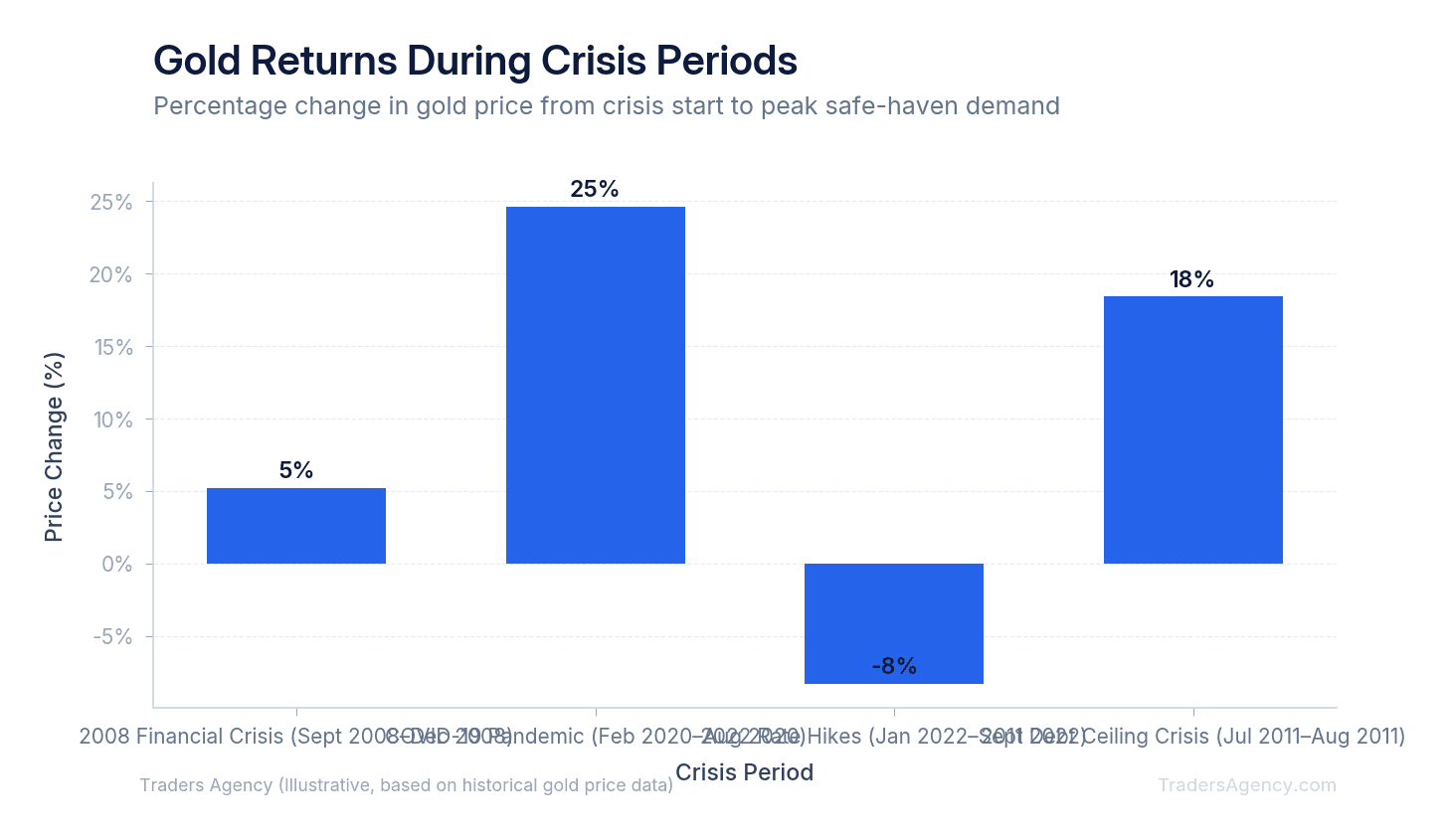
During the 2008 financial crisis, the S&P 500 lost more than 50% of its value. Gold initially dipped with the broader market as funds liquidated everything for cash. However, it quickly recovered and ended the year in positive territory.
When the COVID-19 pandemic hit in early 2020, global markets crashed overnight. Gold surged as central banks slashed interest rates to zero, pushing the metal to new all-time highs above $2,000 per ounce by August of that year.
Key Drivers of Gold Price Movement
What actually causes this commodity to move on a daily basis? Our team focuses on three primary variables before executing any trade.
- Real Interest Rates: You calculate real rates by taking the current government bond yield and subtracting the inflation rate. If a 10-year Treasury bond pays 4% but inflation is 5%, the real yield is negative. Investors lose purchasing power holding that bond, making zero-yield assets like precious metals highly attractive.
- Central Bank Purchasing Behavior: Quarterly data on how much bullion global central banks are buying is publicly available. When foreign governments aggressively buy physical reserves to diversify away from the dollar, it creates a massive base of institutional demand.
- Technical Chart Levels: Like any traded asset, psychological support and resistance levels matter. If the price breaks above a major psychological barrier like $2,000 per ounce, momentum traders often flood the market and accelerate the trend.
Why Does Gold Move Inversely to the Dollar?
The relationship between gold and the US Dollar is one of the most reliable indicators we track. Because gold is priced in dollars globally, a weaker dollar makes gold cheaper for foreign buyers. This increases global demand and pushes the price of gold higher.
Conversely, a strong dollar makes gold more expensive in other currencies. This typically suppresses international demand and lowers prices.
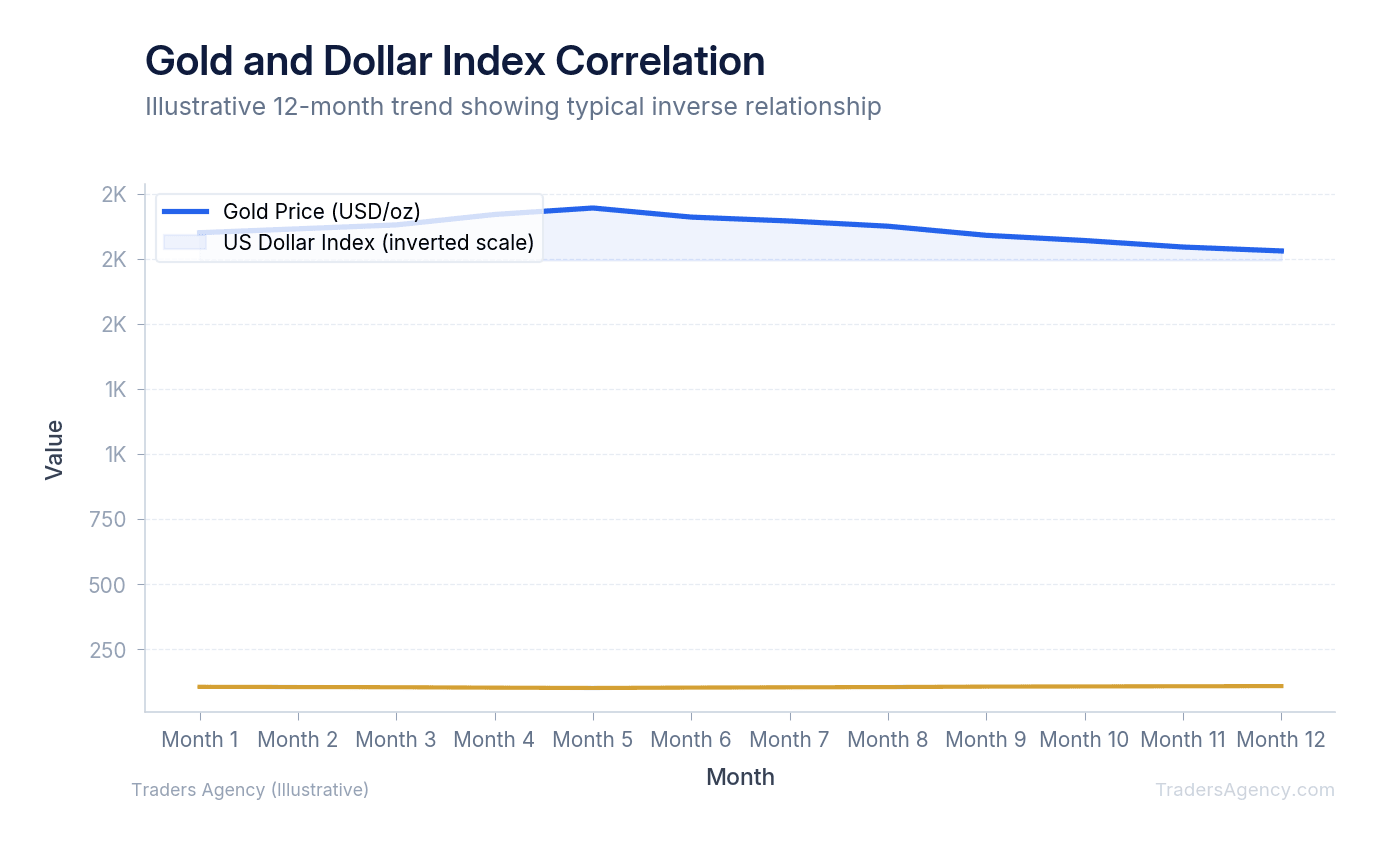
We prefer to watch the US Dollar Index (DXY) before entering a precious metals trade. If the DXY is in a strong uptrend, buying gold becomes a much higher-risk proposition. We teach our members to wait for the dollar to show signs of weakness before taking a heavy position in metals.
Key Concept: Gold and the US Dollar typically move in opposite directions. A falling DXY is one of the strongest tailwinds for precious metals prices, while a rising dollar acts as a headwind.
Want expert trading insights delivered daily?
Join thousands of traders who rely on Traders Agency for market analysis and trade ideas.
Join Traders AgencyHow to Gain Exposure to Gold: ETFs, Physical, and Futures
You don't need to buy a physical vault to trade this commodity. We teach our members several different ways to gain exposure, depending on their account size and goals.
1. Gold ETFs (Exchange-Traded Funds)
For most beginners, ETFs are the easiest entry point. You buy and sell them exactly like regular stocks in your standard brokerage account.
The SPDR Gold Shares (GLD) is the largest and most liquid option. Each share represents roughly one-tenth of an ounce of gold, though this ratio drifts slightly lower over time due to the fund's expense ratio. If gold trades at $2,000, GLD will trade in the neighborhood of $185 to $190.
The iShares Gold Trust (IAU) is another excellent choice. It has a lower expense ratio than GLD, making it better for long-term holding.
2. Physical Gold
Buying physical coins or bars gives you direct ownership. You eliminate counterparty risk entirely because you hold the actual asset in your hands.
However, physical metals come with high dealer markups. You might pay a 5% to 10% premium over the spot price just to acquire a one-ounce coin. You also have to pay for secure storage, whether that's a home safe or a bank deposit box.
3. Gold Futures
Advanced traders use the futures market for maximum capital efficiency. A standard COMEX gold futures contract (GC) controls 100 ounces of gold.
This requires significant margin and carries high risk. A $10 move in the price of gold equals a $1,000 change in the contract value. We do not recommend futures for beginners due to the extreme leverage involved.
| Exposure Method | Best For | Key Advantage | Key Drawback |
|---|---|---|---|
| GLD ETF | Most traders | High liquidity, easy to trade | Slightly higher expense ratio |
| IAU ETF | Long-term holders | Lower expense ratio | Slightly less liquid than GLD |
| Physical Gold | Long-term wealth preservation | No counterparty risk | 5%-10% dealer premium + storage costs |
| Futures (GC) | Advanced traders only | Maximum capital efficiency | Extreme leverage, $1,000 per $10 move |
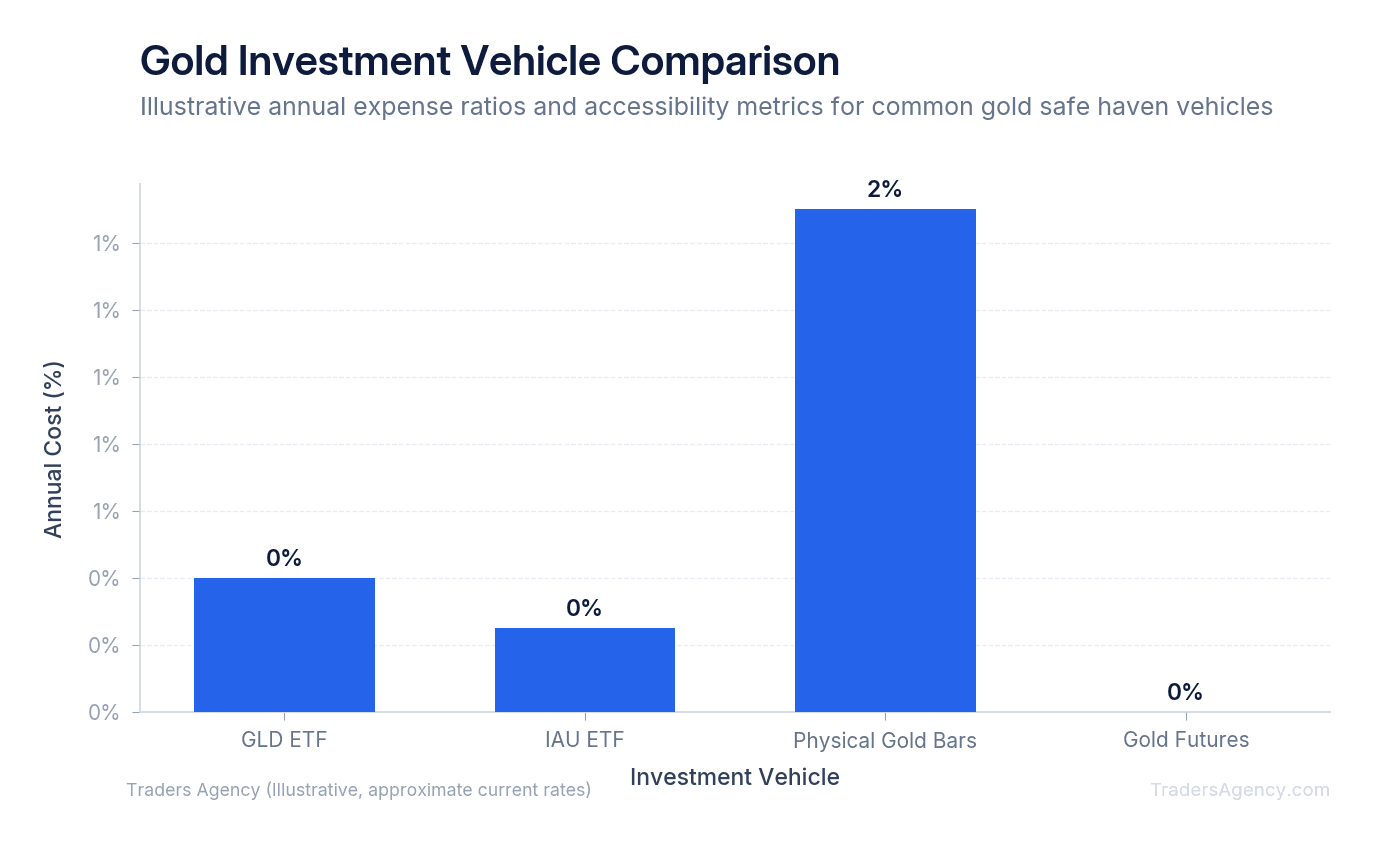
Watch Out: Gold futures carry extreme leverage. A standard COMEX contract controls 100 ounces, meaning small price swings create large dollar gains or losses. If you're new to precious metals trading, start with ETFs like GLD or IAU and build experience before considering futures.
When Does Gold Fail as a Safe Haven?
Gold is still a safe haven, but it appears to fail when investors misunderstand its primary drivers. If the stock market drops due to a strong economy forcing the Federal Reserve to raise interest rates, gold will likely fall too. High rates make non-yielding assets less attractive.
This happened during the 2022 rate hike period. Inflation was hitting 40-year highs, which usually helps gold. Many beginners bought heavily, expecting a massive rally.
However, the Federal Reserve aggressively raised interest rates to fight that inflation. The US Dollar spiked to 20-year highs.
Because you could suddenly earn a risk-free 4% to 5% yield on government bonds, institutional investors dumped gold. The metal dropped from $2,050 in March to $1,620 by September.
This is why we teach that context matters. A stock market crash caused by a liquidity crisis or energy shock will affect precious metals differently than a crash caused by rising rates.
How Much Gold Should You Hold in Your Portfolio?
Our team recommends keeping gold allocations between 5% and 10% of your total investment portfolio. This specific sizing provides enough exposure to cushion your account during a market panic, without dragging down your long-term compounding returns during extended economic boom periods.
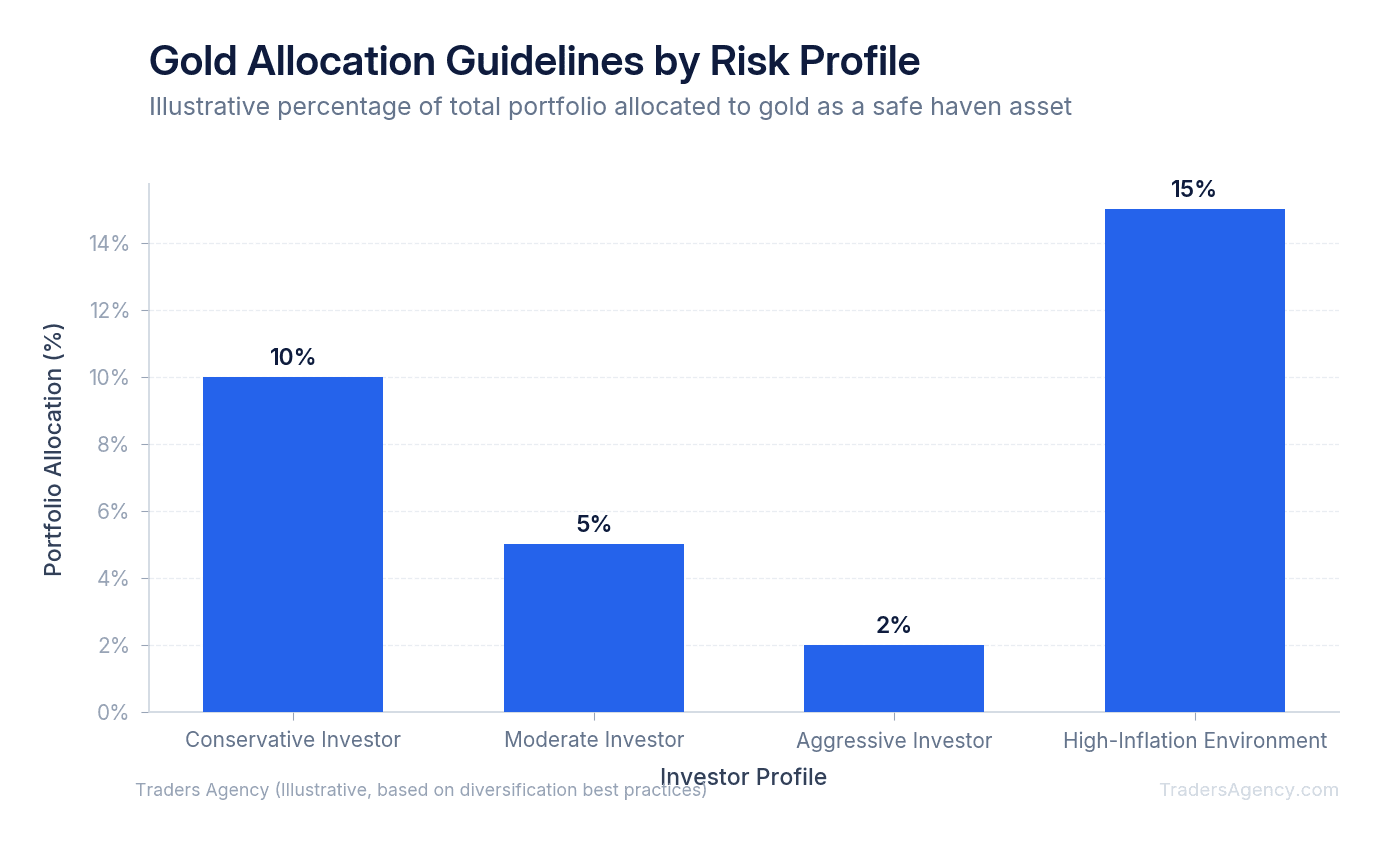
Position sizing is your first line of defense in risk management. If you allocate 50% of your account to precious metals, you're no longer diversifying. You're making a massive directional bet against the global economy.
Step-by-Step: Structuring a Beginner Gold ETF Trade
Here's exactly how we suggest structuring a beginner trade using an ETF:
- Identify the Trend: Check the daily chart on GLD to ensure it is trading above its 200-day moving average. This confirms the broader uptrend is intact.
- Determine Position Size: Calculate 5% of your total account value. If you have a $10,000 account, your maximum allocation is $500.
- Calculate Shares: If GLD is trading at $190 per share, you will purchase exactly 2 shares for a total investment of $380.
- Set a Stop Loss: Place a hard stop order 8% to 10% below your entry price to protect your capital from a sudden trend reversal.
- Plan Your Exit: Take profits when the crisis narrative fades and traditional equity markets show confirmed uptrends.
| Trade Parameter | Value |
|---|---|
| Instrument | GLD (SPDR Gold Shares) |
| Account Size | $10,000 |
| Max Allocation (5%) | $500 |
| Entry Price | $190 per share |
| Shares Purchased | 2 shares ($380 total) |
| Stop Loss | 8%-10% below entry (~$171-$175) |
| Max Risk per Share | $15-$19 |
Common Mistakes to Avoid When Trading Gold
Many new traders buy precious metals at the exact wrong time. They watch the news, see a crisis unfolding, and buy after the price has already spiked 20%. By the time a financial panic makes the evening news, the safe haven move is usually over.
Another major error is confusing gold mining stocks with the metal itself. Companies like Newmont Corporation (NEM) mine the metal, but they are still corporate equities. Mining stocks carry operational risks, debt obligations, and management issues. If the stock market crashes, mining stocks often crash right alongside it, even if the underlying commodity price stays flat. Stick to direct exposure vehicles like GLD or IAU when you want pure defensive protection.
Finally, don't treat gold as a growth asset. It doesn't pay a dividend, and it doesn't produce quarterly earnings. We use it strictly as a defensive tool to preserve capital when our primary growth strategies face hostile market conditions.
Watch Out: Don't confuse gold mining stocks with direct gold exposure. Mining companies like NEM carry corporate risk and often sell off during broad market crashes, even when the price of gold holds steady. For pure safe haven protection, use GLD, IAU, or physical bullion.
Our education team publishes new strategy guides and market analysis every week. If you found this guide helpful, check out our CME Group gold futures specifications for additional details on contract sizing and margin requirements.
Want expert trading insights delivered daily?
Join thousands of traders who rely on Traders Agency for market analysis and trade ideas.
Join Traders AgencyKey Takeaways
- Gold carries no credit risk because it is a physical element with no debt obligations. Unlike equities, it cannot go to zero regardless of broader market conditions.
- For pure safe haven exposure, ETFs like GLD and IAU track spot gold prices directly. Gold mining stocks such as NEM carry corporate risk and can sell off during market crashes even when gold holds steady.
- Gold's limited physical supply creates a natural long-term value floor that fiat currencies, which central banks can print without restriction, do not have.
- Gold operates outside the traditional financial system, making it most effective as a defensive position when primary growth strategies face hostile market conditions.
- Execution matters as much as the thesis. Timing, position sizing, and choosing the right vehicle (ETF, physical bullion, or futures) determine whether the safe haven strategy actually protects the portfolio.
DISCLAIMER: Traders Agency does not offer financial advice. The information provided is for educational purposes only and should not be considered financial advice. Traders Agency is not responsible for any financial losses or consequences resulting from the use of the information provided. Trading carries inherent risks and may not be suitable for all individuals. You are advised to conduct your own research and seek personalized advice before making any investment decisions, recognizing the potential risks and rewards involved.
See more from Traders Agency on Google
Make us a preferred source and our market analysis will appear more prominently in your Google Search, Top Stories, and AI results.
Add to Preferred Sources