
You've probably watched a stock you wanted to buy, waiting for a dip that never came. You placed a limit order below the market price and sat on your hands, earning nothing while you waited. Our team takes a different approach: we get paid while waiting. Selling cash-secured puts lets you collect income upfront while positioning yourself to buy great stocks at prices you've already chosen. By the end of this guide, you'll know how to select the right strike prices, manage your risk, and execute these trades with confidence.
What Is a Cash-Secured Put?
Bottom Line: Cash-secured puts work best when you sell them on stocks you would genuinely want to own, at prices you have already decided are fair. The premium is not a bonus on top of a speculative trade; it is the core reason to enter the position. Size conservatively, stick to quality names, and the strategy becomes a repeatable income engine rather than a hidden way to take on stock risk.
A cash-secured put is a short options position where you sell a put contract and hold enough cash in your brokerage account to buy the underlying stock if you're assigned. You collect a premium upfront, and your cash collateral guarantees you can fulfill the obligation to purchase the shares.
Here's how it works. When someone buys a put option, they have the right to sell shares at a specific price. When you sell a put option, you take the other side of that trade. You're accepting the obligation to buy 100 shares of the underlying stock at a predetermined price, known as the strike price.
The Options Clearing Corporation (OCC) ensures these contracts are standardized across the market. Because you're taking on the risk of buying shares, the options market pays you a cash premium. The "cash-secured" part simply means you're not using margin. You have the actual cash sitting in your account to cover the purchase if the stock drops.
Key Concept: A cash-secured put means you sell a put option and keep enough cash in your account to buy 100 shares at the strike price. You collect premium income immediately, and your cash backs the obligation.
How Do You Make Money on Cash-Secured Puts?
You make money by keeping the upfront premium you collected when you sold the option contract. If the underlying stock stays above your chosen strike price through expiration, the option expires worthless. The premium becomes your profit.
Think of yourself as an insurance company. Investors buy put options to protect their stock portfolios from a crash. They pay a premium for that protection. You're the one selling them that protection and collecting their premium.
As long as the stock doesn't crash below your strike price, you keep the money. Even if the stock drops slightly, as long as it stays above your strike, you retain 100% of the premium. When selling out-of-the-money puts, you have a statistical probability of profit above 50%, though the losses when they occur can be significant relative to the premium collected.
Real-World Example with Specific Numbers
Let's walk through a specific setup using a hypothetical trade on Apple (AAPL). Assume AAPL is currently trading at $150 per share. You want to own 100 shares, but you'd prefer to pay $140 per share.
- Identify the Setup: Instead of placing a standard limit order at $140, you look at the options chain. You decide to sell one AAPL $140 put option expiring in exactly 30 days. The options market pays you a $2.00 premium per share for taking on this obligation.
- Execute the Trade: Options contracts control 100 shares. You collect $200 in total premium ($2.00 x 100 shares) immediately upon executing the trade. Your broker requires you to set aside $14,000 in cash collateral ($140 strike x 100 shares) to secure the position. This cash remains in your account but cannot be used for other trades.
- Evaluate the Outcomes: Fast forward 30 days to expiration. You'll face one of two primary scenarios, outlined in the table below.
| Scenario | Stock Price at Expiration | Outcome | Profit / Loss |
|---|---|---|---|
| A: Stock stays above $140 | Above $140 | Option expires worthless. You keep the premium. Your $14,000 collateral is released. | +$200 |
| B: Stock drops to $135 | $135 | You're assigned 100 shares at $140. You still keep the $200 premium. | -$300 (unrealized) |
| Breakeven | $138 | Strike minus premium collected ($140 - $2.00) | $0 |
| Worst Case | $0 | Stock goes to zero. You paid $14,000 for worthless shares. | -$13,800 |
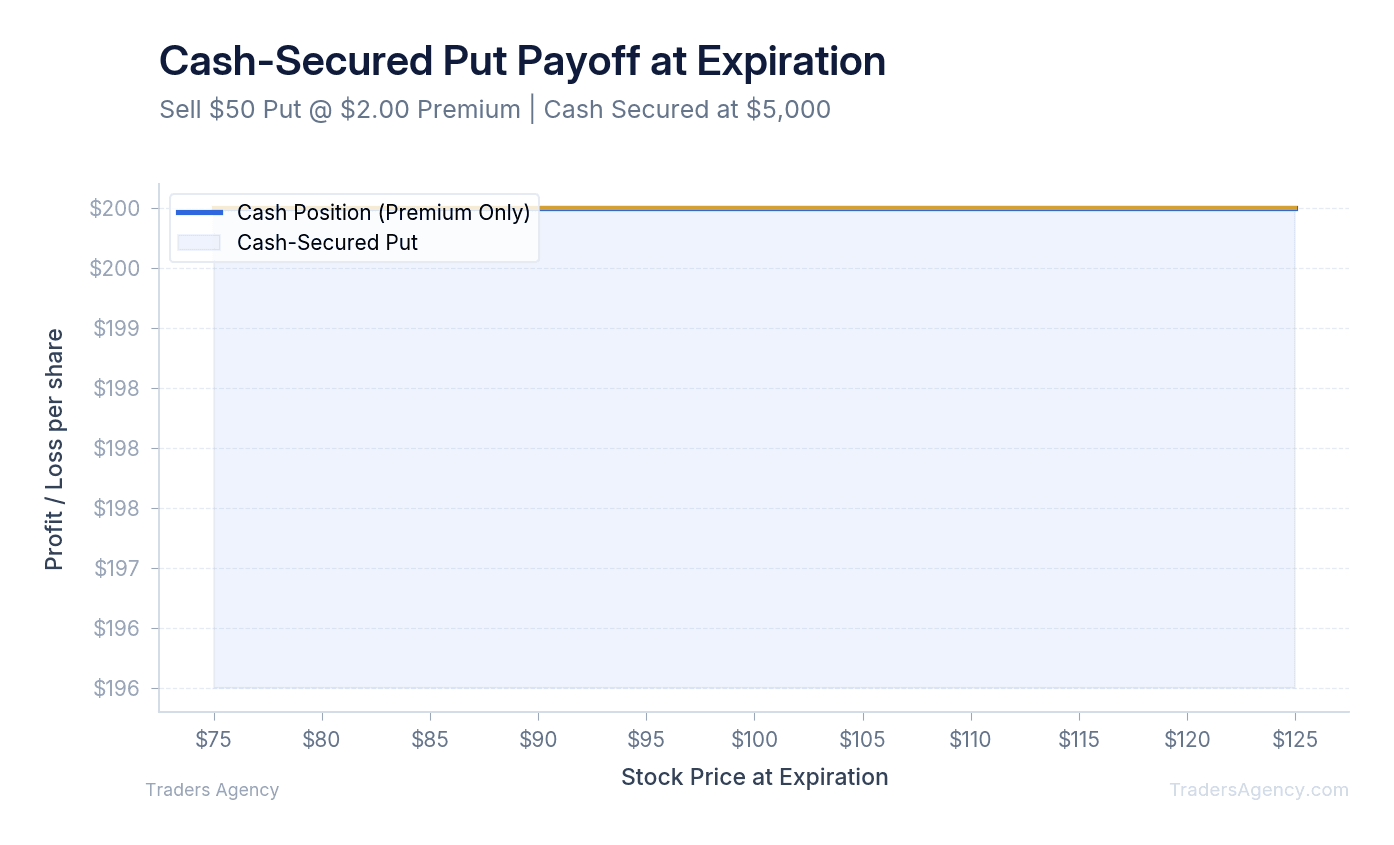
In Scenario B, your true breakeven price is $138 ($140 strike minus the $2.00 premium). Your maximum gain on this trade is strictly the $200 premium. Your maximum loss is $13,800, which only happens if the stock goes completely to zero.
Want expert trading insights delivered daily?
Join thousands of traders who rely on Traders Agency for market analysis and trade ideas.
Join Traders AgencyWhich Strike Price Should You Choose When Selling Puts for Income?
Our team relies on options Greeks to select the best strike prices. The two most important metrics for selling puts for income are delta and theta.
Delta: Your Probability Gauge
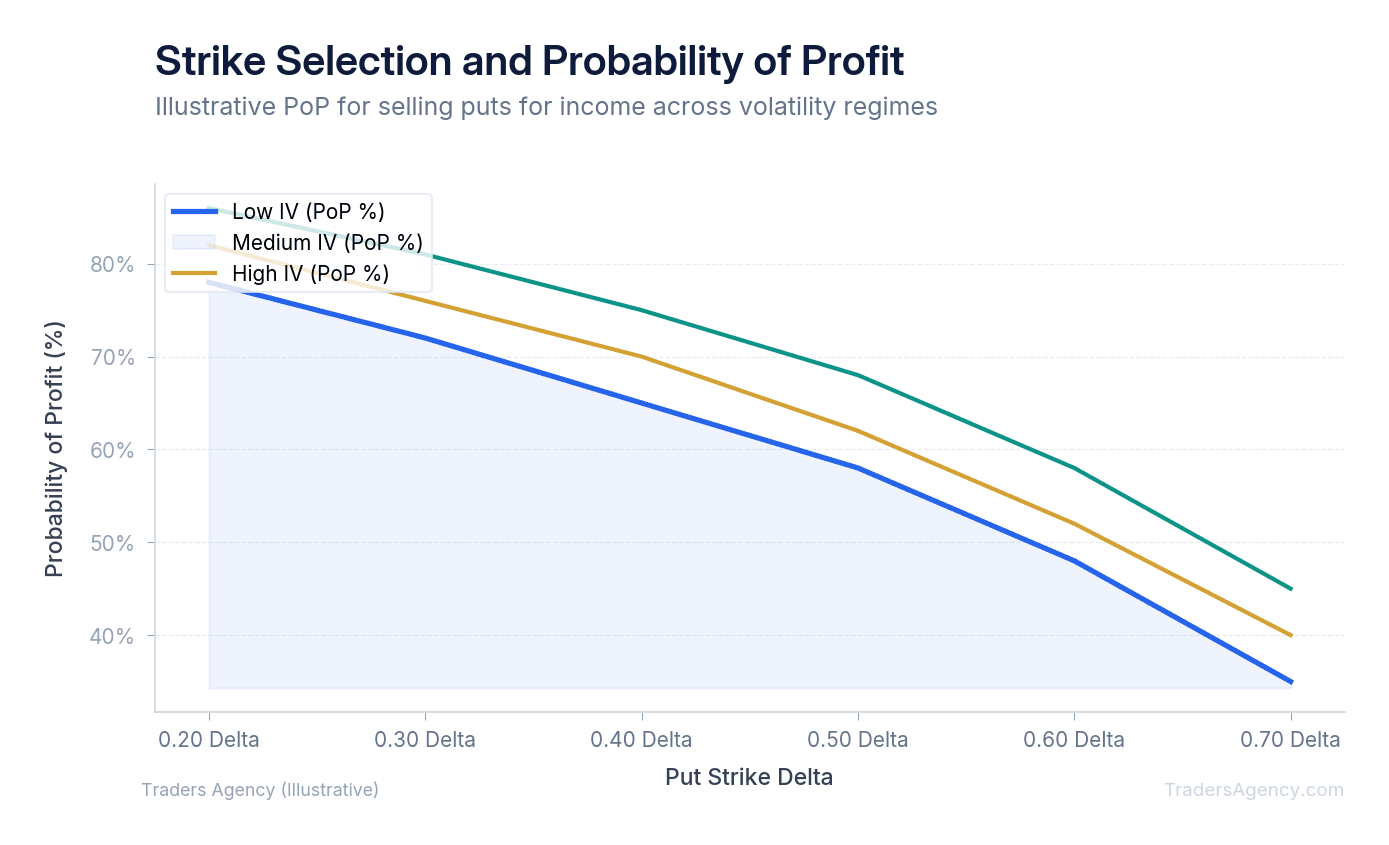
Delta approximates the probability of the option expiring in the money. When selling puts for income, we typically look for a delta around 0.20 to 0.30. This translates to roughly a 20% to 30% chance that you'll be assigned the stock. It provides a healthy balance between collecting enough premium and maintaining a high probability of success.
Theta: Time Decay Working in Your Favor
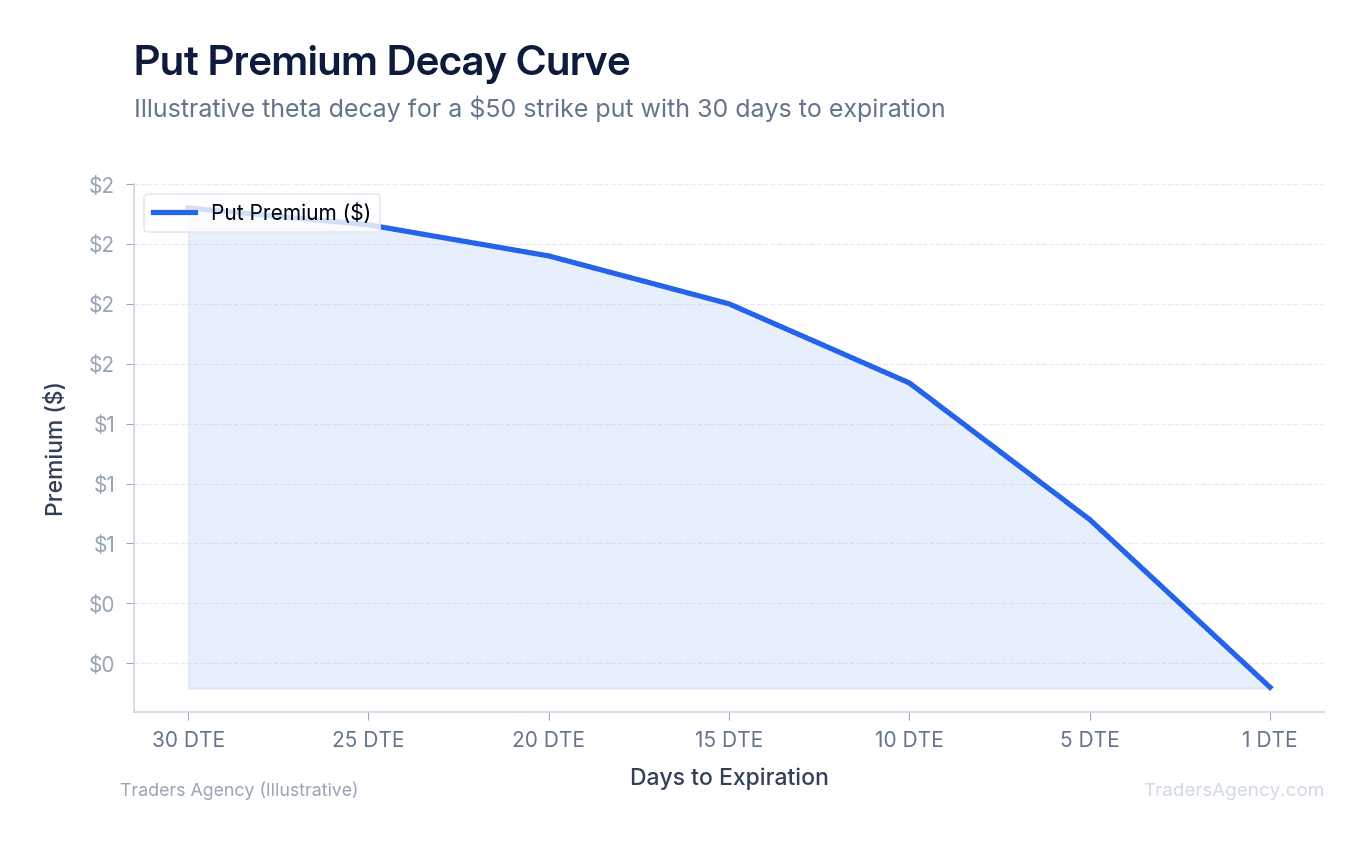
Theta measures time decay. Options contracts are wasting assets. They lose value every single day as expiration approaches. As a put seller, theta is your best friend.
The rate of time decay is not linear. Premium drops significantly faster in the final 30 to 45 days before expiration. This is why we prefer selling puts with 30 to 45 days to expiration (DTE). You capture the steepest part of the theta decay curve, maximizing the rate at which the option loses value in your favor.
Key Concept: Target a delta of 0.20 to 0.30 and 30 to 45 DTE when selling puts for income. This combination gives you a high probability of profit while capturing the fastest rate of time decay.
Cash-Secured Puts vs. Covered Calls: The Wheel Strategy
Selling puts is often the first step in a broader system known as the wheel strategy. The wheel alternates between selling cash-secured puts and selling covered calls to generate continuous income. Here's how the cycle works in practice:
- Sell a cash-secured put on a stock you want to own.
- Repeat Step 1 until you're eventually assigned the shares.
- Sell a covered call against the 100 shares you now own.
- Repeat Step 3 until your shares are called away.
- Return to Step 1 and start the process over.
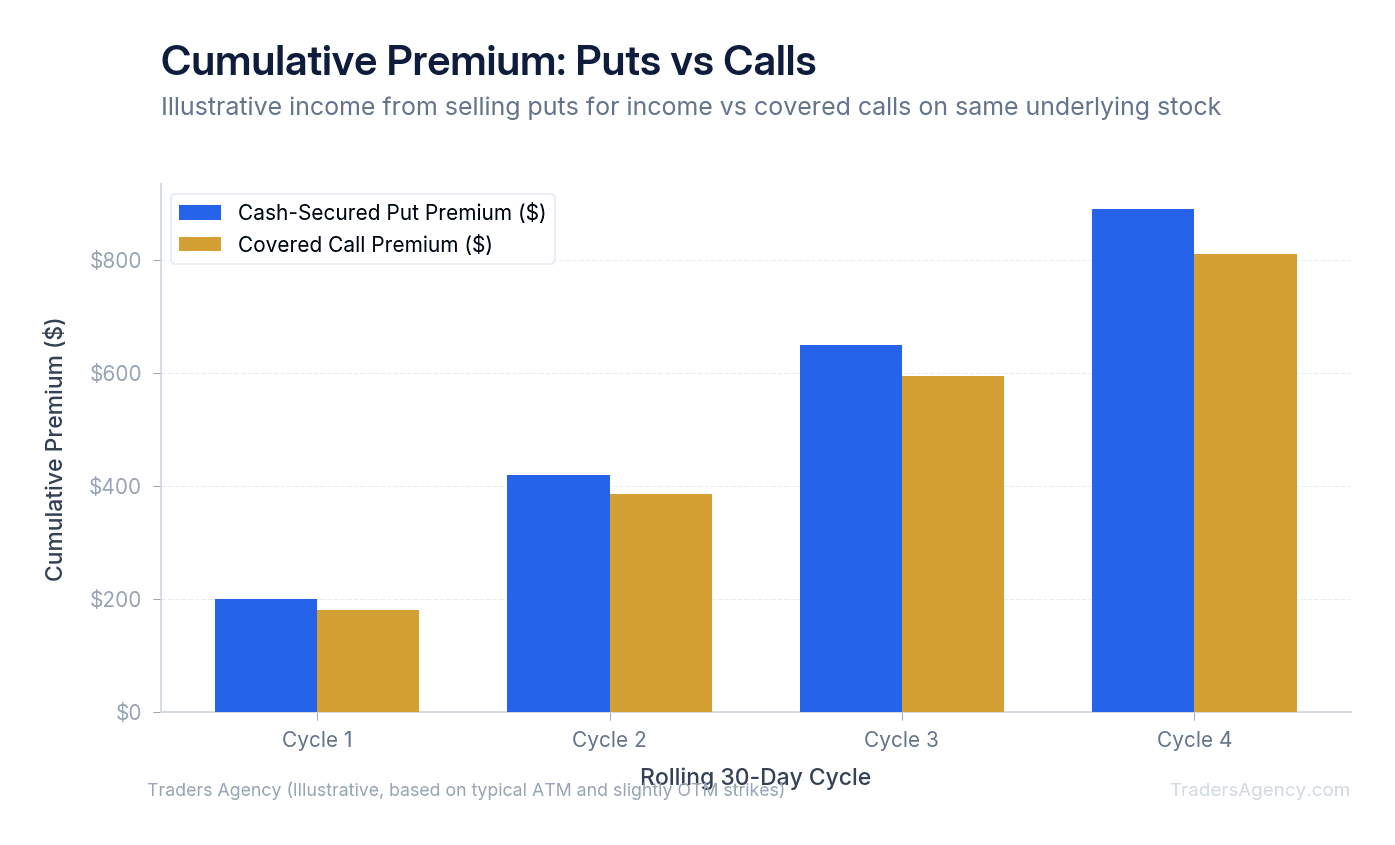
Both strategies generate premium, but they serve different purposes. Selling puts generates income on your cash while waiting to buy. Selling covered calls generates income on your shares while waiting to sell. Together, they create a repeatable income cycle.
You should also understand the tax implications of this income. Options premiums are generally taxed as short-term capital gains. This differs from the favorable qualified dividend tax rates you might receive from simply holding a dividend-paying stock. The SEC's investor education resources offer helpful background on how options income is treated. Always consult a tax professional regarding your specific trading account.
What Is the Downside of a Cash-Secured Put?
The primary downside of a cash-secured put is the strict obligation to buy the stock at the strike price, even if the market value crashes. You also tie up significant capital as collateral. And your upside profit is strictly capped at the initial premium collected.
Let's look closely at the risk of forced buying. If you sell a $140 strike put and the company reports terrible earnings, the stock might gap down to $100. You're still legally obligated to buy those shares for $140. You'll face an immediate unrealized loss of $4,000 upon assignment, offset only by the small premium you collected.
Opportunity cost is another major downside. Your $14,000 in collateral is locked up for the duration of the trade. If the broader market rallies aggressively, your capital is stuck sitting in cash. If the underlying stock rockets to $180, you miss out on those massive gains because your profit is capped at the $200 premium.
Watch Out: Your obligation to buy is absolute. If the stock crashes 30%, 50%, or more, you must purchase at the strike price. Only sell puts on stocks you genuinely want to own at the strike price you've chosen.
What Should You Do When a Cash-Secured Put Goes Against You?
Sometimes a trade moves against you. The stock drops below your strike price before expiration. You don't have to sit back and accept assignment if you change your mind about owning the stock.
Our team uses a technique called "rolling" to manage losing put positions. Rolling involves two simultaneous actions:
- Buy back your current put option to close the losing trade.
- Sell a new put option with a later expiration date (and optionally a lower strike price).
By pushing the expiration date further out in time, you collect additional premium. This extra premium helps offset the cost of buying back the losing position. You can also roll the strike price down to a lower level, giving the stock more room to recover. We recommend rolling a position when the stock price breaches your strike, ideally before the intrinsic value gets too deep in the money.
When Are Market Conditions Right for Selling Cash-Secured Puts?
We prefer to use this strategy in neutral to slightly bullish market conditions. If the market is crashing, selling puts is incredibly dangerous because you'll be catching falling knives. If the market is in a massive bull run, you're better off just buying the stock outright.
Implied volatility (IV) is a critical factor for put sellers. High IV inflates option premiums. We look for stocks experiencing elevated volatility, perhaps after a mild market correction. Higher premiums mean you can select strike prices further away from the current stock price while still collecting acceptable income.
Our Core Risk Management Rules
To protect your capital, our team follows a strict set of rules when selling puts for income:
- Never sell puts on garbage stocks. Only sell puts on high-quality companies or ETFs that you genuinely want to own long-term. If you get assigned, you need to be comfortable holding the asset.
- Keep position sizes small. We suggest allocating no more than 5% to 10% of your total account value to a single underlying stock. Don't tie up all your buying power in one trade.
- Take profits early. You don't have to hold until expiration. If you capture 50% to 80% of the maximum profit in the first few weeks, buy the option back. Free up your capital and look for the next setup.
- Avoid earnings announcements. Binary events like earnings reports can cause massive price swings. We generally close our short puts before a scheduled earnings release to avoid unpredictable gaps.
Risk Warning: Selling puts ties up significant capital and exposes you to large losses if the underlying stock drops sharply. Always size your positions conservatively and only sell puts on companies you'd be happy to own at your chosen strike price.
Selling puts for income is a highly effective way to generate cash flow from your portfolio. It requires patience, discipline, and a clear understanding of your obligations. Stick to quality stocks, respect your delta targets, and manage your risk on every single trade.
Want expert trading insights delivered daily?
Join thousands of traders who rely on Traders Agency for market analysis and trade ideas.
Join Traders AgencyKey Takeaways
- Selling a cash-secured put means holding enough cash to buy 100 shares at the strike price, so you are never using margin to cover the obligation.
- You collect the premium upfront regardless of outcome, which means the cash sits in your account earning nothing only if you skip this strategy entirely.
- Strike selection targets a specific delta range to balance premium income against the probability of assignment, giving you a measurable way to compare trades.
- Avoid selling puts before scheduled earnings releases, because unpredictable price gaps can turn a manageable position into a large, fast loss.
- The Wheel Strategy connects cash-secured puts to covered calls, letting you cycle between the two positions on the same stock to keep generating income after assignment.
DISCLAIMER: Traders Agency does not offer financial advice. The information provided is for educational purposes only and should not be considered financial advice. Traders Agency is not responsible for any financial losses or consequences resulting from the use of the information provided. Trading carries inherent risks and may not be suitable for all individuals. You are advised to conduct your own research and seek personalized advice before making any investment decisions, recognizing the potential risks and rewards involved.
See more from Traders Agency on Google
Make us a preferred source and our market analysis will appear more prominently in your Google Search, Top Stories, and AI results.
Add to Preferred Sources