
Dividend investing for beginners is a strategy where you buy shares of companies that distribute a portion of their profits back to shareholders on a regular basis. You buy a stock, and instead of just hoping the price goes up, the company deposits cash directly into your brokerage account. This creates a predictable stream of passive income over time.
You've probably seen this happen if you own mutual funds or index funds. Suddenly, a small cash balance appears in your account at the end of the quarter. That cash is a dividend payment.
Our team recommends mastering this concept early in your trading journey. We'll walk you through the core metrics, how to spot dangerous dividend traps, and the exact steps to build a reliable dividend income portfolio. By the end of this guide, you'll know exactly how to evaluate a dividend stock and execute your first trade.
What Is Dividend Investing and How Does It Work?
Bottom Line: Dividend investing gives beginners a concrete, measurable way to build passive income by focusing on companies with consistent profits and sustainable payout ratios. The biggest risk for new investors is chasing high yields without understanding why they are high. Master the fundamentals of payout ratios and reinvestment, and you build a portfolio that generates cash regardless of short-term market swings.
Dividend investing is a strategy focused on purchasing stocks that pay regular cash rewards, known as dividends, to their shareholders. It works by providing investors with a steady stream of passive income, which can be withdrawn as cash or reinvested to buy more shares and compound wealth over time.
When a company generates consistent profits, the management team has a choice. They can reinvest all the cash back into the business, or they can distribute a portion of it to the people who own the company. Mature, established businesses often choose to pay dividends.
Key Concept: Think of dividend investing like owning a rental property without the maintenance headaches. You own a piece of the asset, and it pays you "rent" every three months.
Here's how the mechanics work in a real brokerage account:
| Step | What Happens |
|---|---|
| Purchase | You buy 100 shares of a company trading at $50 per share |
| Dividend Declared | The company announces a $2.00 annual dividend, paid quarterly |
| Quarterly Payout | Every three months, you receive $0.50 per share |
| Cash Deposited | Your account receives a $50 cash deposit four times a year |
This approach gives you a return on your investment regardless of what the stock price does on a given day. Even if the broader market is down, those cash deposits generally continue to hit your account, though companies can reduce or suspend dividends at any time. Mastering dividend investing for beginners means learning to identify which companies will actually sustain those payments.
What Is the Difference Between Dividend Yield and Payout Ratio?
Dividend yield measures the annual dividend payment as a percentage of the current stock price, showing your return on investment. The dividend payout ratio measures the percentage of a company's total earnings paid out as dividends, indicating whether the company can actually afford to keep paying that dividend.
These are the two most critical metrics you'll use to evaluate a stock. The yield tells you how much you get paid today. The payout ratio tells you if you'll still get paid tomorrow.
To calculate the dividend yield, you divide the annual dividend by the current stock price. If Company A pays $4 a year and the stock costs $100, the yield is 4%. If the stock price drops to $80, that same $4 payment now represents a 5% yield.
To calculate the dividend payout ratio, you divide the annual dividend by the company's earnings per share (EPS). If Company A earns $10 per share in profit and pays out $4 in dividends, the payout ratio is 40%. The company keeps the remaining 60% to grow the business or pay down debt.
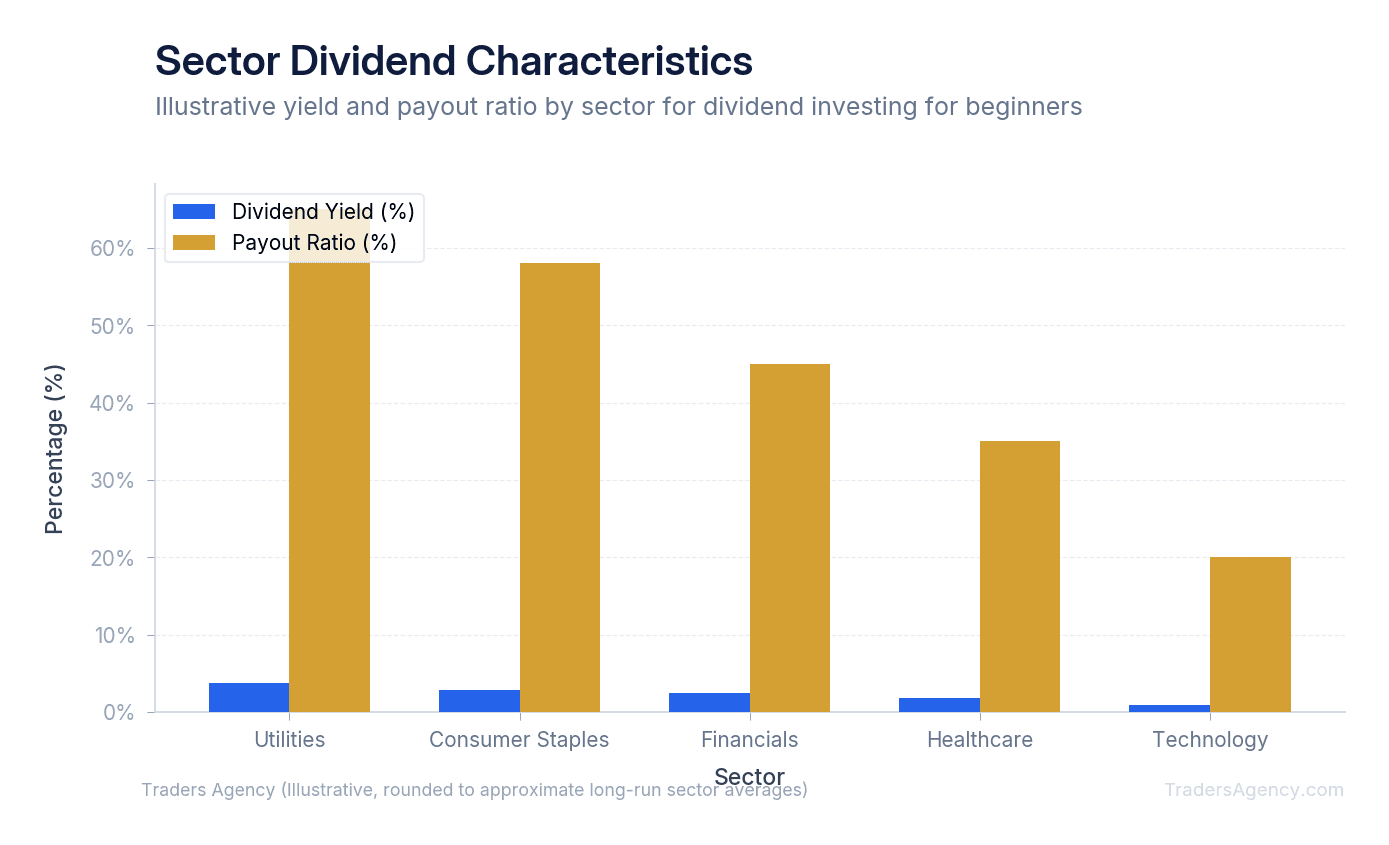
Our Recommended Ranges: We look for yields between 2% and 5%. Anything higher often signals excessive risk. We also target payout ratios between 30% and 60%. A payout ratio above 80% means the company is stretching its finances to pay shareholders.
How Does a Dividend Reinvestment Plan (DRIP) Work?
A Dividend Reinvestment Plan (DRIP) is an automated program that takes your cash dividends and immediately uses them to purchase additional shares of the same stock. This creates a compounding effect, as your new shares will then generate their own dividends in the next payout cycle.
We teach our members to use DRIPs to accelerate their portfolio growth. Instead of letting small cash payments sit idle in your account, a DRIP puts every penny back to work. Most major brokerages offer this service for free.
Here's a specific example with concrete numbers. Assume you buy 1,000 shares of a stock at $20 per share. The stock pays a 5% dividend yield, which equals $1.00 per share annually.
| Year | Shares Owned | Dividend Income | New Shares Purchased via DRIP |
|---|---|---|---|
| Year 1 | 1,000 | $1,000 | 50 shares at $20 |
| Year 2 | 1,050 | $1,050 | 52.5 shares at $20 |
| Year 3 | 1,102.5 | $1,102.50 | 55.1 shares at $20 |
| Year 5 | ~1,216 | ~$1,216 | Compounding accelerates each year |
Without adding any new money yourself, your share count and your income stream grow significantly over time.
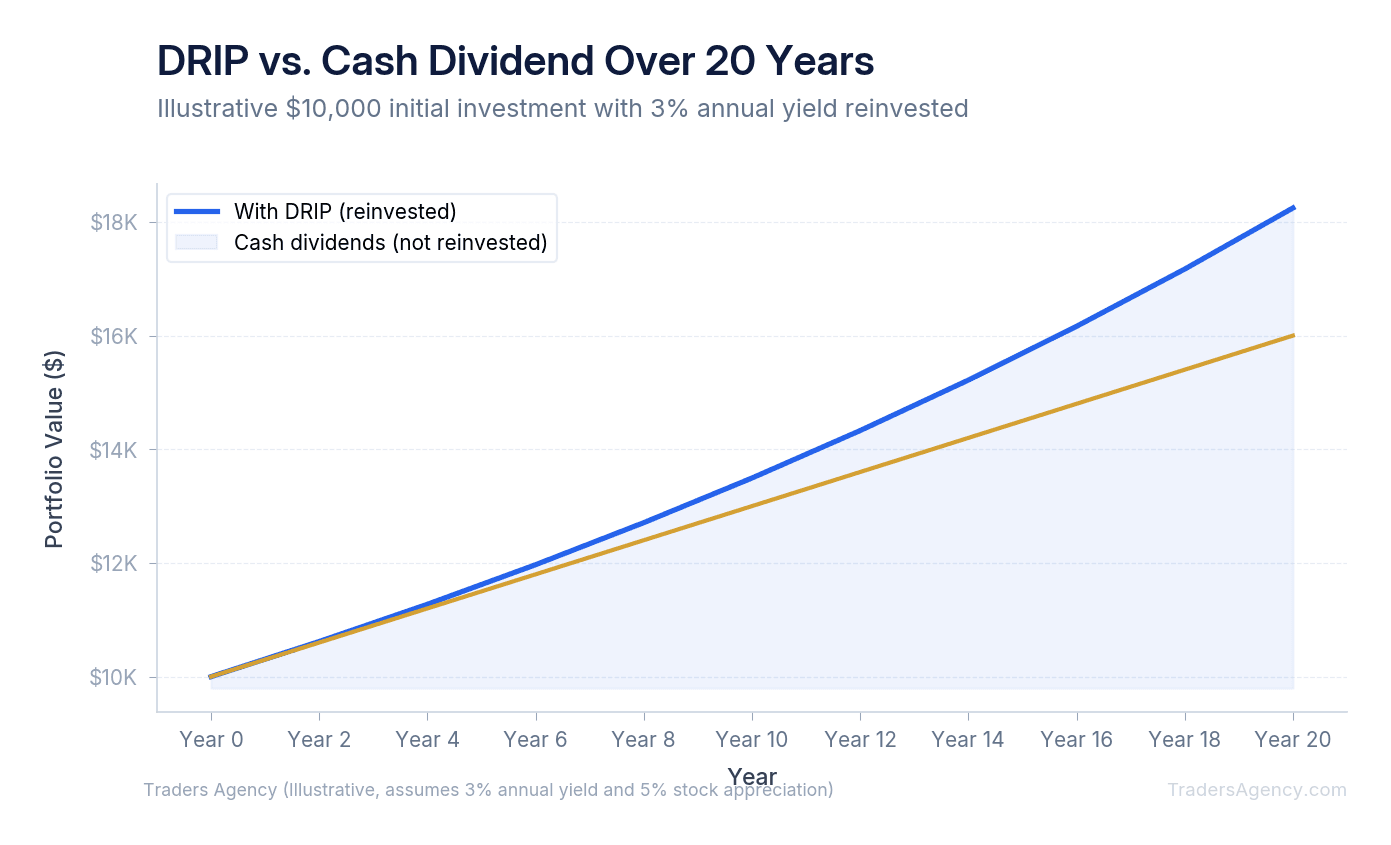
A DRIP allows you to buy fractional shares. Even if your dividend payment is only $15 and the stock costs $100, the DRIP will purchase 0.15 shares for you. This automated compounding is a core principle of dividend investing for beginners.
Want expert trading insights delivered daily?
Join thousands of traders who rely on Traders Agency for market analysis and trade ideas.
Join Traders AgencyWhat Are Dividend Yield Traps and How Do You Avoid Them?
A yield trap occurs when a stock displays an unusually high dividend yield because its stock price has recently collapsed. These high yields are often unsustainable, and the company is highly likely to cut or eliminate the dividend entirely to preserve cash, causing further losses for investors.
New traders often screen for the highest possible yield and blindly buy stocks paying 10% or 12%. We prefer to avoid these entirely. A massive yield is usually a warning sign from the market that the business is in trouble.
Remember the yield formula: Annual Dividend ÷ Stock Price. If a company pays a $2 dividend and the stock is $40, the yield is 5%. If the business loses a major contract and the stock price plummets to $10, that same $2 dividend now represents a 20% yield.
The screener shows a 20% yield, but the company is actually bleeding cash. Within a few months, the board of directors will announce a dividend cut. When they do, the stock price will crash even further.
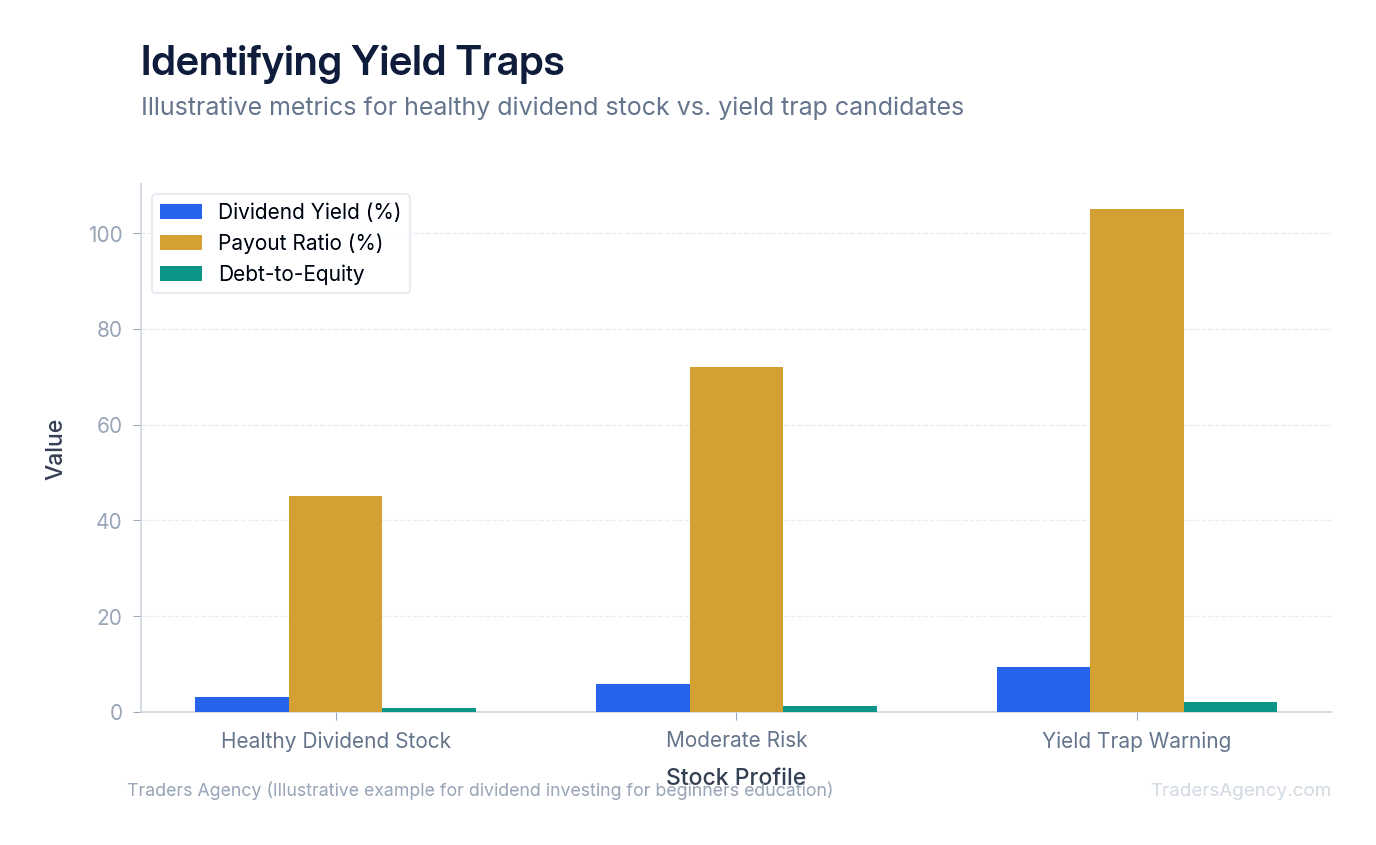
Watch Out: If a company's payout ratio exceeds 100%, it is literally paying out more than it earns, often by borrowing or drawing down reserves. That cannot last. Our rule: strictly avoid companies with payout ratios over 80%, regardless of how tempting the yield looks.
How Are Dividends Taxed? Qualified vs. Ordinary Dividends
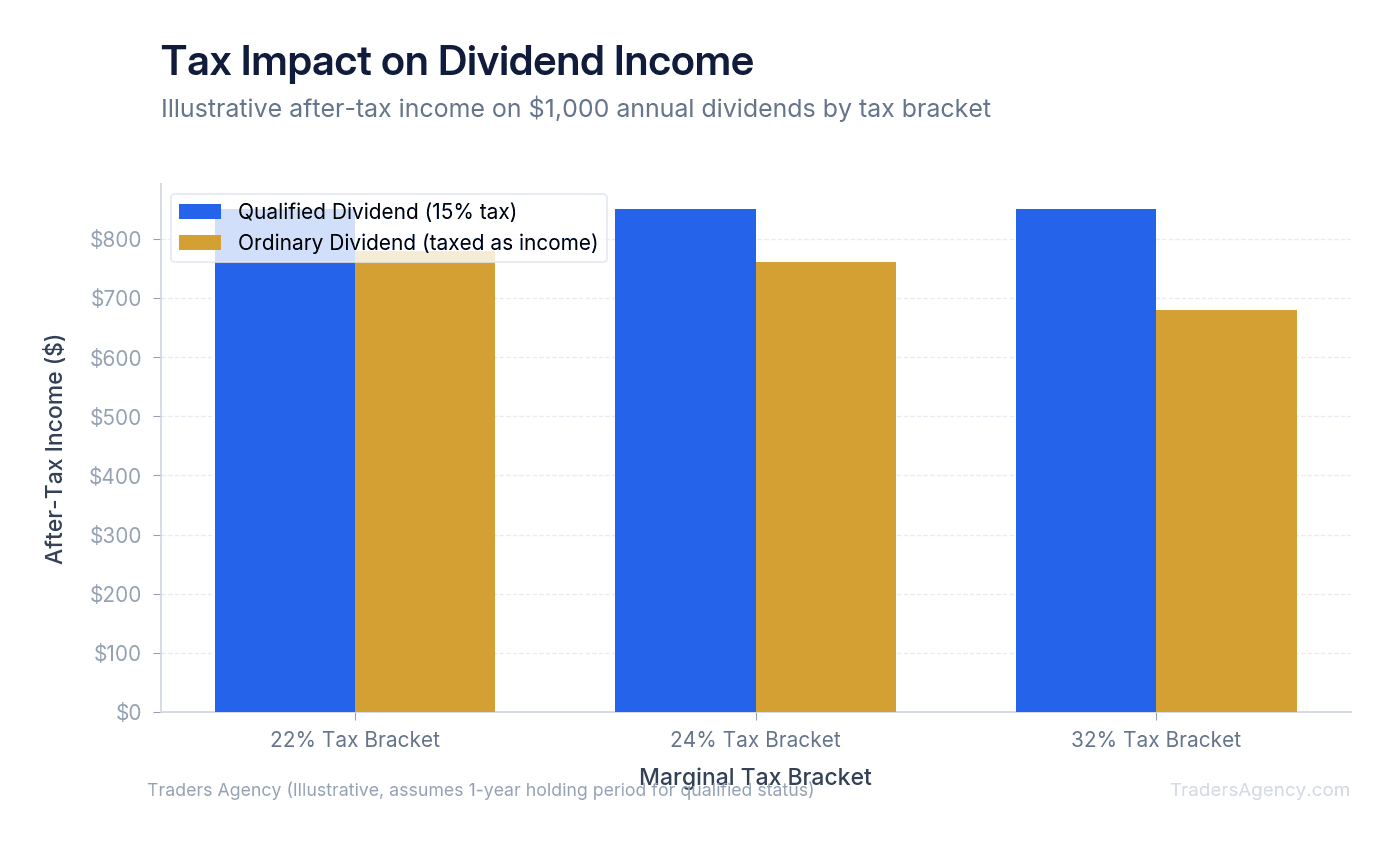
Dividends are taxed in two different ways depending on how long you hold the stock. Ordinary dividends are taxed at your standard income tax rate, while qualified dividends receive preferential tax treatment and are taxed at lower long-term capital gains rates.
Understanding taxes is a required part of dividend investing for beginners. If you hold dividend stocks in a standard taxable brokerage account, you owe taxes on that income every year. You owe this tax even if you use a DRIP to reinvest the money.
Per IRS rules, a dividend becomes a qualified dividend if you meet a specific holding period. You must hold the stock for more than 60 days during the 121-day period that begins 60 days before the ex-dividend date.
The ex-dividend date is the cutoff day determined by the stock exchange. You must purchase the stock before this date to receive the upcoming dividend payment. If you buy the stock on the ex-dividend date, the previous owner gets the cash.
| Dividend Type | Holding Requirement | Tax Rate |
|---|---|---|
| Qualified Dividends | 60+ days within the 121-day window | 0%, 15%, or 20% (based on income) |
| Ordinary Dividends | Holding period not met | Up to 37% (your regular income bracket) |
We advise our members to hold dividend stocks long-term to secure these favorable tax rates. The difference between a 15% tax rate and a 37% tax rate on the same income is significant, especially as your portfolio grows.
How Do I Start Investing in Dividend Stocks?
To start investing in dividend stocks, you need to open a brokerage account, screen for companies with a consistent history of payouts, and purchase shares. Focus on established businesses with sustainable payout ratios and consider setting up automatic dividend reinvestment to grow your position over time.
We recommend building your strategy systematically. Don't just buy random stocks because you recognize the brand name. Follow a strict set of criteria to protect your capital and ensure reliable income.
Here is the exact process our team uses to evaluate and purchase dividend-paying assets:
- Screen for Dividend Aristocrats. Start your search with Dividend Aristocrats. These are companies in the S&P 500 index that have increased their base dividend payout for at least 25 consecutive years. A company that can raise its dividend through recessions, market crashes, and inflation is demonstrating exceptional financial stability.
- Verify the Payout Ratio and Yield. Once you find a stock you like, check the financial data. Ensure the dividend yield is between 2% and 5%. Next, confirm the payout ratio is below 60%. This confirms the company has plenty of cash left over to fund its own operations.
- Check the Ex-Dividend Date. Look at the company's investor relations page or your broker's calendar. Find the next ex-dividend date. You must execute your buy order at least one business day before this date to qualify for the next payment cycle.
- Size Your Position Properly. Never put all your capital into a single stock. We prefer to allocate a maximum of 5% of our total portfolio to any one dividend payer. If you have $10,000 to invest, buy $500 worth of shares. This protects you if a company unexpectedly cuts its dividend.
- Enable Your DRIP. Log into your brokerage account settings and locate the dividend reinvestment options. Turn on the DRIP for your new position. This simple step automates your compounding and removes the temptation to spend the cash payouts.
Remember: Dividend investing for beginners does not require complex technical analysis or day trading skills. It requires patience, basic math, and a long-term perspective. By focusing on sustainable payout ratios and utilizing DRIPs, you can slowly build a portfolio that pays you cash while you sleep.
Our education team publishes new strategy guides and market analysis every week. If you're ready to take the next step, we'll show you how to put these principles into action with real-time guidance and a community of active traders behind you.
Want expert trading insights delivered daily?
Join thousands of traders who rely on Traders Agency for market analysis and trade ideas.
Join Traders AgencyKey Takeaways
- Dividend investing works by buying shares of profitable companies that deposit cash directly into your brokerage account on a regular schedule, creating passive income without requiring you to sell shares.
- A sustainable payout ratio is one of the most important metrics to evaluate before buying a dividend stock. A company paying out more than it earns is a red flag, not a reward.
- DRIPs (Dividend Reinvestment Plans) allow you to automatically reinvest dividend payments to buy more shares, compounding your returns over time without additional capital.
- High dividend yields can signal danger rather than opportunity. A yield that looks unusually attractive often means the stock price has dropped sharply, which may indicate underlying business problems.
- Dividend investing does not require technical analysis or day trading skills. The core requirements are patience, basic math, and a long-term perspective.
DISCLAIMER: Traders Agency does not offer financial advice. The information provided is for educational purposes only and should not be considered financial advice. Traders Agency is not responsible for any financial losses or consequences resulting from the use of the information provided. Trading carries inherent risks and may not be suitable for all individuals. You are advised to conduct your own research and seek personalized advice before making any investment decisions, recognizing the potential risks and rewards involved.
See more from Traders Agency on Google
Make us a preferred source and our market analysis will appear more prominently in your Google Search, Top Stories, and AI results.
Add to Preferred Sources