
You have probably spotted a stock you want to trade, but buying a standard call option feels too expensive or too risky. We hear this from new traders all the time. The bull call spread is the defined-risk options strategy our team recommends to lower your upfront cost while still participating in the upside. In this guide, we will walk you through exactly how to set up this trade, pick your strike prices, calculate your potential profits, and manage your risk like a professional.
What Is a Bull Call Spread?
Bottom Line: A bull call spread is a practical starting point for traders who want defined risk and a lower cost basis than a standard long call, with the trade-off being a capped profit ceiling. The strategy works best when you have a clear directional view, realistic strike selection, and the discipline to avoid holding through binary events like earnings. What you give up in upside, you gain in predictability, and for most beginners that is a worthwhile exchange.
Think of a bull call spread as a discounted way to bet on a stock going up. Instead of buying a single expensive call option, you buy one call and simultaneously sell a cheaper call at a higher strike to offset your cost. This lowers your total cost but caps your maximum potential profit.
We teach our members to view this as a simple trade-off: you give up unlimited upside potential to get a cheaper entry price today. That makes it one of the best strategies in options trading for beginners.
Here is an easy way to picture it. Imagine renting a two-story house because you expect property values to rise in that neighborhood. To lower your monthly rent, you sublet the top floor to someone else. You still benefit from living in the house, but your total usable space is capped because you shared the property. A bull call spread works the same way. You keep the first chunk of upside and "sublet" the rest to another trader in exchange for a lower cost.
Key Concept: A bull call spread combines two call options on the same stock with the same expiration date. You buy a lower-strike call and sell a higher-strike call. The premium you collect from the short call reduces your total cost and your maximum risk.
Spread strategies are a fundamental way to manage risk in volatile markets. By combining two positions into one trade, you protect your trading account from outsized losses while still giving yourself room to profit.
How Does a Bull Call Spread Work?
A bull call spread works by combining two separate options contracts, called legs, into a single trade. You buy a lower-strike call option to capture upside gains, then sell a higher-strike call option with the same expiration date to generate premium and reduce your overall trade cost.
The two legs work together to create a mathematically defined boundary for your money. You know your exact maximum loss and maximum gain the moment you enter the trade.
Here is what you need to build this setup:
- Underlying asset: A stock or ETF you believe will go up in price.
- Long call leg: The option you buy at a lower strike price.
- Short call leg: The option you sell at a higher strike price.
- Expiration date: Both contracts must expire on the exact same day.
When you execute this trade, your broker will process both legs simultaneously as a single order. You do not have to buy one and then manually try to sell the other.
How Do You Set Up a Bull Call Spread Step by Step?
Now let's put this into practice with a bull call spread example. We will use a hypothetical stock, XYZ Corp, currently trading at $50 per share.
- Buy the Lower Strike Call: Purchase the $50 strike call expiring in 30 days. This contract costs $3.00 in premium. Since standard options control 100 shares, your total out-of-pocket cost for this leg is $300. This leg gives you the right to buy shares at $50.
- Sell the Higher Strike Call: Sell the $55 strike call with the same 30-day expiration. The market pays you $1.00 in premium for this contract. You collect $100 in cash immediately. This leg obligates you to sell shares at $55 if the buyer exercises their option.
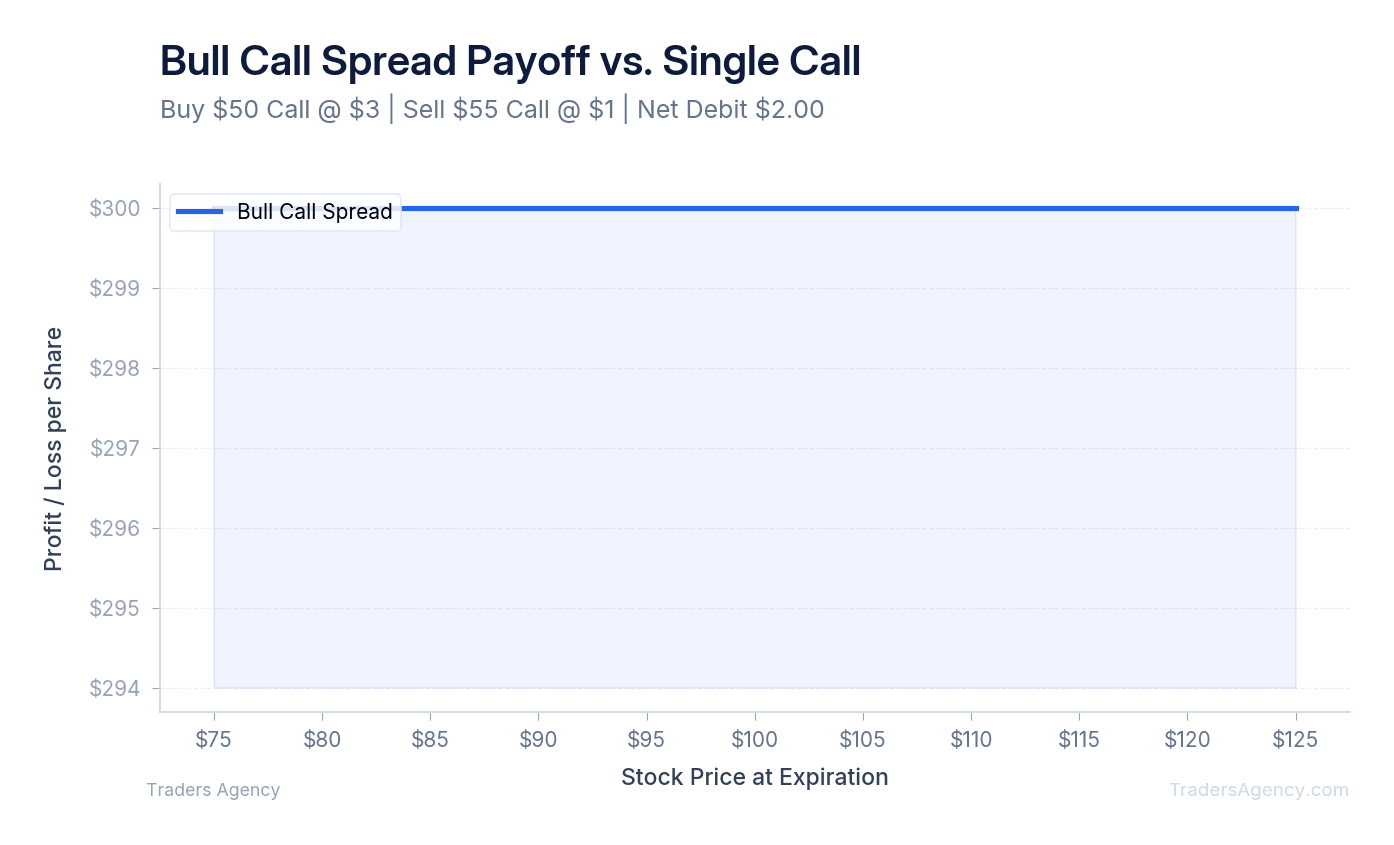
- Calculate the Net Debit: You paid $300 and collected $100. Your total out-of-pocket cost is $200. This is called your net debit, and it represents your absolute maximum risk on the trade.
| Parameter | Value |
|---|---|
| Stock Price | XYZ Corp at $50.00 |
| Long Call (Bought) | $50 strike, $3.00 premium ($300 total) |
| Short Call (Sold) | $55 strike, $1.00 premium ($100 total) |
| Net Debit (Max Risk) | $2.00 per share / $200 total |
| Expiration | 30 days |
What Is the Maximum Profit and Maximum Loss on a Bull Call Spread?
The maximum loss on a bull call spread is strictly limited to the net debit paid to enter the trade. The maximum profit is calculated by subtracting the net debit from the difference between the two strike prices. Both scenarios are known before you even place the order.
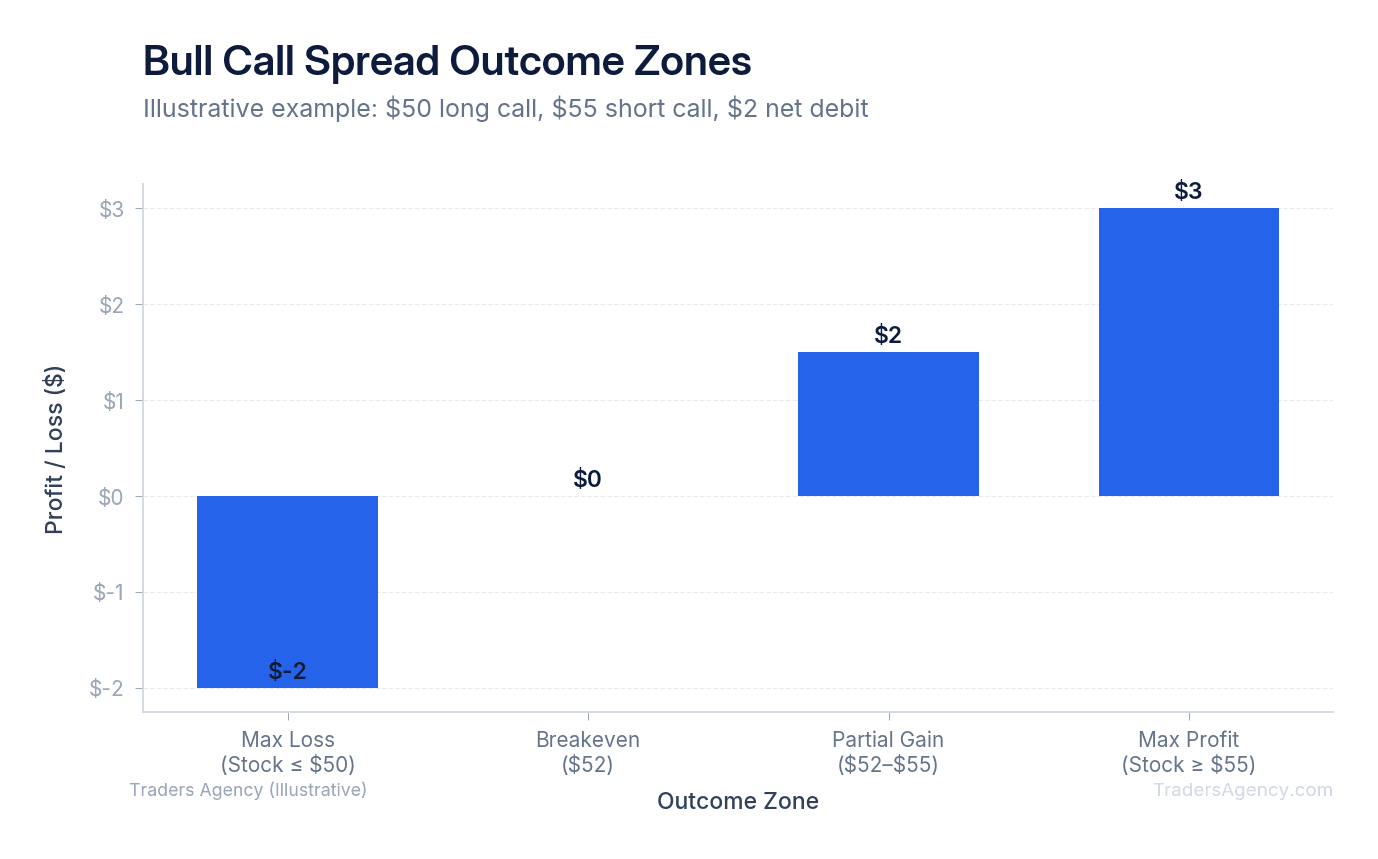
We can calculate the exact call option spread profit and loss using our XYZ Corp example. Understanding these numbers is a core skill for any options trader.
Maximum Loss: If XYZ Corp stays below $50 at expiration, both options expire worthless. You lose your initial $200 investment. You cannot lose more than this amount, even if the stock drops to zero.
Maximum Profit: The distance between your $50 strike and $55 strike is $5.00. Multiply by 100 shares to get $500 of total spread value. Subtract your $200 initial cost, and your maximum profit is $300. You achieve this if the stock closes anywhere above $55 at expiration.
Breakeven Point: Add your $2.00 net debit to your lower $50 strike. The stock must close above $52.00 at expiration for you to make a profit. Any price between $52.00 and $55.00 results in a partial profit.
| Scenario | Stock Price at Expiration | Profit / Loss |
|---|---|---|
| Best Case (Max Profit) | $55.00 or above | +$300 |
| Breakeven | $52.00 | $0 |
| Worst Case (Max Loss) | $50.00 or below | -$200 |
Key Concept: Your risk-to-reward ratio on this trade is $200 risked for a potential $300 gain. That is a 1:1.5 ratio, which is a solid setup for a defined-risk strategy. You always know these numbers before you click "submit."
Want expert trading insights delivered daily?
Join thousands of traders who rely on Traders Agency for market analysis and trade ideas.
Join Traders AgencyHow Do Options Greeks Affect a Bull Call Spread?
Options Greeks measure how different factors impact your contract prices. Because a bull call spread involves buying and selling options simultaneously, the Greeks partially cancel each other out. This makes the strategy less sensitive to time decay and volatility changes compared to buying a single naked call option.
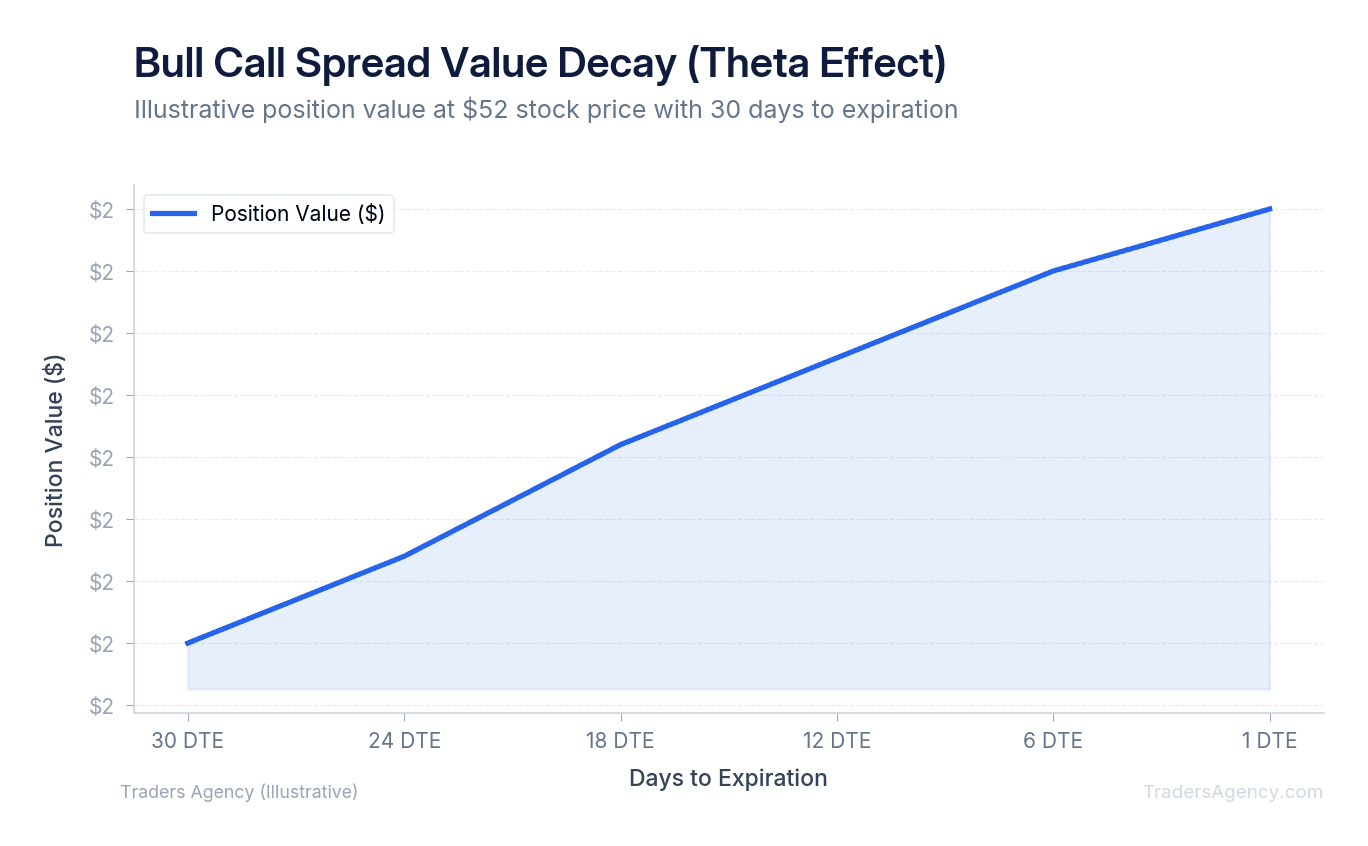
Our team prefers this bull call spread strategy for newer traders specifically because it softens the blow of the Greeks. Here is how the big three impact your trade.
1. Delta (Directional Risk)
Delta measures how much your option price changes when the stock moves $1. Your long call has positive delta, and your short call has negative delta. The combined position has a net positive delta, meaning you profit when the stock rises.
2. Theta (Time Decay)
Theta measures how much value your option loses each day. Buying a call hurts you through time decay. However, selling the higher call helps you because you collect time decay from the buyer. This offsets your overall time decay risk significantly.
3. Vega (Volatility Risk)
Vega measures sensitivity to implied volatility. If volatility drops, long options lose value. But your short call also loses value when volatility drops, which benefits you as the seller and partially protects your overall position from sudden market shifts. The Cboe (Chicago Board Options Exchange) offers extensive educational resources on how spreads help neutralize volatility risk.
When Should You Use a Bull Call Spread?
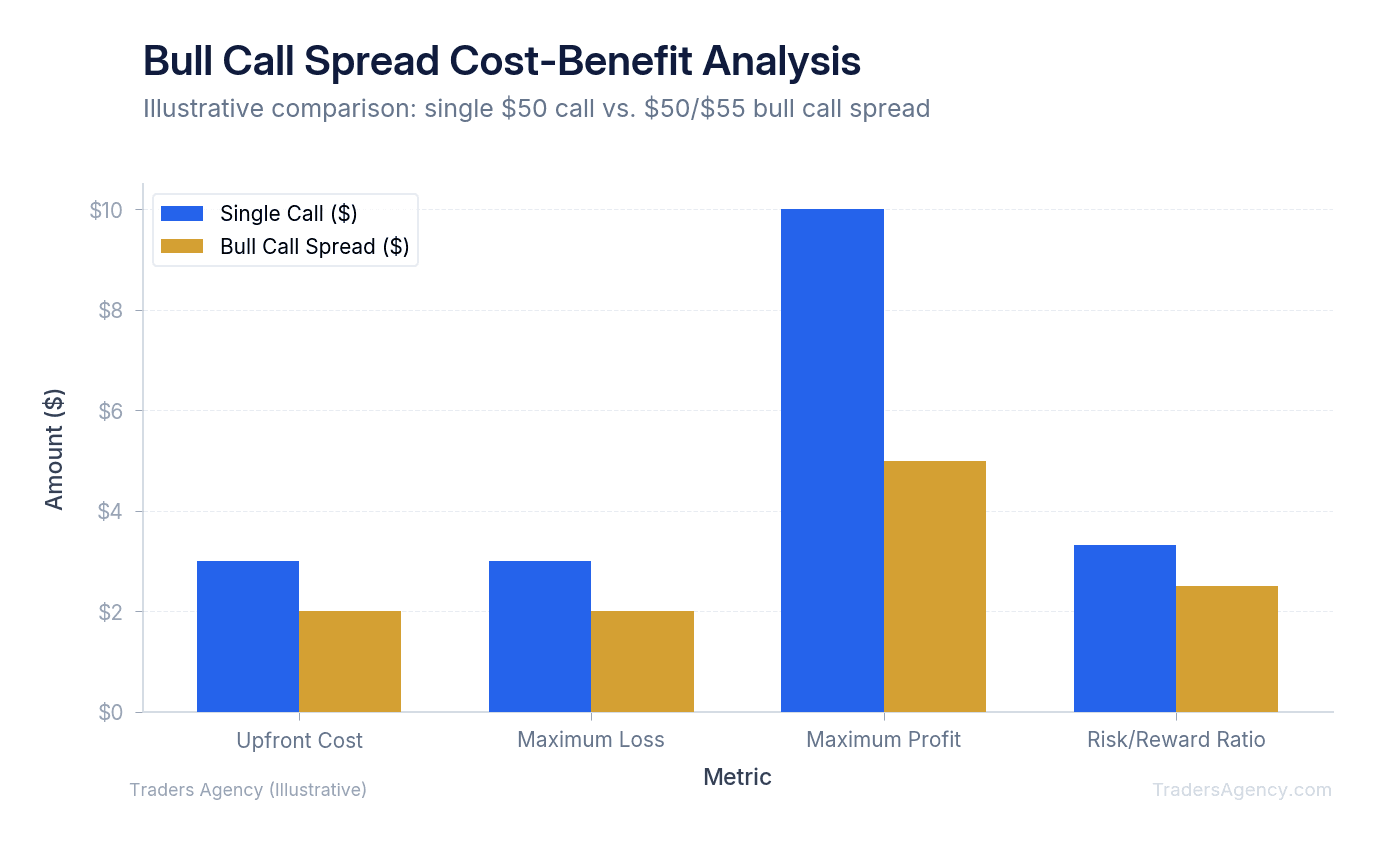
You should use a bull call spread when you expect a stock to rise moderately over a specific timeframe. It is ideal for expensive stocks where buying a single call option requires too much capital. It is also useful when implied volatility is high and options premiums are generally expensive.
We prefer to use this setup in a few specific scenarios:
- Trading high-priced stocks: A single call option on a $500 stock might cost thousands of dollars. A spread reduces that capital requirement to a few hundred dollars.
- Stock approaching a known resistance level: If you believe a stock will rise to $60 but struggle to break past it, selling the $60 call makes perfect sense. You get paid for upside you do not expect to happen anyway.
- High implied volatility environments: When option premiums are inflated, the credit you receive from the short leg becomes more valuable, reducing your net cost even further.
Watch Out: Do not use this strategy if you expect a massive, explosive breakout. If the stock rockets from $50 to $80, your gains are strictly capped at your short strike. You will miss out on the entire run above $55. Choose a different strategy when you have strong conviction in a large move.
Risk Management Tips for New Options Traders
Proper risk management is essential for any options strategy. Keep your position sizes small, never risking more than one to two percent of your total account on a single spread. Always close your positions before expiration to avoid assignment risks and unexpected after-hours market movements.
Here is what we teach our members about protecting their capital when trading options spreads:
- Control Your Position Size: Just because a spread is cheaper than a single call does not mean you should buy ten of them. Stick to your standard risk limits. If your maximum risk per trade is $200, only buy one contract in our XYZ example.
- Take Profits Early: You do not have to hold until expiration. If you capture 70 to 80 percent of your maximum profit early in the trade, close the position. Taking guaranteed money off the table is always a smart trading habit.
- Avoid Expiration Day Risks: We highly recommend closing all spreads before the market closes on expiration Friday. If the stock price lands exactly between your two strikes, you could face unexpected stock assignment. Closing the trade early eliminates this risk completely.
- Watch Earnings Dates: Never hold a short-term spread through an earnings announcement unless you are specifically trading that event. Earnings create wild price swings that can instantly push your trade to maximum loss. Always check the corporate calendar before placing your order.
Risk Warning: Options trading involves significant risk and is not appropriate for all investors. A bull call spread limits your maximum loss to the net debit paid, but you can still lose 100% of the capital you put into the trade. Never trade with money you cannot afford to lose.
Want expert trading insights delivered daily?
Join thousands of traders who rely on Traders Agency for market analysis and trade ideas.
Join Traders AgencyKey Takeaways
- A bull call spread involves buying one call option and simultaneously selling a higher-strike call to offset the upfront cost, reducing your net debit compared to buying a single call outright.
- Your maximum loss on a bull call spread is strictly limited to the net debit paid, meaning you can never lose more than what you put in, but that amount can go to zero.
- Maximum profit is capped at the difference between the two strike prices minus the net debit, so choosing your strikes carefully determines your reward-to-risk ratio before you place the trade.
- Never hold a short-term bull call spread through an earnings announcement unless you are specifically trading that event, since the resulting price swings can push the trade to maximum loss instantly.
- The strategy suits beginners because it trades unlimited upside potential for a lower entry cost, making it more forgiving than buying a naked call in a high-volatility environment.
DISCLAIMER: Traders Agency does not offer financial advice. The information provided is for educational purposes only and should not be considered financial advice. Traders Agency is not responsible for any financial losses or consequences resulting from the use of the information provided. Trading carries inherent risks and may not be suitable for all individuals. You are advised to conduct your own research and seek personalized advice before making any investment decisions, recognizing the potential risks and rewards involved.
See more from Traders Agency on Google
Make us a preferred source and our market analysis will appear more prominently in your Google Search, Top Stories, and AI results.
Add to Preferred Sources