
You have probably experienced the frustration of holding a stock that trades sideways for months. Your capital sits idle while you wait for a breakout that never seems to come. What if you could generate cash from those stagnant positions every single month? That is exactly what a covered call strategy does, and we are going to walk you through every step of setting one up, calculating your potential profits, and managing the risks involved.
What Is a Covered Call Strategy?
Bottom Line: A covered call strategy turns a stagnant stock position into a recurring income source by selling the right to buy your shares at a set price. The trade-off is straightforward: you collect premium now and agree to cap your upside if the stock rallies past the strike. Mastering strike selection, understanding how delta and theta affect your position, and knowing when to roll are what separate a disciplined covered call writer from someone just hoping for the best.
A covered call is an options trading approach where you hold 100 shares of a stock and sell a call option against those shares to generate immediate income. The premium you collect from selling that option is yours to keep, regardless of what the stock does next.
Our team recommends this approach for investors who want to create a yield on stocks they already own. It is considered a conservative options strategy because you already own the underlying asset. The shares act as your "cover" in case the option buyer decides to exercise their contract.
Key Concept: A covered call combines long stock ownership with a short call option. You collect premium income upfront in exchange for agreeing to sell your shares at a specific price (the strike price) if the stock rises above that level.
Think of this strategy like renting out a house you own. You own the property (the stock shares) and you collect rent from a tenant (the option premium). If someone offers you a pre-agreed price for the house (the strike price), you are obligated to sell it to them. Until then, you keep the rent money no matter what happens to the property value.
Every standard options contract represents 100 shares of the underlying stock. If you own 300 shares of a company, you can sell up to three covered call contracts. You collect the premium immediately in your brokerage account, and that cash is yours to keep. The Cboe Options Exchange classifies this as one of the most foundational options strategies for income generation.
How Does a Covered Call Work Step by Step?
A covered call works by combining long stock ownership with a short call option. You buy or already own 100 shares of a stock, then you sell one call option contract to another trader. In exchange for an upfront premium, you agree to sell your shares at a specific strike price if the stock rises above that level by expiration.
Here is how we teach our members to set up the trade from start to finish:
- Own (or buy) at least 100 shares of a stock you are comfortable holding for the next 30 to 45 days.
- Open your brokerage's option chain for that stock and select an expiration date 30 to 45 days in the future.
- Choose a strike price above the current stock price (we will cover strike selection in detail below).
- Sell to open one call contract at your chosen strike price. The premium is credited to your account immediately.
- Monitor the position as expiration approaches. If the stock stays below your strike, the option expires worthless and you keep both your shares and the premium. If the stock rises above the strike, your shares will be called away at that price.
Covered Call Example: $50 Stock, $55 Strike, $2 Premium
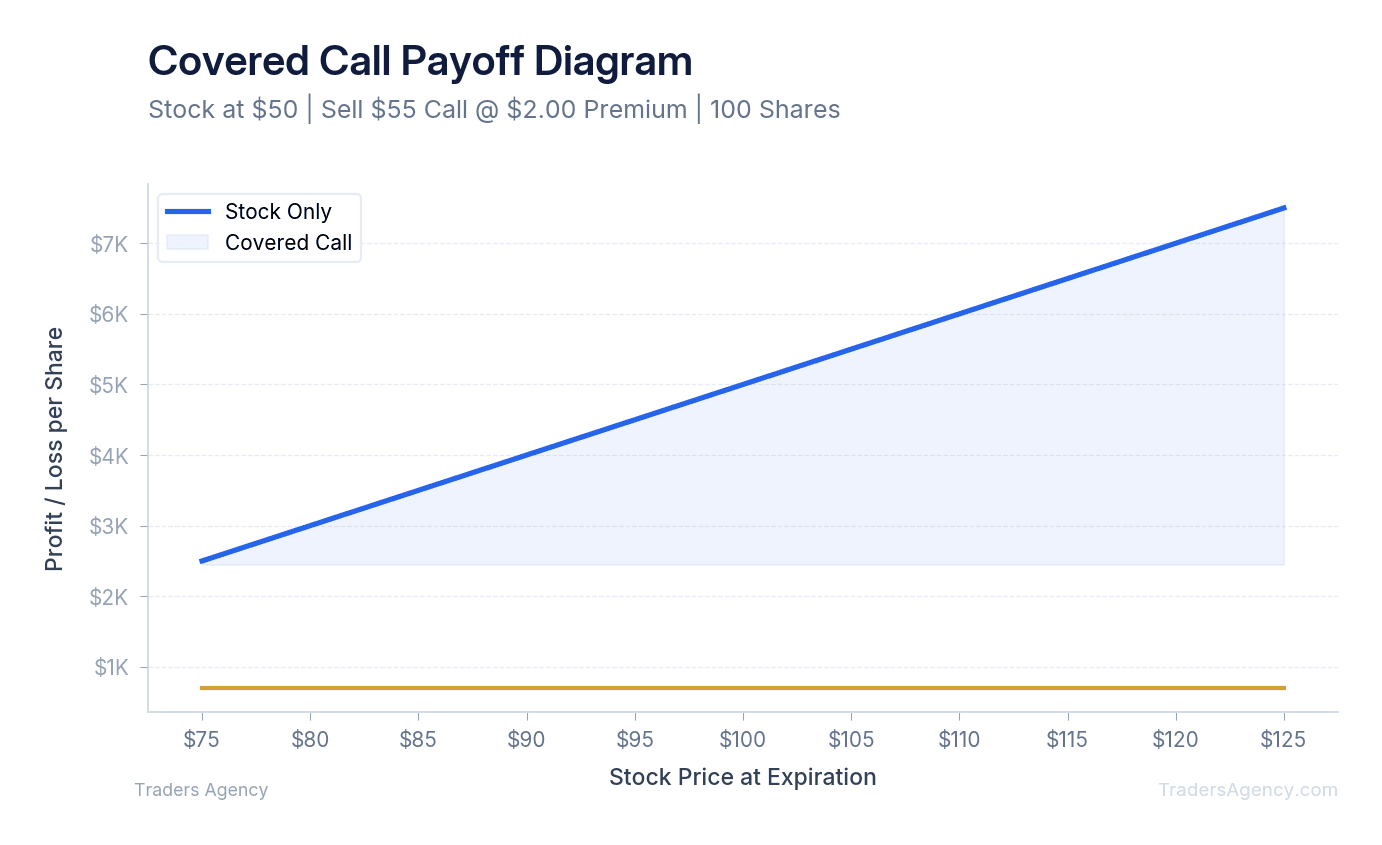
Let us look at a specific trade setup to see how the mechanics work in practice. Assume you own 100 shares of XYZ Corp, currently trading at $50 per share. Your total investment in the stock is $5,000.
You decide to sell one call option contract with a $55 strike price expiring in 30 days. The buyer pays you a $2.00 premium per share. Since options contracts cover 100 shares, you collect $200 in cash immediately.
| Parameter | Value |
|---|---|
| Stock | XYZ Corp at $50.00 |
| Shares Owned | 100 |
| Call Sold | $55 strike, 30 days to expiration |
| Premium Collected | $2.00/share ($200 total) |
Here is what happens at expiration based on the stock price:
| Scenario | Stock Price at Expiration | Option Outcome | Total Profit/Loss |
|---|---|---|---|
| Stock stays flat or dips slightly | $50 (unchanged) | Expires worthless | +$200 (premium only) |
| Stock rises above strike | $60 | Exercised at $55 | +$700 ($500 stock gain + $200 premium) |
| Stock drops significantly | $40 | Expires worthless | -$800 ($1,000 loss offset by $200 premium) |
In Scenario 1, the call option expires worthless. You keep your 100 shares and the $200 premium. You are now free to sell another call option for the next month.
In Scenario 2, the option buyer exercises the contract. You must sell your 100 shares at the agreed $55 strike price. You keep the $200 premium, plus you make a $500 profit from the stock rising from $50 to $55. However, you miss out on the additional $500 gain above the $55 strike. Your total profit is capped at $700.
In Scenario 3, the option expires worthless. You keep the $200 premium, which helps offset the $1,000 paper loss on your shares. Your net position value is $4,200 instead of $4,000.
How Do You Calculate Max Profit, Breakeven, and Max Loss on a Covered Call?
Understanding your exact numbers before entering a trade is a core principle we teach our members. Here are the three calculations you need to know for every covered call you place.
Maximum Profit
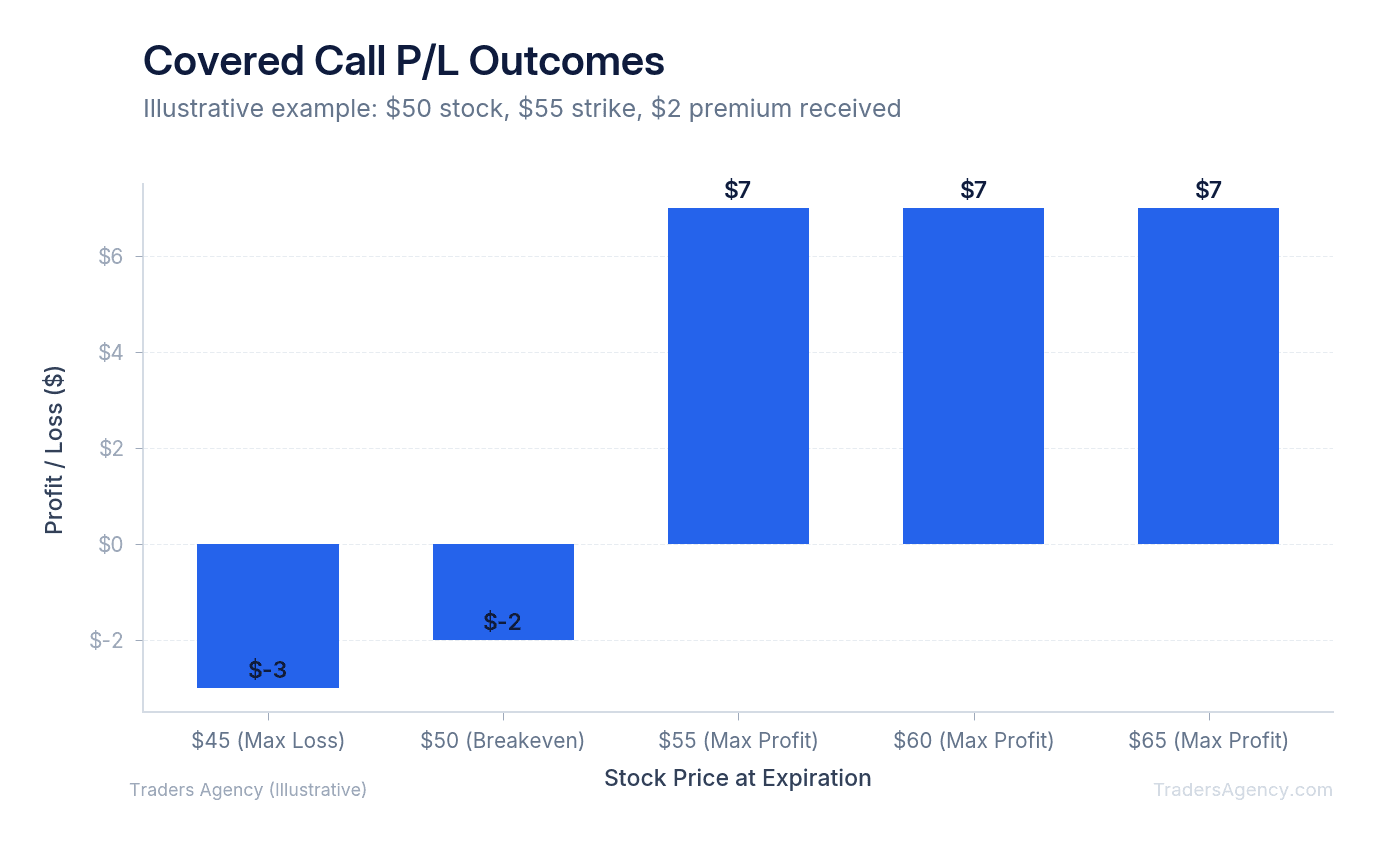
Your upside is strictly capped at the strike price. To find your maximum gain, take the strike price ($55) minus your stock entry price ($50). This gives you a $5.00 per share capital gain. Add the premium collected ($2.00). Your maximum profit is $7.00 per share, or $700 total. You achieve this max profit if the stock is at or above $55 at expiration.
Breakeven Point
The premium you collect lowers your effective cost basis on the stock. Take your stock purchase price ($50) and subtract the premium received ($2.00). Your new breakeven point is $48.00 per share. If the stock drops to $48, the $200 you made on the option perfectly cancels out the $200 you lost on the stock.
Maximum Loss
Because you own the stock, you carry the risk of the company going to zero. Your maximum loss is your breakeven point ($48.00) multiplied by 100 shares. If XYZ Corp goes to zero, you would lose $4,800. The option premium provides a small cushion, but it does not protect you from a severe decline.
| Calculation | Formula | Result |
|---|---|---|
| Max Profit | (Strike - Entry) + Premium = ($55 - $50) + $2.00 | $7.00/share ($700 total) |
| Breakeven | Entry - Premium = $50 - $2.00 | $48.00/share |
| Max Loss | Breakeven × 100 = $48.00 × 100 | $4,800 |
Want expert trading insights delivered daily?
Join thousands of traders who rely on Traders Agency for market analysis and trade ideas.
Join Traders AgencyHow Do Delta, Theta, and Vega Affect a Covered Call?
The options Greeks measure how different factors impact your covered call position. Understanding these three metrics will help you choose better strikes, better timing, and better trade management.
Theta: Time Decay Is Your Ally
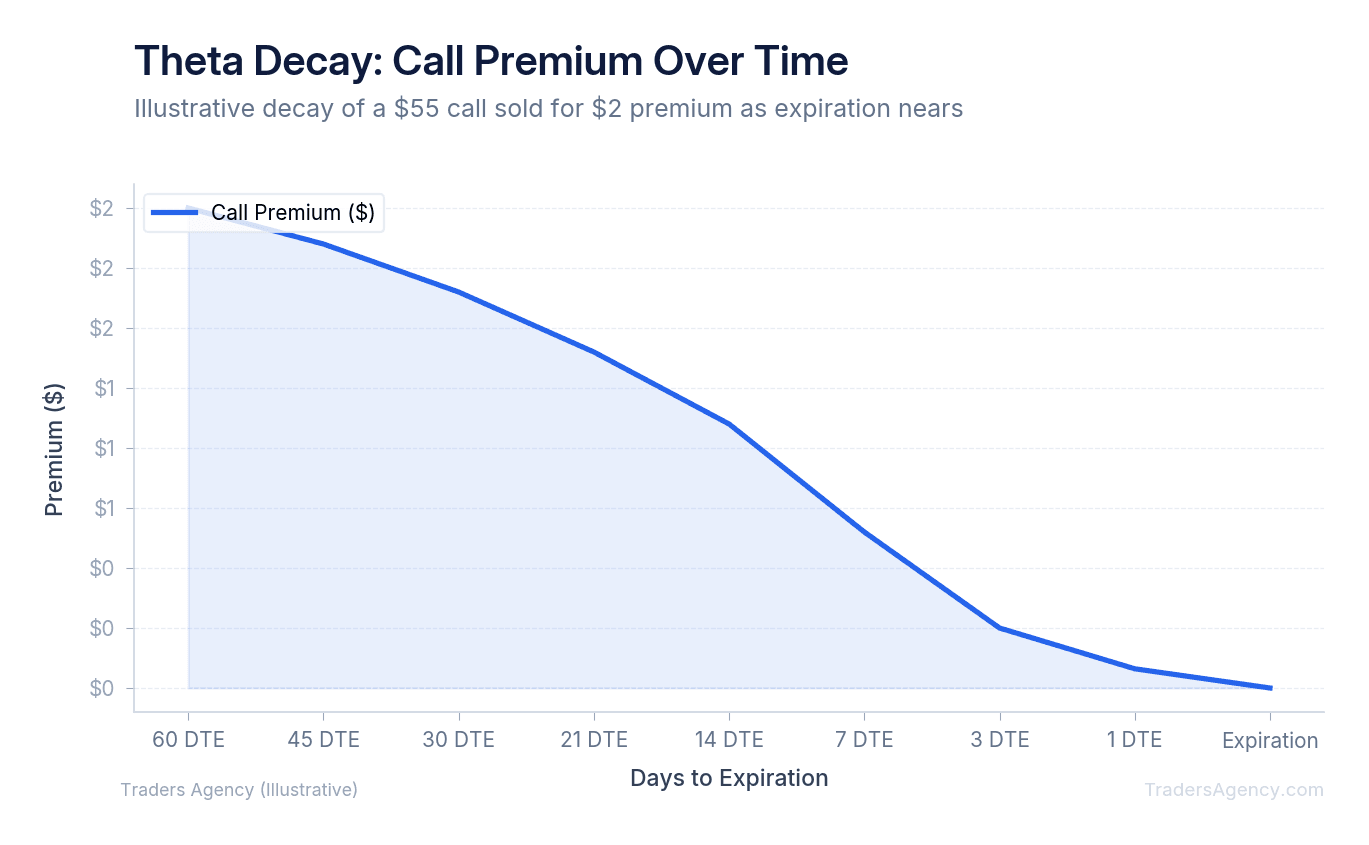
Time is your greatest ally when you sell options. As expiration approaches, the time value of the option decreases automatically. This process is called theta decay. Because you sold the option, you want its value to drop to zero. Theta decay accelerates rapidly in the final 30 days before expiration, which is exactly why we prefer selling options in that window.
Delta: Probability of Assignment
Delta tells you the probability that your option will finish in the money. A call option with a .30 delta has roughly a 30% chance of expiring above your strike price. We often look for deltas between .20 and .30 when selling covered calls. This range provides a solid balance of premium income while keeping the probability of retaining your shares relatively high (around 70% to 80%).
Vega: Volatility Means Bigger Premiums
Vega measures sensitivity to implied volatility. When a stock has an upcoming earnings report or faces market uncertainty, implied volatility spikes. This makes option premiums more expensive. We prefer to sell covered calls when implied volatility is elevated because we can collect larger premiums for the exact same strike price.
Key Concept: Sell covered calls when implied volatility is high and choose options with 30 to 45 days until expiration. This combination maximizes the premium you collect while putting theta decay to work in your favor.
How Do You Choose the Right Strike Price for a Covered Call?
Selecting the right strike price is a balancing act between income and growth potential. A strike price close to the current stock price offers higher premium income but caps your stock gains early. A higher strike price provides less premium but leaves more room for the stock to appreciate.
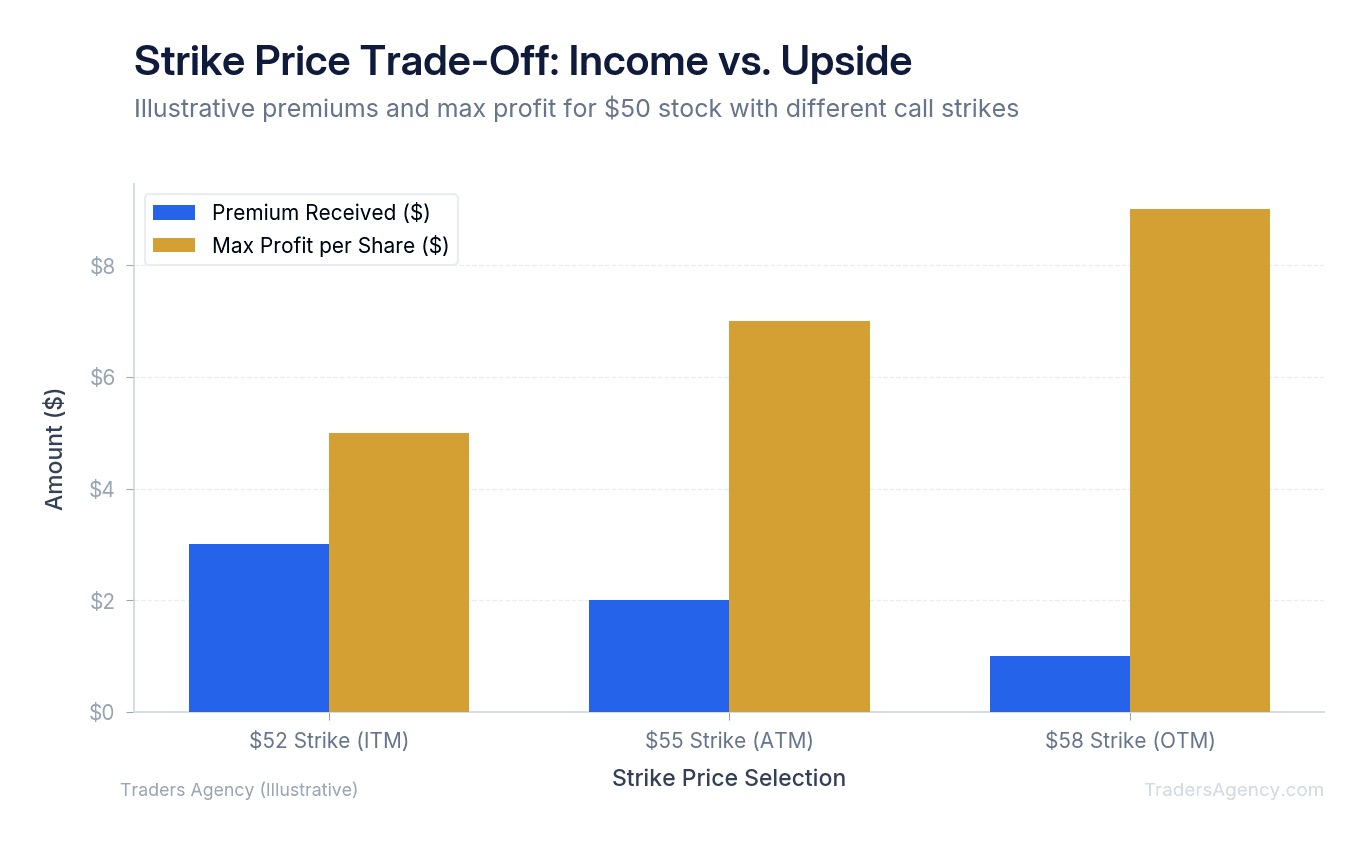
Here are the specific steps we teach for selecting your strike and executing the trade:
- Identify your primary goal. Decide if you want maximum monthly income or if you want to hold the stock long-term for growth. Income-focused traders choose strikes closer to the current price. Growth-focused traders choose strikes further out.
- Check the option chain. Look at the available premiums for strike prices that are 5% to 10% above the current stock price. This is the sweet spot for most covered call sellers.
- Select an expiration date. We generally prefer selling options that expire 30 to 45 days in the future to maximize the benefits of theta decay.
- Confirm your willingness to sell. Never sell a covered call at a strike price where you would be upset to lose your shares. If you are not comfortable selling at that price, choose a higher strike or skip the trade entirely.
When Should You Use a Covered Call Strategy?
You should use a covered call strategy when you have a neutral to slightly bullish outlook on a stock you already own. It works best in sideways or slowly rising markets. This strategy allows you to generate additional income while you wait for moderate price appreciation.
We do not recommend selling covered calls on stocks you believe are about to surge in value. If a company just announced a massive new product and you expect the stock to jump 30%, a covered call will force you to miss out on those gains. You want to use this strategy on stable, predictable companies.
Many of our traders prefer using this strategy on broad market ETFs like SPY or QQQ. ETFs generally have lower volatility than individual stocks. This means the premiums are slightly smaller, but the risk of a sudden, massive price spike calling your shares away is also reduced. It is a highly effective way to generate a steady yield on a long-term portfolio.
You can also use this strategy to get paid while waiting to exit a position. If you bought a stock at $40 and your target selling price is $50, you can continually sell $50 strike calls. You collect income every month until the stock finally hits your target and the shares are automatically sold at your desired price.
What Are the Risks of Selling Covered Calls?
The primary risks of selling covered calls are opportunity cost and downside exposure. If the stock price skyrockets, your profits are strictly capped at the strike price. If the stock price crashes, the small premium you collected offers very little protection against the loss in share value.
Watch Out: Covered calls are not a hedge. If you buy a stock for $100 and collect a $3 premium, your breakeven is $97. If the stock drops to $70, you still suffer a $27 per share loss. You must still use proper position sizing and risk management on the underlying stock.
There are also tax implications to consider. Selling a covered call can affect your holding period for long-term capital gains. If you sell an option that is "in-the-money" (the strike price is below the current stock price), the IRS might suspend your holding period. This could turn a favorable long-term capital gain into a heavily taxed short-term gain. Always consult a tax professional regarding your specific situation. The SEC's investor education resources provide additional context on options-related tax considerations.
Rolling the Option: Your Defensive Maneuver
If the stock price rises rapidly and approaches your strike price, you have choices. You can let the shares be called away and take your maximum profit. Alternatively, you can buy back the call option to close the trade and simultaneously sell a new call option at a higher strike price and a later expiration date. This defensive maneuver is called rolling the option.
Rolling allows you to keep your shares and participate in further upside, though it requires careful management of the debit and credit involved. Here is how we approach it:
- Buy to close your current short call (this will cost you money since the option has gained value).
- Sell to open a new call at a higher strike price and a later expiration date (this generates new premium).
- Calculate the net cost. Ideally, the credit from the new call covers most or all of the debit from closing the old one.
Watch Out: Rolling is not free money. If you roll repeatedly into losing positions, the costs can add up. Only roll when the math makes sense and you still want to own the underlying stock.
The covered call strategy is one of the most practical approaches we teach because it turns idle stock positions into income-generating assets. Whether you are collecting premium on SPY in a retirement account or generating monthly cash flow on individual holdings, the mechanics are the same: own the shares, sell the call, collect the premium, and manage the position. Start with one contract on a stock you know well, and build your confidence from there.
Want expert trading insights delivered daily?
Join thousands of traders who rely on Traders Agency for market analysis and trade ideas.
Join Traders AgencyKey Takeaways
- A covered call requires owning 100 shares of a stock and selling one call option against those shares to collect an upfront premium you keep regardless of the outcome.
- Your maximum profit is capped at the premium collected plus any gain up to the strike price. If the stock surges past the strike, you miss out on those additional gains.
- The breakeven point on a covered call is your original stock purchase price minus the premium collected, which gives you a built-in cushion against small losses.
- Strike price selection is a core decision: a higher strike preserves more upside but pays less premium, while a lower strike generates more income but limits your gains sooner.
- Rolling a covered call, closing the current position and opening a new one at a later date or higher strike, is a management tool, but only makes sense when the math works and you still want to hold the stock.
DISCLAIMER: Traders Agency does not offer financial advice. The information provided is for educational purposes only and should not be considered financial advice. Traders Agency is not responsible for any financial losses or consequences resulting from the use of the information provided. Trading carries inherent risks and may not be suitable for all individuals. You are advised to conduct your own research and seek personalized advice before making any investment decisions, recognizing the potential risks and rewards involved.
See more from Traders Agency on Google
Make us a preferred source and our market analysis will appear more prominently in your Google Search, Top Stories, and AI results.
Add to Preferred Sources