
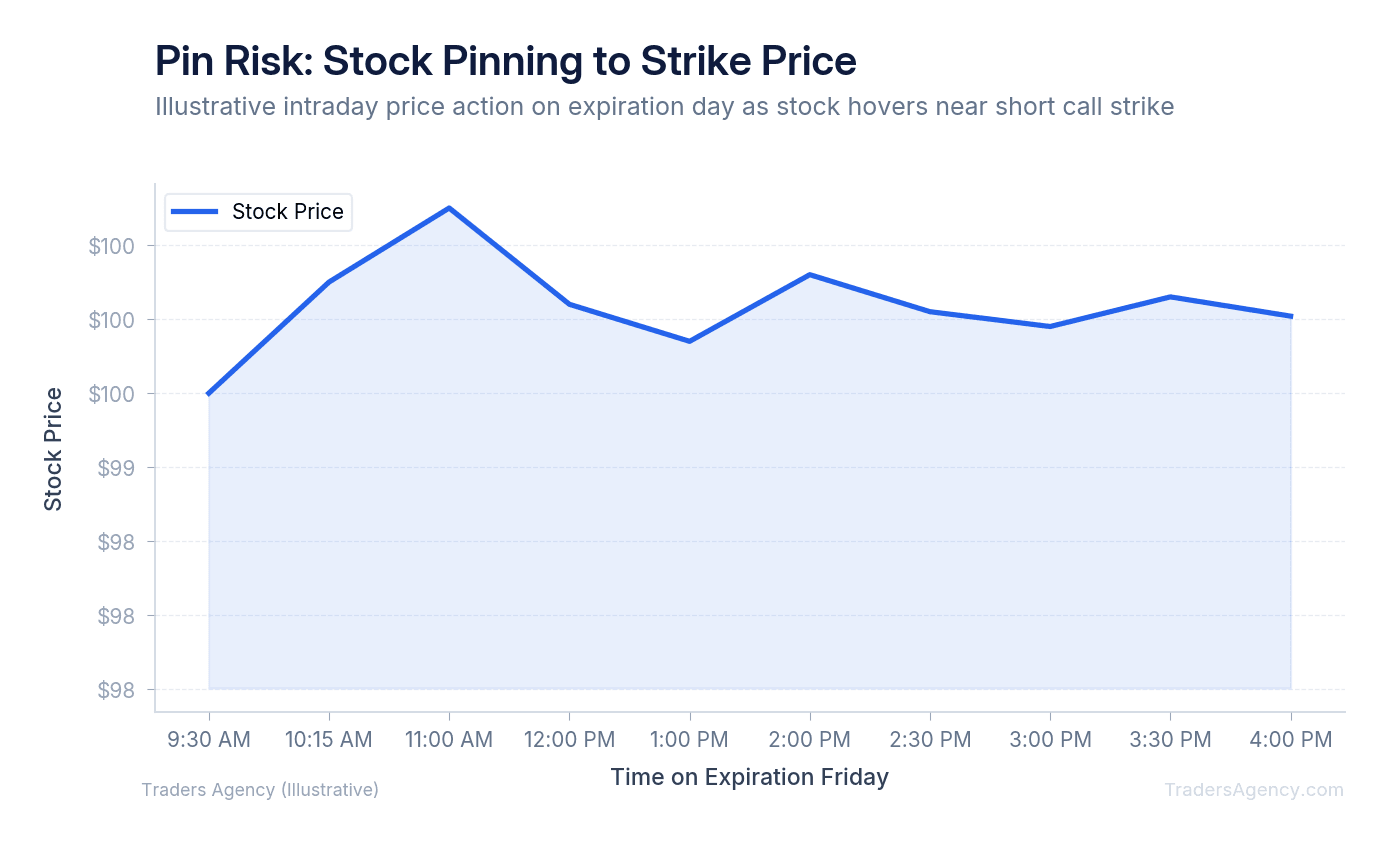
You have probably seen this happen. You sell a credit spread or a covered call, and the stock price hovers right on your strike price as the final bell approaches on expiration Friday. The tension builds as you watch the ticker bounce up and down by pennies. This is options pin risk in action, and if you do not understand how it works, it can turn a winning trade into a weekend nightmare. We are going to walk you through exactly how assignment works, the mechanics of expiration day, and how to protect your portfolio from unexpected exposure.
What Is Options Pin Risk and Why Does It Matter?
Bottom Line: Pin risk is not a theoretical edge case. It is a mechanical reality that can move thousands of dollars in or out of your account over a single weekend based on a decision made by a counterparty you cannot see or predict. The consistent takeaway from this article is that proactive position management, specifically closing short options before expiration rather than riding them to zero, is the only reliable way to avoid assignment surprises. Respecting the mechanics of expiration is what separates disciplined options traders from those who learn these lessons the hard way.
Options pin risk occurs when an underlying stock closes at or extremely close to your option's strike price on expiration day. This matters because it leaves short option sellers guessing whether they will be assigned shares, potentially resulting in massive, unintended stock positions over the weekend.
The Options Clearing Corporation (OCC) handles the clearing and settlement of all listed options in the US market. The OCC automatically exercises any option that is $0.01 or more in the money at expiration. If the stock closes exactly on your strike price, the long holder of the option has the right to manually choose whether to exercise it or let it expire.
Key Concept: Pin risk is the uncertainty you face when a stock closes at or near your short option's strike price at expiration. You cannot predict whether the long holder will exercise, leaving you exposed to an unplanned stock position over the weekend.
Think of it like a coin flip where the coin lands perfectly on its edge. You have zero control over the outcome. If you sold a put option and get assigned, you will be forced to buy 100 shares of stock per contract at the strike price. If you do not have the cash in your account to cover this, your broker will issue a margin call on Monday morning.
How Pin Risk Changes Your Delta and Gamma Near Expiration
As expiration approaches, at-the-money options experience massive changes in their pricing metrics. The Greeks behave very differently in the final hours of trading compared to weeks prior.
Gamma measures the rate of change in delta. On expiration day, gamma spikes to its highest possible levels for at-the-money options. This means your position's delta can flip from 0 to 100 (or 0 to -100) with just a few cents of movement in the underlying stock.
If you are short an at-the-money call on Friday afternoon, a ten-cent move up in the stock price suddenly gives you a massive short delta exposure. A ten-cent move down removes that exposure entirely. This rapid flipping makes it nearly impossible to properly hedge your position.
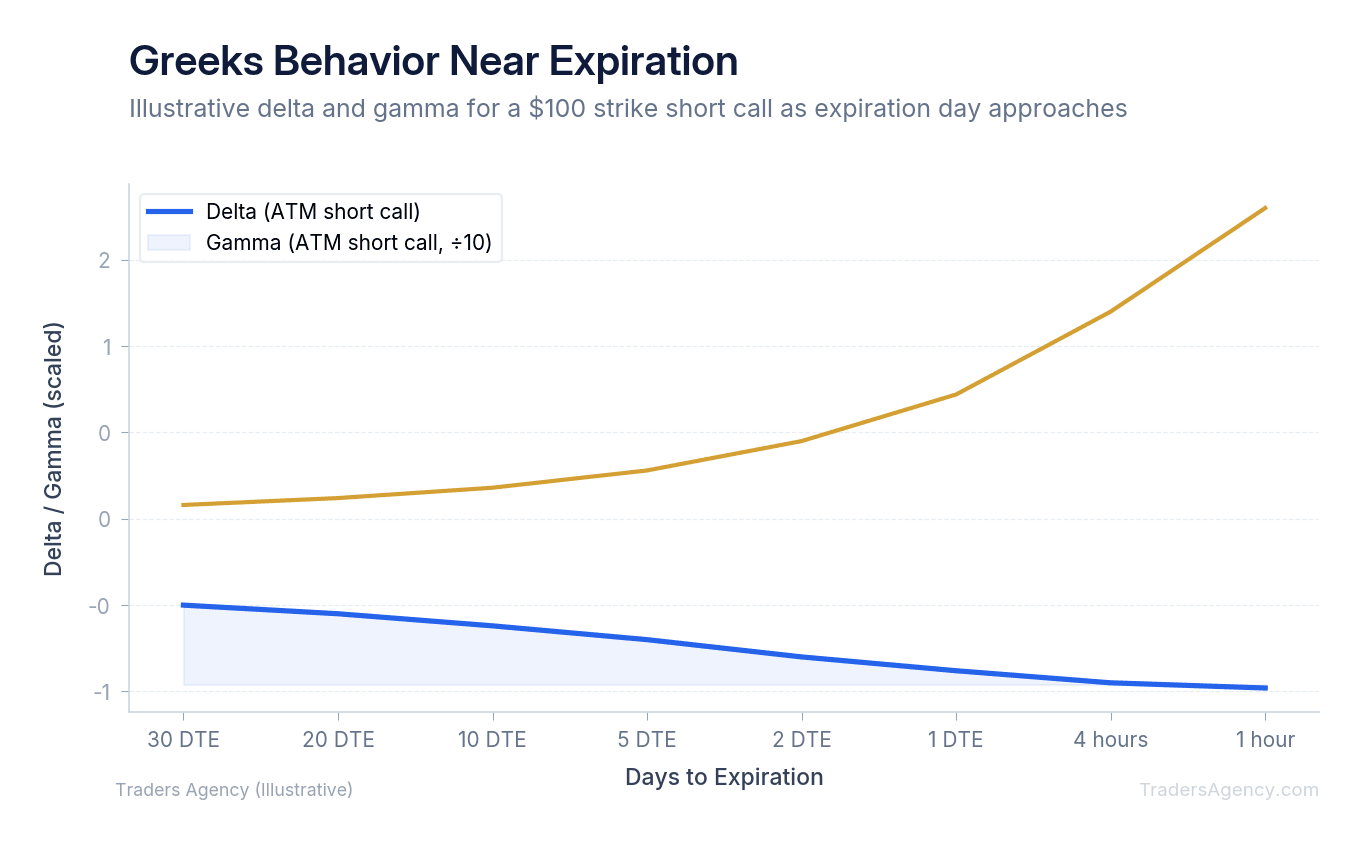
Watch Out: We teach our members to avoid this gamma trap entirely. Holding short options into the final hours of expiration day turns a calculated trade into a pure gamble. The math no longer works in your favor when gamma is at extreme levels.
Can You Be Assigned After the Market Closes on Expiration Friday?
Yes, you can be assigned after the market closes on expiration Friday. While regular trading stops at 4:00 PM Eastern Time, options holders typically have until 5:30 PM Eastern Time to instruct their brokers to exercise an option based on after-hours stock price movements.
This is where many intermediate traders get caught off guard. A stock might close at $100.00 at 4:00 PM, leaving your $100.50 short call safely out of the money. You breathe a sigh of relief and turn off your computer.
Then, an after-hours news event pushes the stock to $101.00 at 4:15 PM. The long holder of that call option sees the price jump and instructs their broker to exercise the contract. You wake up Monday morning with a short stock position you never intended to hold. The stock might gap up to $105.00 at the Monday open, leaving you with a severe loss.
| Timeline | Stock Price | Your Position Status |
|---|---|---|
| Friday 3:55 PM | $100.00 | Short call appears safe (OTM by $0.50) |
| Friday 4:00 PM (close) | $100.00 | Market closes, you assume trade is over |
| Friday 4:15 PM | $101.00 | After-hours move puts call ITM |
| Friday 5:30 PM | N/A | Long holder exercises the call |
| Monday 9:30 AM | $105.00 | You are short 100 shares at $100.50, stock opens at $105 |
How Does Early Assignment Work on American-Style Options?
Options pin risk is closely related to early assignment risk. To manage these trades effectively, you must understand the difference between American-style and European-style options. American-style options can be exercised at any time before expiration. Most equity and ETF options in the US market use the American style.
Early assignment usually happens when an option is deep in the money and has very little extrinsic value left. The holder exercises the option to take control of the actual shares.
Here are the primary conditions that increase your risk of early assignment:
- The option is deep in the money
- The remaining extrinsic value (time value) is less than $0.10
- The underlying stock is hard to borrow, driving up short interest fees
- An ex-dividend date is approaching
We monitor the extrinsic value of our short options closely. If the time value drops to pennies, the market is telling you that early assignment is highly probable. This is your signal to act, not wait.
Want expert trading insights delivered daily?
Join thousands of traders who rely on Traders Agency for market analysis and trade ideas.
Join Traders AgencyWhat Is Dividend Risk for Short Call Sellers?
Dividend risk is a specific type of early assignment risk that catches many traders by surprise. If you hold a short call going into an ex-dividend date, the long holder might exercise early to capture the dividend payment.
This happens when the upcoming dividend amount is greater than the remaining extrinsic value of the call option. Institutional traders run automated algorithms to find these exact scenarios. They exercise the call to acquire the stock, collect the dividend, and may buy a put to protect their downside.
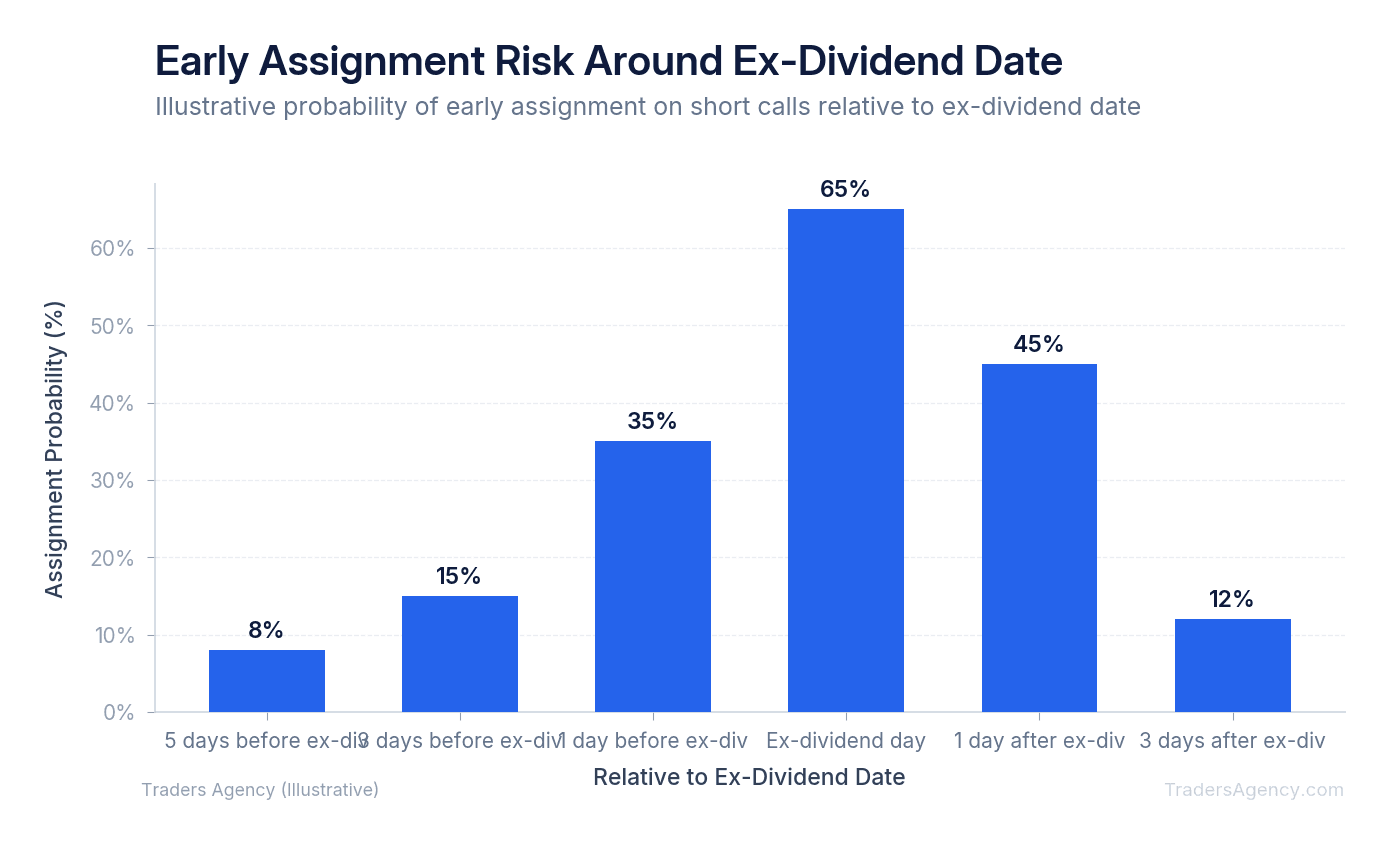
Watch Out: Always check the dividend calendar before selling calls on dividend-paying stocks. If the ex-dividend date falls before your expiration date, you must factor this risk into your trade plan. The dividend amount versus remaining extrinsic value tells you everything you need to know.
How Do You Manage a Covered Call Assignment?
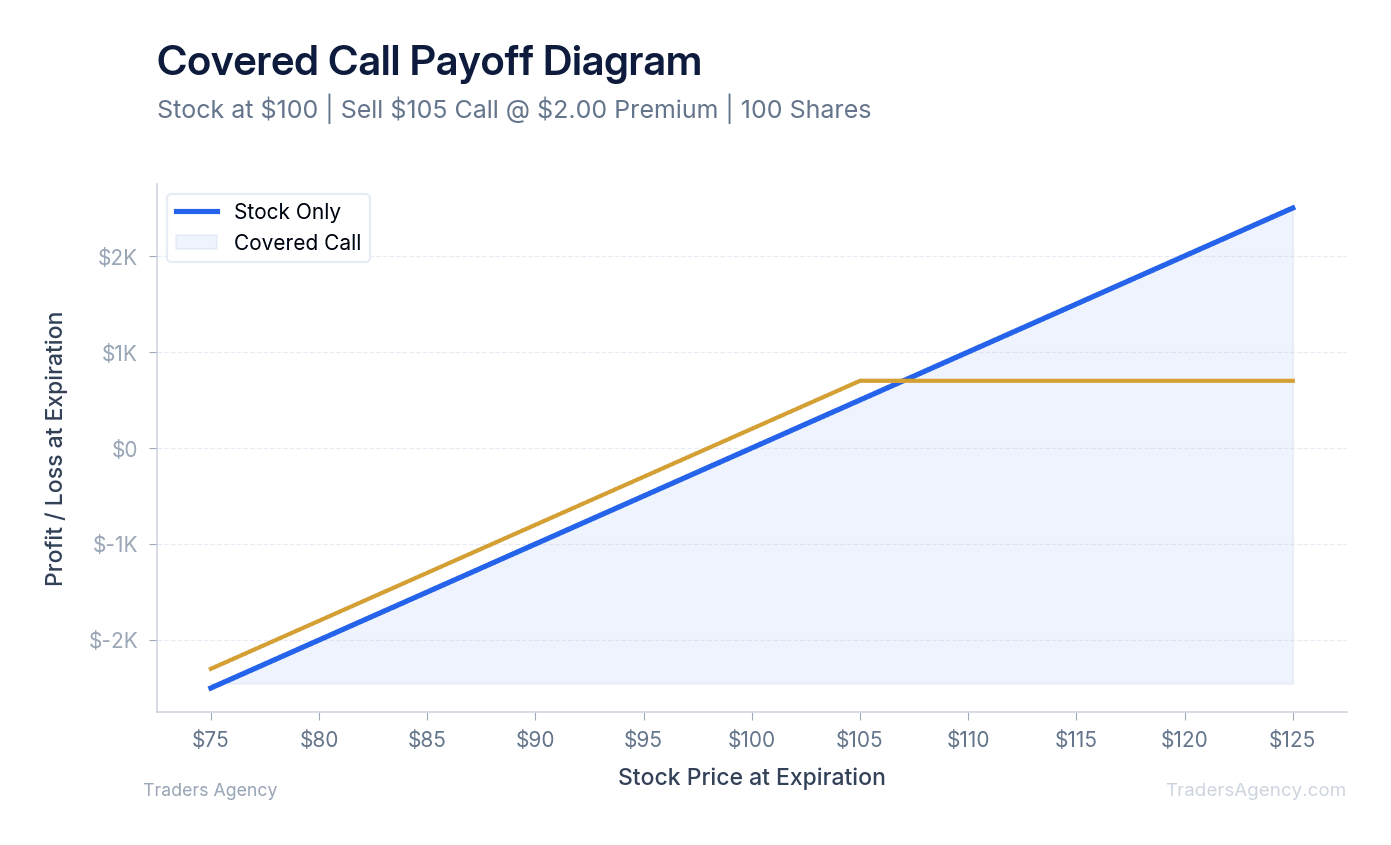
Here is a concrete example of how pin risk and assignment play out with a standard covered call strategy. We will use specific numbers to show the mechanics in action.
| Parameter | Value |
|---|---|
| Stock | AAPL at $170.00 |
| Call Sold | $175.00 strike, $1.50 premium |
| Premium Collected | $150 (per contract) |
| Max Profit | $650 ($500 stock gain + $150 premium) |
| Breakeven | $168.50 |
- The Setup: You own 100 shares of AAPL trading at $170.00. You want to generate income, so you sell the $175.00 strike call expiring this Friday. You collect $1.50 in premium, putting $150 directly into your account.
- The Expiration Day Action: On Friday at 3:55 PM, AAPL is trading at $174.98. You decide to let the option expire, assuming it will stay out of the money. You want to keep your shares and keep the premium.
- The After-Hours Surprise: At 4:05 PM, AAPL jumps to $175.20 in after-hours trading. The long holder instructs their broker to exercise the call. Because you did not close the short option before the market closed, you are now exposed to this after-hours movement.
- The Outcome: Over the weekend, you are assigned. Your 100 shares of AAPL are called away at $175.00. You keep the $150 premium, and you keep the capital gains up to $175.00. However, you miss out on any stock gains above that price. If you wanted to hold those shares for the next ten years, you now face a taxable event and have to buy the stock back on Monday morning at the current market price.
When Should You Close a Short Option to Avoid Pin Risk?
Our recommendation: close a short option before the final trading session on expiration day, ideally by Thursday afternoon or Friday morning. Closing the position early eliminates the threat of after-hours assignment and protects your portfolio from unpredictable weekend exposure.
We prefer to close short options when we have captured 80% of the maximum profit. Do not risk a massive stock assignment just to squeeze the last $0.05 of premium out of a trade. Buying the option back for a few pennies is the cheapest insurance policy you can buy.
Understanding your broker's specific cutoff times for exercise instructions is a basic requirement of risk management. Every broker has slightly different deadlines for submitting exercise notices. The SEC's investor education resources emphasize that knowing these operational details is part of responsible options trading.
Key Concept: If you are trading credit spreads, the risk is amplified. If your short leg is assigned but your long leg expires worthless, you are left holding a naked stock position with undefined risk. Always close your spreads before the final bell. Factor in trading fees and bid-ask spreads, and exit the trade on your own terms.
Our Closing Checklist for Expiration Week
- Monday through Wednesday: Monitor your short options. If you have captured 80% or more of max profit, close the trade.
- Thursday afternoon: Evaluate any remaining short options. If the stock is within $1.00 of your strike price, close the position regardless of profit percentage.
- Friday morning: This is your final window. Close anything that still carries pin risk. Do not wait for the afternoon session.
- Never hold through the close: If you are still holding a short option at 3:30 PM on Friday, you are gambling. Buy it back and move on to the next trade.
Pin risk and assignment are not abstract concepts. They are real mechanical events that can move thousands of dollars in and out of your account over a single weekend. The traders who consistently profit from options are the ones who respect these mechanics and manage their positions proactively. Our approach is simple: take your profits early, close your risk before expiration, and never let a winning trade turn into a margin call.
Want expert trading insights delivered daily?
Join thousands of traders who rely on Traders Agency for market analysis and trade ideas.
Join Traders AgencyKey Takeaways
- The OCC automatically exercises any option that is $0.01 or more in the money at expiration, but when a stock closes exactly on your strike price, the long holder decides whether to exercise, leaving short sellers with no way to predict their assignment.
- Pin risk creates unintended overnight stock positions that can expose you to gap risk over the weekend, turning a controlled options trade into an unplanned equity position with full directional exposure.
- American-style options can be assigned early at any point before expiration, not just on expiration day, which means short option sellers must monitor their positions continuously, not just on Fridays.
- Dividend risk is a specific threat for short call sellers: if a call is in the money before an ex-dividend date, the long holder may exercise early to capture the dividend, triggering unexpected assignment.
- The practical rule from the article is direct: if you are still holding a short option at 3:30 PM on expiration Friday, you are taking on unnecessary risk. Closing the position early eliminates pin risk entirely.
DISCLAIMER: Traders Agency does not offer financial advice. The information provided is for educational purposes only and should not be considered financial advice. Traders Agency is not responsible for any financial losses or consequences resulting from the use of the information provided. Trading carries inherent risks and may not be suitable for all individuals. You are advised to conduct your own research and seek personalized advice before making any investment decisions, recognizing the potential risks and rewards involved.
See more from Traders Agency on Google
Make us a preferred source and our market analysis will appear more prominently in your Google Search, Top Stories, and AI results.
Add to Preferred Sources