
Rolling an options position means closing an existing contract and simultaneously opening a new one on the same underlying, usually at a different strike price, a later expiration, or both. Traders use this technique to extend a thesis, defend a position that has moved against them, or lock in gains while staying in the trade. We teach rolling not as a standalone strategy but as an ongoing risk management process applied across the entire life of a trade.
If you have ever watched a call option approach expiration while you still believed in the underlying trend, you have already faced the rolling decision. Do you let it expire, close it outright, or roll it into a new contract that better matches your current view? This guide walks through the mechanics, the cost structure, the Greeks impact, and the exact decision framework our education team applies to live positions.
By the end, you will know how to execute a roll step by step, calculate whether it is actually cheaper than closing and reopening, and avoid the mistakes that turn a defensive roll into a much bigger loss.
What Is Rolling an Options Position?
Bottom Line: Rolling only makes sense when the original thesis on the underlying still holds; it extends exposure and can defend a position, but it does not fix a broken trade and adds cost, tax events, and new Greeks risk that must be checked before every roll.
Rolling an options position is a two-part transaction: buy back (or sell to close) the current contract, then sell (or buy to open) a new contract with different terms. On most platforms it executes as a single order, often labeled a "roll" or spread order, so both legs fill together or neither fills at all.
The logic comes down to preserving exposure without fully exiting and re-entering the market. When you close and reopen manually, you take on slippage risk between the two fills and you give up the benefit of combined pricing on multi-leg orders. Put simply, you are trading one contract's remaining risk profile for another that better fits your updated thesis, timeline, or risk tolerance.
Key Concept: A roll is not a new trade and it is not an exit. It is a transfer of exposure from one contract to another, priced as a single net debit or credit.
This matters most for traders running multi-leg positions like verticals, calendars, or diagonals, where rolling one leg changes the risk profile of the entire structure. A trader who rolls the short put in a credit spread without adjusting the long put leg has quietly changed both max loss and breakeven, and usually will not notice until the next mark-to-market check.
What Are the Different Ways to Roll an Option?
There are three primary roll types, separated by what actually changes: expiration, strike, or both.
| Roll Type | What Changes | Typical Purpose |
|---|---|---|
| Rolling out | Later expiration, same strike | Buy time without changing your price target |
| Rolling up or down | Different strike, same expiration | Adjust breakeven or capture a move that already happened |
| Rolling out and up/down | Both expiration and strike | Reset the entire risk profile in one transaction |
The combined roll is the most common institutional choice because it resets time and directional exposure at once. For a losing call option, traders often roll out and down: extending expiration while lowering the strike closer to or below the current stock price. That raises delta and gives the position a better chance of recovering before the new expiration date.
How Do You Roll an Option Step by Step?
Here is the sequence we use. Start by evaluating the existing contract, price the net debit or credit, then submit both legs in the same order ticket. Nearly every major broker supports this as a single roll transaction type.
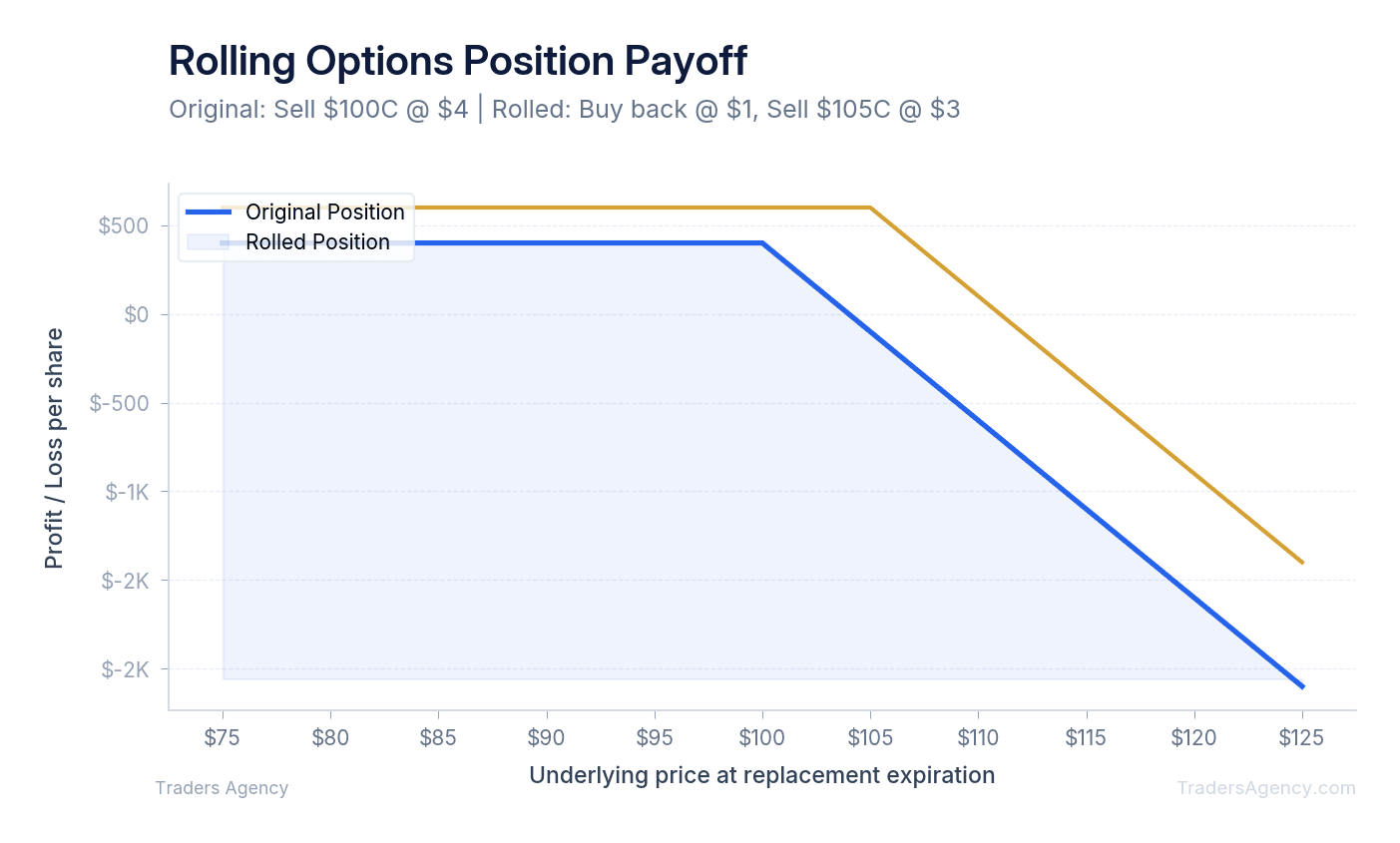
- Step 1: Evaluate the Existing Position. Say you hold a long call on a stock trading at $98, with a $100 strike expiring in 3 days, purchased for $2.50. The option is now worth $1.00 as time decay accelerates and the stock stalls below the strike.
- Step 2: Decide the Roll Type. You still believe the stock moves higher over the next month. Rather than let the call expire worthless, you choose to roll out and up: sell to close the $100 call and open a $105 strike call expiring in 30 days.
- Step 3: Execute the Roll Order. Sell to close the $100 call for a $1.00 credit and buy to open the $105 call for a $3.00 debit, submitted as one roll order so you never carry leg risk between fills. The combined ticket prices out as a $2.00 net debit.
- Step 4: Recalculate Breakeven and Max Loss. The new breakeven becomes $105 plus the $3.00 premium on the new leg, or $108, treating the original $2.50 cost as sunk. Max loss on the new leg alone is the $3.00 premium paid; total capital at risk across both legs depends on your original entry price.
The Example Trade at a Glance
| Parameter | Value |
|---|---|
| Stock Price | $98 |
| Original Contract | $100 strike call, 3 days to expiration, bought at $2.50 |
| Current Value of Original | $1.00 |
| Replacement Contract | $105 strike call, 30 days to expiration, $3.00 debit |
| Net Roll Debit | $2.00 per share, or $200 per contract before fees |
| New Breakeven | $108.00 |
Want expert trading insights delivered daily?
Join thousands of traders who rely on Traders Agency for market analysis and trade ideas.
Join Traders AgencyWhat Is the Difference Between Rolling Out, Up, and Down?
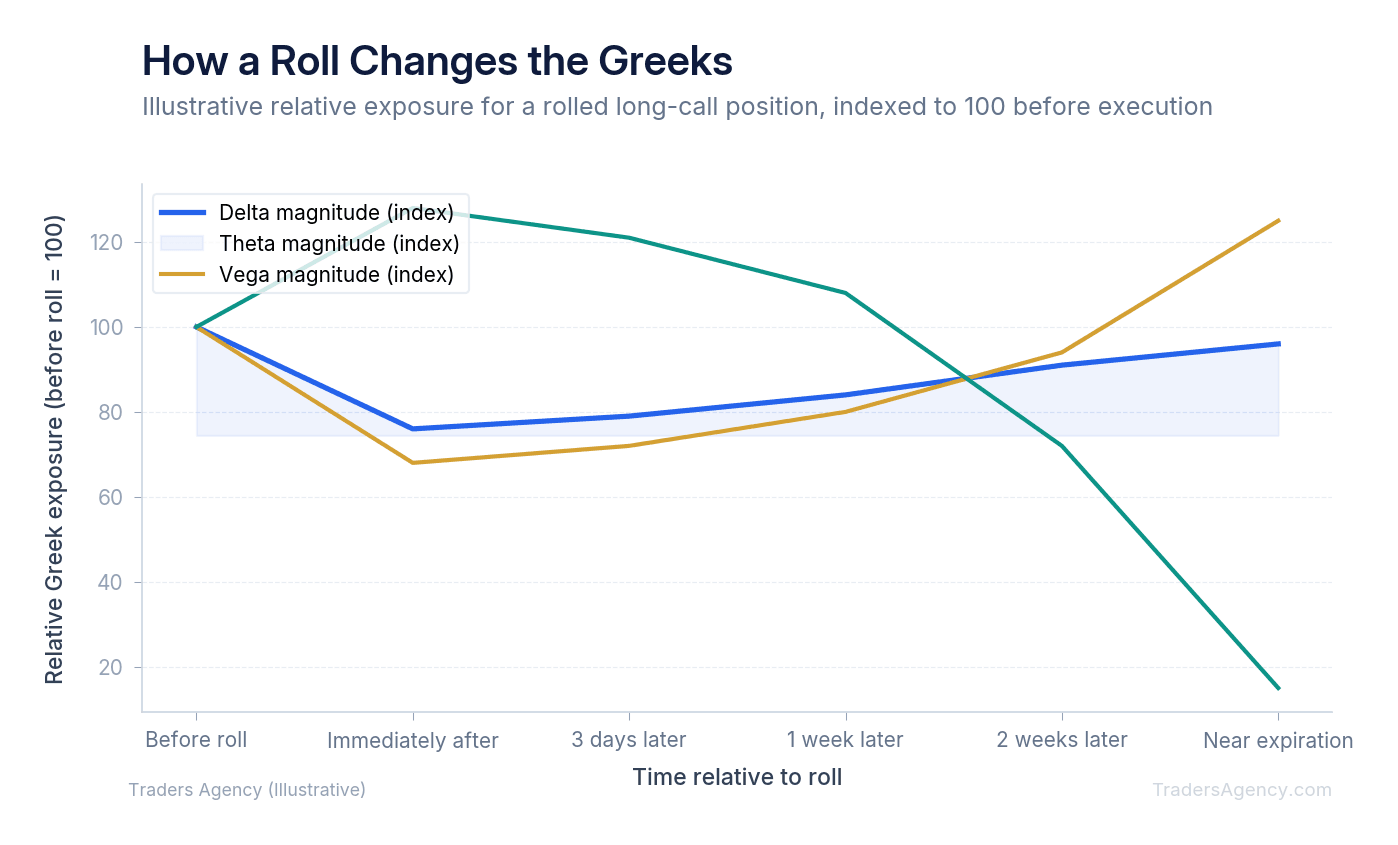
Rolling out lowers the daily rate of time decay and buys back calendar time without moving delta much, since the strike stays fixed. Rolling up or down changes delta immediately, because you are shifting how far in or out of the money the contract sits.
Combining both, as in our $100-to-$105 example, also resets vega exposure, since longer-dated options carry more sensitivity to implied volatility changes. That is exactly why we check the full Greeks profile before rolling instead of glancing only at price and days to expiration. Contract specifications and expiration cycles for listed options are published by the exchanges, and the Cboe product pages are a reliable place to confirm them before you submit a roll.
When Should You Roll vs Close a Position?
Roll when your original thesis is still intact but the current contract's terms no longer match your timeline or price target. Close outright when the thesis has failed, or when the cost of rolling outweighs the expected benefit.
Volatility regime carries enormous weight in this decision:
- Bullish, low-volatility grind: Rolling out and up on winning calls can systematically capture gains while keeping you in the trend.
- Range-bound market: Rolling often just bleeds premium with no payoff, since the underlying is not moving enough to justify the new debit.
- Bearish or high-volatility regime: Closing is frequently the better choice, because implied volatility crush on the new leg can erase any directional benefit you were hoping to buy.
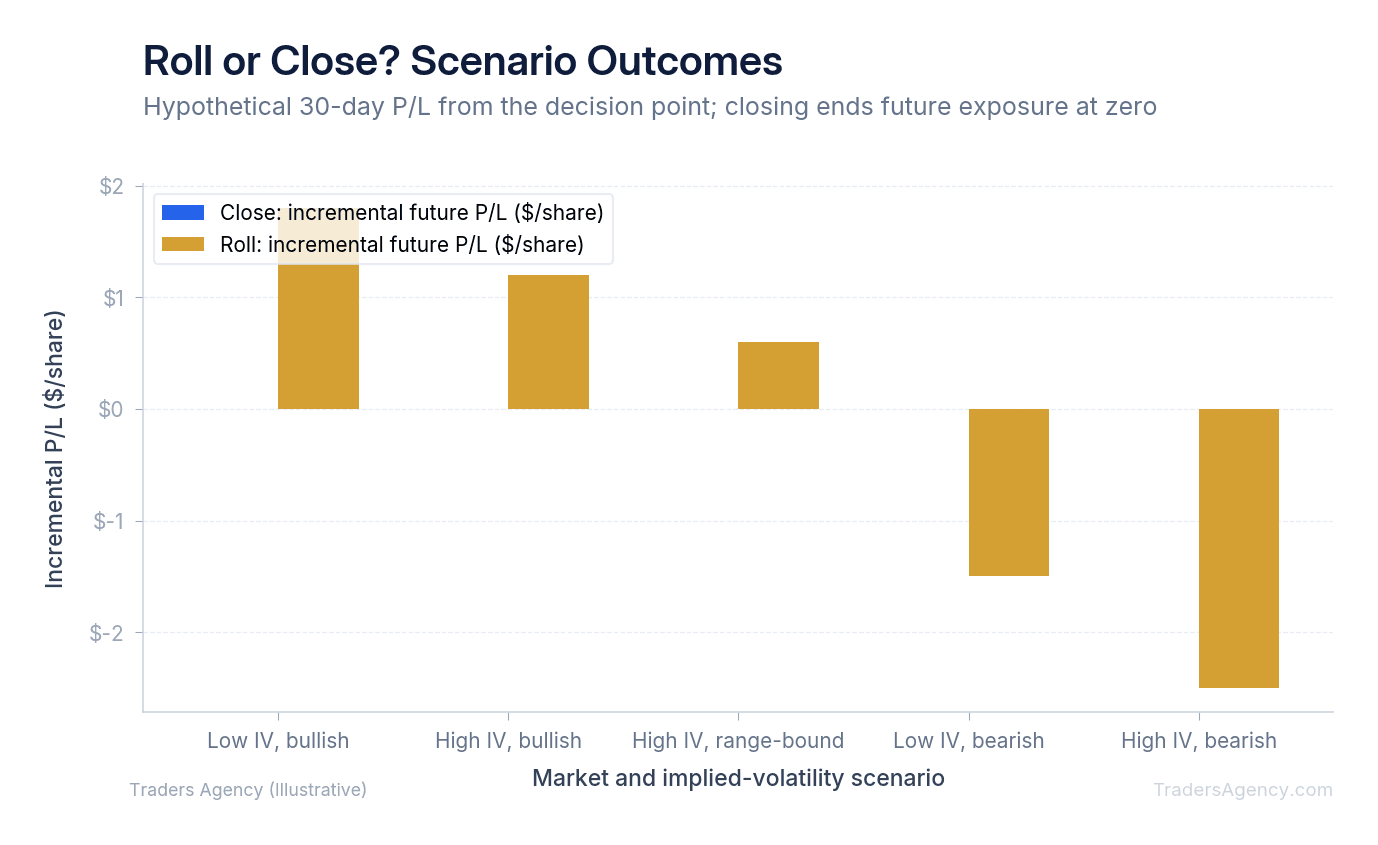
This also answers the question of why you would roll rather than simply sell. Rolling preserves continuous exposure to a thesis you still believe in, while selling and walking away forces you to re-enter later, often at a worse price or through a wider bid-ask spread.
Cost Analysis: Does Rolling Options Cost Money?
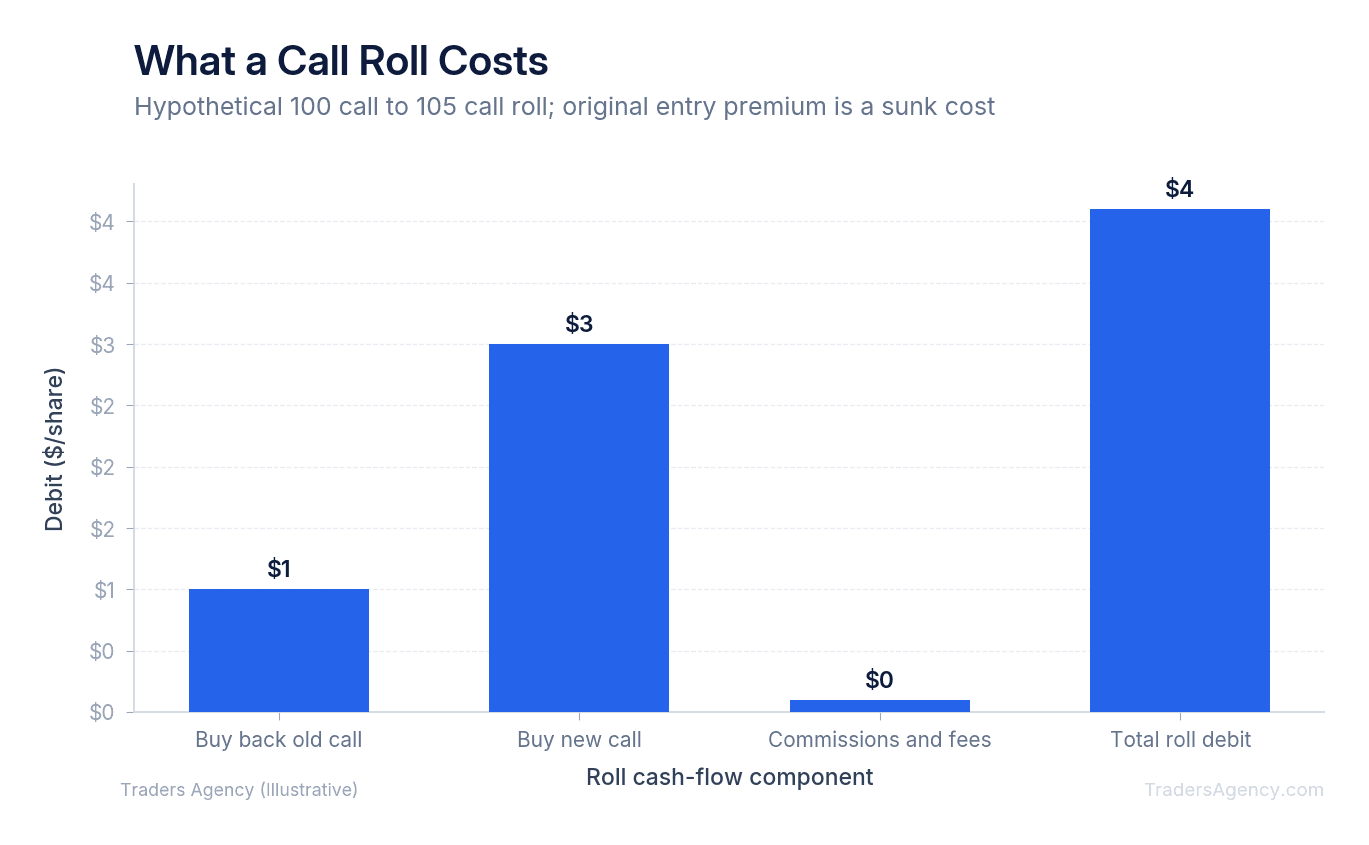
Usually yes. Rolling a long option typically produces a net debit between closing the old contract and opening the new one, while rolling a short option can bring in a net credit. Either way you pay commissions and cross the bid-ask spread on both legs. The real question is never whether it costs money, it is whether the cost is justified by the improved position.
In our example, selling to close the $100 call returned $1.00 and the new $105 call cost $3.00, for a net debit of $2.00 per share, or $200 per contract before fees. Add typical per-contract commissions and exchange fees on both legs, and the all-in cost lands a few dollars above $200.
Taxes deserve real attention if you roll frequently. Closing the old leg is a taxable event on its own, and for a contract held less than a year the gain or loss is short-term regardless of how long you hold the new leg. The wash sale rule can also apply when you roll a losing option into a contract deemed substantially identical, which delays your ability to claim that loss. We recommend keeping a running cost-basis log and reviewing the options guidance in IRS Publication 550 or working with a tax professional who handles active traders.
Watch Out: Repeated rolls on the same losing position can quietly accumulate net debits larger than the premium you originally paid. Track cumulative cost across every roll, not just the cost of the current one.
Greeks Impact on Multi-Leg Rolls
When you roll one leg of a spread, delta, theta, and vega do not move in isolation. Extending expiration on a single leg while leaving the other untouched can flip a formerly delta-neutral position into a directional one overnight, which is one of the fastest ways to end up with risk you never intended to take.
What Are the Most Common Mistakes When Rolling Options?
- Rolling to avoid realizing a loss: The most common error by far. A roll does not repair a broken thesis, it just extends the timeline on the same mistake.
- Ignoring cumulative debits: Rolling again and again on a losing position can stack net debits that exceed the original premium paid.
- Forgetting wash sale exposure: Rolling a losing call into a substantially identical replacement can disallow the loss for tax purposes.
- Rolling multi-leg spreads one leg at a time: This creates leg risk and unintended directional exposure between fills.
- Rolling out of habit near expiration: Not every position deserves a roll. Sometimes closing and reassessing with fresh eyes is the stronger decision.
Remember This: Our roll checklist always opens with the same question. Has anything about the underlying thesis actually changed, or are we just avoiding a decision? If the honest answer is the second one, close the trade.
FAQ: Rolling Options Positions
Is rolling options a good strategy?
Rolling works well when your thesis is intact and the cost of the roll is smaller than the expected benefit of staying in the trade. It works poorly when used to delay accepting a loss.
What are the different ways to roll?
Rolling out (later expiration, same strike), rolling up or down (same expiration, different strike), and rolling out and up or down (both changed at once).
How do you roll an option?
Close the existing contract and open a new one with different strike or expiration terms, ideally submitted as a single combined order so you avoid leg risk between fills.
Does rolling options cost money?
Usually. Rolls on long options generally involve a net debit from the price difference between the old and new contracts, while rolls on short options can bring in a net credit. Either way you pay commissions and cross the bid-ask spread on both legs.
Why roll options instead of selling?
Rolling keeps continuous exposure to a thesis you still hold, which avoids the re-entry cost and timing risk of selling out completely and buying back in later.
Are there tax implications when rolling options?
Yes. Closing the original leg is a taxable event, and rolling a losing position can trigger the wash sale rule if the new contract is considered substantially identical.
Can you roll a losing call option to avoid a loss?
You can, but rolling does not erase the underlying problem with the trade. Only do it when your thesis for the underlying stock is genuinely still valid.
Want expert trading insights delivered daily?
Join thousands of traders who rely on Traders Agency for market analysis and trade ideas.
Join Traders AgencyDISCLAIMER: Traders Agency does not offer financial advice. The information provided is for educational purposes only and should not be considered financial advice. Traders Agency is not responsible for any financial losses or consequences resulting from the use of the information provided. Trading carries inherent risks and may not be suitable for all individuals. You are advised to conduct your own research and seek personalized advice before making any investment decisions, recognizing the potential risks and rewards involved.
See more from Traders Agency on Google
Make us a preferred source and our market analysis will appear more prominently in your Google Search, Top Stories, and AI results.
Add to Preferred Sources