
Payment for order flow, usually shortened to PFOF, is the practice where a broker routes your stock or options order to a market maker instead of sending it straight to a public exchange, and receives a small payment for doing so. It is how many "commission-free" brokers stay in business while charging you nothing per trade. We teach this concept because it directly affects the price you actually pay or receive when your order fills.
You have probably placed a trade on a free app, watched the confirmation appear, and never thought twice about who filled it. That is normal. Most traders never see the layer of activity happening between tapping "buy" and reading "filled" on the screen.
By the time you finish this guide, you will know what payment for order flow is, how it works mechanically, whether it is legal, and how it can quietly shift your fill price depending on your order size. We will also cover which brokers use it and why parts of Europe moved to ban it.
What Is Payment for Order Flow (PFOF)?
Bottom Line: Payment for order flow lets brokers offer commission-free trades, but it means market makers, not exchanges, fill your orders and small price differences can result. You can't control how your broker routes orders, but using limit orders on lower-volume stocks and wide-spread options gives you control over your worst-case fill price.
Payment for order flow is compensation a brokerage receives from a market maker or wholesaler in exchange for sending that firm its customers' orders. Instead of your order traveling straight to an exchange like the NYSE or Nasdaq, it goes to a third party that fills it internally.
This is the engine behind zero-commission trading. Brokers like Robinhood built their entire pitch around commission-free investing, and PFOF is a major reason that pitch is financially possible. The market maker profits from the small difference between what buyers pay and sellers receive (the bid-ask spread), then shares a slice of that profit with your broker for the privilege of seeing your order first.
Key Concept: With PFOF, you are not paying a commission, but you may still be paying. The cost, if there is one, shows up inside your fill price rather than on your trade ticket.
Here is a simple payment for order flow example we walk new traders through:
| Parameter | Value |
|---|---|
| Order | Market buy, 100 shares |
| Public Quote | $100.00 bid / $100.05 ask |
| Route | Wholesale market maker (not the exchange) |
| Fill Price | $100.04 (one cent better than posted ask) |
| Your Savings | $1.00 on the order |
| Broker Payment | A fraction of a cent per share from the market maker |
How Does Payment for Order Flow Work?
Payment for order flow operates through a routing agreement between your broker and a wholesale market maker. The broker sends order flow in bulk and collects per-share payments in return. The market maker makes money on spreads and volume, not on your individual trade going against you.
Here is the mechanical sequence, step by step:
- Step 1: You Submit the Order – You place a buy or sell order through your broker's app or platform.
- Step 2: The Broker Routes It – The broker's routing system sends the order to one of a handful of market making firms it has agreements with, rather than to a public exchange.
- Step 3: The Market Maker Fills You – The firm fills your order out of its own inventory, often at a price slightly better than the current best public quote.
- Step 4: The Broker Gets Paid – The market maker pays the broker a small fee, typically fractions of a cent per share, for that order flow.
- Step 5: You See the Confirmation – Your fill price appears on your ticket. Under SEC rules, payment for order flow must be disclosed on customer confirmations, so brokers are required to tell you whether they receive this kind of payment on your trades.
That flow looks different from a commission-based model, where you pay a flat fee per trade and your order routes directly to an exchange without a third party paying for the right to fill it.
Want expert trading insights delivered daily?
Join thousands of traders who rely on Traders Agency for market analysis and trade ideas.
Join Traders AgencyHow Does PFOF Affect Your Order Fills?
This is where the concept gets practical. Payment for order flow does not automatically mean a worse fill, and it does not guarantee a better one either. The effect shifts with the size of your order.
Market makers advertise price improvement, meaning a fill slightly better than the publicly displayed best bid or ask. On a small retail order, that improvement is frequently real, measured in fractions of a cent per share. As order size grows, though, the same market maker has to source more shares from its own inventory, and the improvement tends to shrink or vanish.
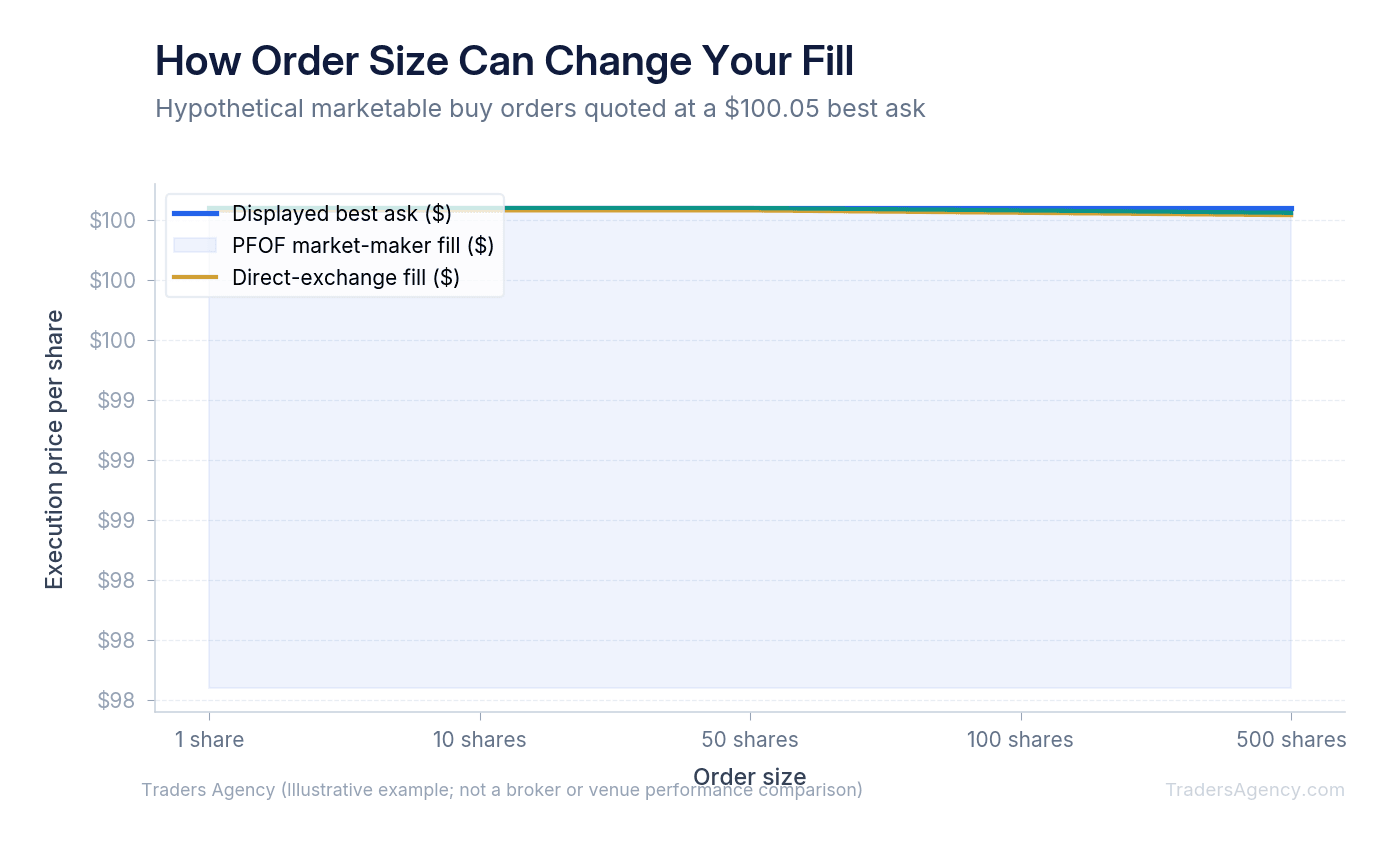
Notice how the gap between the displayed ask and the actual fill price narrows as order size climbs. A 10-share order might capture a slightly better price per share than the quote. A 500-share order in the same stock may fill much closer to the raw quoted price, because the market maker has less room to give on size.
Why Price Improvement Isn't Guaranteed
Price improvement is a possibility, not a promise. It depends on the security's volatility, the width of the current spread, and how much inventory the market maker is willing to hold at that moment.
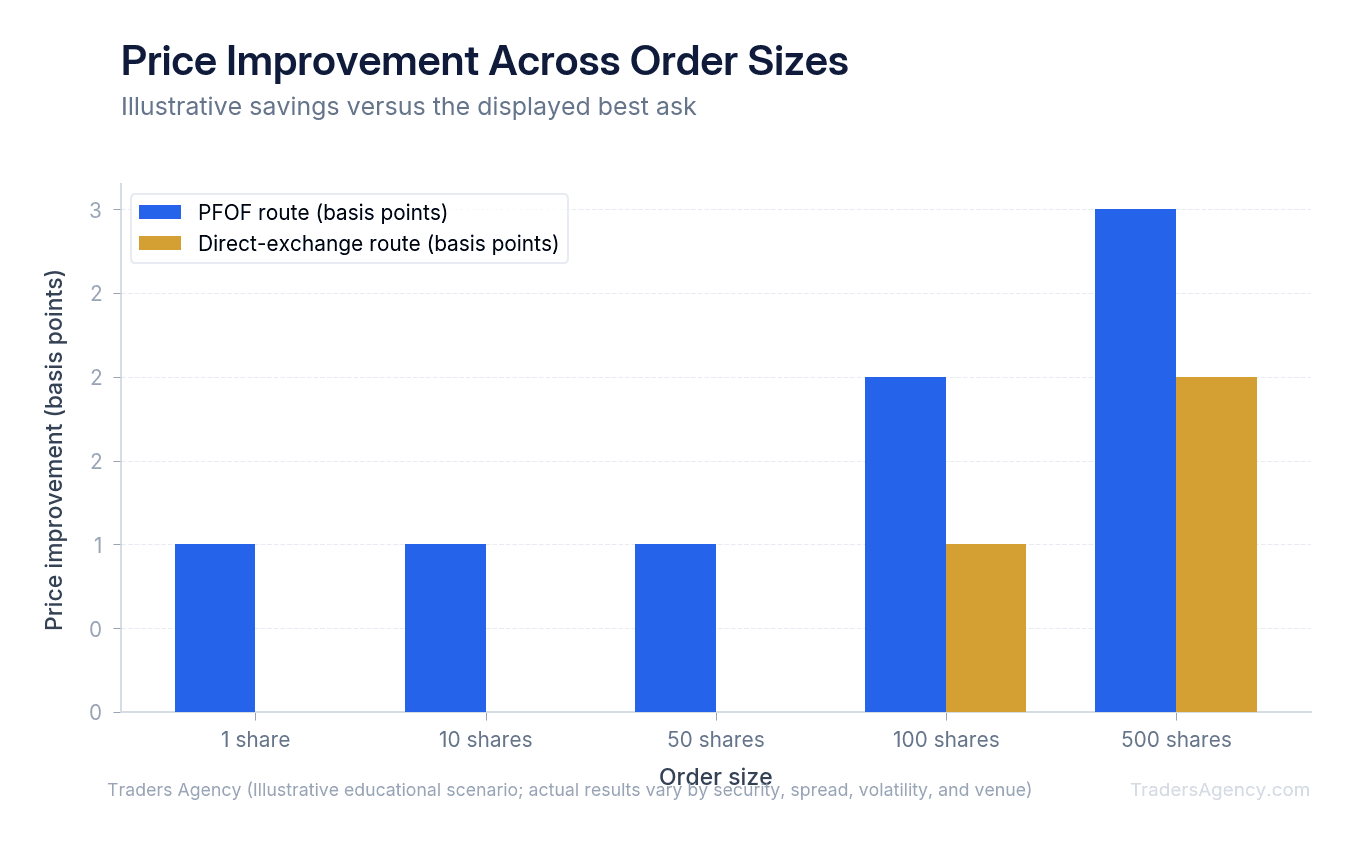
Plenty of traders discuss this openly. Scroll through payment for order flow reddit threads and one theme repeats: retail traders comparing fills across brokers and asking whether they are truly receiving the "best execution" brokers are legally required to seek. Our honest answer is that best execution and best possible price are not always the same thing, and PFOF lives right in that gray area.
Is Payment for Order Flow Legal?
Yes. Payment for order flow is legal in the United States, though it carries strict disclosure requirements enforced by the Securities and Exchange Commission (SEC). Brokers must tell customers whether they receive PFOF and must publish quarterly order routing reports showing where customer orders were sent.
The SEC requires brokers to seek best execution for client orders, meaning the best reasonably available terms rather than the single best price on every trade. That distinction has drawn regulatory attention for years, and the SEC has proposed rules aimed at increasing competition for retail orders and tightening transparency around PFOF arrangements.
Legality and Usage Around the World
The payment for order flow ban conversation is really a story about two regulatory philosophies:
| Jurisdiction | Status of PFOF |
|---|---|
| United States | Legal and widely used, subject to disclosure rules and SEC oversight |
| United Kingdom | Prohibited by UK regulators, now enforced by the Financial Conduct Authority, well ahead of the broader European move |
| European Union | Being phased out under updated markets in financial instruments rules, citing conflict-of-interest concerns |
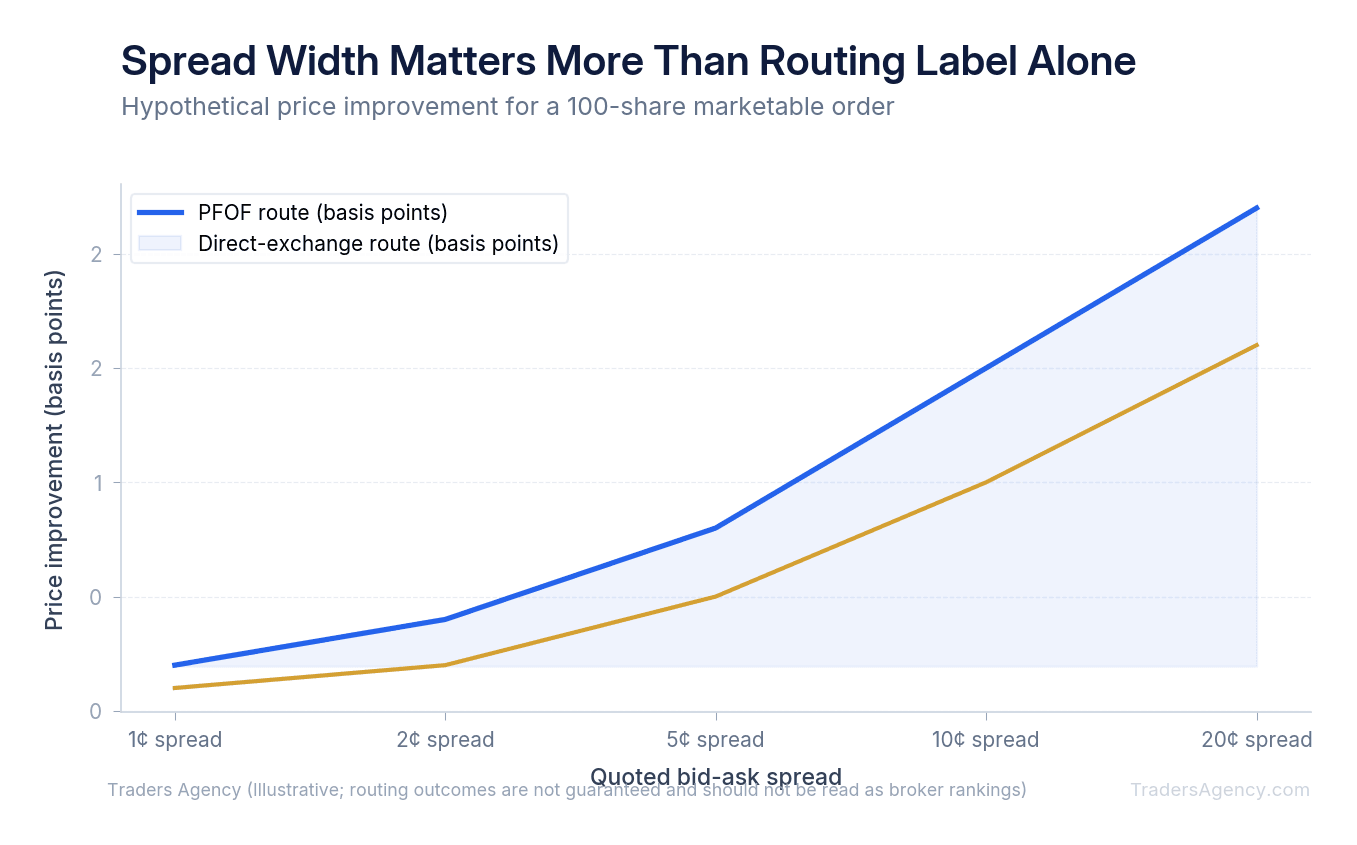
Wider spreads generally create more room for price improvement. Tight, liquid spreads leave market makers little space to offer you anything better than the public quote. Keep that in mind if you trade thinner stocks or options where spreads run naturally wider.
Why Did Europe Ban Payment for Order Flow?
The European Union's move against payment for order flow comes down to one worry: a broker paid to route orders to a specific market maker has an incentive that can conflict with getting its customers the best possible price. Regulators there decided that risk outweighed the savings passed to consumers through free trading.
The UK acted earlier, banning the practice outright for firms under its jurisdiction. The broader EU followed with restrictions phased in through updated investment rules, pushing brokers toward direct exchange routing or transparent commission models instead.
Which Brokers Use Payment for Order Flow?
Many popular commission-free brokers in the US rely on PFOF as a revenue source, since it lets them advertise zero-commission trading. If you want to run a payment for order flow review of your own broker, start with their quarterly order routing disclosures. These break down where orders were sent and what the broker was paid for that flow, alongside published execution quality statistics.
Four Questions to Ask Your Broker
- Do you accept payment for order flow? If so, how much per share on stocks and on options?
- What percentage of my orders receive price improvement over the public quote?
- Can I choose direct exchange routing on any of my orders?
- Where is your quarterly order routing report published?
When Should You Be Cautious About Fill Quality?
Pay closer attention to payment for order flow effects when you trade larger share sizes, thinner securities, or fast-moving markets around news events. In those conditions, the gap between a "good enough" fill and an ideal one gets wider.
Watch Out: These are the mistakes we see most often from newer traders. Assuming commission-free means cost-free, since the cost can appear in your fill price instead of a ticket charge. Never checking execution quality reports, which are public and free to review. Placing large market orders in illiquid stocks when a limit order would serve better. Forgetting that spreads and volatility change how much price improvement is realistic to expect.
For risk management, our team's default guidance is straightforward: use limit orders instead of market orders on lower-volume stocks and wide-spread options. A limit order gives you control over your worst-case fill price no matter how your broker routes the trade. That single habit removes most of the fill-quality guesswork from your process.
Remember This: You cannot control your broker's routing agreements, but you can control your order type. The order type is where your leverage as a retail trader actually lives.
Want expert trading insights delivered daily?
Join thousands of traders who rely on Traders Agency for market analysis and trade ideas.
Join Traders AgencyDISCLAIMER: Traders Agency does not offer financial advice. The information provided is for educational purposes only and should not be considered financial advice. Traders Agency is not responsible for any financial losses or consequences resulting from the use of the information provided. Trading carries inherent risks and may not be suitable for all individuals. You are advised to conduct your own research and seek personalized advice before making any investment decisions, recognizing the potential risks and rewards involved.
See more from Traders Agency on Google
Make us a preferred source and our market analysis will appear more prominently in your Google Search, Top Stories, and AI results.
Add to Preferred Sources