You watch a stock trade sideways for hours. Suddenly, a block of 500,000 shares executes on the tape, but the price does not budge. You have just witnessed institutional activity hiding in plain sight. We're going to show you exactly how to track this hidden flow and build a practical trading system around it.
What Is Dark Pool Trading?
Bottom Line: Dark pool prints are delayed, public records of large institutional block trades, and the core idea here is that the price levels where those prints occur can serve as meaningful support and resistance zones. The strategy depends on patience: waiting for price to retest a print level and show confirmation before entering, rather than acting on the print alone.
Dark pool trading is a method of executing large block trades on private, off-exchange venues where order details remain hidden until after the transaction completes. Institutions use these private exchanges to move significant amounts of capital without immediately alerting the broader public.
By the end of this guide, you will understand how to read these delayed prints and build a practical system around them. Our team relies on these specific price levels to identify hidden support and resistance zones. We prefer to trade alongside institutional money, not against it.
Key Concept: A dark pool is an Alternative Trading System (ATS) that runs parallel to public exchanges. Large institutional orders are matched privately, and the details are only reported to the public tape after execution is complete.
What Does "Dark Pool" Mean in the Stock Market?
In the stock market, a dark pool is a private financial exchange where institutional investors trade large blocks of shares without exposing their orders to the public. Unlike public exchanges, these private venues do not display the trade size or price until the transaction is finalized.
Think of it like buying a house off-market. The buyer and seller agree on a price in private, and the public only finds out about the transaction after the deed is recorded. This prevents a sudden rush of competing bids.
Institutions use these venues to avoid severe price slippage. If a mutual fund tries to buy two million shares of Apple (AAPL) on the public Nasdaq exchange, high-frequency algorithms will detect the order. The price will spike before the fund can fill its entire position. The fund would end up paying significantly more for the last million shares than the first.
By matching buyers and sellers privately, institutions protect their average entry price. Off-exchange venues now account for nearly 40% of total equity volume, based on data from the SEC's regulation of Alternative Trading Systems.
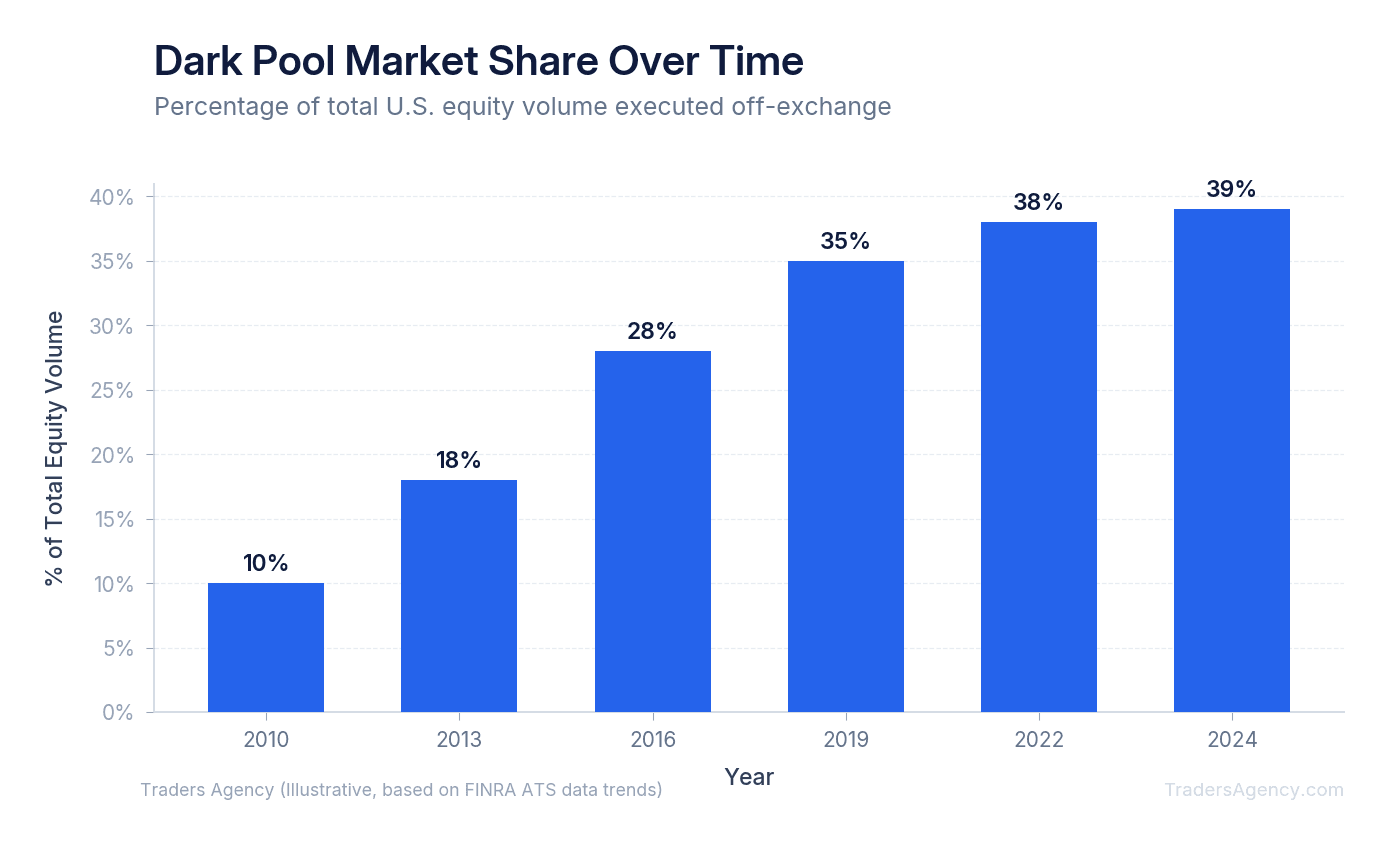
When you search for what "dark pool" means in stock market terms, it simply refers to an Alternative Trading System (ATS). These systems run parallel to the public exchanges you trade on every day. They serve a specific mechanical purpose for large market participants.
How Do You Read Dark Pool Prints and What Do They Signal?
Reading dark pool prints involves analyzing the price, size, and timing of delayed block trades to determine institutional intent. A large print at a specific price level often signals major support or resistance, indicating where institutions are accumulating or distributing shares.
A "print" is simply the record of a completed trade. Because these trades happen off-exchange, they are reported to the consolidated tape with a delay. You will often see a volume spike on your chart that does not match the current price action.
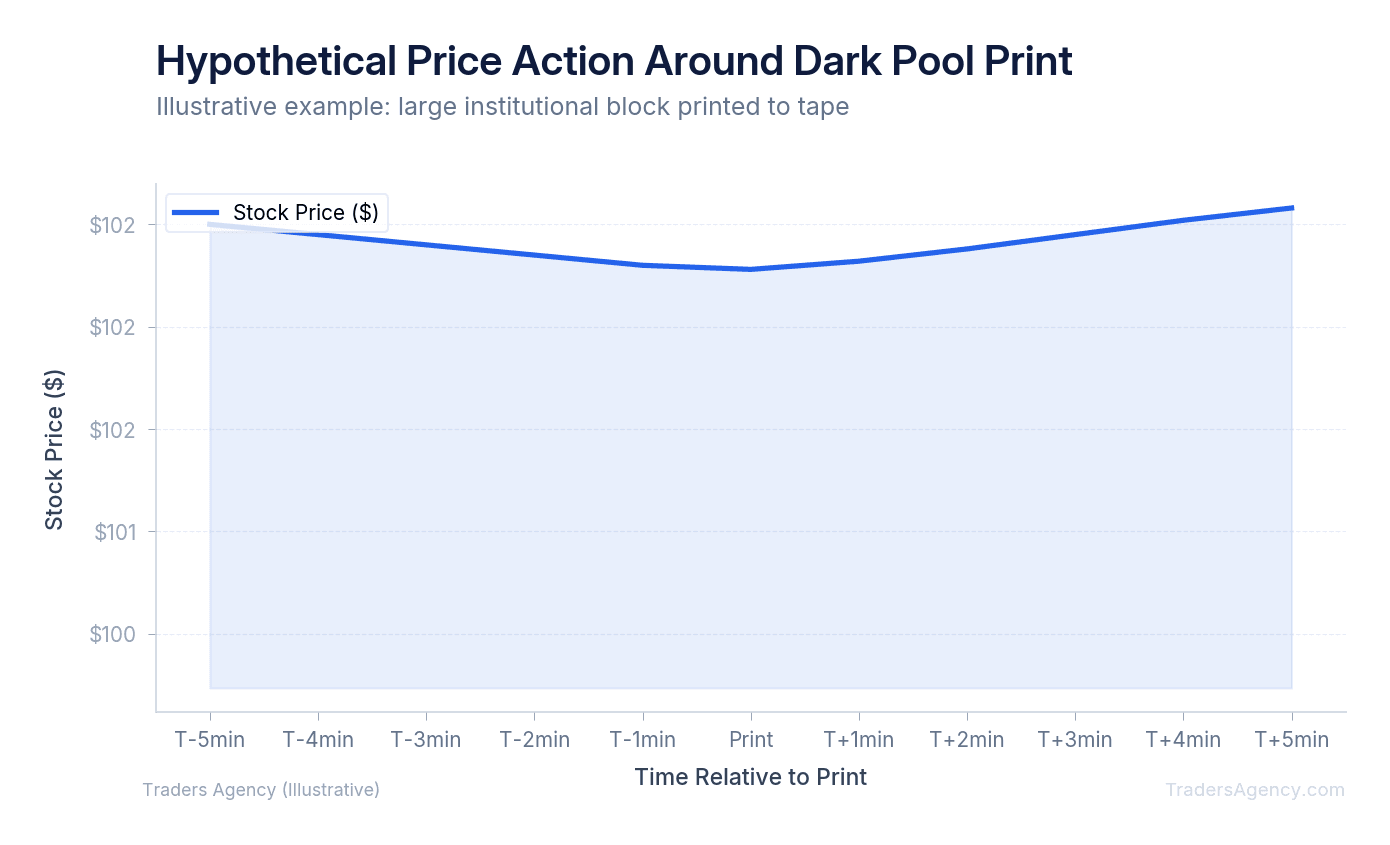
We teach our members to look for signature prints. A signature print is an unusually large transaction that stands out from the daily average volume. If a stock typically trades 5 million shares a day, a single print of 2 million shares is highly significant.
The price level of that print becomes a magnet. If institutions bought 2 million shares at $150.00, they will likely defend that price. If the stock drops back to $150.00, institutional buyers often step in to prevent the price from falling further.
You must also pay attention to late prints. In some cases, a trade executed during the session may not appear on your scanner until later in the day or after the close. These delayed reports still provide valuable data for the next trading session. The price level remains relevant regardless of the reporting delay.
Where Can You See Dark Pool Trades?
You can see dark pool trades using specialized financial software and market data feeds that aggregate off-exchange reporting. Retail traders typically access this information through a dedicated dark pool trading platform that filters institutional block trades and options flow in real time.
Finding this data requires the right tools. Your standard retail brokerage account rarely displays off-exchange block trades clearly. Instead, you need a scanner that specifically tracks the Trade Reporting Facility (TRF).
Many newer traders search for dark pool data free of charge. While some free websites offer end-of-day summaries, they are heavily delayed. Trading based on yesterday's institutional flow puts you at a severe disadvantage. The market moves too fast to rely on stale information.
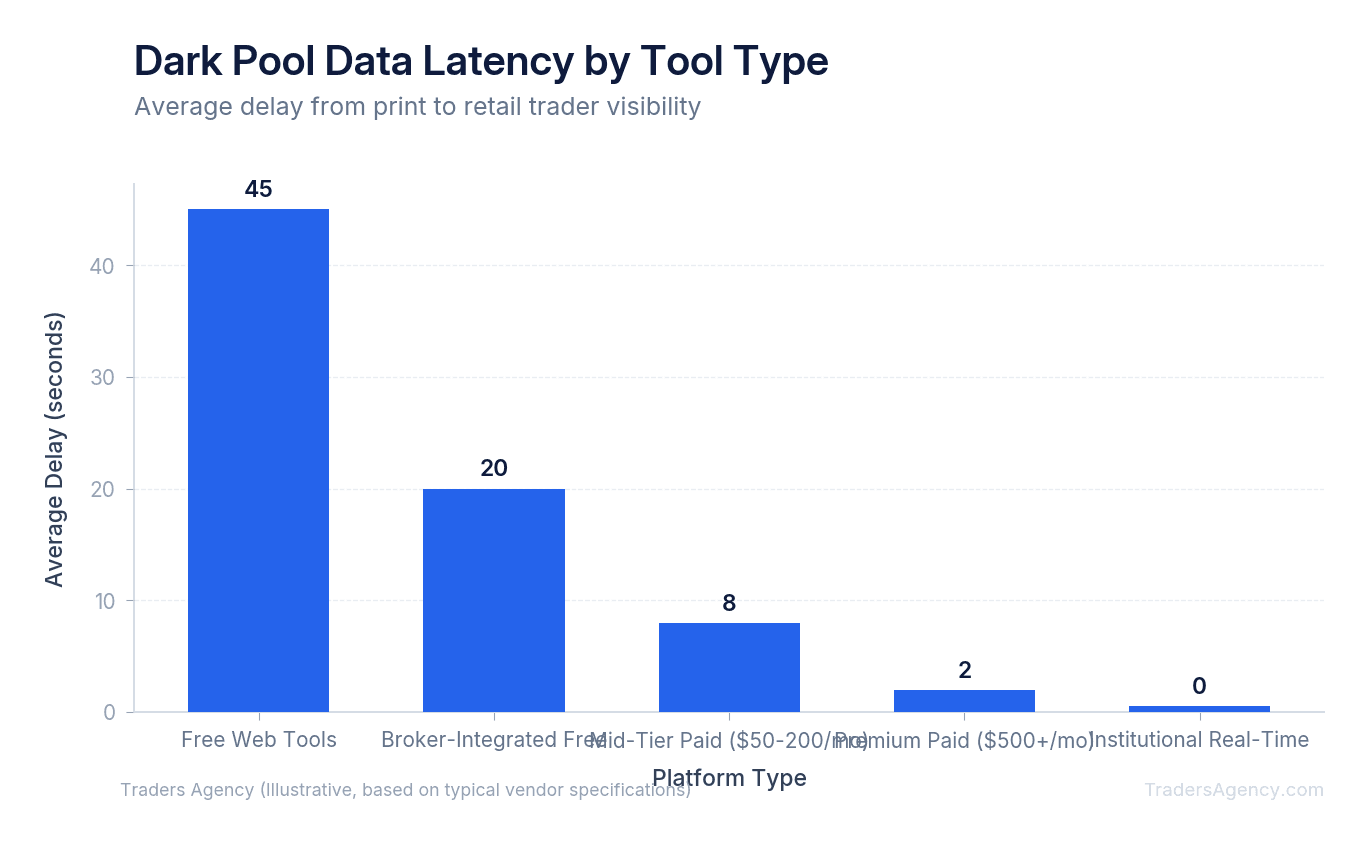
To build a responsive system, you need real-time dark pool data. Premium scanners filter out the noise and highlight the block trades as soon as they hit the tape. We prefer platforms that allow you to set minimum share size alerts for specific tickers. This keeps your screen clean and focuses your attention only on the most significant institutional moves.
Watch Out: Free dark pool data sources are typically delayed by hours or even a full trading day. Building a strategy around stale institutional prints can lead to entries at levels that are no longer being defended. Real-time data is essential for intraday execution.
Want expert trading insights delivered daily?
Join thousands of traders who rely on Traders Agency for market analysis and trade ideas.
Join Traders AgencyA Practical Dark Pool Trading Strategy for Retail Traders
A reliable dark pool trading strategy involves identifying significant off-exchange block trades and using those price levels as strict support or resistance zones. Traders wait for the stock to retest the print level during regular market hours before entering a position with defined risk.
We never blindly buy a stock just because a large print appears. We do not know if the institution was buying or selling. Instead, we let the market reaction dictate our trade direction. Here is exactly how we approach this setup:
- Identify the Institutional Level: Scan for an unusually large print on a highly liquid asset like the SPDR S&P 500 ETF (SPY). Suppose you spot a 3-million share print at $510.25. Immediately draw a horizontal line on your chart at $510.25. This is your primary area of interest for the session.
- Wait for the Retest and Reaction: Watch how the price behaves when it approaches that line. If the price drops to $510.25 and immediately bounces with strong buying volume, we assume institutions are defending their long positions. If the price breaks below $510.25 and fails to climb back over it, the level has become resistance. Patience is required here.
- Execute the Trade with Strict Risk Management: If the price bounces off $510.25, enter a long position at $510.50. Place a strict stop loss at $509.80, just below the institutional level. Set your first profit target at the next major technical resistance zone on the chart.
| Parameter | Value |
|---|---|
| Ticker | SPY |
| Dark Pool Print Level | $510.25 (3M shares) |
| Entry | $510.50 (after confirmed bounce) |
| Stop Loss | $509.80 |
| Risk Per Share | $0.70 |
| Profit Target | Next technical resistance zone |
This setup offers a highly favorable risk-to-reward ratio. You are risking $0.70 to potentially make several dollars on the upside. You are using the institution's capital as your protective shield. If the price breaks your stop loss, the institution is likely no longer defending the level, and you should exit immediately.
When Should You Follow Dark Pool Flow and When Should You Avoid It?
You should follow dark pool flow when multiple large prints cluster at a specific price level during a broader market trend. You should stay away from trading off-exchange signals during low-volume periods or when prints appear scattered without establishing clear support or resistance zones.
Not every block trade is actionable. Institutions frequently execute delta-neutral options strategies or rebalance index funds. These trades create high volume but offer zero predictive value for directional price movement. You have to filter out the noise.
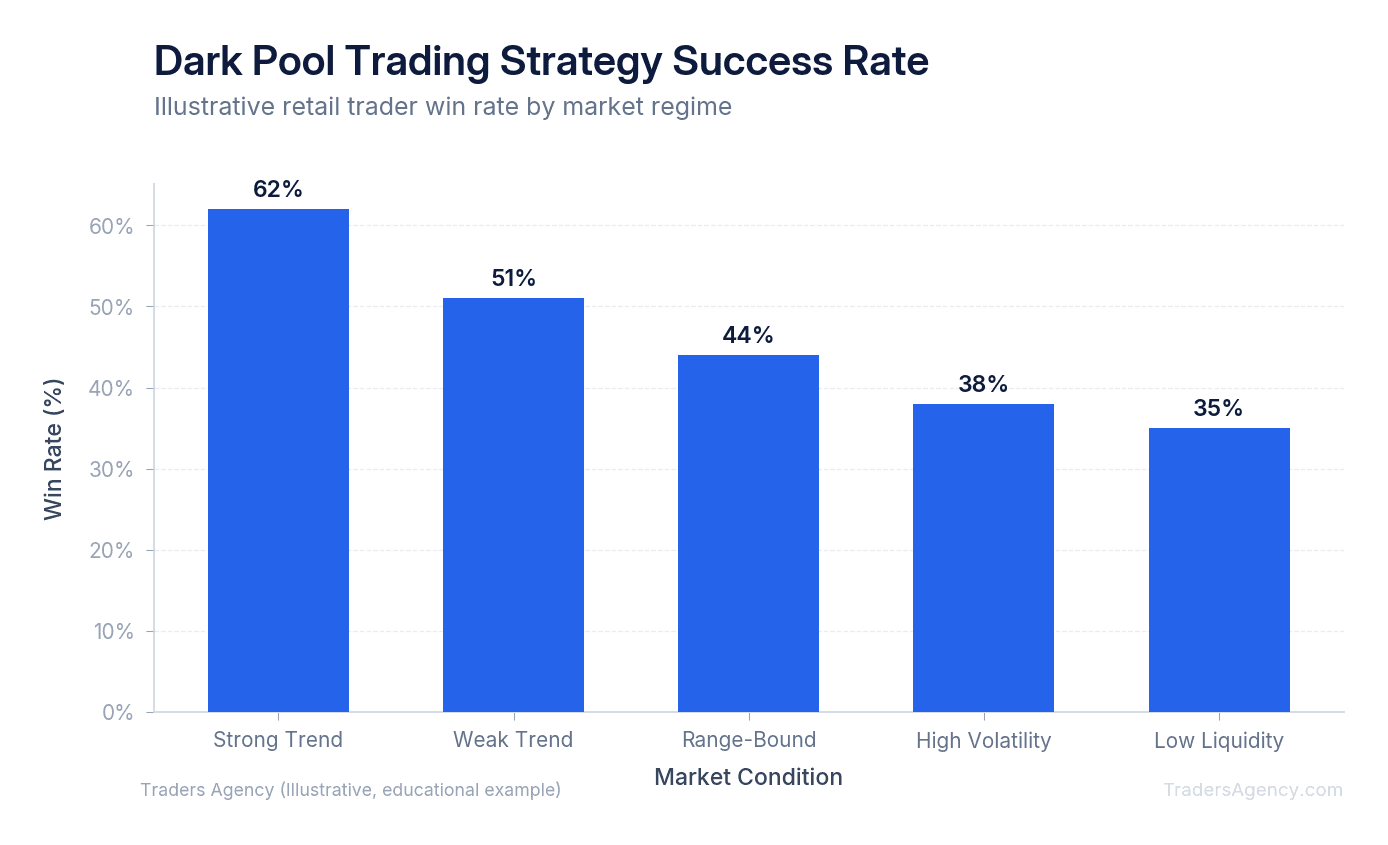
We teach our members to filter these signals using specific criteria. You want to see alignment between the institutional flow and the broader market context. Here are the conditions we require before taking a trade based on off-exchange flow:
- Multiple prints at the same price: Three prints of 500,000 shares at exactly $150.00 show clear intent.
- Confluence with technicals: The print level aligns with a known moving average or historical support zone.
- High relative volume: The stock is already trading with higher-than-average volume for the day.
Watch Out: Avoid trading these signals during the first 15 minutes of the market open. The opening cross generates delayed prints from overnight orders that will completely distort your intraday support and resistance levels. Let the morning volatility settle before trusting the tape.
We also recommend strict position sizing. Never allocate more than 2% of your total account equity to a single trade, even if the signal looks perfect. Institutional levels break all the time. Your survival depends on keeping your losses small when they do.
Is Dark Pool Trading Illegal?
Dark pool trading is completely legal and heavily regulated by the Securities and Exchange Commission (SEC). While the lack of pre-trade transparency frustrates some retail investors, these private exchanges operate under strict rules designed to facilitate large institutional trades without causing immediate market volatility.
Many new traders assume this practice is a conspiracy against retail investors. The reality comes down to market structure and stability. If a pension fund needs to liquidate 10 million shares, dumping them on the public lit exchange would cause a flash crash. The resulting panic would hurt retail investors far more than the lack of transparency does.
The SEC governs these venues under Regulation ATS. They are required to report their completed trades to the consolidated tape, ensuring the public eventually sees the volume. The delay is intentional, giving the institution time to complete their order without predatory algorithms front-running them.
You can even find a public list of dark pools registered with the SEC. Major investment banks operate the largest venues, including Goldman Sachs' Sigma X and Morgan Stanley's MS Pool. Independent operators like Liquidnet also manage high off-exchange volume.
Key Concept: You cannot stop institutions from trading in private venues. You can, however, learn to read their footprints and align your trades with their capital flows. By tracking the prints and waiting for the retest, you gain an edge over traders who only watch the public tape.
Our team focuses on adapting to the market rather than fighting it. The prints are there for anyone willing to look. The difference between profitable traders and everyone else is knowing how to interpret those prints and having the discipline to wait for confirmation before committing capital.
Want expert trading insights delivered daily?
Join thousands of traders who rely on Traders Agency for market analysis and trade ideas.
Join Traders AgencyKey Takeaways
- Dark pools are Alternative Trading Systems (ATS) that operate parallel to public exchanges. Trade size and price are only reported to the public tape after execution is complete, meaning retail traders see the print after the fact.
- A single block of 500,000 shares can execute without moving the price, which is the defining characteristic that makes dark pool prints useful as potential support and resistance markers rather than momentum signals.
- The practical edge described is not in catching the print in real time but in waiting for price to retest the level where the block printed, using that zone as a reference for entries with defined risk.
- Tracking dark pool flow is framed as a way to trade alongside institutional capital rather than against it, but confirmation before committing capital is treated as a required step, not an optional one.
- Dark pool activity is legal and regulated. Institutions use these venues specifically to avoid moving the market with large orders, which is why the prints appear on the public tape delayed rather than in real time.
DISCLAIMER: Traders Agency does not offer financial advice. The information provided is for educational purposes only and should not be considered financial advice. Traders Agency is not responsible for any financial losses or consequences resulting from the use of the information provided. Trading carries inherent risks and may not be suitable for all individuals. You are advised to conduct your own research and seek personalized advice before making any investment decisions, recognizing the potential risks and rewards involved.
See more from Traders Agency on Google
Make us a preferred source and our market analysis will appear more prominently in your Google Search, Top Stories, and AI results.
Add to Preferred Sources