
You place a market order for five Ethereum, expecting a specific fill price based on the chart you're watching. A few seconds later, your broker confirms the trade, but your average entry price is significantly worse than the quote you saw on your screen. You've just experienced the hidden cost of fragmented liquidity, and it's eating into your profits every single day you ignore it.
Crypto market structure is the underlying framework of exchanges, market makers, and liquidity pools that facilitates the buying and selling of digital assets. Unlike traditional stock markets where trades route through a highly regulated central clearinghouse, digital asset trading happens across dozens of disconnected venues. We see many intermediate traders lose a percentage of their account to invisible fees and poor execution simply because they don't understand the plumbing of these markets.
Our team recommends treating trade execution as a core strategy, not just an afterthought. By the end of this guide, you'll understand how order books function, how to route large trades efficiently, and how to protect your capital from wash trading traps. We'll walk you through the exact mechanics our education team uses to minimize slippage and secure the best possible entry prices.
What Is Crypto Market Structure and Why Does It Matter for Traders?
Bottom Line: Understanding crypto market structure means recognizing that execution quality is itself a form of edge. Slippage, fragmented liquidity, and wash trading are not random bad luck but predictable costs that can be reduced by learning how order books, market makers, and venue selection actually work. Over hundreds of trades, the difference between a trader who manages these mechanics and one who ignores them shows up directly in account performance.
Crypto market structure refers to the network of centralized exchanges, decentralized protocols, and liquidity providers that process digital asset trades. It matters for traders because this structure is highly fragmented, meaning prices and available liquidity vary wildly between different platforms, directly impacting your execution costs.
To master trade execution, you must first understand the venues where your orders actually go. The digital asset ecosystem splits primarily into two categories:
Centralized exchanges (CEX) act as middlemen, holding your funds in custody and matching buyers and sellers using a traditional central limit order book. Platforms like Coinbase or Kraken operate this way, functioning similarly to traditional equity brokers.
Decentralized exchanges (DEX) operate entirely on blockchain smart contracts without a central authority. Instead of an order book, platforms like Uniswap use Automated Market Makers (AMMs) and liquidity pools. Traders swap tokens directly with a smart contract that mathematically determines the price based on the ratio of assets in the pool.
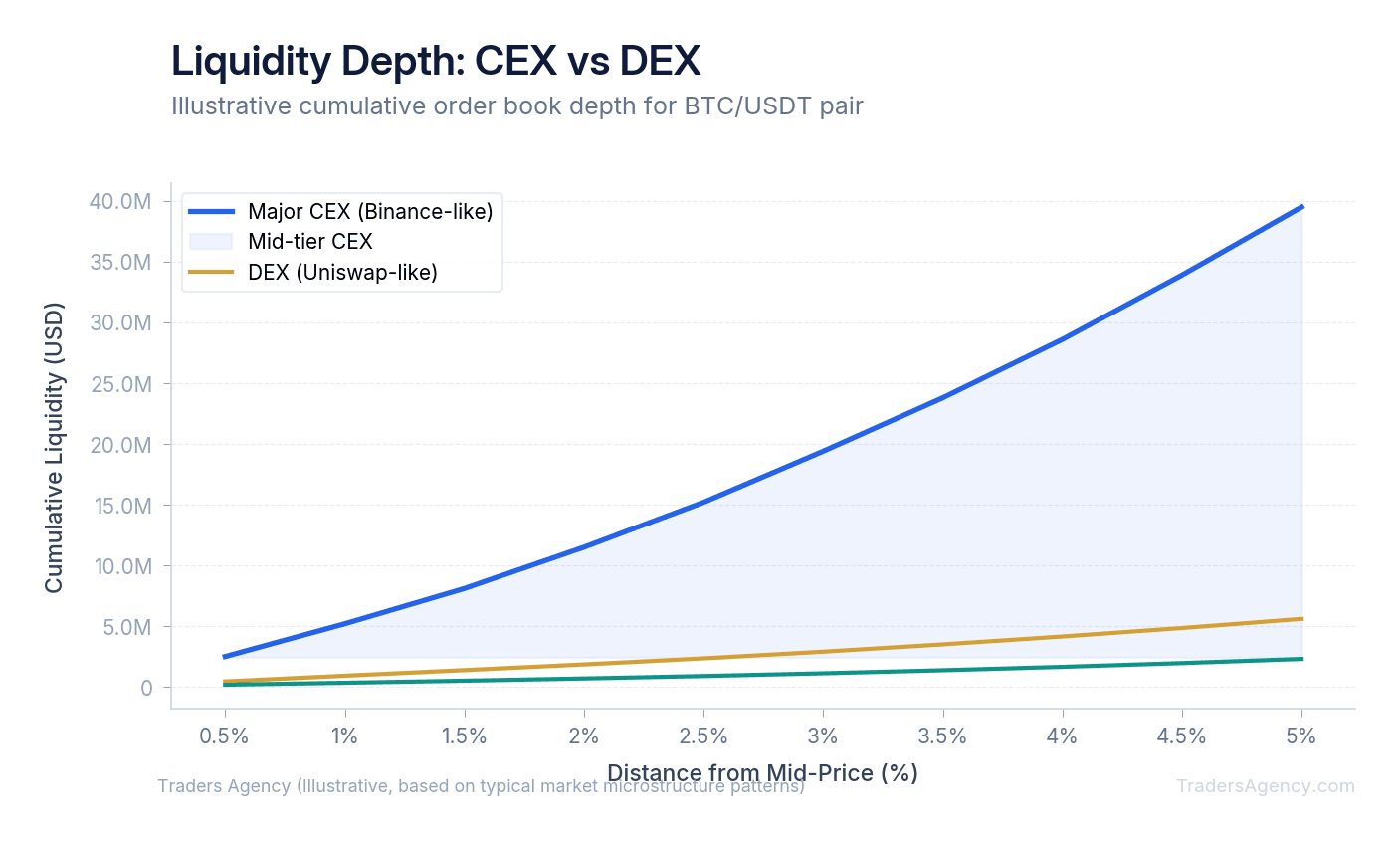
Key Concept: Because CEX and DEX systems do not automatically share liquidity, a token might trade at $100.00 on a CEX and $100.50 on a DEX simultaneously. This fragmentation requires intermediate traders to actively hunt for the deepest liquidity before executing a large position.
How Do Market Makers Shape Crypto Prices and Spreads?
Market makers provide continuous buy and sell quotes on an exchange order book to ensure traders can execute positions immediately. In crypto markets, these entities profit from the bid-ask spread while absorbing inventory risk, which ultimately reduces slippage for retail traders executing market orders.
When you look at a CEX order book, you're mostly looking at orders placed by institutional market makers. They use automated algorithms to post a bid (buy price) slightly below the current market value and an ask (sell price) slightly above it. The difference between these two numbers is the bid-ask spread.
If a market maker quotes a bid for Bitcoin (BTC) at $60,000 and an ask at $60,010, the spread is $10. They capture that difference as profit for providing the service of immediate liquidity. On highly liquid exchanges, heavy competition between market makers keeps this spread incredibly tight. On smaller exchanges with few market makers, that spread might widen to $50 or more.
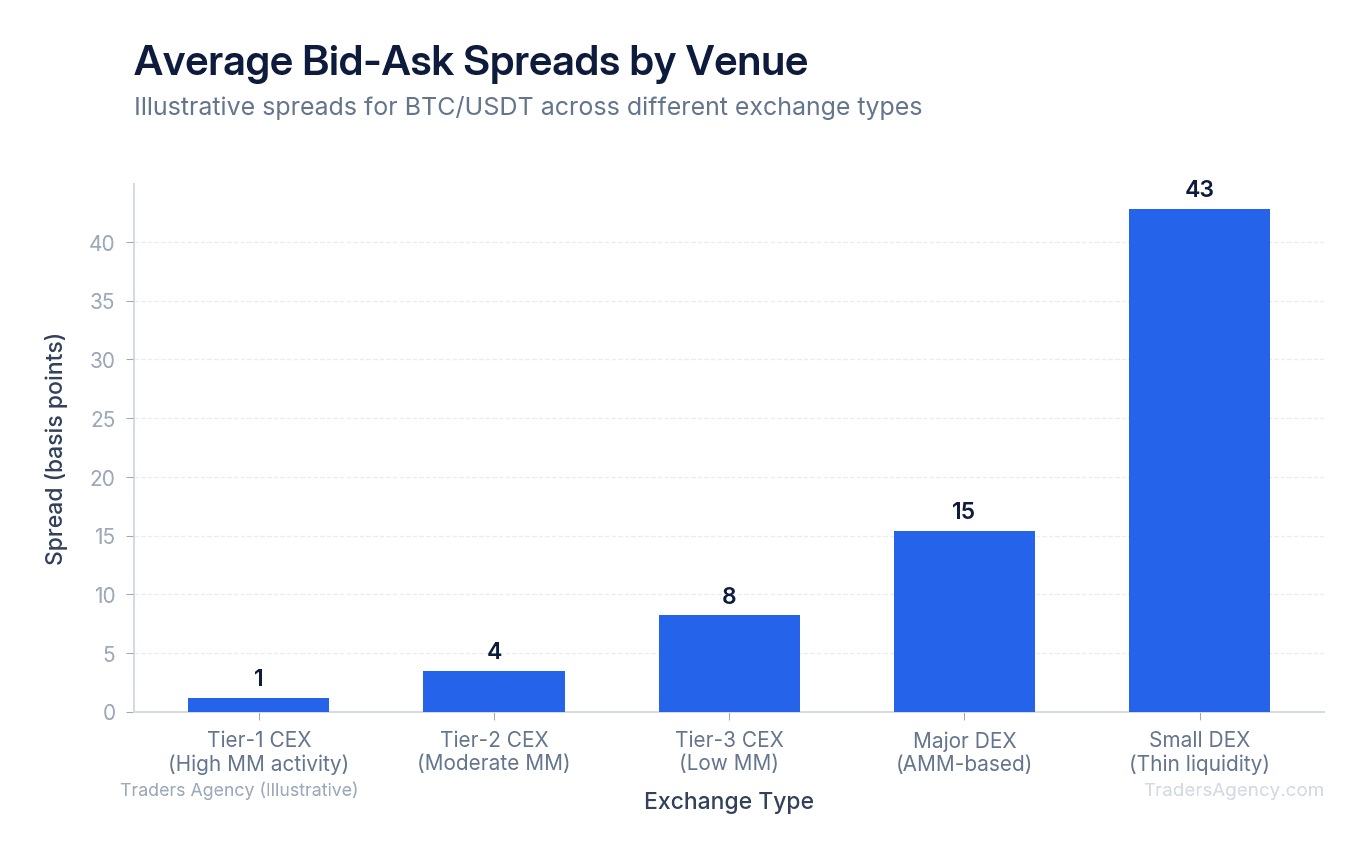
We teach our members to always check the spread before placing a market order. A wide spread acts as an invisible tax on your trade. If you buy at the ask and immediately sell at the bid on an illiquid exchange, you start your trade in the red.
How Does Crypto Market Structure Legislation Affect Your Trading?
A crypto market structure bill establishes clear regulatory boundaries between securities and commodities, dictating how digital asset exchanges must operate. These legislative efforts aim to protect traders by mandating transparent order books, preventing wash trading, and requiring exchanges to register with specific federal oversight bodies.
Regulatory shifts directly impact the liquidity and safety of the exchanges you use. We closely monitor the crypto market structure legislation moving through Congress because it dictates which tokens exchanges can legally list. A comprehensive bill summary typically outlines new reporting requirements that force exchanges to prove their trading volume is real.
Traders frequently ask how the debate between broader structural bills and the Digital Asset Market Clarity Act affects their daily execution. The Clarity Act focuses heavily on defining which tokens fall under commodity rules versus securities rules. Meanwhile, broader structural bills address the actual mechanics of the exchanges themselves. Some lawmakers are attempting to merge these concepts into a unified framework to provide a single rulebook for the industry.
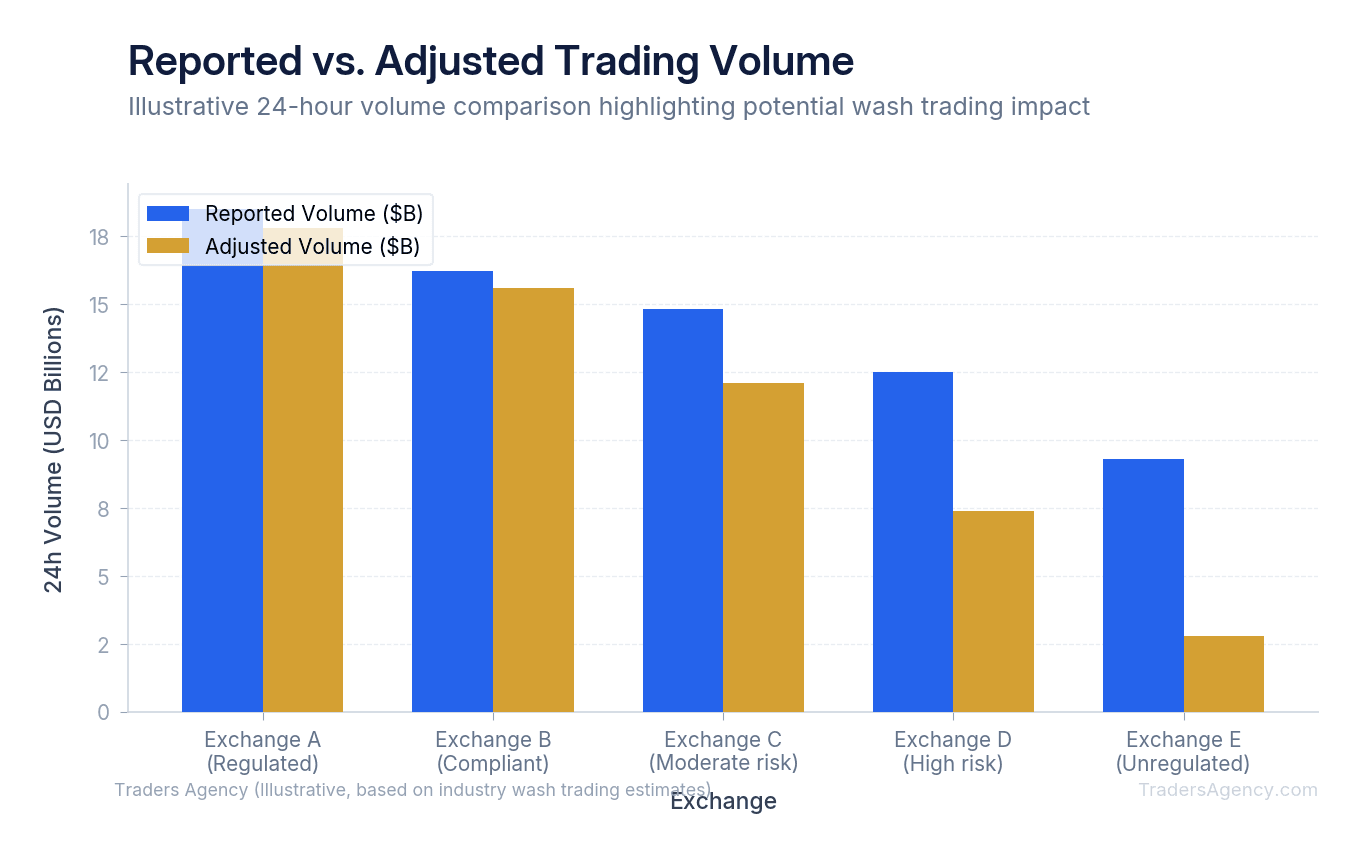
Watch Out: One of the primary targets of these regulations is wash trading. This occurs when an entity simultaneously buys and sells the same asset to create fake trading volume. Fake volume tricks traders into thinking an exchange has deep liquidity, but when they place a real order, the order book collapses and they suffer massive slippage. The SEC frequently warns traders about market manipulation on unregulated offshore platforms.
Want expert trading insights delivered daily?
Join thousands of traders who rely on Traders Agency for market analysis and trade ideas.
Join Traders AgencyStep-by-Step: Executing Large Orders Across Fragmented Liquidity
When you trade small sizes, you can usually hit the buy button without much thought. When you scale up to intermediate position sizes, poor execution mechanics will destroy your profit margins. We prefer to break down large executions into a systematic process.
Here's a concrete example. You want to buy $50,000 worth of Solana (SOL). The current quoted price is $150.00.
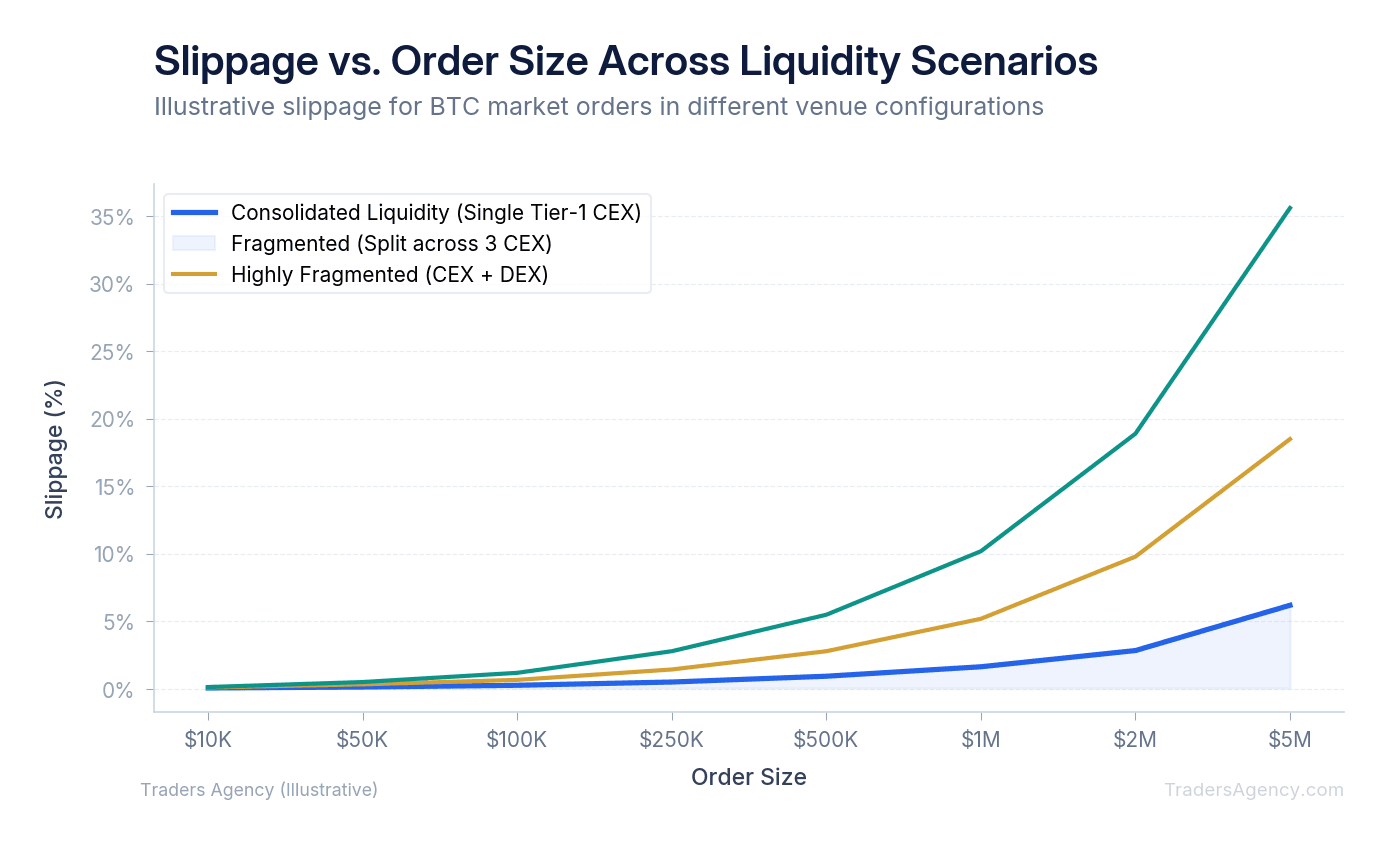
- Analyze the Order Book: First, check the depth of the order book on your chosen exchange. Order book depth refers to the total volume of resting limit orders at each price level. Look at the ask side (the sellers) and calculate how many tokens are available within a 0.5% price range of the current quote. If the exchange only has $20,000 worth of SOL offered between $150.00 and $150.75, your $50,000 market order will eat through all those sellers. Your order will continue buying at higher and higher prices until the entire amount is filled.
- Route the Trade Using Smart Execution: Instead of firing a single market order, use one of these three strategies:
- Limit Orders: Place a limit buy order at $150.00 and wait for sellers to come to you. You avoid slippage entirely, but you risk missing the trade if the price moves up without filling your order.
- Iceberg Orders: Use an advanced exchange feature that breaks your $50,000 order into ten smaller $5,000 orders. The exchange executes them sequentially, allowing market makers time to replenish the order book between fills.
- DEX Aggregators: If trading on-chain, use an aggregator protocol. This software automatically splits your $50,000 order across Uniswap, Sushiswap, and other pools simultaneously to secure the best blended average price.
- Calculate Your Slippage Cost: After your fill, compare your average entry price to the quoted price at the time you initiated the trade. This tells you exactly how much you paid in execution costs.
| Execution Method | Average Fill Price | Slippage | Hidden Cost on $50,000 |
|---|---|---|---|
| Single Market Order (thin book) | $152.00 | 1.33% | $667 |
| Limit Order | $150.00 | 0% | $0 |
| Iceberg / Aggregator | $150.10 | 0.07% | $33 |
Understanding market structure directly translates to higher net profitability over a series of trades. That $667 saved on a single execution compounds dramatically across dozens of trades per month.
When Should You Use a CEX vs a DEX?
Knowing how these venues operate is only half the battle. You must also know when market conditions favor one over the other. Our team approaches venue selection based on the specific asset and the current market volatility.
Use a Centralized Exchange (CEX) when trading major, high-market-cap assets like Bitcoin or Ethereum. Institutional market makers concentrate their capital on the top three or four global exchanges. During periods of high volatility, CEX order books offer the fastest execution and the tightest spreads for these major pairs.
Use a Decentralized Exchange (DEX) when trading newly launched tokens or smaller altcoins. Many legitimate projects don't have the capital to pay CEX listing fees. The only place to find liquidity for these assets is in decentralized AMM pools.
Common Mistakes We See:
- Ignoring gas fees: On a DEX, you pay blockchain network fees (gas) on top of the trading fee. If you're executing a small $500 trade, a $40 Ethereum gas fee destroys your risk-to-reward ratio.
- Trusting offshore volume: Traders often route orders to unregulated offshore exchanges because the reported volume looks high. Wash trading creates a mirage of liquidity that vanishes when you actually try to execute.
- Market ordering illiquid pairs: Never use a market order on a token outside the top 100 by market cap. Always use limit orders to strictly control your maximum entry price.
Portfolio Integration and Risk Management
Crypto market structure differs significantly from traditional markets. If you trade precious metals futures on the Chicago Mercantile Exchange (CME), you benefit from a highly centralized, heavily regulated liquidity pool. Gold and silver contracts have massive, predictable order book depth.
Digital assets don't offer that luxury. Because crypto liquidity is fragmented, price discovery is often messy. We view digital assets as a high-beta addition to a broader portfolio of equities and commodities. They offer uncorrelated upside, but they require stricter risk management rules regarding execution.
Our team enforces strict position sizing limits to account for structural risks. We never allocate more than 2% to 5% of our total portfolio to a single digital asset trade. This sizing protects us not just from price volatility, but from exchange-level failures or sudden liquidity droughts.
Key Concept: When placing stop-loss orders, you must factor in the bid-ask spread. If your technical analysis invalidates a trade at $100.00, don't place your stop exactly at that level. Market makers often widen spreads during volatile sell-offs. We prefer to place stops slightly below obvious technical levels (perhaps at $99.25) to avoid being triggered by a momentary spread expansion rather than true price action.
Mastering crypto market structure takes time. You have to study order books, track spreads, and respect the mechanics of liquidity. Once you integrate these concepts into your daily routine, you'll stop giving away your profits to bad fills and hidden slippage. Treat execution quality as a skill worth developing, because over hundreds of trades, it's the difference between a growing account and one that slowly bleeds out to invisible costs.
Want expert trading insights delivered daily?
Join thousands of traders who rely on Traders Agency for market analysis and trade ideas.
Join Traders AgencyKey Takeaways
- Fragmented liquidity across dozens of disconnected venues means your fill price can differ significantly from the quoted price you see on screen, a cost that compounds across hundreds of trades.
- Crypto market structure spans centralized exchanges, decentralized protocols, and liquidity providers, and unlike traditional stock markets, there is no central clearinghouse routing trades through a single regulated venue.
- Execution quality should be treated as a core strategy, not an afterthought. Routing large orders efficiently across fragmented liquidity is a learnable skill that directly affects account growth.
- Setting limit orders slightly inside the spread (the article cites an example of $99.25 rather than the full ask) can protect against being filled by momentary spread expansion rather than genuine price movement.
- Wash trading is a specific trap within crypto market structure that traders need to actively screen for, as artificial volume can distort the order book signals you rely on for entries.
DISCLAIMER: Traders Agency does not offer financial advice. The information provided is for educational purposes only and should not be considered financial advice. Traders Agency is not responsible for any financial losses or consequences resulting from the use of the information provided. Trading carries inherent risks and may not be suitable for all individuals. You are advised to conduct your own research and seek personalized advice before making any investment decisions, recognizing the potential risks and rewards involved.
See more from Traders Agency on Google
Make us a preferred source and our market analysis will appear more prominently in your Google Search, Top Stories, and AI results.
Add to Preferred Sources