
You've probably seen this happen. You buy a stock, watch it climb into profitable territory, step away from your screen, and come back to find the trade has reversed into a painful loss. Watching a green trade turn red is one of the most frustrating experiences for newer investors. We're going to walk you through a simple, reliable solution to this common problem.
A trailing stop bracket order is an automated trade management tool that packages your entry, profit target, and a moving stop-loss into a single combined order. It takes the manual work out of managing an open position. Whether you're a day trader looking to capture quick momentum or a swing trader holding positions for weeks, this tool is essential. By the end of this guide, you'll know exactly how to set up these orders to protect your profits and limit your downside risk.
What Is a Trailing Stop Bracket Order?
Bottom Line: A trailing stop bracket order automates the two decisions that trip up most traders: when to take profits and when to cut losses. The key insight is that the bracket works best when you set it before emotion enters the picture and leave it alone. Avoid the four common pitfalls covered here, stops set too tight, ignoring gap risk, holding through earnings, and moving stops lower, and the tool does exactly what it promises.
A trailing stop bracket order is a specialized trade setup that surrounds your initial position with two automated exit points. It combines a profit target order with a trailing stop-loss order that moves up as the stock price rises. If either exit triggers, the other is automatically canceled.
Our team recommends using this tool because it removes emotion from your trading plan. The bracket order acts like a protective net around your trade from the exact second you enter the market. The paired exit orders use One-Cancels-Other (OCO) logic, a concept well documented in SEC investor education resources.
Key Concept: A trailing stop bracket order wraps your position with a profit target above and a trailing stop below. If one exit fills, the other cancels automatically. The two exit orders are linked using One-Cancels-Other (OCO) logic.
Think of it like setting cruise control on your car. You set the parameters before you start driving, and the system manages your speed automatically. The trailing stop acts as a flexible floor that rises with your stock but never lowers.
If the stock goes up, your stop-loss moves up with it. If the stock drops, the stop-loss stays exactly where it was last set. This means you lock in gains as the trend continues in your favor.
What Are the Different Types of Trailing Stops?
When configuring a trailing stop bracket order, you need to decide how the stop-loss will track the price. We teach our members three primary calculation methods. Each one serves a different trading style.
- Fixed Dollar Amount: The stop stays a specific dollar amount below the highest price reached. If you set a $5 trailing stop on a $100 stock, your exit is $95. If the stock hits $110, your new stop is $105.
- Percentage: The stop trails by a set percentage. A 5% trailing stop on a $100 stock places your exit at $95. As the stock climbs to $120, the stop adjusts to $114.
- Average True Range (ATR): This method uses a technical indicator to measure the stock's recent volatility. You might set your stop at two times the current ATR value.
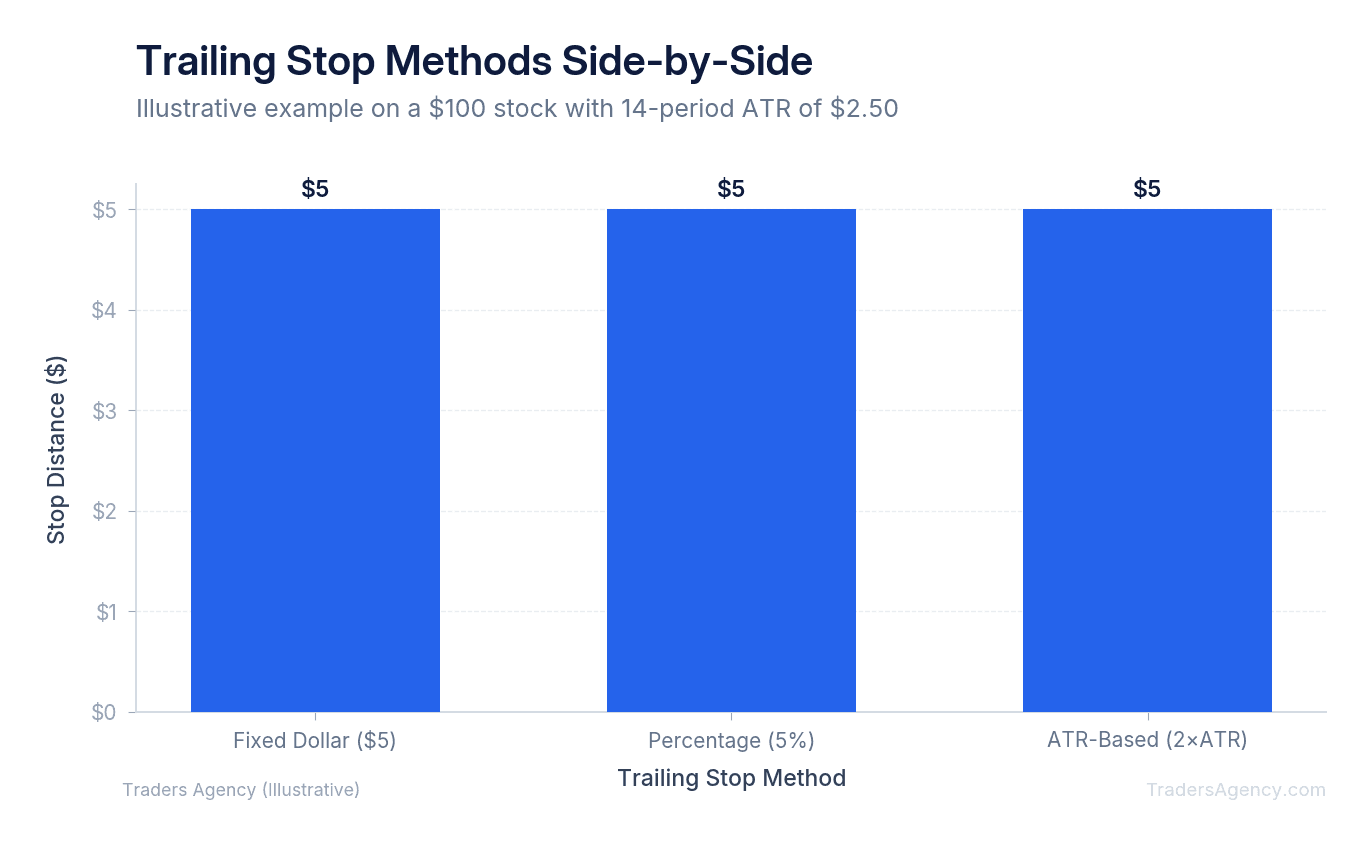
| Method | How It Works | Best For |
|---|---|---|
| Fixed Dollar | Stop trails by a set dollar amount (e.g., $5) | Beginners; simple to understand |
| Percentage | Stop trails by a set % (e.g., 5%) | Swing traders; scales with price |
| ATR-Based | Stop trails by a multiple of ATR (e.g., 2x ATR) | Active traders; adapts to volatility |
The fixed dollar amount is the easiest for beginners to understand. However, it doesn't account for how expensive the stock is. A $5 stop on a $20 stock is massive, while a $5 stop on a $500 stock is incredibly tight.
Percentage stops solve this scaling problem. They automatically adjust based on the share price. Many long-term swing traders prefer using a 10% or 15% trailing stop to capture large trends.
What Is the Best Way to Set a Trailing Stop-Loss?
The best way to set a trailing stop-loss is to base the distance on the stock's natural volatility rather than arbitrary numbers. We recommend using the Average True Range (ATR) indicator to measure daily price swings, then setting the stop outside of normal fluctuations to avoid premature exits.
We prefer to calculate our stops using the ATR because it adapts to current market conditions. A highly volatile tech stock requires a wider stop than a slow-moving utility stock. The ATR tells you exactly how much the stock typically moves in a single day.
Here's a practical example: if a stock typically moves $3 per day, a $1 trailing stop will almost certainly get triggered by normal price action. You need to give the trade room to breathe. Setting your stop at two times the daily ATR is a standard practice we use to survive normal market noise.
Key Concept: Set your trailing stop distance based on the stock's ATR, not a round number. A good starting point is 2x the daily ATR. This keeps you in the trade through normal price swings while still protecting against real reversals.
How to Set a Trailing Stop Bracket Order: Step by Step
Let's walk through a concrete example using a hypothetical trade on a stock with the ticker symbol XYZ. Assume XYZ is currently trading at $100 per share.
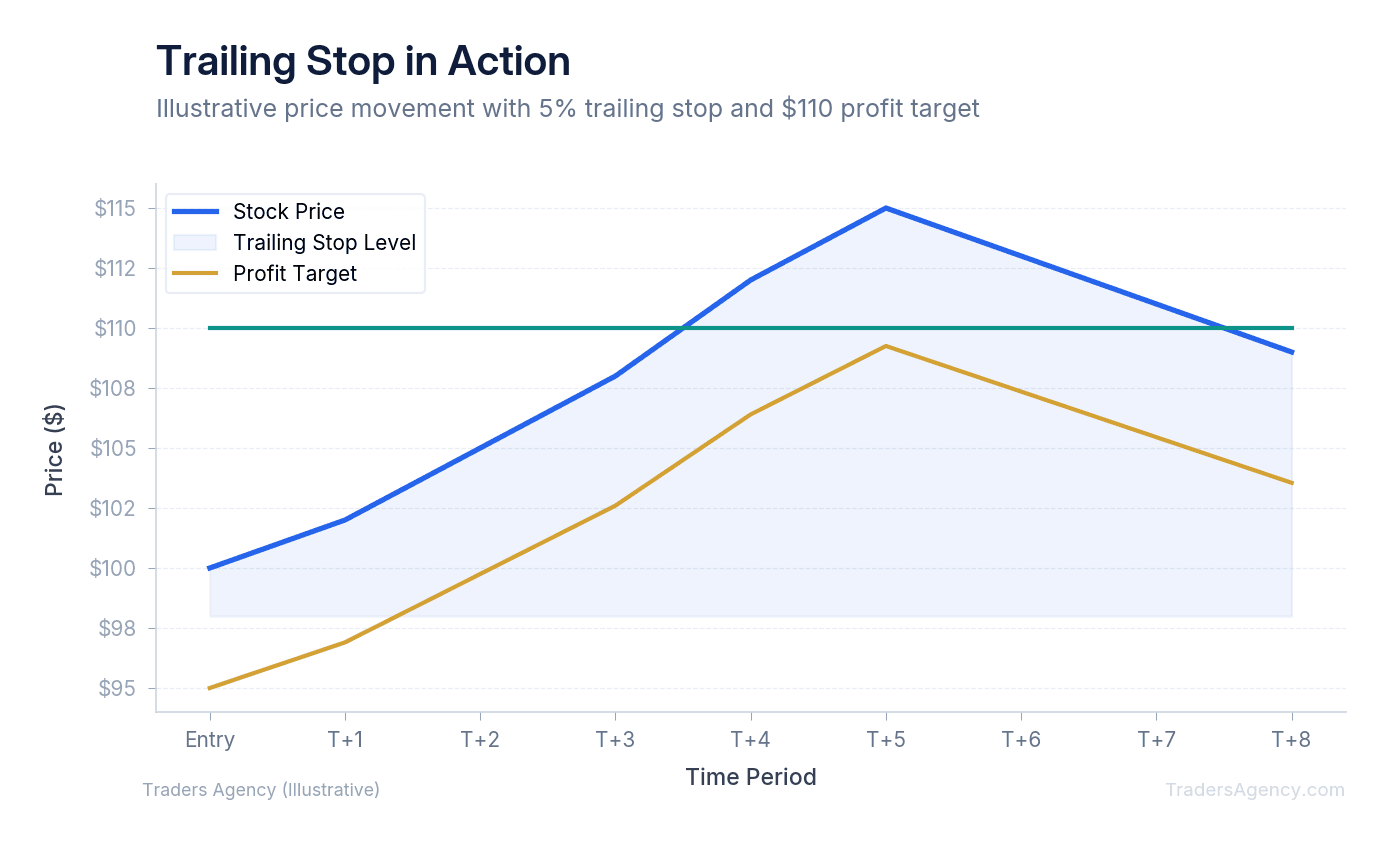
We want to buy 100 shares, take profit if it reaches $115, and protect our downside with a $5 trailing stop. Here's how we execute this trailing stop bracket order on a standard brokerage platform.
- Define the Entry Order: Initiate the primary order ticket. Select "Buy" and enter 100 shares of XYZ at a limit price of $100. This tells the broker exactly how much you want to pay for the initial position.
- Set the Profit Target: Attach a "Take Profit" or "Limit" exit order to the primary ticket. Set this price to $115. If XYZ hits $115, the system will automatically sell your shares and lock in a $1,500 profit.
- Configure the Trailing Stop: Attach the stop-loss and change the type to "Trailing Stop." Set the trail amount to $5. Set the Time-in-Force for both exit orders to "Good 'Til Canceled" (GTC) so they remain active for multiple days.
- Review and Submit: Always review the order confirmation screen carefully before clicking submit. Make sure the link between the entry and the exits is clearly displayed.
| Parameter | Value |
|---|---|
| Stock | XYZ at $100 |
| Shares | 100 |
| Profit Target | $115 (+$1,500) |
| Trailing Stop Distance | $5 |
| Initial Stop Level | $95 |
| Max Loss (immediate drop) | -$500 |
| If stock reaches $110 | Stop moves to $105 (locked-in +$500 profit) |
If the stock drops to $95 immediately, you exit with a $500 maximum loss. If the stock climbs to $110, your stop moves up to $105, guaranteeing a $500 profit even if the trade suddenly reverses.
Want expert trading insights delivered daily?
Join thousands of traders who rely on Traders Agency for market analysis and trade ideas.
Join Traders AgencyCan You Adjust a Bracket Order After Your Trade Is Open?
Once your trailing stop bracket order is live, you might wonder if you can change the parameters. The short answer is yes. Most modern trading platforms allow you to modify active orders directly on your chart.
We frequently adjust our profit targets if market conditions change drastically. If XYZ is showing massive strength and breaking through major resistance levels, you might want to raise your target from $115 to $125.
To do this, simply locate the active limit price order in your broker's platform and select the modify option. When you update the target price, the automated link to your trailing stop remains intact. The One-Cancels-Other (OCO) logic continues to function normally.
Watch Out: Never lower your stop-loss once the trade is active. Moving a stop further down defeats the entire purpose of risk management. Only modify a stop-loss to lock in more profit, never to accept a larger loss.
When Should You Use This Strategy?
A trailing stop bracket order works best in trending markets where a stock is making clear higher highs and higher lows. We prefer to use them during breakout trades or when riding strong momentum. They allow you to capture upside potential while systematically reducing risk.
You should avoid this strategy in choppy, sideways markets. When a stock is bouncing rapidly between a tight range, a trailing stop will frequently trigger right before the stock moves back in your favor. This results in a frustrating series of small losses.
This setup fits perfectly with standard risk management practices. We teach our members to risk no more than 1% to 2% of their total account equity on any single trade.
If you have a $50,000 account, your maximum loss on the XYZ trade should not exceed $500 to $1,000. By using a bracket order, you define this risk before you even enter the trade. You never have to rely on willpower to cut a losing position.
What Mistakes Should You Avoid When Setting Trailing Stops and Bracket Orders?
The most frequent mistake beginners make is setting their trailing stop distance too tight. They want to avoid losses so badly that they choke the trade.
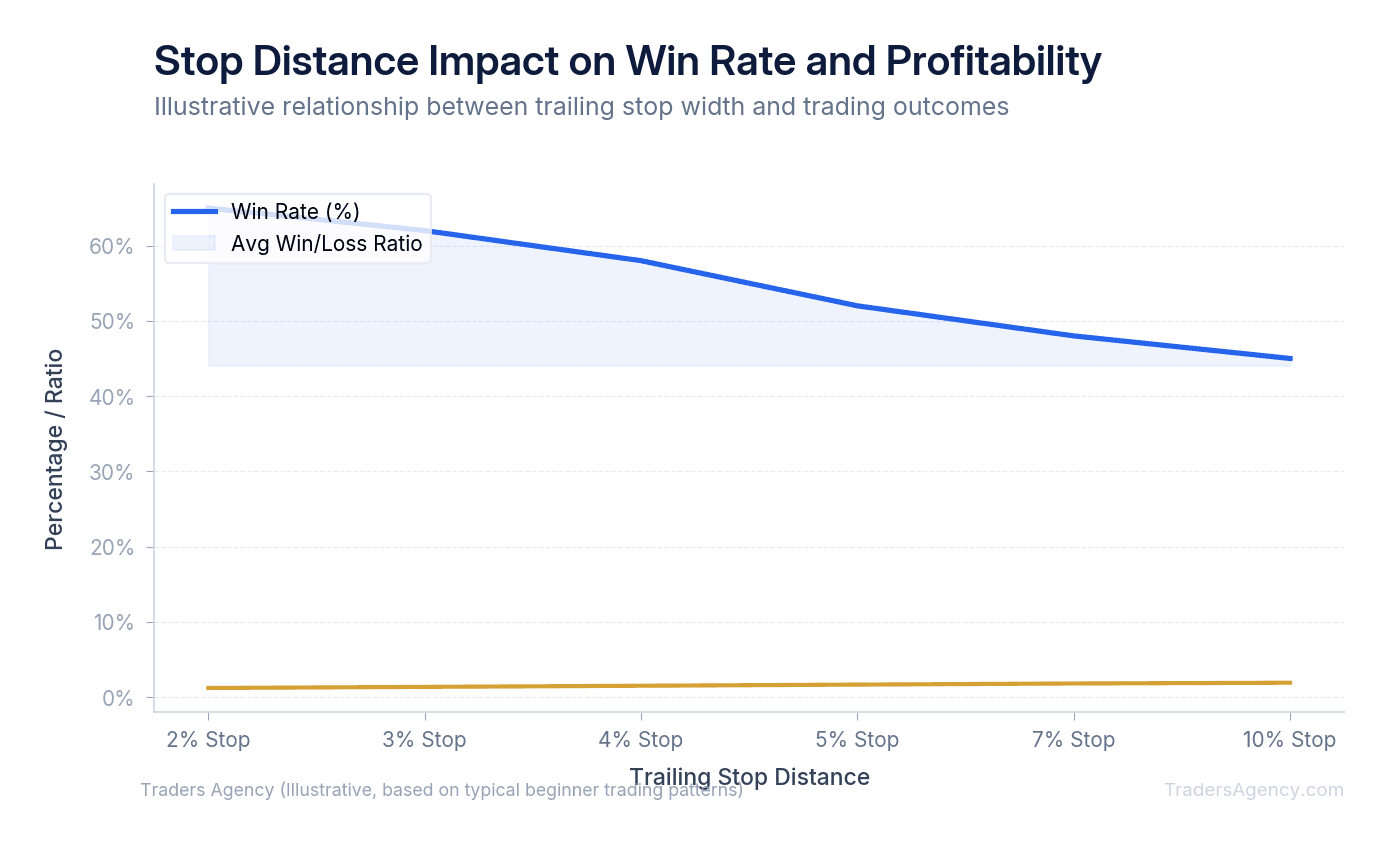
When your stop is too close to the current price, normal market noise will trigger your exit. You'll watch from the sidelines as the stock proceeds to hit your profit target without you. Give your trades enough room to experience normal daily fluctuations.
Another common error is failing to understand how overnight gaps affect your orders. If a stock closes at $110 and opens the next morning at $90 due to bad news, your $105 trailing stop will trigger at the market open. You'll be filled near $90, turning an expected profit into a $10-per-share loss from your $100 entry. Standard equity markets do not guarantee your exact stop price during a gap down. Your stop simply becomes a market order when the trigger price is breached.
Watch Out: Trailing stops do not protect you from overnight gaps. If a stock gaps below your stop price, your order fills at the next available market price, which could be significantly worse than expected. Be especially careful holding positions through major earnings announcements.
We also advise against holding tight trailing stops through major earnings announcements. The extreme volatility during these events can easily trigger your stop at an unfavorable price. We prefer to close positions manually before earnings or widen our stops significantly to account for the expected move.
Here's a quick summary of the mistakes to avoid:
- Stop too tight: Normal price swings trigger your exit before the real move happens.
- Ignoring overnight gap risk: Your fill price can be far worse than your stop level.
- Holding through earnings: Extreme volatility makes tight stops unreliable.
- Lowering your stop: This turns a risk management tool into a recipe for larger losses.
The Traders Agency education team publishes new strategy guides and market analysis every week. If you found this guide helpful, there's much more waiting for you inside our membership.
Want expert trading insights delivered daily?
Join thousands of traders who rely on Traders Agency for market analysis and trade ideas.
Join Traders AgencyKey Takeaways
- A trailing stop bracket order combines a profit target and a moving stop-loss into one setup, using One-Cancels-Other (OCO) logic so that when one exit triggers, the other is automatically canceled.
- The trailing stop moves up as the stock price rises, locking in gains without requiring manual adjustments while the position is open.
- Setting a stop too tight is one of the most common mistakes: normal price swings can trigger your exit before the real move develops.
- Holding a bracket order through an earnings announcement is unreliable because extreme volatility can cause fills far outside your intended stop level.
- Lowering your stop after entry defeats the purpose of the tool entirely, turning a risk management mechanism into a source of larger losses.
DISCLAIMER: Traders Agency does not offer financial advice. The information provided is for educational purposes only and should not be considered financial advice. Traders Agency is not responsible for any financial losses or consequences resulting from the use of the information provided. Trading carries inherent risks and may not be suitable for all individuals. You are advised to conduct your own research and seek personalized advice before making any investment decisions, recognizing the potential risks and rewards involved.
See more from Traders Agency on Google
Make us a preferred source and our market analysis will appear more prominently in your Google Search, Top Stories, and AI results.
Add to Preferred Sources