
You look at two different stocks on your trading screen. Stock A trades at $150 per share, while Stock B trades at just $15 per share. It's incredibly common for new traders to assume the company with the higher share price is the larger, more valuable business. But share price alone tells you absolutely nothing about the actual size of a company. To understand true company size, you need to look at the total value of all its shares combined. With market capitalization explained in simple terms, you'll see it's the ultimate equalizer that allows us to compare a $10 stock to a $500 stock on a level playing field. In this guide, we'll walk you through exactly how to calculate this metric, what the different size categories mean, and how to use this data to build a balanced trading portfolio.
What Is Market Capitalization?
Bottom Line: Market capitalization is the single most reliable way to compare companies of different share prices on equal footing, and it should be the first number you check before entering any trade. The size category a stock falls into determines your risk parameters, expected volatility, and position sizing, not the price of a single share. Build the habit of verifying market cap every time, and your trading decisions will be grounded in actual company size rather than the illusion of a high or low share price.
Market capitalization is the total market value of a publicly traded company's outstanding shares. It represents the theoretical total value of all the company's shares at the current market price. Traders use this metric to determine a company's true size, rather than just looking at its individual share price.
Think of a publicly traded company like a large pizza. The share price is simply the cost of one single slice. Market capitalization is the cost of the entire pizza. A $10 slice from a very small pizza might cost more than a $5 slice from a massive pizza. Even though the individual slice is cheaper, the massive pizza is still worth much more overall.
Key Concept: Market capitalization (or "market cap") equals the current share price multiplied by the total number of outstanding shares. It represents the market's assessment of a company's total equity value, and it changes every second the market is open.
Understanding this concept prevents a very common beginner mistake. A stock trading at $2 per share is not necessarily "cheap" or undervalued. If that company has billions of shares outstanding, it could actually be a massive, overpriced corporation. Conversely, a stock trading at $1,000 per share might belong to a relatively small company that simply issued very few shares.
How Do You Calculate Market Capitalization?
You calculate market capitalization by multiplying the current market price of one share by the total number of outstanding shares. The formula is straightforward: Share Price × Total Outstanding Shares = Market Capitalization. This calculation provides the total equity value of the business at any given moment.
To execute this calculation yourself, you just need two basic pieces of information. Here is the exact process our team uses to verify a company's size:
- Identify the Current Share Price. You can find the current share price on any standard trading platform or financial website. For this example, let's assume we're looking at a fictional business called Company XYZ. Company XYZ currently trades at exactly $50.00 per share.
- Find the Outstanding Shares. Outstanding shares represent the total number of shares that have been issued and are held by all shareholders, including company insiders, institutional investors, and the general public. You can find this number on your broker's quote page or by looking at the company's official balance sheet. For the most accurate and legally binding numbers, we prefer to check the company's quarterly 10-Q report filed with the Securities and Exchange Commission (SEC). Let's assume Company XYZ has 20 million outstanding shares.
- Multiply the Two Numbers. Now, you simply multiply the share price by the outstanding shares: $50.00 (Share Price) × 20,000,000 (Outstanding Shares) = $1,000,000,000. The market cap for Company XYZ is $1 billion.
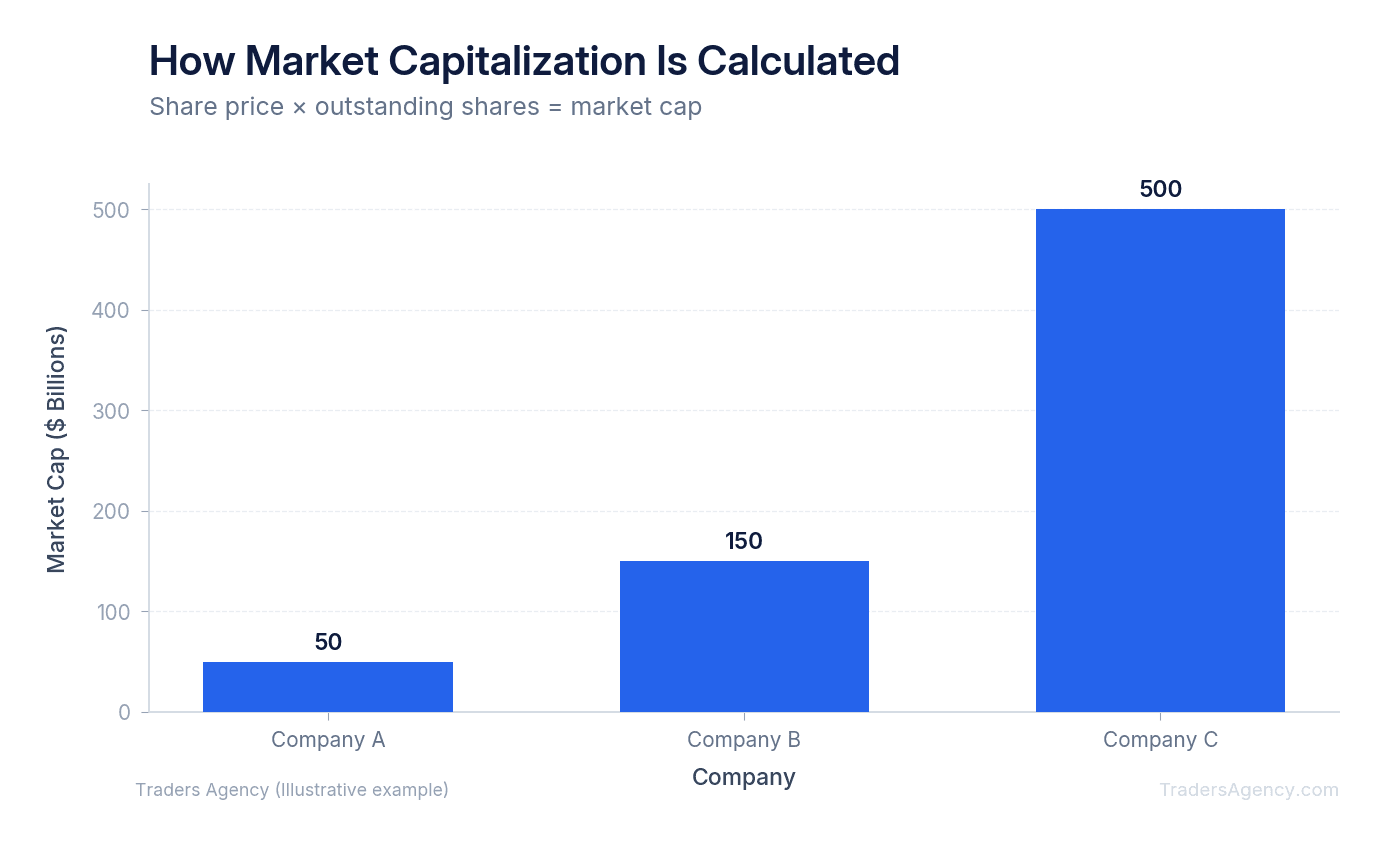
Now let's look at a contrasting example to prove why share price can be deceiving. Company ABC trades at just $10.00 per share. However, Company ABC has 500 million outstanding shares.
| Company | Share Price | Outstanding Shares | Market Cap |
|---|---|---|---|
| Company XYZ | $50.00 | 20 million | $1 billion |
| Company ABC | $10.00 | 500 million | $5 billion |
Even though Company XYZ has a much higher share price ($50 vs $10), Company ABC is actually five times larger as a business. This is exactly why market cap matters more than share price when evaluating company size.
What Are the Different Market Cap Segments?
The stock market categorizes companies into different market cap segments based on their total valuation. These segments typically include mega-cap, large-cap, mid-cap, small-cap, and micro-cap stocks. Each category carries a different level of risk, growth potential, and market liquidity.
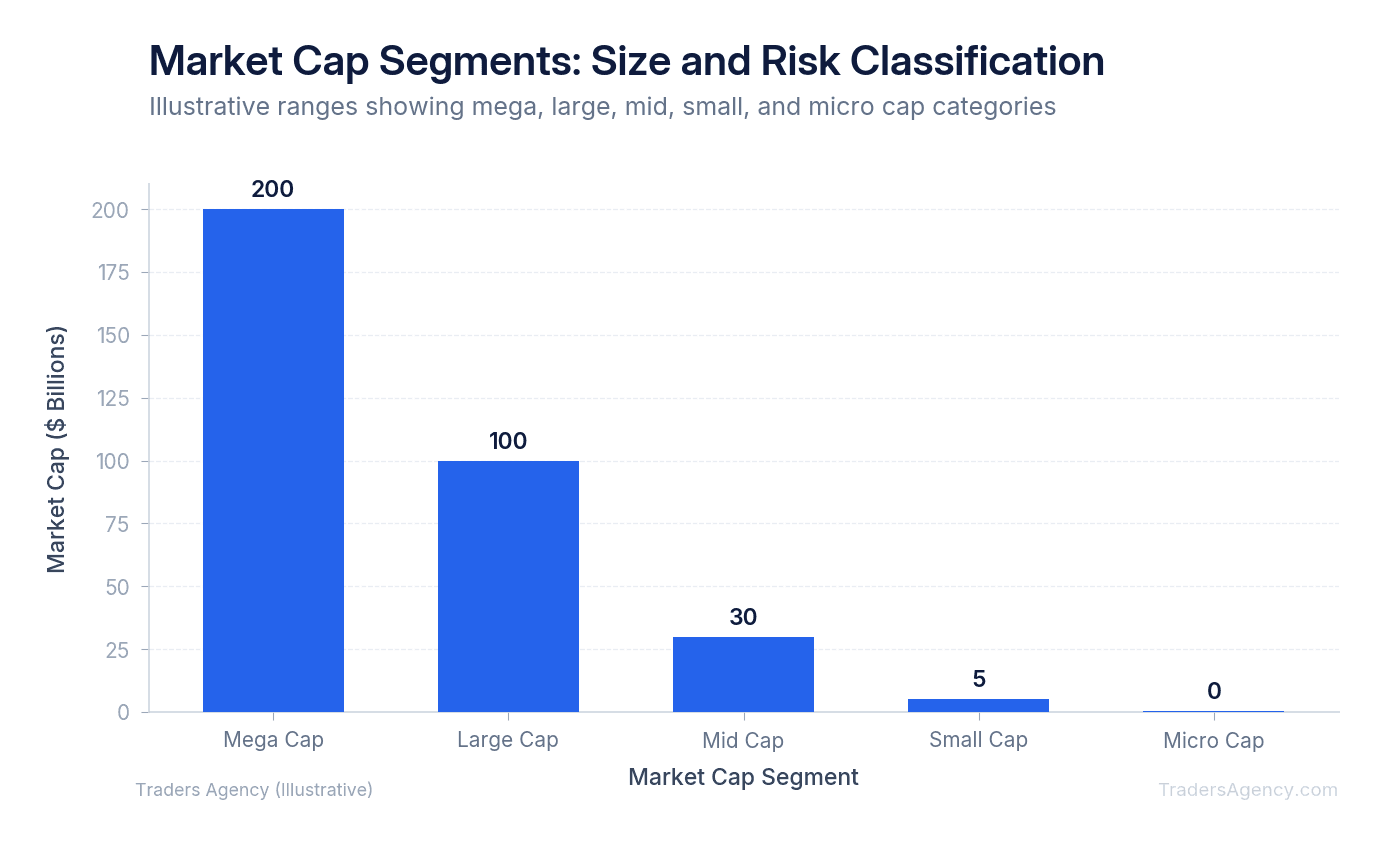
Traders use these categories as a shorthand way to describe a stock's behavior. While the exact dollar cutoffs can shift slightly over time as the overall market grows, the financial industry generally accepts the following tiers:
| Category | Market Cap Range | Characteristics |
|---|---|---|
| Mega-Cap | $200 billion+ | Household names (Apple, Microsoft, Amazon). Highly liquid, generally considered the safest equities. Rapid growth days are usually behind them. |
| Large-Cap | $10B to $200B | Established, mature businesses that often pay regular dividends. Core foundation of most long-term portfolios. Stable balance of moderate growth and capital preservation. |
| Mid-Cap | $2B to $10B | The "sweet spot" for many traders. Proven business models with steady revenue, yet still small enough for rapid growth if they capture new market share. |
| Small-Cap | $300M to $2B | Much more volatile. High growth potential but significantly higher risk of bankruptcy or severe drawdowns. Wider bid-ask spreads possible. |
| Micro-Cap | $50M to $300M | Highly speculative. Prone to extreme price swings, low trading volume, and potential market manipulation. |
Watch Out: We warn our beginner traders to be very careful with micro-cap stocks. Low volume and wide spreads mean you can get trapped in a position you can't exit at a reasonable price. Always check average daily volume before entering any trade in this territory.
Is $2 Billion a Good Market Cap?
A $2 billion market cap is neither inherently good nor bad, but it places a company right on the border between a small-cap and a mid-cap stock. Companies at this size often have established business models but still offer significant room for growth compared to massive large-cap corporations.
When a company reaches the $2 billion threshold, it often begins to attract attention from institutional investors. Mutual funds and pension funds usually have strict rules preventing them from buying tiny micro-cap stocks. Crossing into the $2 billion range puts a stock on Wall Street's radar, which can lead to increased trading volume and better liquidity.
However, context matters immensely. A $2 billion valuation for a brand-new technology startup might be incredibly expensive and risky. On the other hand, a $2 billion valuation for an established regional bank with decades of steady profits might be considered a conservative, value-oriented investment. Our team recommends evaluating the market cap relative to the company's actual revenue and sector peers.
Want expert trading insights delivered daily?
Join thousands of traders who rely on Traders Agency for market analysis and trade ideas.
Join Traders AgencyHow Does Market Cap Affect Your Portfolio Risk Profile?
Market cap directly affects your portfolio risk profile because smaller companies generally experience higher price volatility than larger companies. Large-cap stocks tend to offer stability and dividends, while small-cap stocks offer higher growth potential but come with increased risk of business failure.
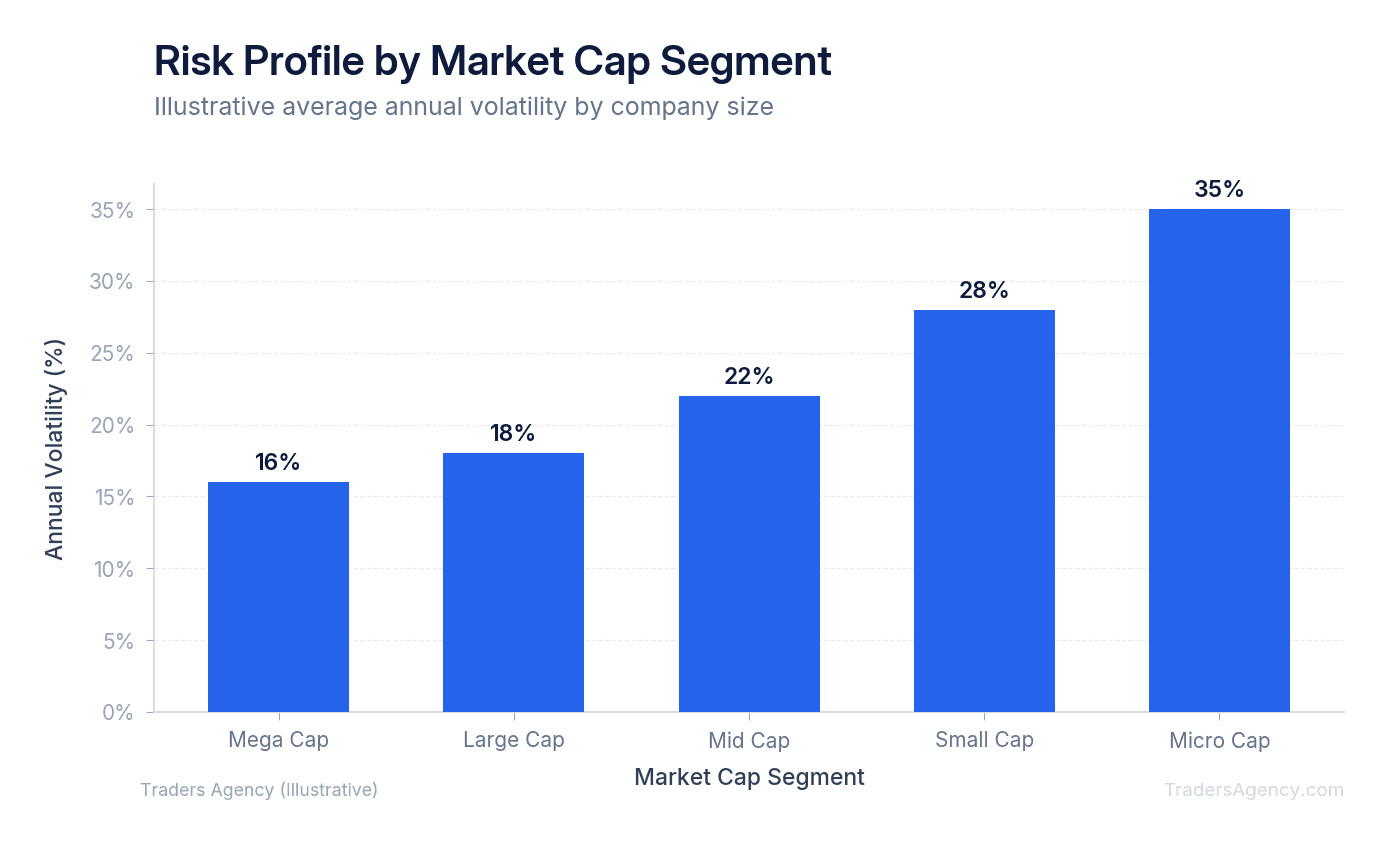
When we review a new trader's portfolio, we immediately look at their market cap distribution. If a trader holds 100% of their capital in micro-cap and small-cap stocks, they have an extremely aggressive risk profile. A bad week in the broader market could result in massive losses for that specific portfolio.
Conversely, a portfolio consisting entirely of mega-cap stocks will likely experience much smoother price action. The downside is that this conservative portfolio might underperform during a strong bull market. Proper portfolio construction requires balancing these different sizes based on your personal risk tolerance.
Here are the risk management guidelines we teach our members regarding company size:
- Position Sizing: We prefer to allocate larger percentages of our capital to large-cap stocks. We might risk 5% of an account on a large-cap trade, but only 1% on a volatile small-cap trade.
- Stop Losses: Small-cap stocks have wider daily price swings. You must use wider stop losses for small-caps to avoid getting stopped out by normal daily noise.
- Liquidity Checks: Before buying any stock under a $1 billion market cap, always check the average daily trading volume. You need to ensure you can exit the trade easily when it's time to sell.
Market-Cap Weighted vs. Equal-Weight Indexes
A market-cap weighted index gives larger companies a higher percentage of the index, meaning massive tech stocks drive most of the performance. An equal-weight index assigns the exact same percentage to every company, regardless of their total market capitalization.
Most popular index funds, like those tracking the S&P 500, are market-cap weighted. This means the biggest companies dictate the direction of the entire index. If the S&P 500 contains 500 companies, you might assume each company represents 0.2% of the fund. In reality, the top 10 mega-cap companies often make up more than 30% of the entire index's value.
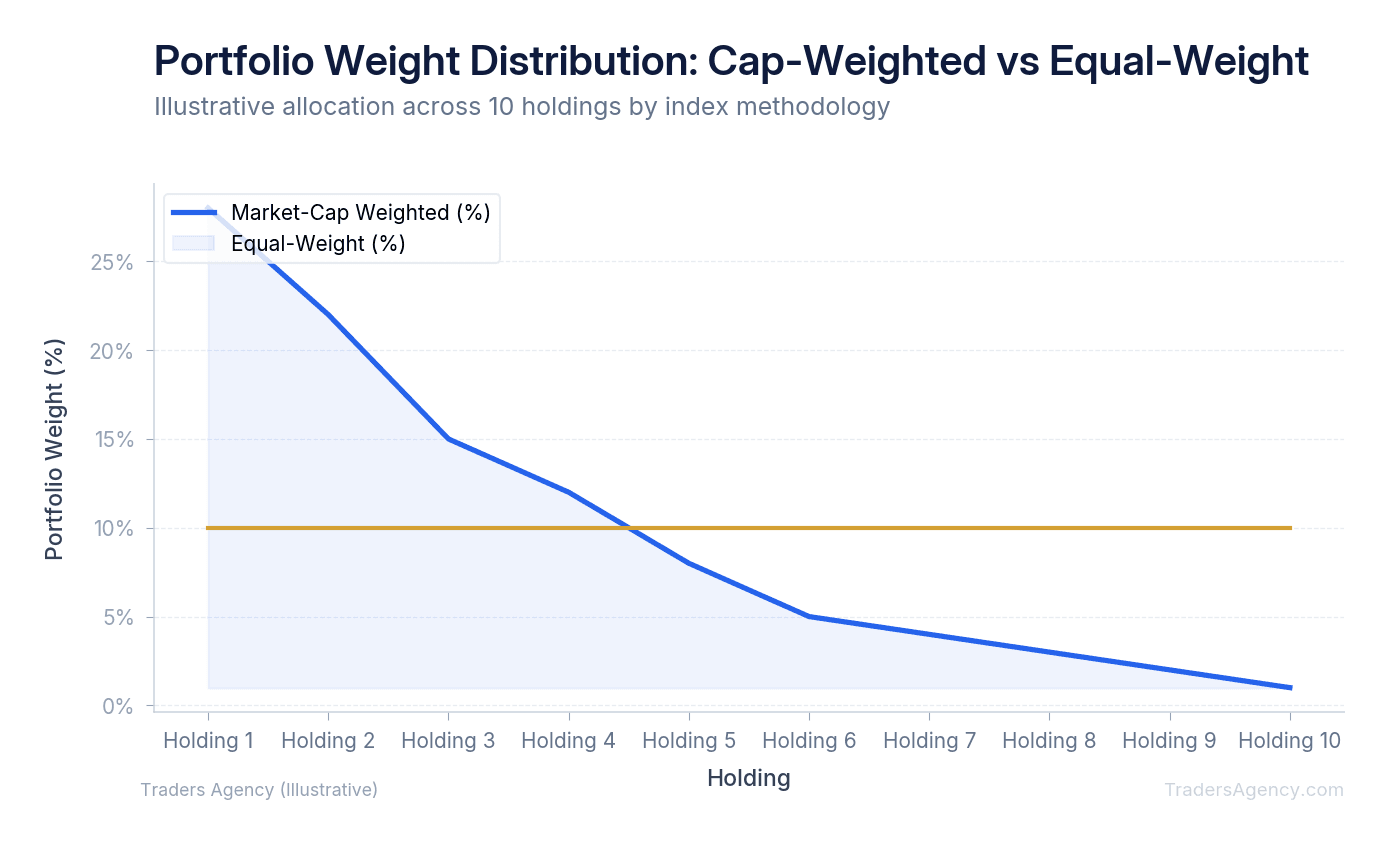
This weighting system creates a unique dynamic for traders. When you buy a standard S&P 500 ETF (like SPY), your money is heavily concentrated in just a few massive tech giants. If those specific mega-cap stocks have a bad earnings season, the entire index will drop, even if the other 490 smaller companies are performing well.
Key Concept: We often watch the performance difference between market-cap weighted and equal-weight indexes to gauge true market health. If the cap-weighted index is hitting new highs but the equal-weight index is falling, it tells us that only a few giant companies are holding the market up. That's a warning sign of narrow market breadth.
To counter this concentration risk, some traders prefer equal-weight index funds (like RSP). In an equal-weight fund, a $2 trillion company and a $10 billion company hold the exact same influence over the fund's performance. This gives you broader, more diversified exposure to the entire index.
Practical Application: Where to Find Market Cap Data and How to Use It
You can find market cap data on any standard financial website, stock screener, or directly through your brokerage platform. For the most accurate outstanding share counts, traders can review a company's quarterly 10-Q or annual 10-K reports filed directly with the SEC's EDGAR database.
Understanding market capitalization is only useful if you actually apply it to your daily trading routine. We highly recommend using a free stock screener to filter your potential trade setups by company size. This prevents you from accidentally trading a highly volatile micro-cap stock when you were looking for a stable swing trade.
Here is a practical screening setup we use to find stable, growing companies:
- Open your preferred stock screener.
- Set the Market Cap filter to Mid-Cap ($2B to $10B).
- Set Average Daily Volume to greater than 1 million shares to ensure liquidity.
- Set the Share Price to greater than $10 to filter out penny stocks.
This simple filter instantly removes massive, slow-moving mega-caps and highly dangerous micro-caps. It leaves you with a manageable list of mid-sized companies that have plenty of liquidity and room for growth.
Remember This: Always verify the market cap before you enter a position. A quick glance at this single metric tells you immediately what kind of stock you're dealing with. It dictates how wide your stop loss should be, how much capital you should risk, and what kind of price movement you should expect. Once you make this check a permanent part of your routine, you'll trade with much more confidence and precision.
Want expert trading insights delivered daily?
Join thousands of traders who rely on Traders Agency for market analysis and trade ideas.
Join Traders AgencyKey Takeaways
- Share price alone tells you nothing about a company's size. A $150 stock can belong to a smaller company than a $15 stock depending on how many shares are outstanding.
- Market capitalization is calculated by multiplying the current share price by the total number of outstanding shares, giving you the total theoretical value of the entire company.
- Market cap segments (such as micro-cap, mid-cap, and large-cap) directly influence how wide your stop loss should be, how much capital you should risk, and what kind of price movement to expect.
- Mid-cap stocks are highlighted as a practical middle ground, offering more liquidity than micro-caps and more growth potential than mega-caps.
- Checking market cap before entering any position is presented as a non-negotiable routine step, not an optional filter, because it immediately tells you what kind of stock you are dealing with.
DISCLAIMER: Traders Agency does not offer financial advice. The information provided is for educational purposes only and should not be considered financial advice. Traders Agency is not responsible for any financial losses or consequences resulting from the use of the information provided. Trading carries inherent risks and may not be suitable for all individuals. You are advised to conduct your own research and seek personalized advice before making any investment decisions, recognizing the potential risks and rewards involved.
See more from Traders Agency on Google
Make us a preferred source and our market analysis will appear more prominently in your Google Search, Top Stories, and AI results.
Add to Preferred Sources