
You have probably seen this happen before. You buy a call option on a stock you love, the stock goes up, and you still lose money. This frustrating scenario occurs because options lose value over time, a concept known as time decay. To fix this problem, our team recommends learning about vertical spread options. A solid understanding of debit spreads vs credit spreads is one of the most important lessons in options trading, and we are going to walk you through both approaches so you know exactly which one fits your next trade.
A debit spread is an options strategy where you buy an expensive option and sell a cheaper one, paying money upfront. A credit spread is a strategy where you sell an expensive option and buy a cheaper one, receiving money upfront. By the end of this guide, you will understand how to set up these trades, manage your risk, and choose the right strategy based on market conditions.
What Is a Debit Spread and How Does It Work?
Bottom Line: The choice between debit spreads and credit spreads is not about one being better than the other. It comes down to reading the volatility environment before you place the trade. Checking IV Percentile first and matching your strategy to current conditions is the single habit most likely to improve your long-term results.
A debit spread is a multi-leg options strategy where you simultaneously buy one option and sell another option of the same type and expiration, resulting in a net cost. You pay a premium upfront to enter the trade. Your maximum risk is strictly limited to that initial cost.
This strategy is essentially a directional bet. You want the underlying stock to move significantly in your chosen direction. By selling the cheaper option, you reduce the overall cost of the trade compared to buying a single option outright.
Think of a debit spread like buying a large house and immediately renting out the basement. You pay a large sum for the house, but the rental income offsets some of your initial cost. In exchange for that cost reduction, you give up the right to use the basement.
In options terms, you give up unlimited profit potential to lower your upfront risk. This makes the trade much safer than buying naked options.
Key Concept: A debit spread costs money to open and profits when the stock moves in your chosen direction. Your maximum loss is limited to the premium you paid upfront.
What Is a Credit Spread and How Does It Work?
A credit spread is an options strategy where you simultaneously sell a high-priced option and buy a lower-priced option of the same type and expiration. This results in a net credit, meaning cash is deposited into your account immediately. Your goal is for both options to expire worthless.
Credit spreads are primarily income-generating strategies. We teach our members to use them when they expect a stock to stay above or below a specific price level. You do not need the stock to make a massive move to win. You just need it to stay away from your strike prices.
Imagine you are an insurance company. You sell a policy to a homeowner and collect a premium. To protect yourself from a catastrophic loss, you buy a cheaper reinsurance policy from another company. You keep the difference between the premium you collected and the premium you paid. That difference represents your maximum profit.
Key Concept: A credit spread puts cash in your account when you open it and profits when the stock stays away from your sold strike. Your maximum profit is the premium collected.
What Are the Key Differences Between Debit Spreads and Credit Spreads?
Understanding the mechanical differences between these two strategies will help you make better trading decisions. Here is how they compare across major trading metrics:
| Metric | Debit Spread | Credit Spread |
|---|---|---|
| Cash Flow at Open | You pay money (net debit) | You receive money (net credit) |
| Time Decay (Theta) | Works against you | Works in your favor |
| Directional Need | Requires stock to move in your favor | Can profit if stock trades sideways |
| Maximum Profit | Strike width minus premium paid | Premium collected |
| Maximum Loss | Premium paid | Strike width minus premium collected |
| Best Volatility Environment | Low implied volatility | High implied volatility |
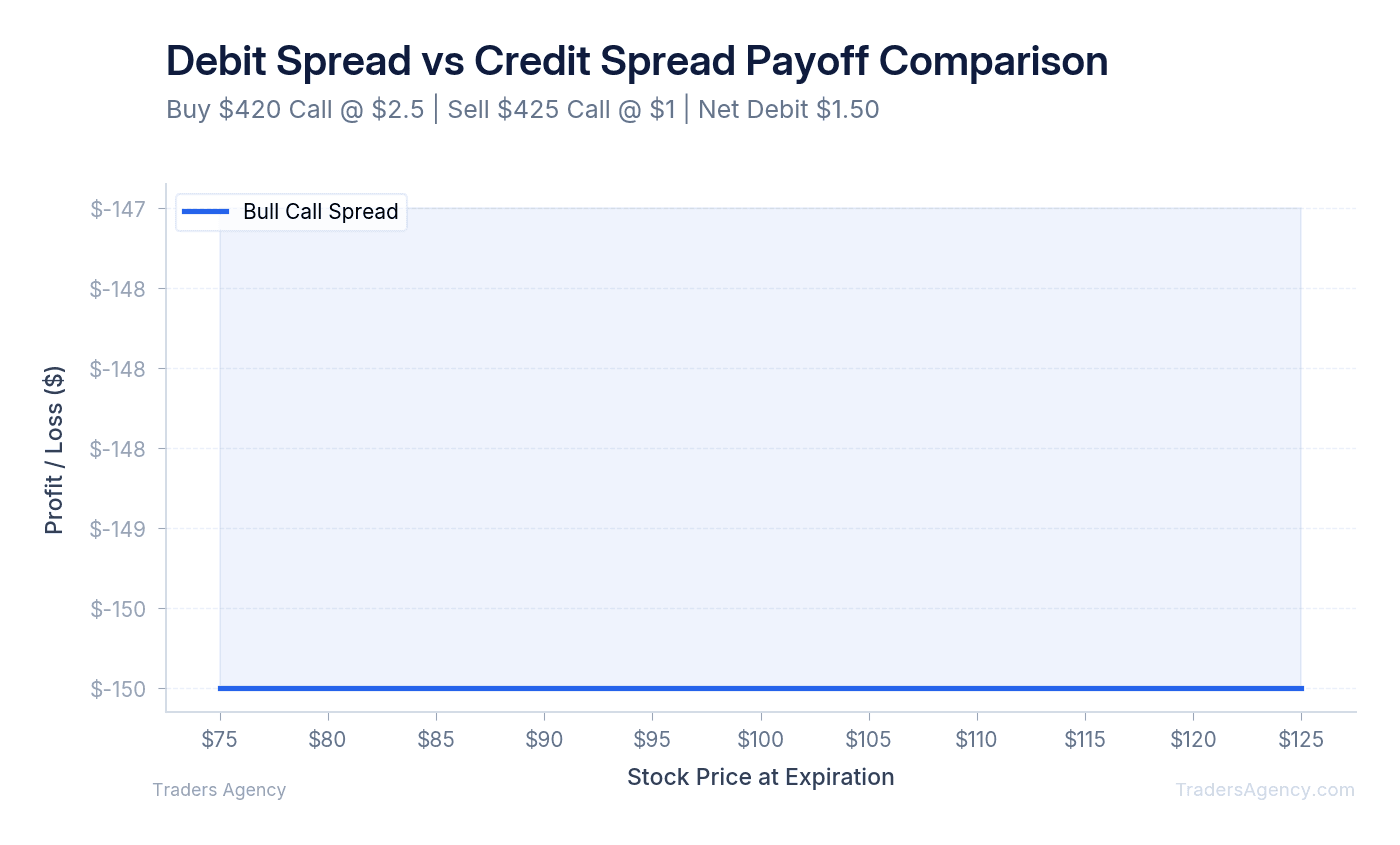
As you can see, both strategies cap your maximum profit and your maximum loss. The main difference lies in how you achieve that profit.
How Does Implied Volatility Determine Which Spread Strategy to Use?
Implied volatility measures how much the market expects a stock to move in the future. High implied volatility means options are expensive. Low implied volatility means options are cheap.
We rely heavily on volatility mechanics when teaching our members. The core principle is simple: when options are expensive, you want to be a net seller. When options are cheap, you want to be a net buyer.
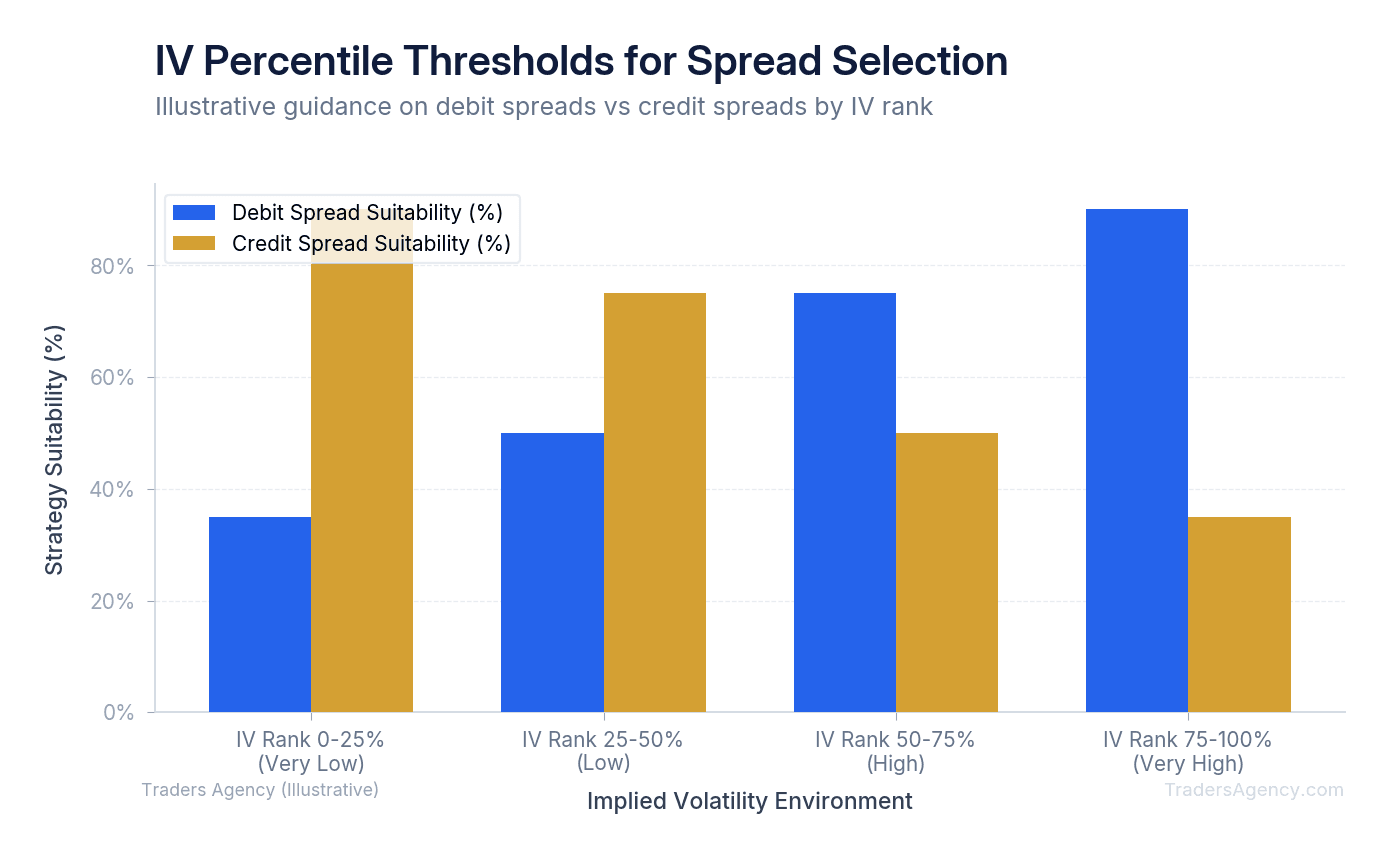
We prefer to look at a metric called IV Rank or IV Percentile to make this decision:
- If the IV Percentile is below 50, options are relatively cheap. This is the ideal environment for a debit spread.
- If the IV Percentile is above 50, options are relatively expensive. This is the ideal environment for a credit spread.
When earnings are approaching, uncertainty is high. This drives up the demand for options, which increases their price. This is why credit spreads are so popular around earnings season. Conversely, during quiet market periods, demand drops. Options become cheap, making debit spreads highly attractive.
Trading with the volatility trend gives you a mathematical edge. Ignoring implied volatility is a common mistake that leads to unnecessary losses. You can explore more about how volatility impacts option pricing through the Cboe Options Exchange educational resources.
Watch Out: Buying debit spreads when implied volatility is high means you are overpaying for options. Even if the stock moves in your direction, a drop in volatility can eat into your profits.
Want expert trading insights delivered daily?
Join thousands of traders who rely on Traders Agency for market analysis and trade ideas.
Join Traders AgencyWhen Should You Use a Debit Spread?
You should use a debit spread when you expect a strong directional move in a stock, but implied volatility is low. This strategy allows you to capitalize on the expected price movement while strictly defining your risk and keeping your upfront capital requirements relatively low.
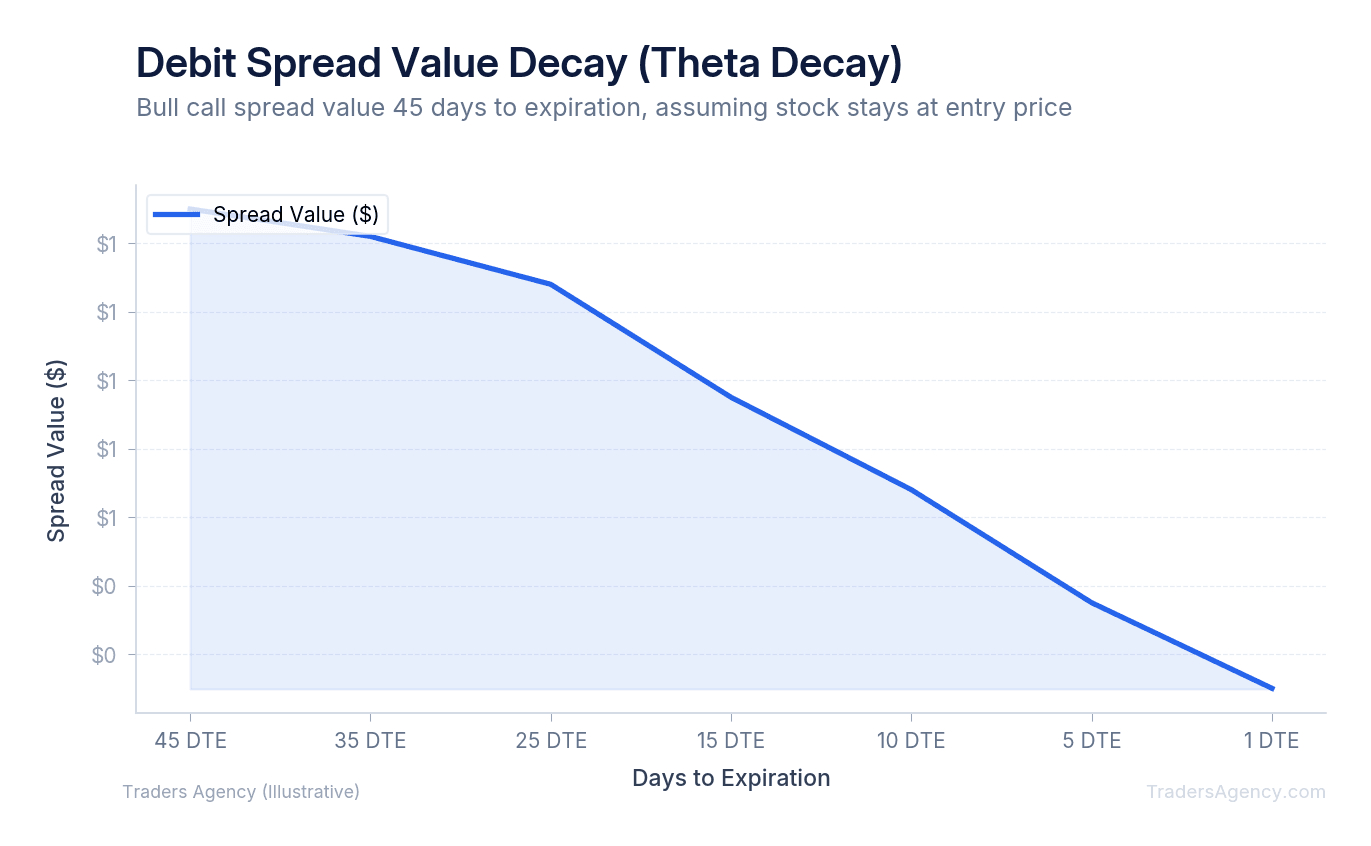
Here is a specific bull call spread example. Assume Apple (AAPL) is trading at $150 per share. You believe the stock will rise to $160 over the next 30 days. Implied volatility is low, making options reasonably priced.
Bull Call Spread: Step-by-Step Execution
- Identify the setup: AAPL is at $150. You target a move to $160 within 30 days.
- Buy the near-the-money option: You buy the $150 strike call option expiring in 30 days. This costs $4.00 per share ($400 total).
- Sell the out-of-the-money option: You simultaneously sell the $160 strike call option with the same expiration. You collect $1.00 per share ($100 total) for this leg.
| Parameter | Value |
|---|---|
| Stock | AAPL at $150 |
| Call Bought | $150 strike, $4.00 premium paid |
| Call Sold | $160 strike, $1.00 premium collected |
| Net Cost (Max Loss) | $3.00/share ($300 total) |
| Max Profit | $7.00/share ($700 total) |
| Breakeven | $153.00 at expiration |
Your maximum profit of $700 is achieved if AAPL closes above $160 at expiration. Your maximum loss of $300 occurs if AAPL stays at or below $150.
When Should You Use a Credit Spread?
You should use a credit spread when implied volatility is high and you want to generate income. This strategy works best when you believe a stock will not drop below a certain support level or rise above a certain resistance level before the options expire.
Here is a specific bull put spread example. Assume Microsoft (MSFT) is trading at $300 per share. Earnings are approaching, so implied volatility is very high. You believe MSFT will stay above $280 over the next 30 days.
Bull Put Spread: Step-by-Step Execution
- Identify the setup: MSFT is at $300. You want to collect premium by betting it stays above $280.
- Sell the closer out-of-the-money option: You sell the $280 strike put option expiring in 30 days. You collect $3.00 per share ($300 total).
- Buy the further out-of-the-money option: To protect yourself, you buy the $270 strike put option. This costs $1.00 per share ($100 total).
| Parameter | Value |
|---|---|
| Stock | MSFT at $300 |
| Put Sold | $280 strike, $3.00 premium collected |
| Put Bought | $270 strike, $1.00 premium paid |
| Net Credit (Max Profit) | $2.00/share ($200 total) |
| Max Loss | $8.00/share ($800 total) |
| Breakeven | $278.00 at expiration |
Your net credit of $200 goes into your account immediately. If MSFT stays anywhere above $280 at expiration, you keep the entire $200 profit. Your maximum risk of $800 only occurs if MSFT drops below $270.
Margin and Capital Requirements Explained
Understanding broker requirements is a major part of trading. FINRA sets baseline margin rules, but individual brokers often have stricter requirements.
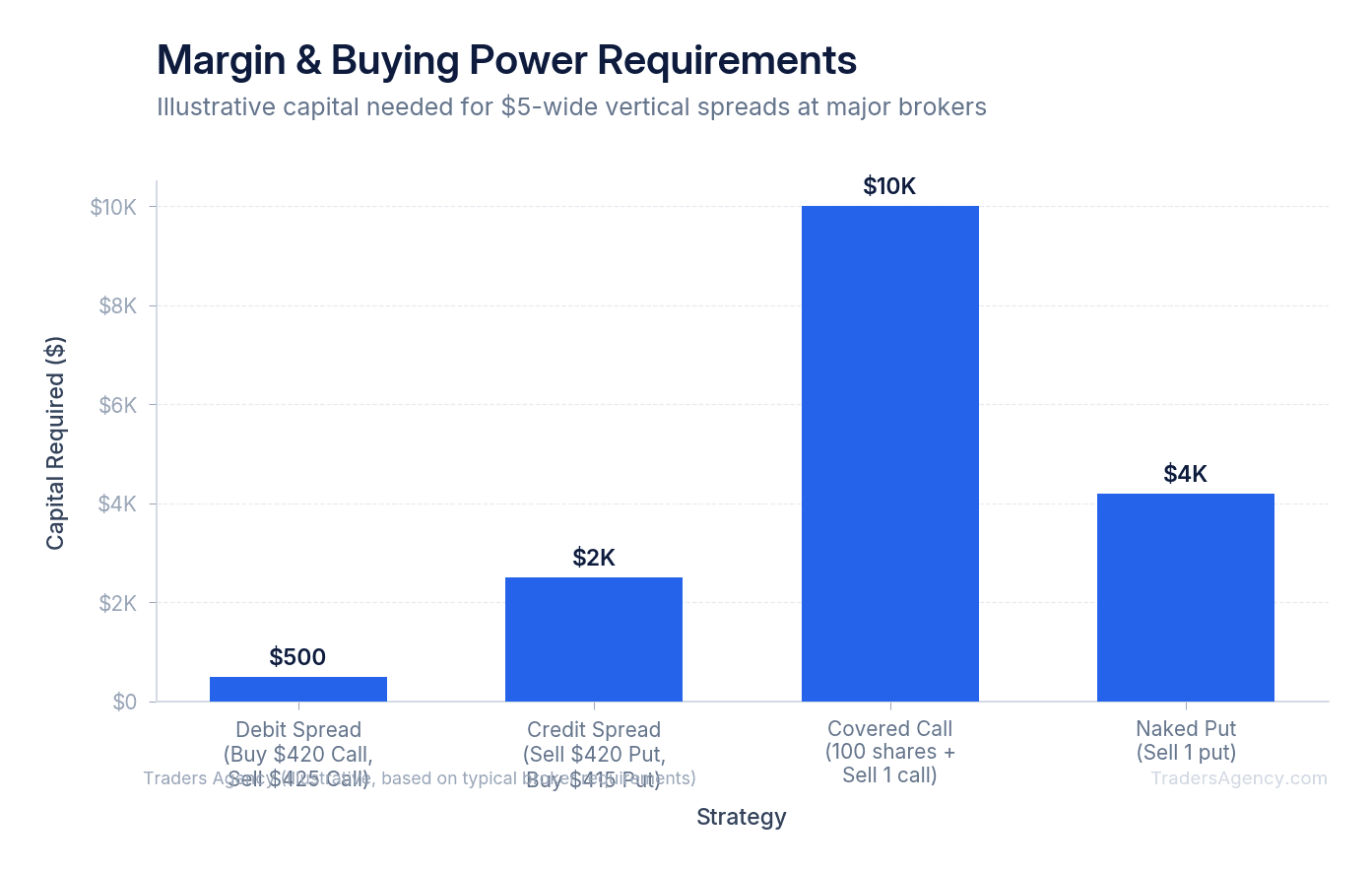
Debit spreads only require you to have enough cash to cover the cost of the trade. If a debit spread costs $300, you just need $300 in your account. Your buying power is reduced by exactly the cost of the trade. If you have a smaller account, debit spreads are often easier to manage. You do not need special margin privileges to buy a debit spread in most retirement accounts.
Credit spreads require margin approval from your broker. Because you are selling options, the broker must ensure you can cover the maximum potential loss. You must prove to your broker that you understand the risks of selling premium. In our MSFT example, your broker will hold $800 of your buying power as collateral until the trade is closed. You cannot use those funds for other trades while the spread is active.
How Do You Close a Spread Trade Before Expiration?
You do not have to hold these trades until expiration. In fact, our team recommends closing them early to lock in profits and reduce risk.
To close a debit spread: You simply do the opposite of your opening trade. You sell the option you bought and buy back the option you sold. If the spread is worth more than you paid for it, you secure a profit.
To close a credit spread: You buy back the option you sold and sell the option you bought. If the spread is worth less than the credit you received, you secure a profit.
We prefer to close credit spreads when we have captured 50% of the maximum potential profit. This frees up capital and eliminates the risk of a late market reversal.
Watch Out: A common mistake beginners make is holding a losing spread all the way to expiration. Our approach is to cut losses early. If a trade hits 50% of its maximum potential loss, consider closing the position to protect your remaining capital.
Which Spread Is Right for Your Trade Setup?
The right spread depends entirely on your market outlook and the current volatility environment. Here is our simple decision framework:
- Choose a debit spread for aggressive directional plays in low volatility environments.
- Choose a credit spread for conservative, income-generating plays in high volatility environments.
We teach our members to keep position sizes small. Never risk more than 2% to 5% of your total account on a single spread trade. Both strategies are excellent tools. Mastering the choice between debit spreads vs credit spreads simply means learning how to read the market environment before placing your trade.
Start by checking the IV Percentile on your next trade idea. If it is low, look for a debit spread setup. If it is high, look for a credit spread opportunity. Over time, this single habit will dramatically improve your win rate and overall profitability.
Want expert trading insights delivered daily?
Join thousands of traders who rely on Traders Agency for market analysis and trade ideas.
Join Traders AgencyKey Takeaways
- Debit spreads cost money upfront and cap your maximum loss to that initial premium paid, making them the better choice when implied volatility is low.
- Credit spreads put money in your account immediately and profit from time decay, making them most effective when implied volatility is high and likely to contract.
- Use IV Percentile as your primary filter: low IV Percentile points to debit spreads, high IV Percentile points to credit spreads.
- Never risk more than 2% to 5% of your total account on a single spread trade, regardless of which strategy you choose.
- Both debit and credit spreads solve the same core problem: reducing the damage that time decay does to a single long option position.
DISCLAIMER: Traders Agency does not offer financial advice. The information provided is for educational purposes only and should not be considered financial advice. Traders Agency is not responsible for any financial losses or consequences resulting from the use of the information provided. Trading carries inherent risks and may not be suitable for all individuals. You are advised to conduct your own research and seek personalized advice before making any investment decisions, recognizing the potential risks and rewards involved.
See more from Traders Agency on Google
Make us a preferred source and our market analysis will appear more prominently in your Google Search, Top Stories, and AI results.
Add to Preferred Sources