
The iron condor strategy is an advanced options trading technique designed to generate income in a range-bound market. You construct this four-leg options setup to collect premium upfront while strictly defining your maximum risk on both the upside and downside. If you've watched markets chop sideways for weeks, frustrating every directional trader in sight, you already know why this strategy matters. We teach our members that horizontal markets demand non-directional strategies, and the iron condor is one of the most effective tools available. By the end of this guide, you'll understand how to execute this strategy at a professional level. We'll walk you through the structural mechanics, the exact Greek exposures to monitor, and the advanced adjustment techniques necessary to protect your capital.
What Is the Objective of the Iron Condor?
Bottom Line: The iron condor strategy gives traders a structured way to profit from sideways markets by collecting premium within a defined risk framework. The real edge comes from disciplined exit rules: taking profits at 50% of max credit and closing losing trades before a breach turns into a full loss. Mastering the adjustment techniques, not just the entry, is what separates consistent iron condor traders from those who give back their gains.
The primary objective of the iron condor strategy is to profit from low realized volatility and time decay when an underlying asset remains within a specific price range. Traders use this four-leg options setup to collect premium upfront while strictly defining their maximum risk on both the upside and downside.
We prefer to use this strategy to build a delta-neutral portfolio. Instead of guessing market direction, you're simply betting that the underlying asset will not experience an extreme price move before expiration. This allows you to generate consistent income from assets that are consolidating.
Non-directional premium collection is a core component of professional options trading, and institutional traders frequently rely on range-bound setups to capture premium. You're essentially acting as an insurance provider, collecting small premiums from speculators who are betting on massive breakouts. The Cboe (Chicago Board Options Exchange) offers extensive educational resources on this approach for those who want to study the mechanics further.
Key Concept: An iron condor is a delta-neutral, four-leg options strategy that profits when the underlying asset stays within a defined price range. You collect premium upfront, and your maximum risk is strictly capped on both sides.
How Do You Construct an Iron Condor?
You construct an iron condor by combining a bear call spread and a bull put spread on the same underlying asset with the same expiration date. This involves selling an out-of-the-money put, buying a further out-of-the-money put, selling an out-of-the-money call, and buying a further out-of-the-money call.
To execute this properly, you must establish four distinct options legs simultaneously. Here is the exact structure we teach our advanced members to build:
- Sell an Out-of-the-Money (OTM) Put: This is your downside profit boundary. You collect premium for selling this contract. If the stock stays above this strike price, the option expires worthless and you keep the premium.
- Buy a Further OTM Put: This is your downside protection. You pay a smaller premium for this contract to cap your maximum loss. The distance between your short put and long put determines your total downside risk.
- Sell an Out-of-the-Money (OTM) Call: This is your upside profit boundary. You collect premium for selling this contract. If the stock stays below this strike price, the option expires worthless.
- Buy a Further OTM Call: This is your upside protection. You buy this contract to cap your maximum upside loss. The distance between your short call and long call dictates your total upside risk.
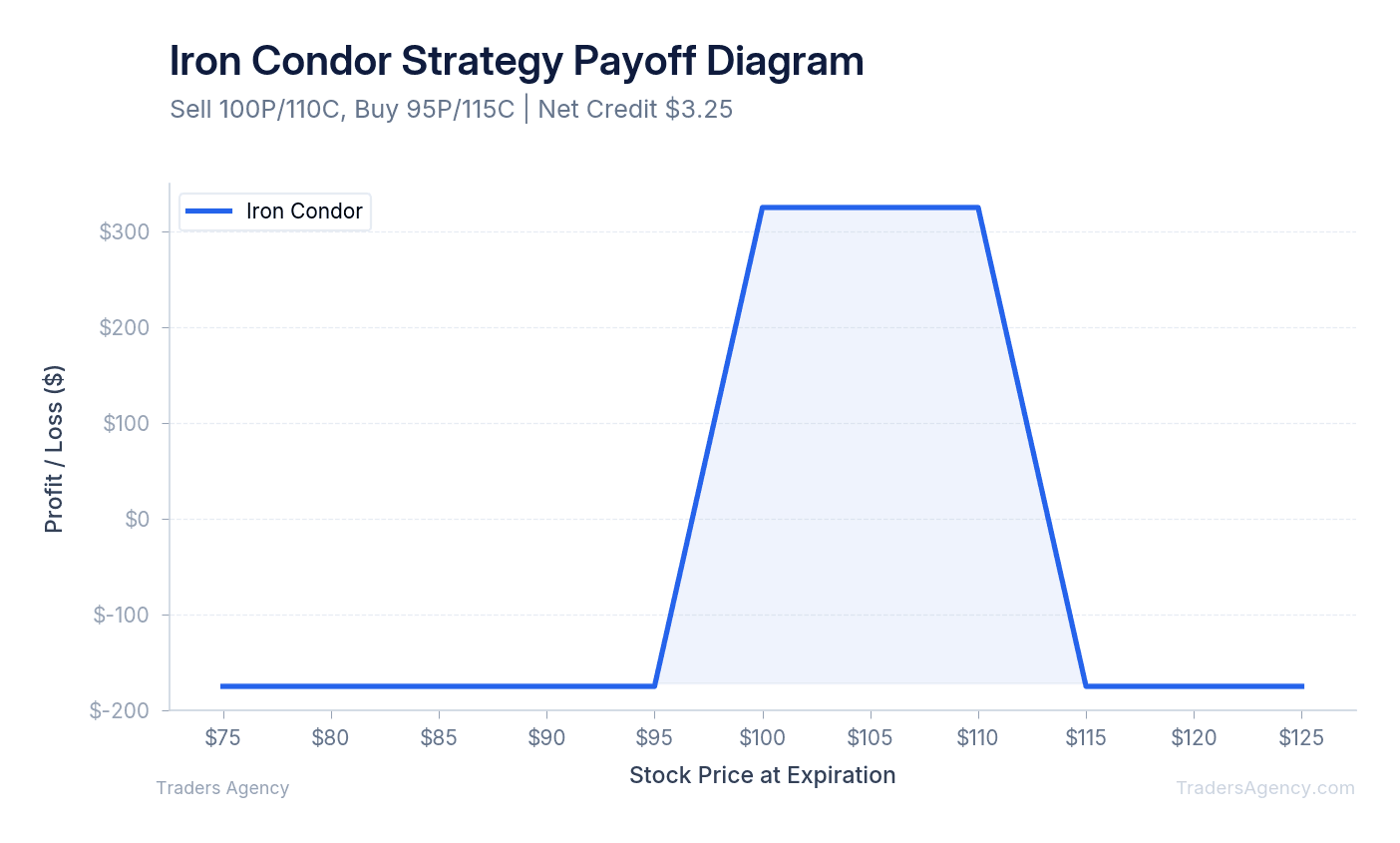
What Does the Profit/Loss Diagram Look Like?
A profit/loss diagram of an iron condor looks like a flat plateau in the middle with steep drop-offs on both sides that flatten out into defined loss zones. The central plateau represents your maximum profit zone, which occurs when the underlying price closes between your two short strike prices.
The visual representation of this trade makes the risk parameters incredibly clear. The flat top of the diagram shows your maximum profit, which is strictly limited to the net premium you collected when opening the trade. You cannot make more money than this initial credit, regardless of how perfectly the stock behaves.
The steep slopes on either side of the plateau represent the breakeven points. You calculate your upside breakeven by adding the net premium collected to your short call strike. You calculate your downside breakeven by subtracting the net premium collected from your short put strike.
The flat sections at the very bottom of the diagram represent your maximum loss. Because you purchased long wings (the further OTM options) to protect the position, your loss stops accumulating once the stock breaches those long strike prices. Your maximum risk equals the width of either spread minus the net premium collected, since the underlying can only breach one side at expiration.
How Do Greeks (Delta, Theta, Vega) Affect Your Iron Condor?
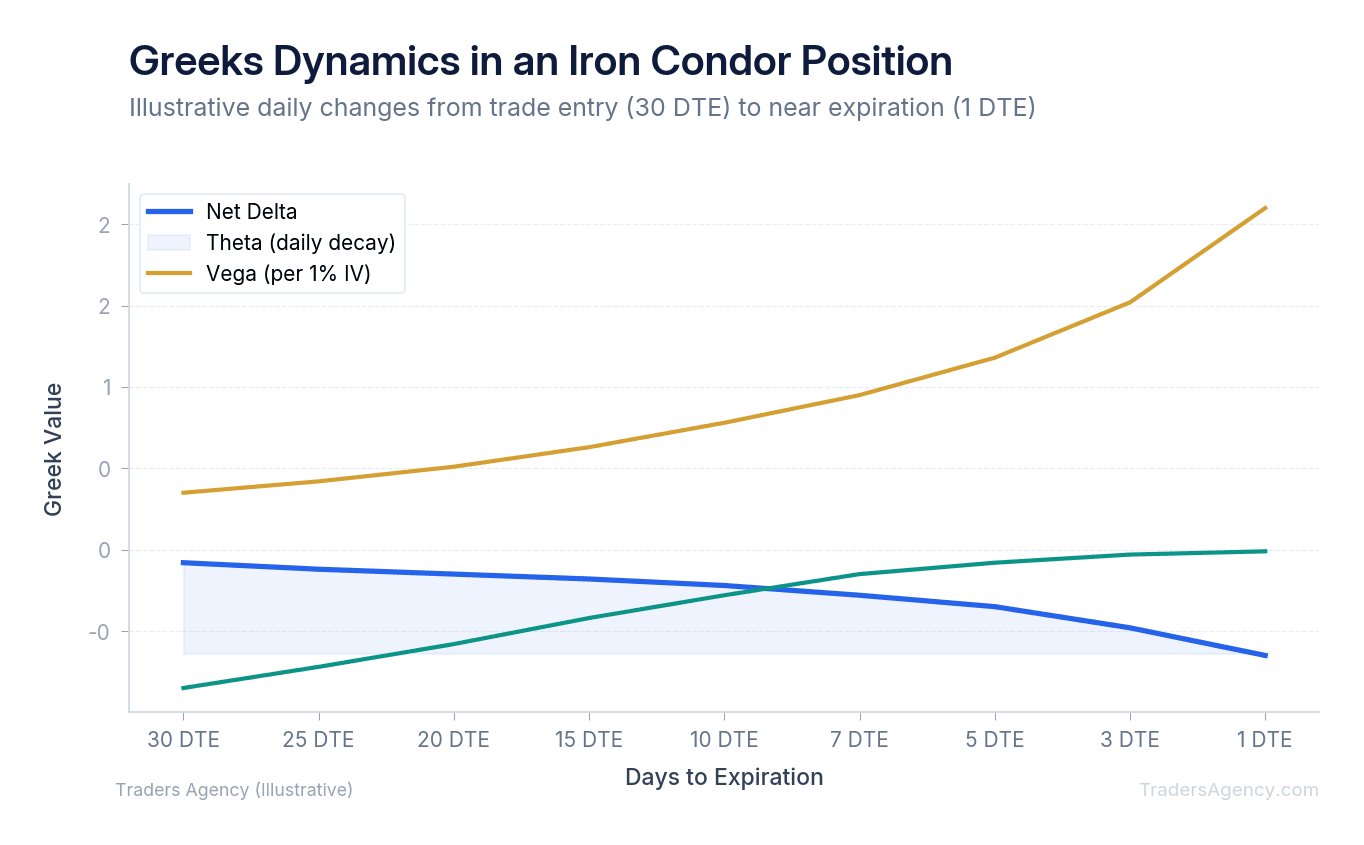
The iron condor strategy relies heavily on positive theta and negative vega. Positive theta means the position gains value as time passes and expiration approaches. Negative vega means the position benefits from a decrease in implied volatility. Delta is kept near neutral to minimize directional price risk.
Understanding the options Greeks is mandatory for managing advanced positions. You cannot simply place the trade and hope for the best. You must monitor how your exposure changes as the market moves.
Managing Delta Exposure
When you first open the position, your net delta should be close to zero. This means small moves in the underlying stock will not significantly impact your profitability. However, as the stock approaches one of your short strikes, your delta will expand rapidly. You must monitor this directional risk closely and be prepared to act.
Profiting from Theta Decay
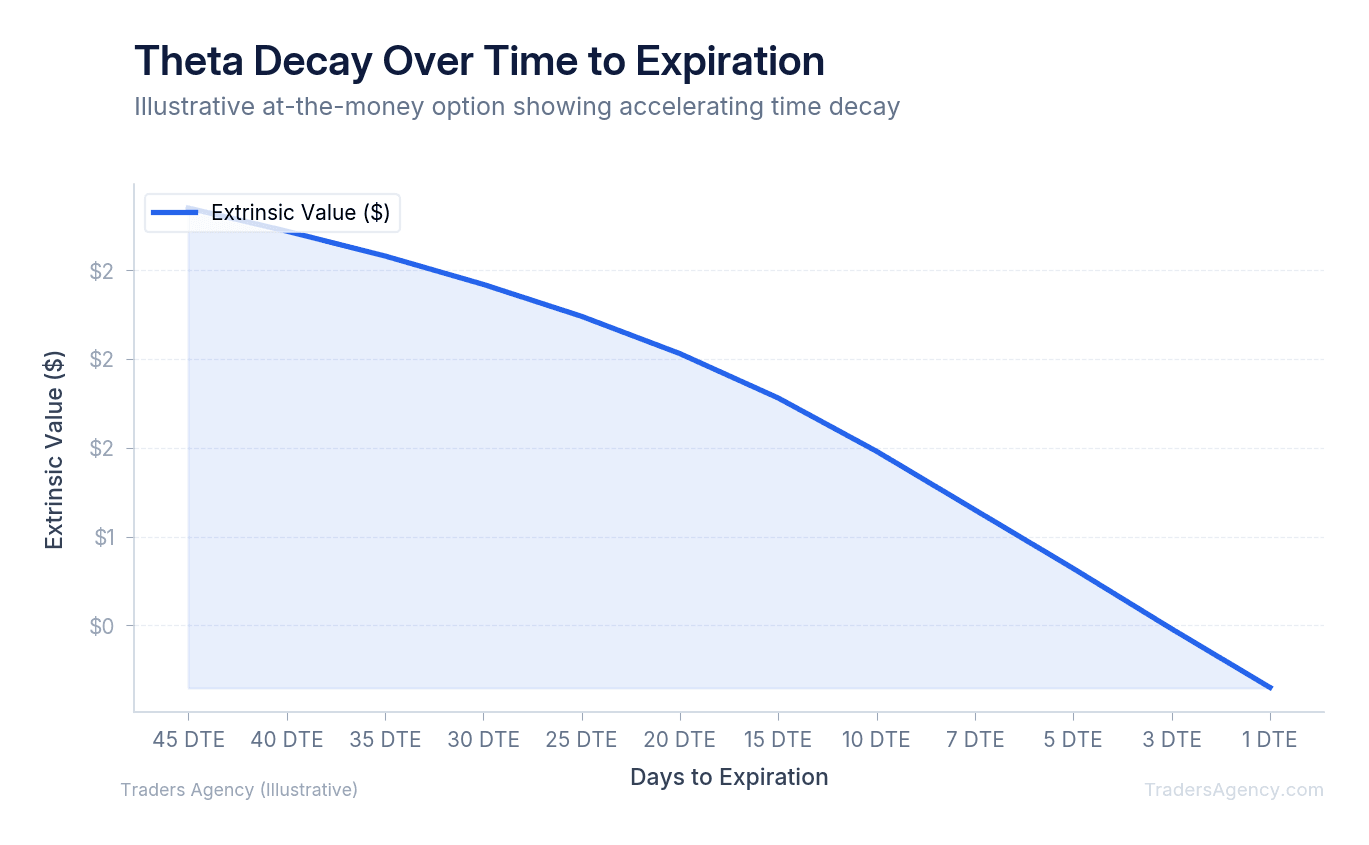
Theta is your primary profit engine. Every single day that passes without a major price swing puts money in your account. The rate of time decay accelerates as you get closer to expiration. Our team prefers to open these trades 30 to 45 days until expiration to capture the steepest part of the theta decay curve.
Surviving Vega Fluctuations
Vega measures your sensitivity to implied volatility. Because you are a net seller of options, you have a negative vega position. If implied volatility spikes after you enter the trade, the value of your short options will increase, resulting in a temporary paper loss. You want volatility to crush downward after you establish your position.
Key Concept: Theta is your profit engine, vega is your volatility risk, and delta is your directional exposure. A well-constructed iron condor starts with near-zero delta, strong positive theta, and negative vega. Monitor all three throughout the life of the trade.
Want expert trading insights delivered daily?
Join thousands of traders who rely on Traders Agency for market analysis and trade ideas.
Join Traders AgencyWhen Is the Best Time to Use an Iron Condor Strategy?
The best time to use an iron condor strategy is during periods of high implied volatility that you expect will contract over the life of the trade. Professional traders typically deploy this setup when a stock is consolidating in a defined trading range without upcoming earnings announcements or major macroeconomic events.
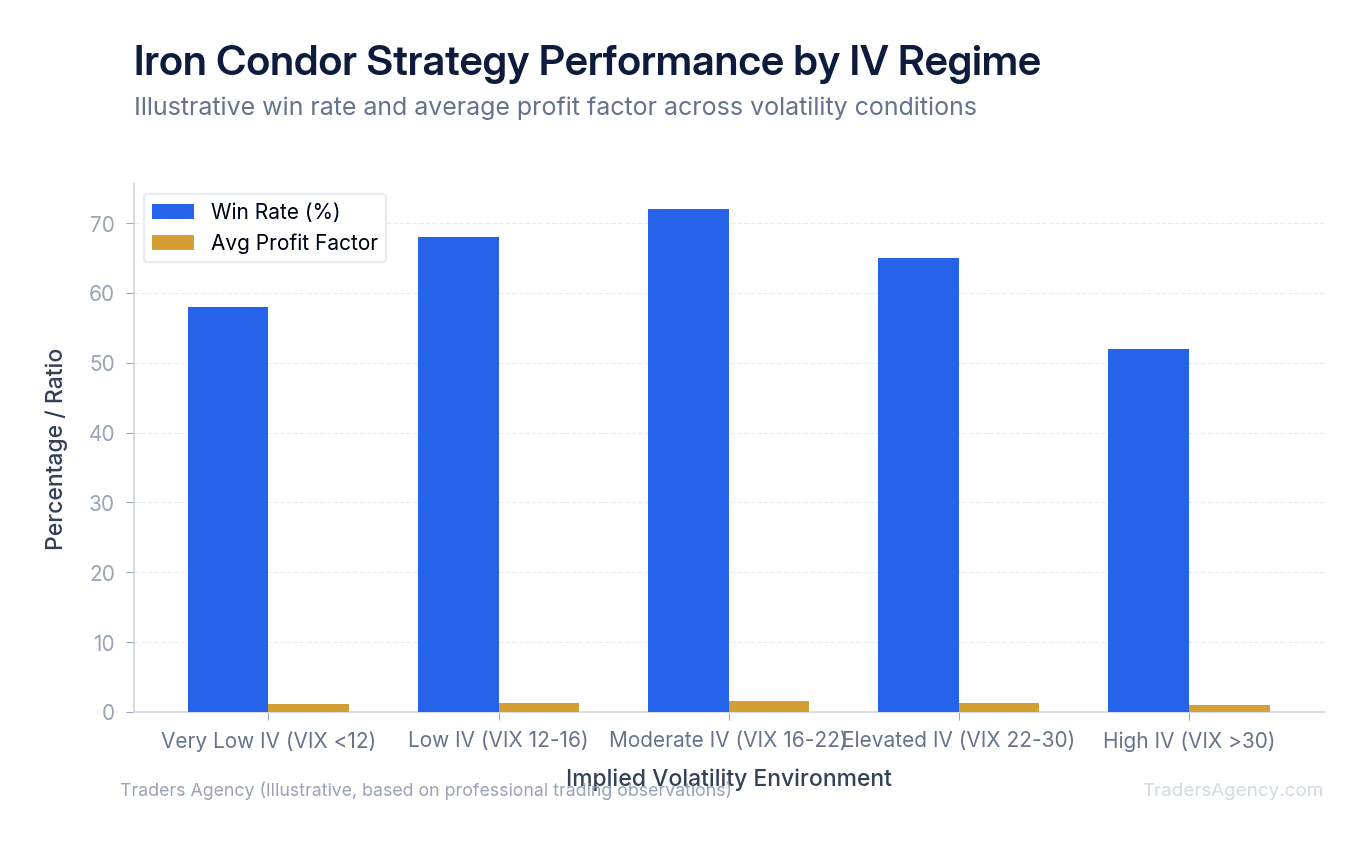
We teach our members to look for an Implied Volatility Rank (IVR) above 50. High IVR means options premiums are historically expensive. By selling when premiums are elevated, you can place your short strikes further away from the current stock price while still collecting an acceptable credit. This widens your profit tent and increases your probability of success.
You should strictly avoid placing these trades immediately before binary events. Earnings reports, FDA approvals, and major Federal Reserve announcements can cause massive, unpredictable price gaps. An iron condor cannot survive a 15% overnight gap against your short strikes.
Market context is everything. We prefer to trade this strategy on broad market indices like the SPX or RUT, or on large-cap, highly liquid stocks. Indices generally exhibit lower idiosyncratic risk than individual stocks, making violent, outsized moves less frequent.
Watch Out: Never place an iron condor immediately before earnings announcements, FDA decisions, or major Fed meetings. These binary events can cause overnight gaps that blow through both your short and long strikes, resulting in maximum loss.
What Does an Iron Condor Trade Look Like with Real Numbers?
Let's walk through a practical iron condor strategy example using a stock trading at $150 per share. We'll construct a 30-day position by selling the $140 put, buying the $135 put, selling the $160 call, and buying the $165 call to collect a net premium of $1.50.
Here is the exact breakdown of the four legs and their associated premiums:
| Leg | Action | Strike | Premium |
|---|---|---|---|
| Long Put | Buy | $135 | -$0.50 |
| Short Put | Sell | $140 | +$1.20 |
| Short Call | Sell | $160 | +$1.10 |
| Long Call | Buy | $165 | -$0.30 |
When you calculate the net credit, you take the premium collected ($1.20 + $1.10 = $2.30) and subtract the premium paid ($0.50 + $0.30 = $0.80). Your total net credit is $1.50 per share, or $150 total per contract. This $150 represents your absolute maximum profit.
Next, we calculate the maximum risk. Both the put spread and the call spread are $5 wide ($140 - $135 = $5, and $165 - $160 = $5). The maximum risk is the width of the spread ($5.00) minus the net credit received ($1.50). Your maximum loss is $3.50 per share, or $350 total per contract.
Finally, we determine the breakeven points. The downside breakeven is the short put strike minus the premium collected: $140 - $1.50 = $138.50. The upside breakeven is the short call strike plus the premium collected: $160 + $1.50 = $161.50. As long as the stock closes between $138.50 and $161.50 at expiration, you will retain at least some of your initial credit.
| Parameter | Value |
|---|---|
| Underlying Price | $150.00 |
| Net Credit Received | $1.50/share ($150 per contract) |
| Maximum Profit | $150 per contract |
| Maximum Loss | $350 per contract |
| Downside Breakeven | $138.50 |
| Upside Breakeven | $161.50 |
| Spread Width | $5.00 (both sides) |
| Days to Expiration | 30 |
How Do You Manage Risk and Adjust an Iron Condor Position?
Effective risk management for an iron condor strategy requires strict position sizing and predefined adjustment rules. Advanced traders often roll the untested side of the condor closer to the current stock price to collect additional premium, which helps offset losses if the underlying asset breaches one of the short strikes.
Defined-risk strategies still carry the potential for total loss of the capital allocated to the trade. We never allocate more than 2% to 3% of our total account equity to a single non-directional setup. Strict capital allocation is your first line of defense against a string of losing trades. The SEC provides additional educational resources on understanding options risk for those who want a broader regulatory perspective.
Taking Profits Early
You should rarely hold an iron condor all the way to expiration. Gamma risk increases exponentially in the final week of a trade, meaning small price movements can cause massive swings in your position's value. Our team's mechanical rule is to close the entire position once we capture 50% of the maximum profit. In our previous example, we would buy the condor back once its value dropped from $1.50 to $0.75.
Rolling the Untested Side
When the stock price aggressively tests one side of your condor, you must take action. If the stock rallies to $159 and threatens your short call, your put spread is now practically worthless. You can buy back the original put spread for pennies and sell a new put spread closer to the current stock price (for example, selling the $150 put and buying the $145 put). This adjustment brings in additional credit, reducing your maximum potential loss on the trade.
Knowing When to Accept the Loss
Sometimes the market simply moves too fast. If a stock blasts through your short strike and approaches your long protection strike, rolling the untested side will not generate enough premium to save the trade. In these scenarios, you must accept the predefined maximum loss and close the position. Hoping for a reversal is not a trading strategy.
Watch Out: Gamma risk spikes dramatically in the final 5 to 7 days before expiration. Small price moves can create outsized P/L swings. Our rule: close the trade at 50% of max profit or with at least one week remaining before expiration, whichever comes first.
Trading non-directional setups requires discipline, patience, and a deep understanding of market mechanics. By strictly adhering to your entry criteria, managing your Greeks, and executing mechanical profit-taking rules, you can effectively trade the iron condor strategy in flat market environments. Here's a quick summary of the management rules we follow:
- Size the position correctly: Never risk more than 2% to 3% of total account equity on a single iron condor.
- Take profits at 50%: Close the entire position once you've captured half of the maximum credit received.
- Roll the untested side when threatened: If the stock approaches a short strike, buy back the safe side for pennies and re-sell it closer to the current price to collect additional credit.
- Accept the loss when the trade is broken: If the stock breaches your short strike and approaches your long wing, close the position and move on.
- Avoid holding through expiration week: Gamma risk makes the final days unpredictable. Exit with time remaining.
Want expert trading insights delivered daily?
Join thousands of traders who rely on Traders Agency for market analysis and trade ideas.
Join Traders AgencyKey Takeaways
- The iron condor is a four-leg options setup built to collect premium upfront while capping maximum risk on both sides, making it a defined-risk trade from the moment you enter.
- The strategy works best in range-bound, low-volatility markets where the underlying asset is unlikely to make an extreme move before expiration.
- Exit the position once you've captured half of the maximum credit received rather than holding for full profit, which reduces gamma exposure in the final days.
- If the underlying approaches a short strike, you can roll the untested side closer to the current price to collect additional credit and rebalance the position.
- Avoid holding iron condors through expiration week: gamma risk makes price behavior unpredictable and can turn a winning trade into a loss quickly.
DISCLAIMER: Traders Agency does not offer financial advice. The information provided is for educational purposes only and should not be considered financial advice. Traders Agency is not responsible for any financial losses or consequences resulting from the use of the information provided. Trading carries inherent risks and may not be suitable for all individuals. You are advised to conduct your own research and seek personalized advice before making any investment decisions, recognizing the potential risks and rewards involved.
See more from Traders Agency on Google
Make us a preferred source and our market analysis will appear more prominently in your Google Search, Top Stories, and AI results.
Add to Preferred Sources