The VIX fear index is one of the most talked-about indicators in trading, and for good reason. When markets sell off, social media lights up with screenshots of massive gains on VIX-related products. These posts make trading volatility look effortless. The reality? It's far more complicated than a Reddit screenshot suggests. We're going to walk you through exactly how this index works, what retail traders on WallStreetBets actually get right, where they go dangerously wrong, and how our team uses the VIX to make smarter, safer trades.
What Is the VIX Fear Index?
Bottom Line: The VIX is a powerful signal, but most retail traders misuse it by treating volatility products as lottery tickets during market panic. The smarter approach is to let a rising VIX tell you when options premiums are expensive, then sell those premiums to collect income. Reading fear correctly is only half the job. Executing through the right vehicle is what separates consistent returns from a blown account.
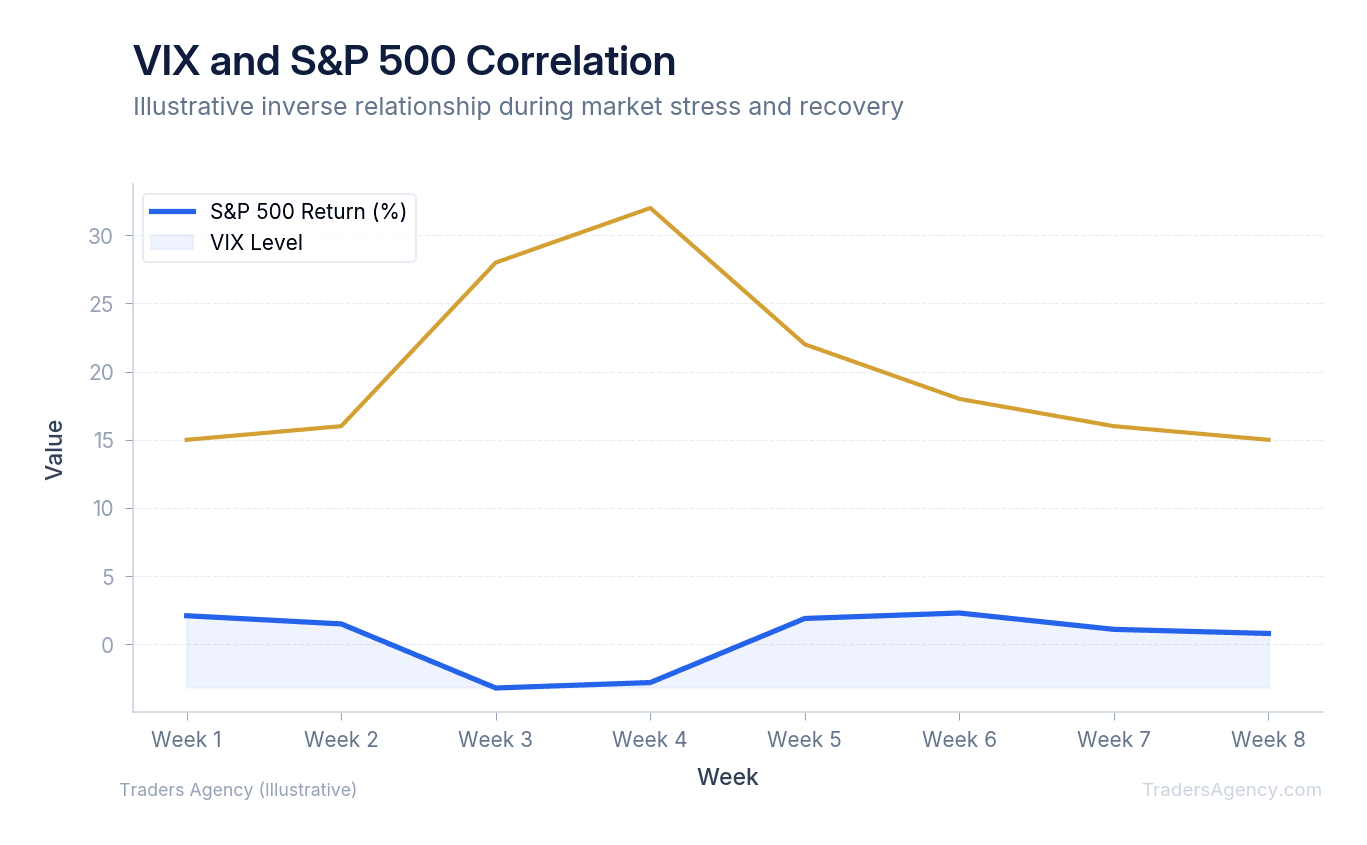
The VIX fear index is a real-time measure of expected stock market volatility over the next 30 days. Its performance is inversely related to the S&P 500. When the VIX goes up, the S&P 500 is usually going down. If the VIX is rising, demand for options is increasing and those options are becoming more expensive.
You've probably seen this play out on social media forums like WallStreetBets. A sudden market drop triggers widespread panic, and suddenly everyone is posting screenshots of their massive gains on VIX-related products. These posts make trading volatility look easy. The reality of trading market fear, however, is much more complicated.
By the end of this guide, you'll understand the true nature of market volatility. We'll show you how to read these signals, how to apply them to your own trading, and how to avoid the expensive mistakes that frequently wipe out beginner accounts.
Key Concept: The VIX measures expected volatility, not past volatility. It tells you what the options market thinks will happen over the next 30 days, based on the prices traders are willing to pay for S&P 500 options.
How Does the VIX Relate to the S&P 500?
The VIX relates to the S&P 500 through an inverse relationship driven by options pricing. When investors expect the S&P 500 to fall, they buy protective put options. This increased demand drives up options prices, which directly causes the VIX to rise and signal higher expected market turbulence.
Think of the VIX like an insurance premium for the stock market. When a hurricane is approaching a coastal town, the cost of flood insurance skyrockets. Similarly, when investors see a market storm coming, the cost to insure their stock portfolios goes up. The Chicago Board Options Exchange (CBOE) calculates this index in real time by looking at the prices people are willing to pay for options on the S&P 500.
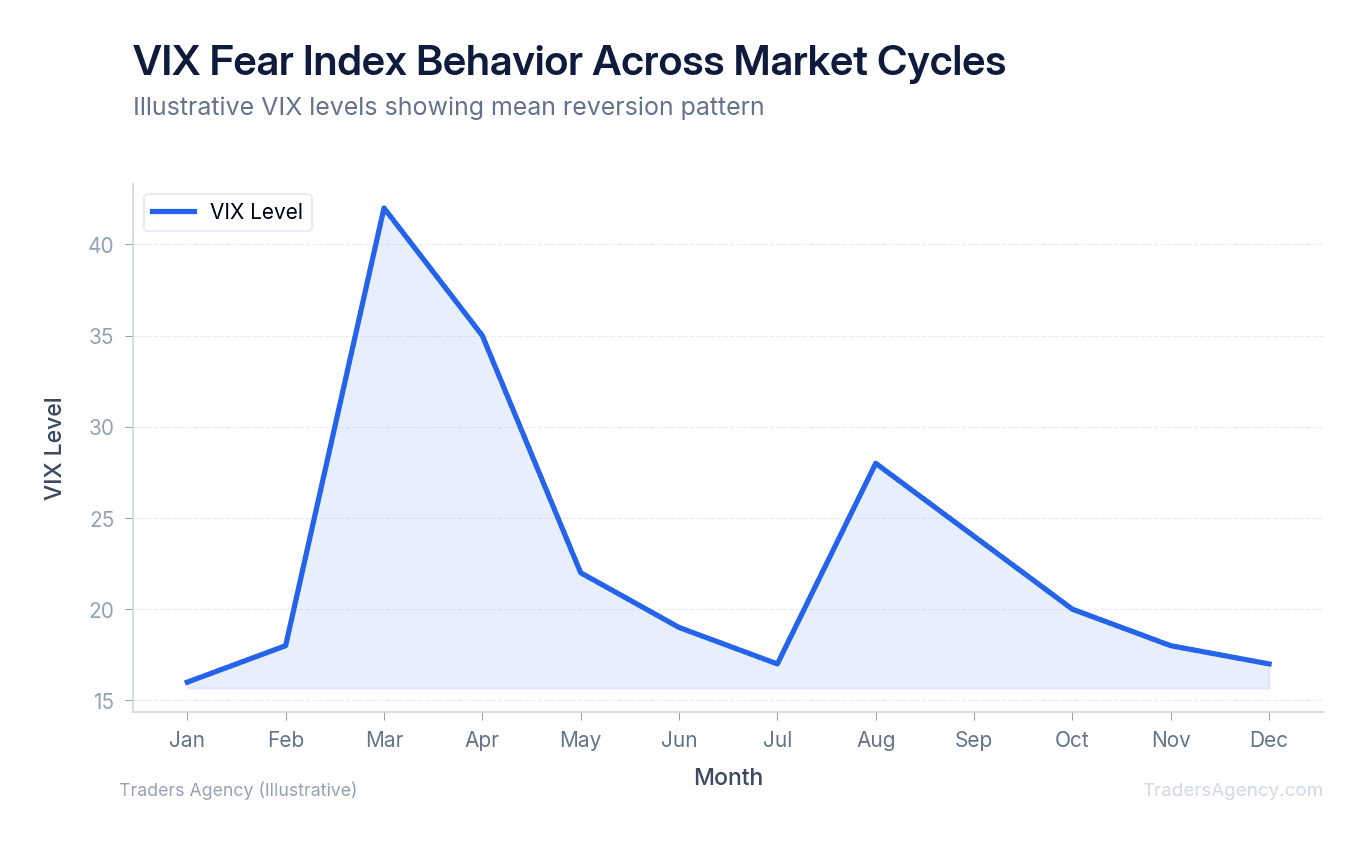
When the market is calm and trending upward, the VIX typically rests between 12 and 15. This means investors expect relatively small daily moves in stock prices. When a major shock hits the financial system, the index can easily spike above 30 or even 40. A reading of 30 implies that the market expects annualized volatility of 30%, which translates to expected daily price swings of roughly 1.9%.
What Does WSB Actually Get Right About Market Fear?
Social media traders on WallStreetBets (WSB) are famous for their aggressive trading styles. While our team prefers a more structured approach, we acknowledge that these retail communities actually get a few things right about the VIX fear index. They have excellent instincts for identifying true market panic.
First, they recognize that volatility creates opportunity. When the VIX spikes, stock prices are usually dropping rapidly across the board. This blind panic selling often creates temporary mispricing in the market. High-quality companies get sold off right alongside failing businesses. WSB traders correctly identify these moments of peak fear as potential buying opportunities.
Second, they understand the concept of mean reversion. Mean reversion simply means that extreme prices tend to return to their historical averages over time. A VIX reading of 45 is not sustainable for long periods. Eventually, the panic subsides, and the index drifts back down toward 15.
When the index hits these extreme highs, fear is peaking. We teach our members that peak fear often aligns with short-term market bottoms. Buying stocks when the VIX is above 35 has historically been a highly profitable strategy for patient investors.
Why Do VXX and UVXY Decay Over Time?
Products like VXX and UVXY decay over time because of a structural pricing mechanic called contango. These funds do not hold the spot VIX. Instead, they hold futures contracts that constantly lose value as they are rolled over to more expensive contracts in the following month.
This is the most expensive lesson a beginner can learn. You cannot actually buy the VIX directly. It is just a math formula, not a tangible asset. To trade it, Wall Street created Exchange Traded Products (ETPs) like VXX and UVXY. These products buy VIX futures contracts to track the index.
A futures contract is an agreement to buy something at a set price on a future date. In normal market conditions, VIX futures expiring further out in time cost more than contracts expiring today. This upward-sloping price curve is what we call contango.
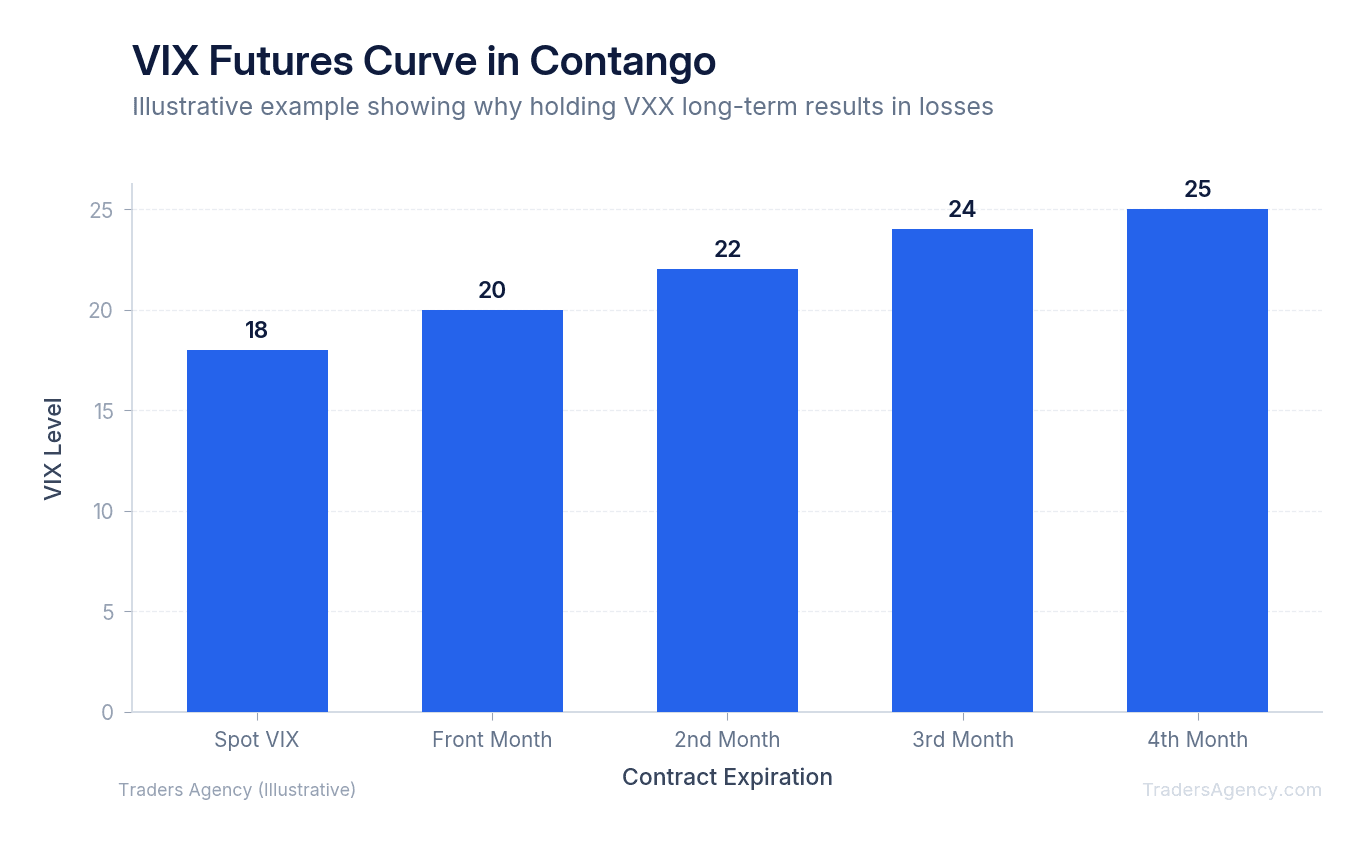
Because the fund managers must constantly sell expiring near-term contracts and buy more expensive longer-dated contracts to maintain exposure, the fund slowly bleeds money. This daily loss is the decay that destroys long-term holders. Think of holding VXX like buying a block of ice. Every single day, a little piece of your investment melts away.
Watch Out: Holding VXX or UVXY for more than a few days can result in devastating losses, even if the VIX itself stays flat. These products are designed for short-term tactical trades only, not portfolio hedging.
Want expert trading insights delivered daily?
Join thousands of traders who rely on Traders Agency for market analysis and trade ideas.
Join Traders AgencyThe Biggest Mistakes Retail Traders Make With the VIX
The most common mistake we see is using products like VXX as a long-term portfolio hedge. Retail traders often look at traditional fear and greed indicators, see that the market is greedy, and buy VXX to protect themselves. They assume that if the market crashes next year, their VXX shares will save them.
This is mathematically flawed. Due to the contango decay we just explained, holding VXX for six months can result in a 30% to 50% loss even if the actual VIX stays completely flat.
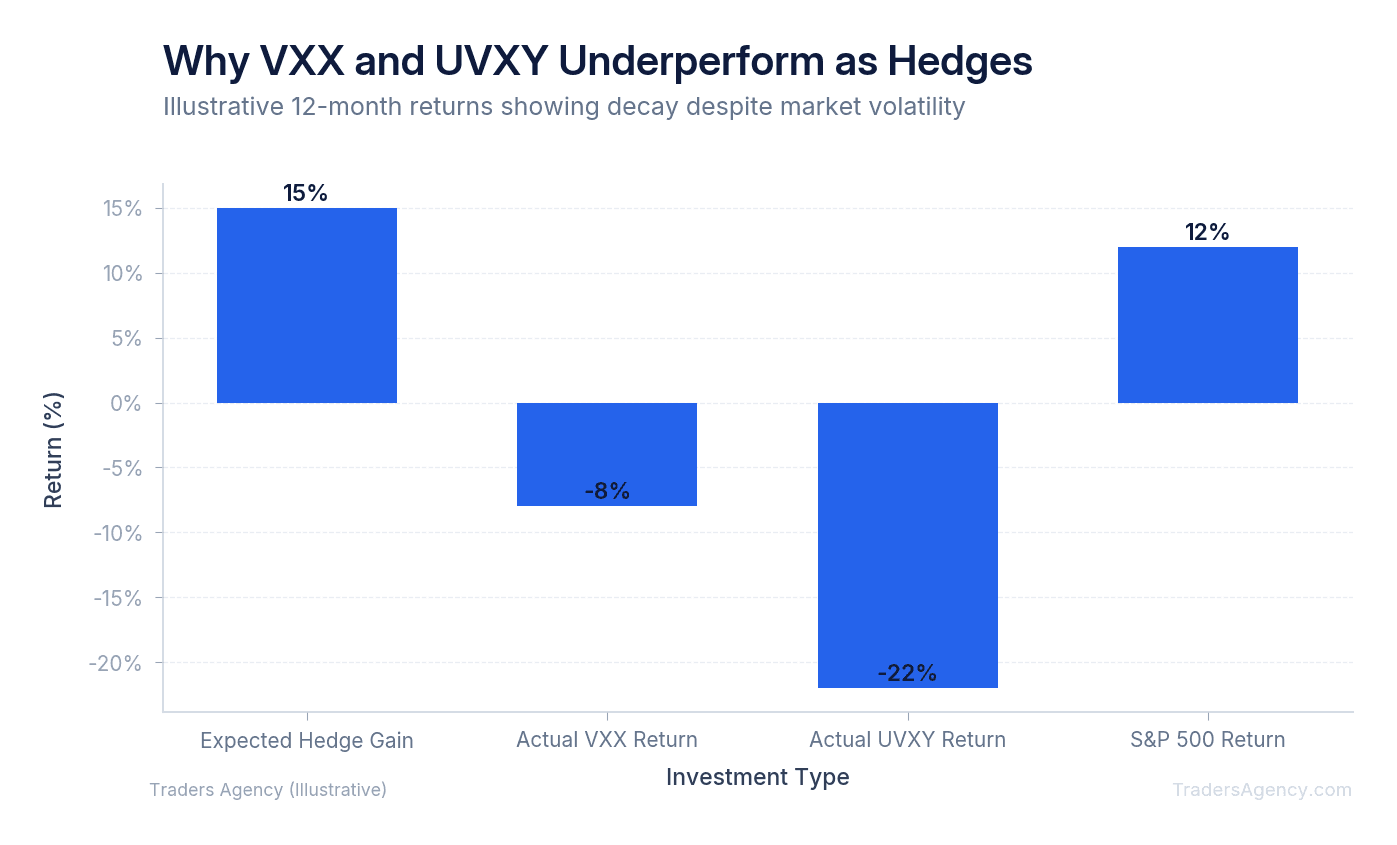
Another major error is buying volatility after the spike has already happened. By the time you see screenshots of massive VXX gains on social media, the move is usually over. Buying the top of a volatility spike guarantees heavy losses as the index reverts to its mean. The SEC has published educational resources warning retail investors about the complex risks of holding these specific volatility products for more than a single trading day.
Common Trap: If you're seeing VIX gains on social media, you're already late. Buying VXX or UVXY after a volatility spike is one of the fastest ways to lose money in the market. The mean reversion that makes these spikes profitable for early traders works directly against latecomers.
How Do You Use the VIX Fear Index in a Trading Strategy?
Instead of buying decaying products, our team prefers to use the VIX as a market timing indicator. We look for extreme readings to help us decide when to buy or sell standard stocks and options. We use the fear gauge to sell options when premiums are expensive.
Here is a concrete example of how we teach our members to trade a volatility spike. We'll look at a hypothetical scenario using SPY, the ETF that tracks the S&P 500.
Step-by-Step: Trading a VIX Spike With Cash-Secured Puts
- Identify the Setup: Establish a baseline. The VIX has been resting at 14 for several weeks. Suddenly, bad economic news hits the market. The VIX fear index spikes to 35 in just two days. At the same time, SPY drops from $500 down to $460. The market is in full panic mode, and retail traders are selling everything.
- Execute the Trade: We do not buy VXX. Instead, we look to sell cash-secured put options on high-quality stocks or SPY itself. When the VIX is at 35, option premiums are incredibly expensive because everyone is rushing to buy insurance. You could sell a 30-day put option on SPY at a strike price of $440. Because fear is so high, a buyer might pay you a $500 premium for this single contract. By selling a cash-secured put, you are agreeing to buy 100 shares of SPY at $440 if it drops that low. You must have $44,000 in cash in your account to secure this trade.
- Manage the Outcome: Monitor the position and understand the three possible scenarios outlined below. In the first two cases, you profit from the premium collected. In the worst case, you own shares at a discount to the recent price but face potential further losses if the market continues to decline.
| Scenario | SPY Price at Expiration | Result |
|---|---|---|
| Best Case | Above $440 (panic subsides, VIX drops to 20) | Option expires worthless. You keep the full $500 premium as profit. |
| Most Likely Case | Chops sideways, stays above $440 | Option expires worthless. You still keep the $500 premium. |
| Worst Case | Crashes to $420 | You buy 100 shares at $440, but your breakeven is $435 after the $500 collected. You own SPY at a discount to its recent $500 price, though you face an unrealized loss of $1,500 at $420. |
Trade Parameters Summary
| Parameter | Value |
|---|---|
| Underlying | SPY at $460 |
| Put Sold | $440 strike, $5.00 premium ($500 per contract) |
| Expiration | 30 days |
| Capital Required | $44,000 (cash-secured) |
| Max Profit | $500 (premium collected) |
| Breakeven | $435 per share |
When Should You Use This Strategy?
You should use this strategy when the VIX fear index spikes rapidly above 30 during a short-term market panic. These conditions favor option sellers because premiums are artificially inflated. You should avoid this strategy during calm markets when the index is below 15 and premiums are cheap.
Risk management is the foundation of everything we teach. You should never allocate your entire account to a single trade, no matter how high the fear gauge spikes. Selling put options requires significant capital, and a prolonged bear market can tie up your funds for months.
Our team recommends keeping your position sizing small. If you are selling options during a high-volatility event, only use 10% to 20% of your total account capital. This leaves you with plenty of cash to deploy if the market drops even further.
To safely trade around market fear, you must follow a strict set of rules. Here are the criteria we use before entering a trade based on volatility:
- Wait for the VIX to break cleanly above 30.
- Confirm that the S&P 500 has dropped at least 5% from its recent highs.
- Sell options that expire in 30 to 45 days to give the panic time to subside.
- Keep your maximum allocation under 20% of your total account value.
- Never buy VXX or UVXY as a long-term investment.
Remember This: The goal is not to trade the VIX directly. The goal is to use the VIX as a signal that tells you when options premiums are expensive, then sell those expensive options to collect inflated income. You're trading the fear, not the index itself.
By following these rules, you can take advantage of the same market panic that WSB traders spot, but you'll execute your trades using much safer mechanics. The difference between a disciplined approach and a YOLO trade is often the difference between consistent returns and a blown account.
Want expert trading insights delivered daily?
Join thousands of traders who rely on Traders Agency for market analysis and trade ideas.
Join Traders AgencyKey Takeaways
- The VIX measures expected S&P 500 volatility over the next 30 days and moves inversely to the index, rising when the market sells off and falling when it recovers.
- When the VIX spikes, options premiums inflate across the board, creating an opportunity to sell those expensive options and collect elevated income rather than buying VIX products directly.
- Products like VXX and UVXY are not suitable as long-term holdings. They are designed for short-term trades and lose value over time due to the structure of volatility futures.
- The core strategic insight is to trade the fear, not the index itself. Use VIX spikes as a signal that options are overpriced, then position as a seller to capture that inflated premium.
- The difference between how disciplined traders and WSB traders use the VIX often comes down to mechanics: spotting the same signal but executing through safer, income-focused strategies instead of directional bets.
DISCLAIMER: Traders Agency does not offer financial advice. The information provided is for educational purposes only and should not be considered financial advice. Traders Agency is not responsible for any financial losses or consequences resulting from the use of the information provided. Trading carries inherent risks and may not be suitable for all individuals. You are advised to conduct your own research and seek personalized advice before making any investment decisions, recognizing the potential risks and rewards involved.
See more from Traders Agency on Google
Make us a preferred source and our market analysis will appear more prominently in your Google Search, Top Stories, and AI results.
Add to Preferred Sources