
You have probably seen the headlines about massive technology companies scrambling for electricity to power their new artificial intelligence data centers. The nuclear energy investment thesis is a strategy focused on capitalizing on this growing global demand for nuclear power and the structural supply deficit of uranium. It is a specific approach to commodity trading that requires patience, risk management, and an understanding of long-term market cycles. We are going to walk you through how to trade this long-cycle commodity, and by the end of this guide, you will know exactly how to structure a trade using uranium equities and ETFs.
Our team prefers to approach this sector with a mix of direct equity exposure and defined-risk options strategies. You will also understand the market mechanics driving the price of these assets and why this opportunity exists right now.
We teach our members to look past the daily noise and focus on the underlying supply and demand fundamentals. Uranium is not like software or consumer goods. It takes years to permit and build a new mine. This massive lag time creates unique opportunities for prepared traders.
What Is the Nuclear Energy Investment Thesis?
Bottom Line: The nuclear energy investment thesis is a long-cycle commodity trade built on a supply deficit that cannot be fixed quickly, no matter how strong demand becomes. Traders who approach it with small position sizes, liquid tickers, and defined-risk options structures are better positioned to stay in the trade long enough to benefit. The core lesson is that patience and risk management matter more here than timing a precise entry.
The nuclear energy investment thesis is the financial expectation that uranium prices and nuclear-related stocks will rise due to a severe imbalance between supply and demand. This imbalance is driven by clean energy mandates, artificial intelligence data center power needs, and a decade of underinvestment in new uranium mines.
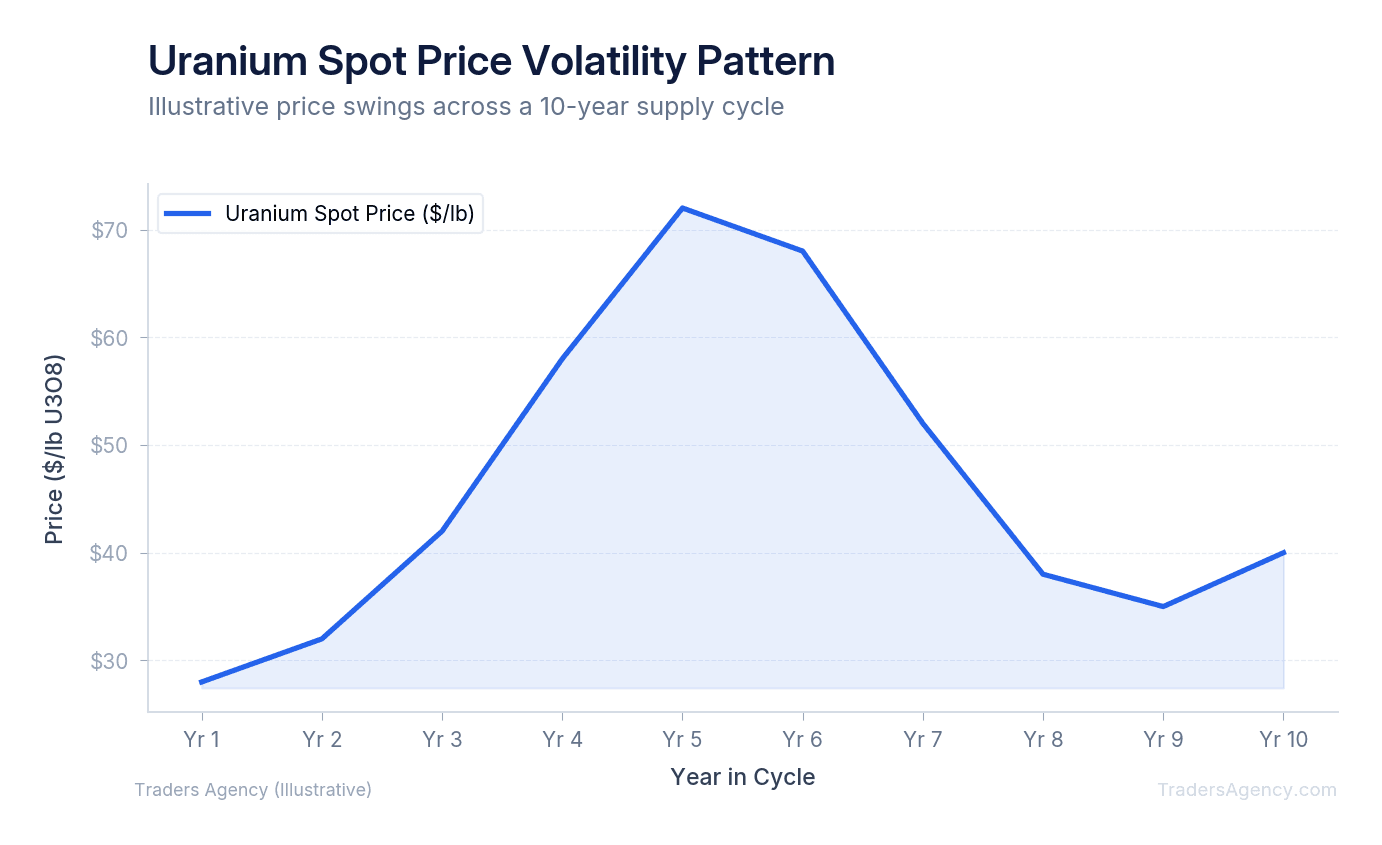
To understand why this works, you have to look at the market mechanics of the uranium supply cycle. Following the Fukushima disaster in 2011, the price of uranium crashed. Mines closed, exploration stopped, and utility companies lived off existing stockpiles. For nearly a decade, the world consumed more uranium than it mined.
Now, those stockpiles are depleted. Global reactor requirements data consistently shows a widening gap between what reactors need and what mines currently produce. Utility companies are now forced to sign long-term contracts at higher prices to secure their fuel.
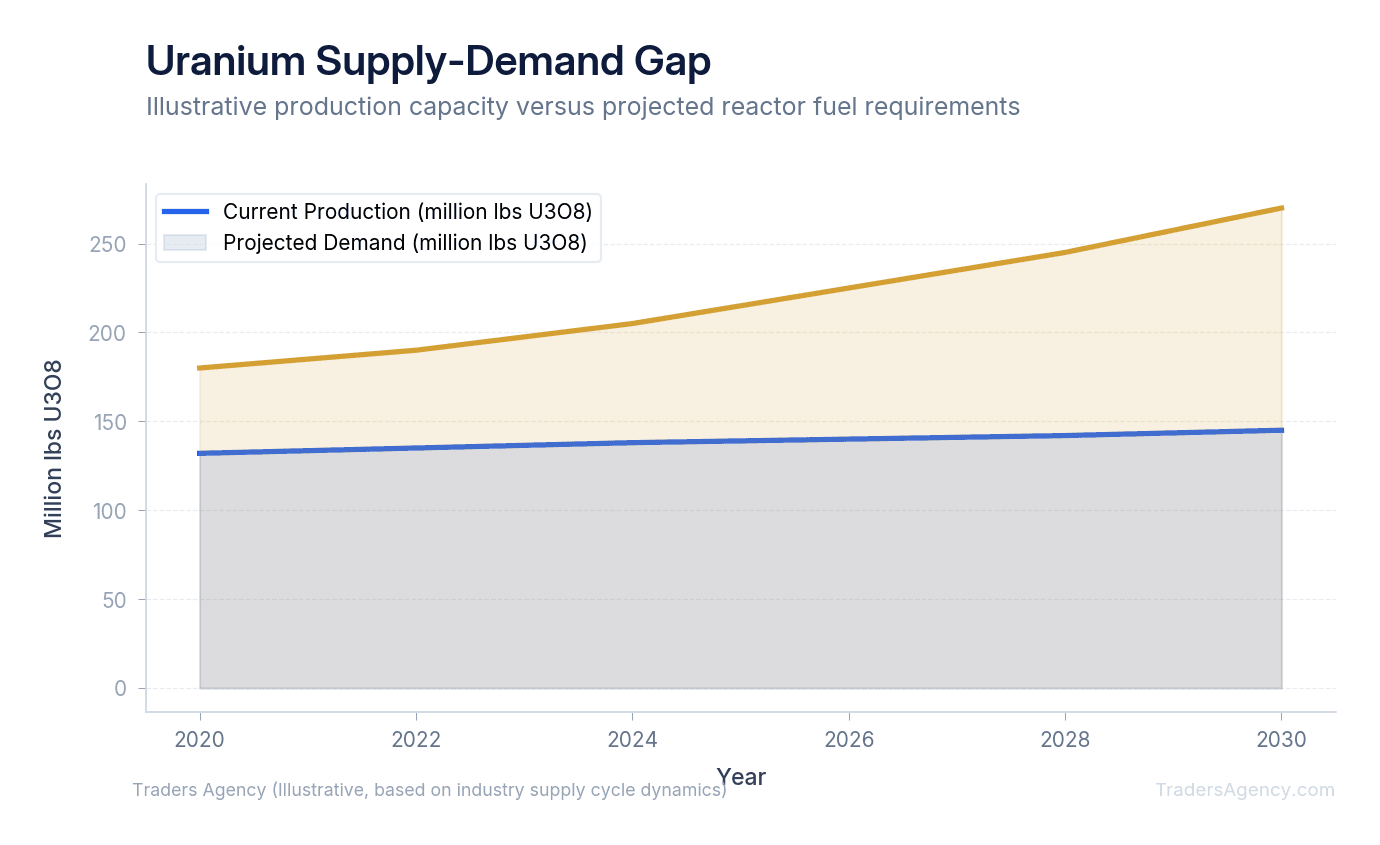
Key Concept: This is a classic commodity supercycle setup. Because it takes up to ten years to bring a new uranium mine into production, higher prices cannot immediately solve the supply shortage. This structural lag is exactly what creates sustained upward pressure on uranium equities.
How Do You Invest in Uranium and Nuclear Energy?
Traders can invest in uranium and nuclear energy through individual mining stocks, physical uranium trusts, or sector-specific exchange-traded funds (ETFs). Our team recommends using ETFs like URA or URNM for broad exposure, or large-cap producers like CCJ for targeted equity trades.
Here is a breakdown of the primary vehicles we use to trade this sector:
- CCJ (Cameco Corporation): The largest publicly traded uranium producer in the world. It offers high liquidity and excellent options volume. We prefer trading CCJ when we want to execute covered calls or cash-secured puts.
- URA (Global X Uranium ETF): The broadest ETF in the space. It holds uranium miners, but it also includes companies involved in nuclear components and infrastructure. It is less volatile than pure-play miners.
- URNM (Sprott Uranium Miners ETF): A pure-play exposure vehicle. It holds physical uranium trusts and companies exclusively focused on mining. It is highly volatile and offers direct exposure to the spot price of uranium.
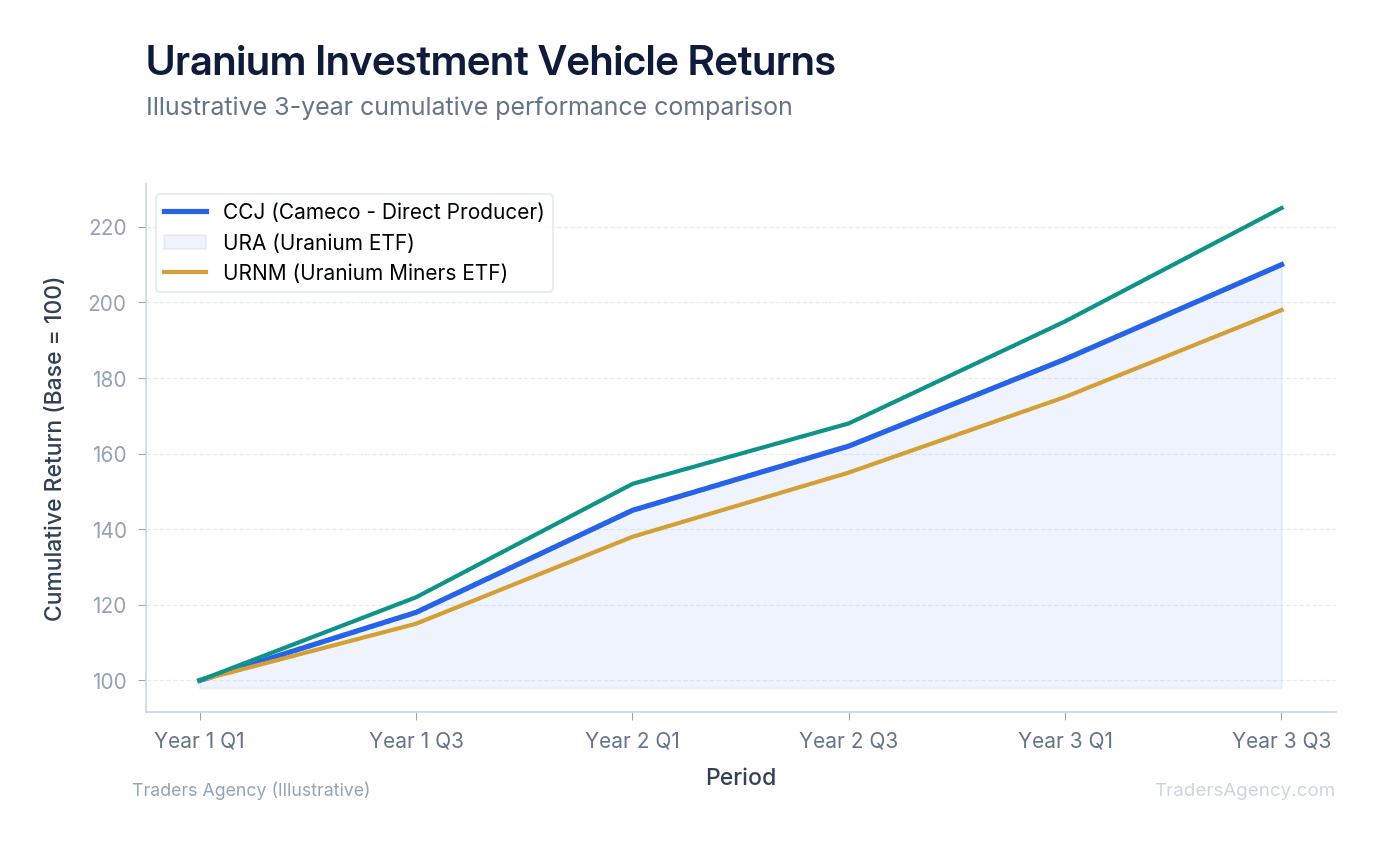
When choosing your exposure, you must match the vehicle to your trading style. If you want broad, lower-risk exposure, URA is the logical choice. If you want aggressive, high-beta price action, URNM will move much faster.
Why Are AI Data Centers Driving Demand for Nuclear Energy?
The recent surge in artificial intelligence development requires massive amounts of electricity. U.S. energy projections point to unprecedented increases in commercial electricity consumption over the next decade. Tech companies are building data centers that require gigawatts of power to train AI models.
These data centers require baseload power. Baseload power means electricity that is generated 24 hours a day, seven days a week, without interruption. Solar and wind energy are intermittent, meaning they only generate power when the sun shines or the wind blows.
Nuclear energy is the only clean energy source capable of providing reliable baseload power at the scale tech companies require. This is why major technology firms are directly funding the restart of dormant nuclear plants and investing in small modular reactor technology.
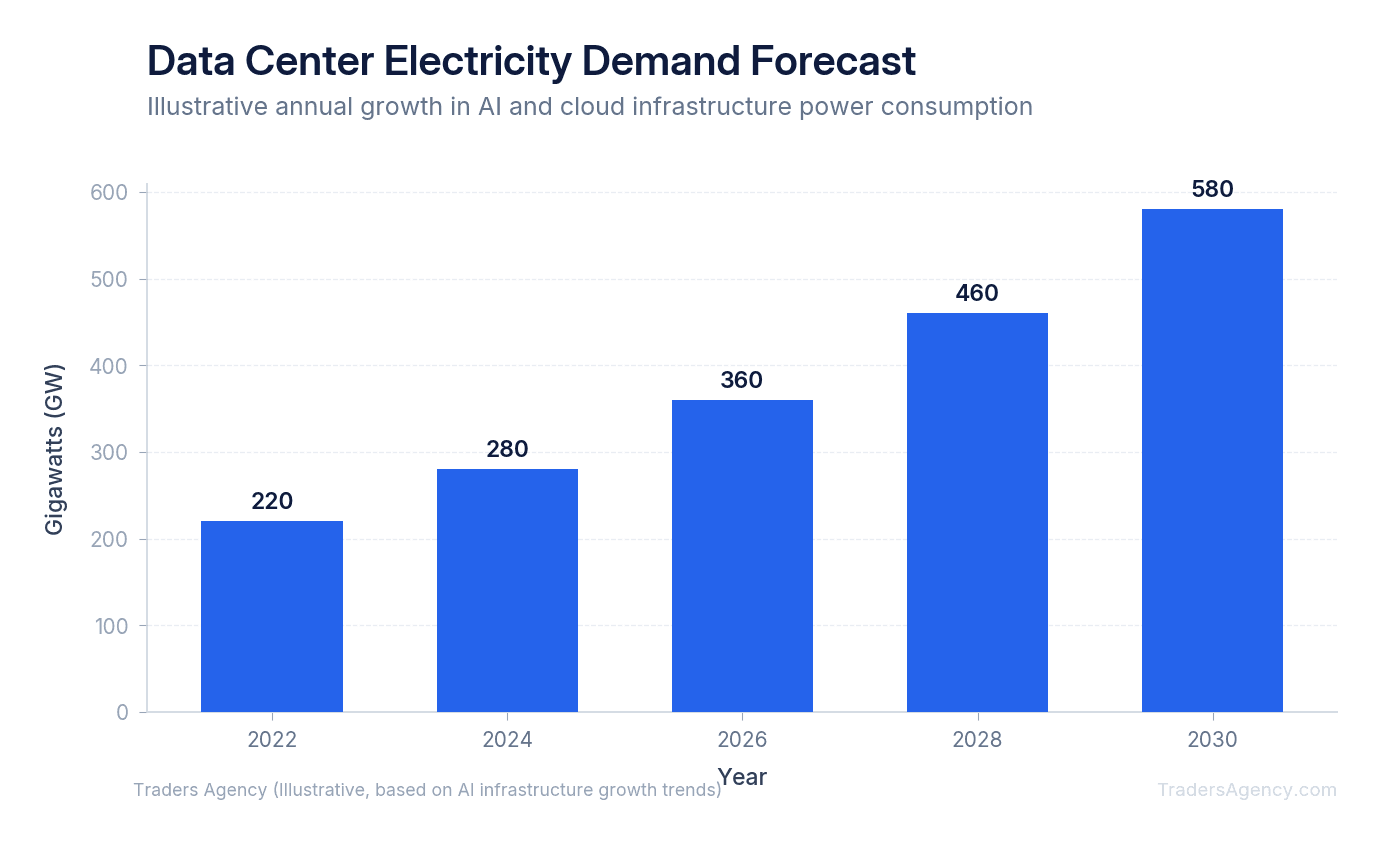
This creates a powerful secondary demand driver. We are no longer just relying on traditional utility companies to buy uranium. We now have the wealthiest technology companies in the world actively participating in the nuclear energy market.
Want expert trading insights delivered daily?
Join thousands of traders who rely on Traders Agency for market analysis and trade ideas.
Join Traders AgencyHow Do You Trade a Covered Call on CCJ?
We prefer to use defined-risk options strategies when trading volatile commodities. Here is a concrete example using a covered call strategy on CCJ. This strategy allows us to capture upside potential while generating income to lower our cost basis.
Key Concept: A covered call involves owning 100 shares of a stock and selling one call option against that position to collect premium income. The premium you collect immediately lowers your breakeven price on the trade.
- Identify the Setup: First, we look for a favorable entry point on the daily chart. We want to see the stock trading above its 200-day moving average, indicating a long-term uptrend. Assume CCJ is currently trading at $48.00 per share. The spot price of uranium is holding steady above $85 per pound, giving us confidence in the underlying commodity strength. Implied volatility is elevated, meaning options premiums are relatively expensive. This is the perfect environment for a covered call.
- Execute the Trade: To execute a covered call, you must buy 100 shares of the underlying stock and sell one call option contract against those shares. Buy 100 shares of CCJ at $48.00 (Capital outlay: $4,800). Sell 1 contract of the CCJ $52.00 Call expiring in 45 days. Collect premium of $1.50 per share (Total premium collected: $150). By collecting this premium, you immediately lower your breakeven price to $46.50 ($48.00 purchase price minus $1.50 premium).
- Manage the Outcome: When expiration day arrives in 45 days, three scenarios can play out. Review the table below to see exactly what happens in each case.
| Scenario | CCJ Price at Expiration | Result | Total Profit/Loss |
|---|---|---|---|
| Best Case (Max Gain) | $55.00 | Shares called away at $52 strike + premium kept | +$550 (11.5% return in 45 days) |
| Most Likely Case | $49.00 | Call expires worthless, keep shares + premium | +$250 ($100 stock gain + $150 premium) |
| Worst Case | $40.00 | Loss on shares, buffered by premium collected | -$650 (still own shares for recovery) |
How Does Nuclear Energy Fit in a Diversified Portfolio?
Uranium has a historically low correlation to the S&P 500 and the Nasdaq. It moves based on its own specific supply and demand fundamentals. This makes the nuclear energy investment thesis an excellent diversification tool for intermediate traders.
When the broader technology sector experiences a pullback, uranium stocks often trade completely independently. They are driven by utility contracting cycles and geopolitical supply shocks, not by consumer spending or interest rate fluctuations.
However, this independence comes with extreme volatility. Position sizing is absolutely essential when trading this sector. A common mistake we see traders make is allocating too much capital to a single mining stock.
Our team recommends capping your total exposure to long-cycle commodities at 5% to 8% of your total portfolio. If you are trading individual junior miners (small companies that do not yet produce uranium), that allocation should be even smaller. You must size your positions so that a 30% drawdown in the sector does not ruin your trading account.
When Should You Avoid This Strategy?
You should avoid trading uranium if you cannot stomach sharp, sudden drawdowns. This is not a sector for traders looking for smooth, low-volatility returns. The market is small, and a single news event can cause massive price swings.
Avoid this strategy if you are looking for quick, intraday scalps. The fundamentals of the uranium market play out over months and years, not minutes. If you try to day-trade these ETFs based on five-minute charts, you will likely get chopped up by the wide bid-ask spreads.
Watch Out: Here are three common mistakes you must avoid when trading the nuclear energy sector.
- Chasing parabolic rallies: When uranium stocks make headlines, retail traders often rush in and buy at the top. We teach our members to buy pullbacks to major moving averages, never to chase green candles.
- Ignoring geopolitical risks: A massive percentage of global uranium production and enrichment happens in politically unstable regions like Kazakhstan and Russia. Supply chains can be disrupted overnight by sanctions or export bans. You must stay aware of global news. You can monitor relevant geopolitical developments through the U.S. Energy Information Administration's nuclear data portal.
- Failing to use stop losses: If you are buying individual mining stocks instead of ETFs, you must use hard stop losses. Mining is a difficult business. Mines flood, permits get denied, and companies go bankrupt. Never hold a losing junior miner hoping it will bounce back.
Trading the nuclear energy sector requires discipline. Stick to highly liquid vehicles like CCJ, URA, and URNM. Use defined-risk options strategies to lower your cost basis. Keep your position sizes small, and let the long-term supply deficit work in your favor. You can research options volume and chain data for these tickers on the CBOE options exchange.
Our education team publishes new strategy guides and market analysis every week. If this approach to commodity trading resonates with your style, we encourage you to keep learning with us.
Want expert trading insights delivered daily?
Join thousands of traders who rely on Traders Agency for market analysis and trade ideas.
Join Traders AgencyKey Takeaways
- The nuclear energy investment thesis centers on a structural supply deficit: uranium mines take years to permit and build, creating a lag that keeps supply constrained even as demand accelerates.
- AI data center power demand is a primary catalyst driving institutional interest in nuclear energy stocks right now, alongside existing clean energy mandates.
- The preferred vehicles for trading this thesis are CCJ, URA, and URNM, chosen specifically for their liquidity and options market depth.
- Defined-risk options strategies, such as covered calls, are recommended to lower cost basis on uranium equity positions rather than taking outright long exposure.
- Position sizing discipline is critical in this sector because uranium is a long-cycle commodity, meaning the trade may take years to fully play out.
DISCLAIMER: Traders Agency does not offer financial advice. The information provided is for educational purposes only and should not be considered financial advice. Traders Agency is not responsible for any financial losses or consequences resulting from the use of the information provided. Trading carries inherent risks and may not be suitable for all individuals. You are advised to conduct your own research and seek personalized advice before making any investment decisions, recognizing the potential risks and rewards involved.
See more from Traders Agency on Google
Make us a preferred source and our market analysis will appear more prominently in your Google Search, Top Stories, and AI results.
Add to Preferred Sources