


The market is actively hunting for the next GameStop meme stock, but most retail traders are looking in the wrong places. A true short squeeze requires a very specific mathematical setup: a tiny share float, high short interest, and a trapped base of institutional sellers forced to buy back shares at the worst possible time.
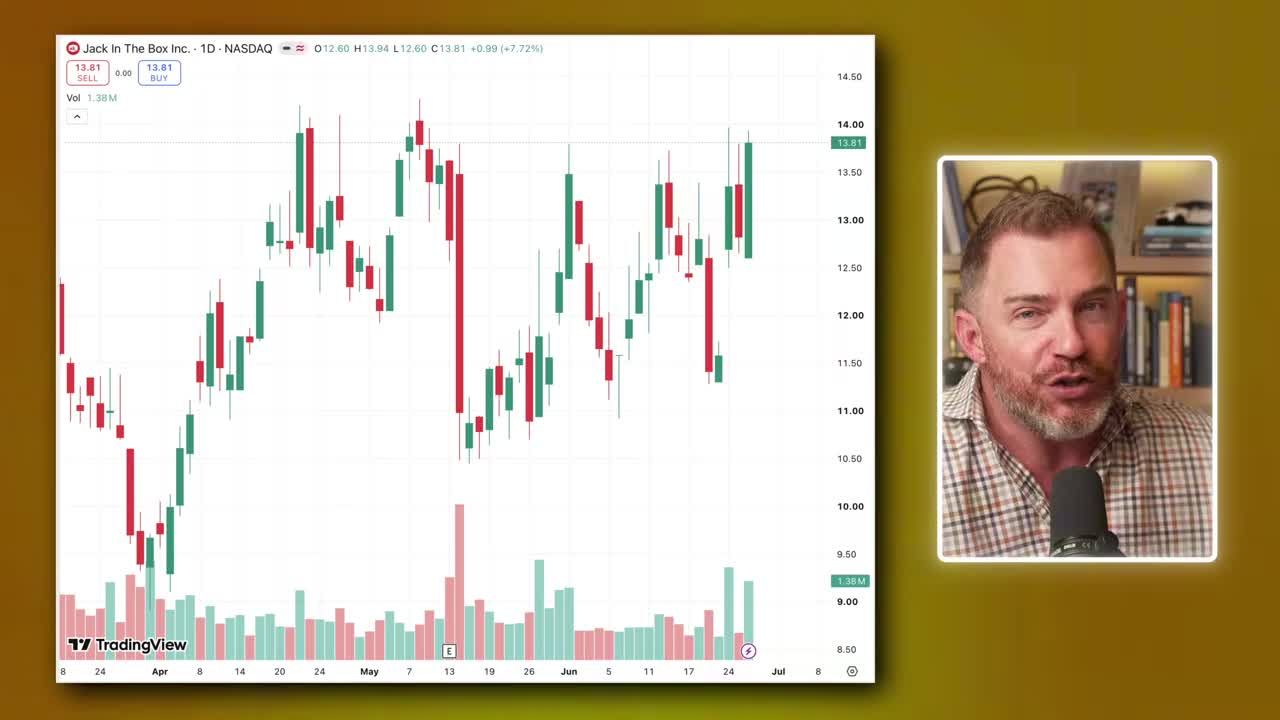
Right now, that exact setup is forming in a well-known fast food brand. The stock trades for $13 a share. A few years ago, it was worth 10 times that amount. It's already being championed in the famous WallStreetBets forum as the next big play.
If you missed the massive 2,800% run in GME a few years ago, you'll want to pay close attention to this data.
What Makes a True Meme Stock?
Bottom Line: Jack in the Box is the rare case where the meme stock math actually works: a collapsed valuation, a tight float, and high short interest create the conditions for a forced squeeze rather than just social media hype. The $14 breakout level is the line to watch, and the downside is cushioned by the fact that the stock is already priced like a distressed asset. Most meme stock candidates fail the structural test. This one passes it.
A real meme stock explosion requires a massive imbalance of supply and demand. You need a tiny number of available shares, a low company valuation, and a high percentage of short sellers who will be forced to buy back the stock when the price rises.
The name currently meeting all of these criteria is Jack in the Box, ticker JAC. It's setting up perfectly. But to understand why this $13 stock has so much upside potential, you first have to understand why other recent hype trades have completely fallen apart.
Why Do Most Meme Stocks Fail to Squeeze?
Recently, the whole internet piled into Wendy's stock. The next GameStop, they said. The stock spiked from $6 to $9, and then it simply collapsed down to around $7. Trading got halted. The hype trade of the week cut in half before lunch.
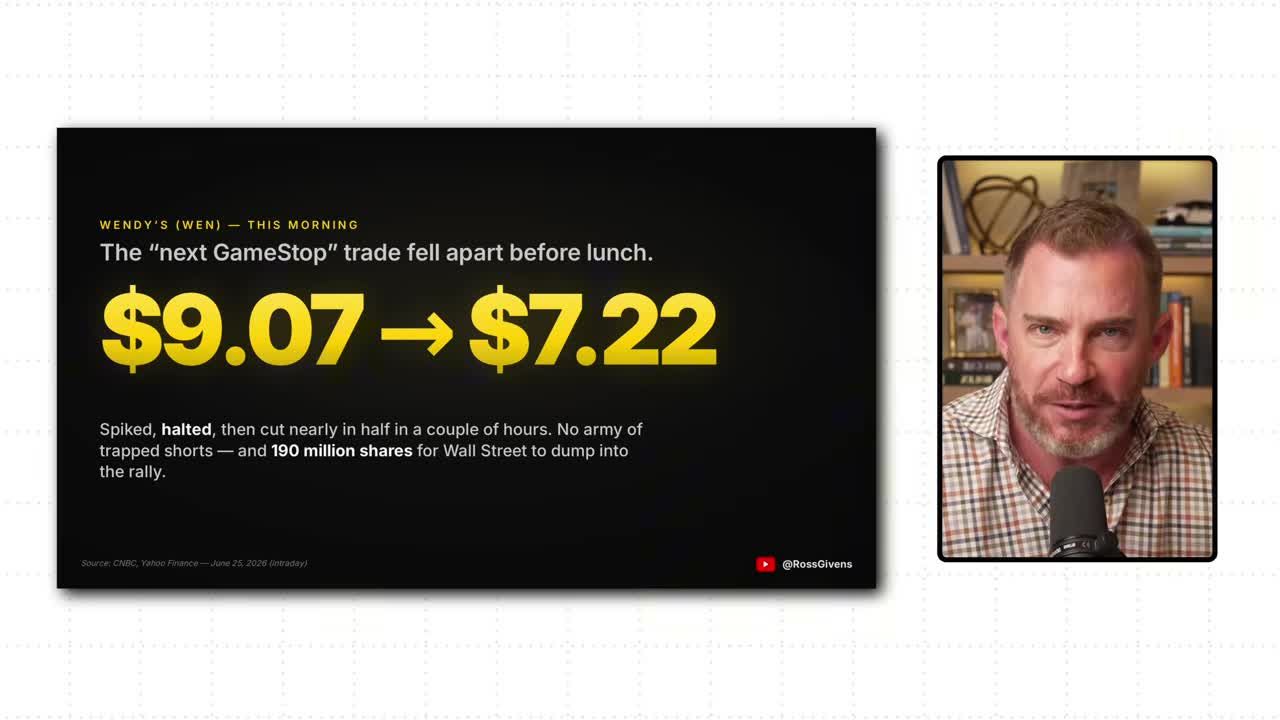
Good. It reminded traders exactly why most meme stocks fail. Wendy's lacked the structural foundation for a real squeeze.
A real short squeeze needs the shorts to be trapped. GameStop short interest before its big run was around 140% of the float. Wall Street was so bearish they sold more shares than even existed. When the price started climbing, those short sellers were forced to buy it back at the worst possible time.
Wendy's never had that. Yes, it was shorted around 30%. That's high, but nowhere close to 140%. There was no army of trapped shorts forced to cover.
The other major problem was share supply. Wendy's has roughly 190 million shares floating around in the market. When the retail crowd rushed in and pushed the price up, Wall Street had all the ammunition in the world to fight back. Institutions, market makers, the shorts that were still solvent, they just kept selling into the rally in size.
The buyers ran out of gas. The sellers did not. The rally got squashed.
How Does a Short Squeeze Actually Work?
To understand the upside of Jack in the Box, you need to understand the mechanics of a short squeeze. This is the exact mechanism that makes these stocks go parabolic.
A short squeeze occurs when a large number of investors bet against a stock. Instead of buying it, they borrow shares from their broker and sell them short. Their goal is to let the stock fall, buy it back at a lower price, return the shares, and keep the profit.
It's a way to make money when a stock goes down. But the risk is infinite.
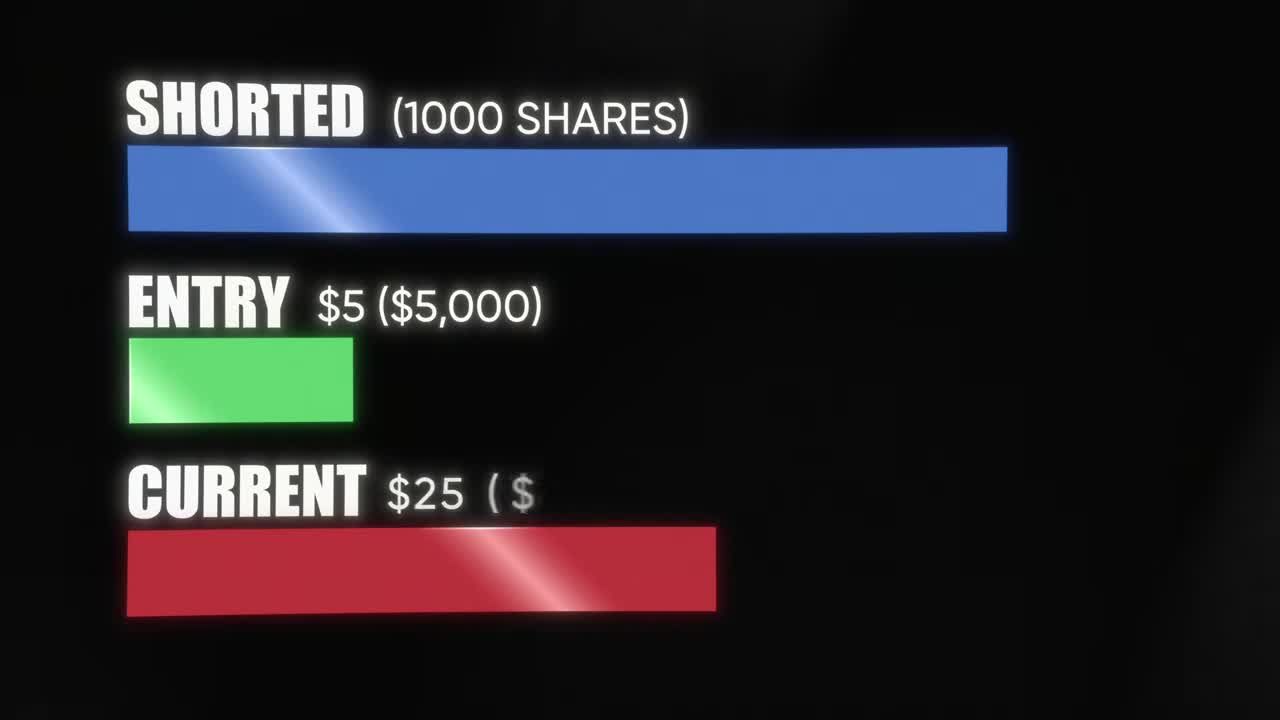
If you buy a stock, the most you can lose is 100%. The stock has to go to zero. When you sell a stock short, your risk has no ceiling. The price could go to a million. You can lose far more than you put into the trade.
Imagine you shorted 1,000 shares of a stock at $5 a share. You're betting $5,000 that the stock will go lower. Instead, it goes up to $25. You're now down $20,000 on a $5,000 trade.
To exit a short trade and stop the bleeding, you have to buy the stock back. You're forced to purchase shares to return the ones you borrowed. This creates a massive wave of buying in a stock that's already surging. The short sellers end up pouring diesel fuel on the fire.
It's the combination of investors buying the stock to get in and short sellers buying to get out. That's what happened with GameStop. And that's what could happen with Jack.
Why Could JACK Be the Next GameStop Meme Stock?
Jack in the Box has the exact structural advantages that GameStop had before its big run. Flip every single problem with the Wendy's trade around, and you get Jack in the Box.
Unlike Wendy's and its 190 million shares, Jack in the Box has a total outstanding share count of just 19 million. Wendy's has ten times as much stock available. That tight share count is the same thing that made GameStop so explosive back in 2021. When there are barely any shares to go around, it doesn't take much buying to send the price higher. There's almost nothing for sale.
Jack in the Box is also a much smaller company than GameStop was. Before the big squeeze, GameStop was worth around $1 billion. Jack in the Box is currently worth $250 million.
To move a stock, you have to overpower its float. The bigger the pile of tradable shares, the more money you need to move it. GameStop's tradable float before it exploded was worth just over $1 billion. That's the amount of stock the WallStreetBets crowd had to overpower to send it from $17 to $483.
Jack in the Box's entire float is worth around $250 million, about a fifth of what GameStop was. In theory, it would take one-fifth of the firepower to move this stock the same amount. A fraction of the money could cause the same potential explosion.
This stock also sees very little trading volume, roughly 500,000 shares a day. Even modest buying, the kind of crowd that just showed up for Wendy's, has an outsized effect here. Less stock for sale, less money needed, and more shorts to squeeze.
Get an entire year of live weekly mentoring sessions, my newsletter, indicators, bonus reports, tons more. Click the link and I'll see you in the next live session.
Join my Black Ops Trading ClubThe Chart Confirms the Setup
The math provides the setup. The chart provides the timing. High short interest stocks only squeeze when the technical pattern aligns with the fundamental data.
A couple of years ago, Jack in the Box was a $125 stock. It recently hit $12. A return to the top implies a 900% move to the upside.
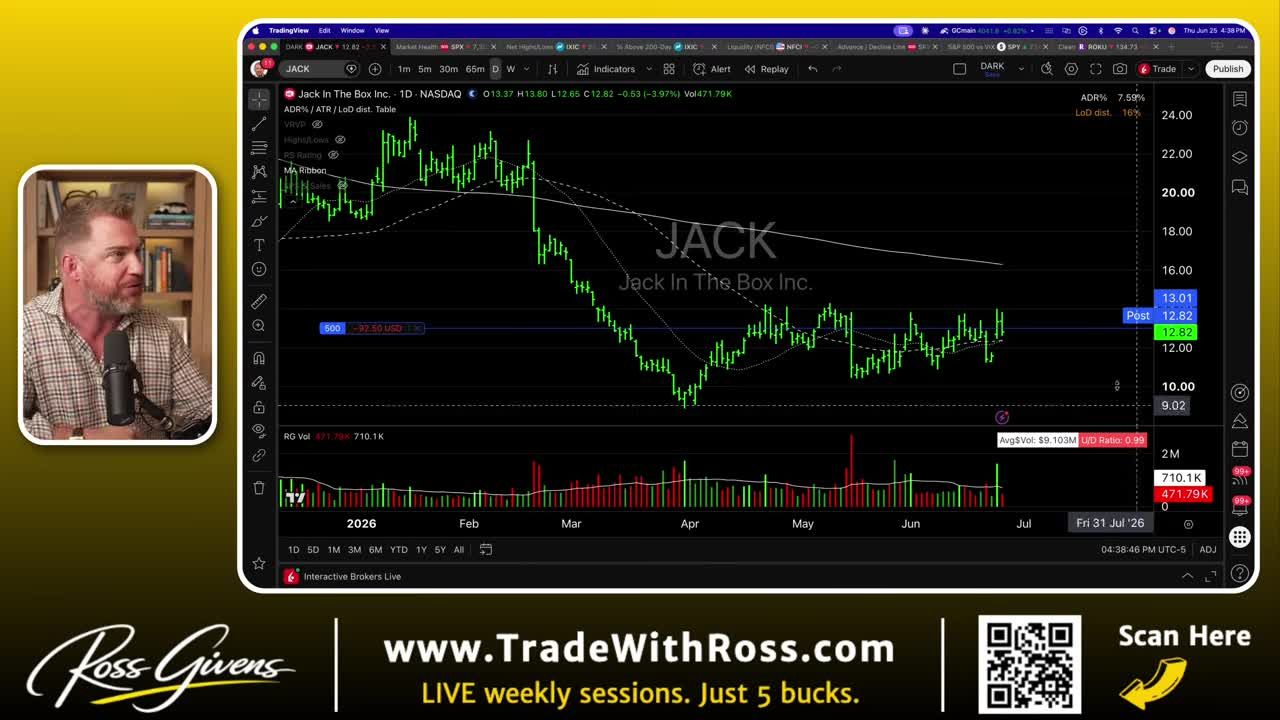
Right now, the chart is forming a textbook shallowing bottom consolidation pattern. Stocks operate purely on supply and demand. When a stock is going down, it will continue to fall as long as more people are selling than buying. When the buyers suddenly overpower the sellers, you get a shallowing effect.
This pattern shows the stock is being accumulated. The pullbacks and drops become less and less each time because there are fewer and fewer shares available for sale. The supply is actively being sucked out of the stock.
When demand grows and supply shrinks, you get a breakout. Buyers are entering a small stock with a tiny float, and a bunch of those shares have already been gobbled up at the lows. As the price accelerates higher, the short sellers who are short about 30% of the float start taking losses. They have to cover, which forces them to buy, piling onto the momentum.
That's the domino effect that causes this stuff.
The Turnaround Beyond the Squeeze
Even if Jack in the Box doesn't become the meme stock of the year, it is far from a lottery ticket. There is a real turnaround happening at this company.
This is what an actual investment looks like. Buying stock in a company under temporary hardship with a strong future outlook at a discounted price. That's all Warren Buffett ever did. And he fared okay.
- A Proven CEO: The board just brought in Mark King as CEO. He ran Taco Bell. He turned that thing around. He knows how to take a tired fast food brand and make it relevant again.
- Renewed Focus: The company sold off Del Taco back in December. That was a distraction. Now it's one brand, one mission: fix Jack in the Box.
- Clean Fundamentals: Despite a couple of down quarters, the company is still profitable. They're also paying down roughly $99 million in debt to clean up the balance sheet.
- Massive Discount: You can buy Jack in the Box for 0.2 times sales. Is it growing sales at 85% a year like Nvidia? No. But you're paying 20 times those sales for Nvidia. Jack in the Box is 100 times cheaper.
- Analyst Upside: Even after Wall Street cut their price targets, the average analyst target sits around $20 a share. With the stock at $13, that's a 50% upside just to reach the pessimistic targets.
You're buying a company with 75 years of successful operations and a couple of down quarters. They make burgers. They sell French fries. The business model is not complicated. The short squeeze is the icing on the cake.
How to Trade This Without Getting Burned
You trade volatile stocks by starting small, waiting for volume confirmation, and adding to your position only as the stock proves your thesis correct. You never bet the farm on these setups right out of the gate. You want to see if it's going to work.
1. Start with a Small Position
I started buying a couple of shares last week, picking up about 500 shares. Very small. You don't want to bet the farm on these things out of the gate.
2. Wait for the Breakout Level
The real move should begin on a push up through the $14 level. My goal was to build a base position below that mark.
3. Add on Volume Confirmation
You want to see if the trade is actually going to work. If the stock starts breaking out and the volume is increasing, that means big buyers are stepping in.
4. Scale In on the Way Up
Once the breakout is confirmed with volume, you add on and add on as this thing rips up the right side of the chart.
The Upside of a Cheap Burger Stock
The market is always looking for the next GameStop meme stock, but very few candidates have the actual math to support a massive run. Jack in the Box has the squeeze mechanics of GameStop, the chart of a stock bottoming out, and a real turnaround story with a proven operator at the wheel. That's the trifecta.
A couple hundred thousand retail traders could send this stock to the stratosphere without much effort. If it breaks out above $14 with real volume, my plan is to add on the way up. Many traders are already calling it the next GameStop meme stock in online forums, and the data backs up the hype this time.
Worst case scenario: I bought a cheap burger stock at a cheap price. Best case scenario: the stock hits $200 and blows up another hedge fund.
Let's see what happens.
Get an entire year of live weekly mentoring sessions, my newsletter, indicators, bonus reports, tons more. Click the link and I'll see you in the next live session.
Key Takeaways
- Jack in the Box (ticker JACK) trades around $13, down roughly 90% from highs of approximately $130, creating the low-valuation entry point that historically precedes meme stock explosions.
- A valid short squeeze setup requires three specific conditions simultaneously: a small share float, high short interest as a percentage of float, and institutional sellers who must buy back shares as price rises. JACK currently meets all three.
- Wendy's failed as a meme stock candidate because its float was too large, meaning retail buying pressure was diluted across too many available shares to force a squeeze.
- The $14 level is the key technical trigger: a breakout above that price on strong volume is the signal to add to the position.
- The bull case price target is $200, which would represent a roughly 1,400% gain from the $13 entry and would be large enough to force a hedge fund-level short covering event.
DISCLAIMER: Traders Agency does not offer financial advice. The information provided is for educational purposes only and should not be considered financial advice. Traders Agency is not responsible for any financial losses or consequences resulting from the use of the information provided. Trading carries inherent risks and may not be suitable for all individuals. You are advised to conduct your own research and seek personalized advice before making any investment decisions, recognizing the potential risks and rewards involved.
See more from Traders Agency on Google
Make us a preferred source and our market analysis will appear more prominently in your Google Search, Top Stories, and AI results.
Add to Preferred Sources