Meme stock volatility is a market phenomenon where a company's share price experiences extreme, rapid fluctuations driven entirely by social media hype rather than traditional business fundamentals or financial performance. You've probably seen it on the financial news: a struggling company suddenly sees its stock price skyrocket by hundreds of percent in a matter of days. Retail investors flood the market while traditional Wall Street analysts watch in confusion. Our education team will walk you through exactly how these situations develop. By the end of this guide, you'll understand the mechanics behind these massive price swings, how to spot them early, and how to manage the intense risks involved.
What Is a Meme Stock?
Bottom Line: Meme stock volatility is a distinct market phenomenon that operates outside normal fundamental analysis, rewarding traders who understand crowd mechanics and punishing those who treat it like a conventional investment. The core lesson is that discipline around position sizing and risk definition matters more here than anywhere else, because the same momentum that creates 300% gains can erase them just as fast. Traders who approach these setups with a clear plan and pre-defined exit points are the ones who survive long enough to trade them again.
A meme stock is a company whose shares see massive trading volume and price spikes fueled by viral internet trends. Retail traders coordinate on social platforms to buy the stock aggressively, causing rapid price appreciation that ignores the actual financial health of the underlying business.
We teach our members to think of these assets differently than traditional investments. Buying a normal stock is like buying a piece of a business because you believe it will grow its profits over time. Buying a meme stock is like buying a ticket to a viral internet event. The price action relies entirely on community momentum rather than earnings reports, revenue growth, or profit margins.
Key Concept: A meme stock's price is driven by social media hype and coordinated retail buying, not by the company's earnings, revenue, or financial outlook. The disconnect between price and fundamentals is what creates both the opportunity and the danger.
How Do Meme Stocks Work?
When a stock goes viral online, retail traders flood the market with buy orders. This sudden surge in demand overwhelms the available supply of shares on the open market.
Meme stock volatility happens because this buying pressure is sudden, coordinated, and highly emotional. The price shoots up rapidly, which attracts even more buyers who suffer from a fear of missing out (FOMO).
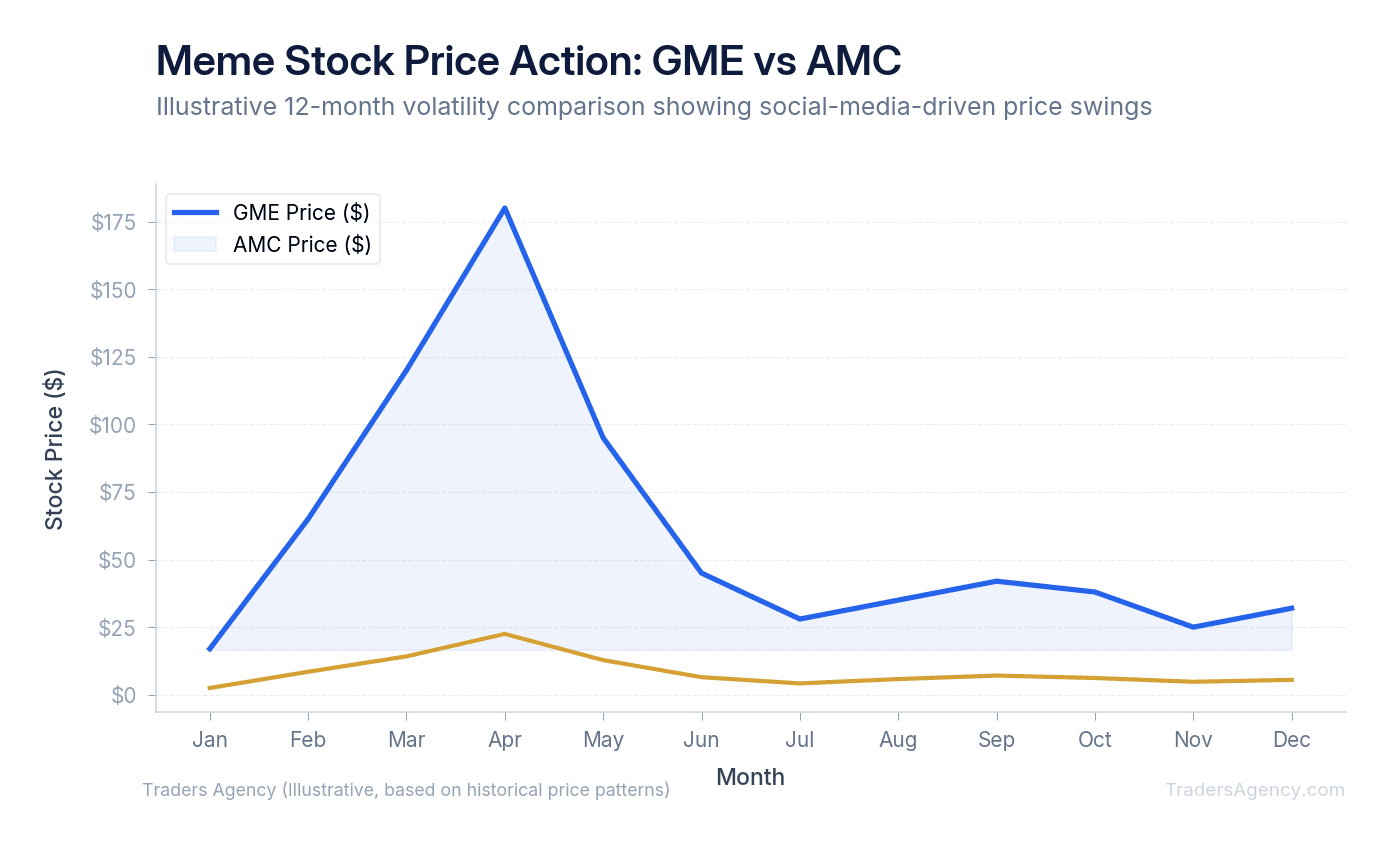
Eventually, the buying pressure dries up. When early buyers start selling to take their profits, the price crashes just as quickly as it rose. We always remind our traders that gravity eventually takes over when underlying business fundamentals do not support the inflated stock price.
How Do You Identify a Potential Meme Stock Before It Moves?
You can identify a potential meme stock by looking for a sudden, unexplained spike in social media mentions combined with unusually high trading volume. These stocks typically have high short interest and a low share price before the viral momentum begins to build.
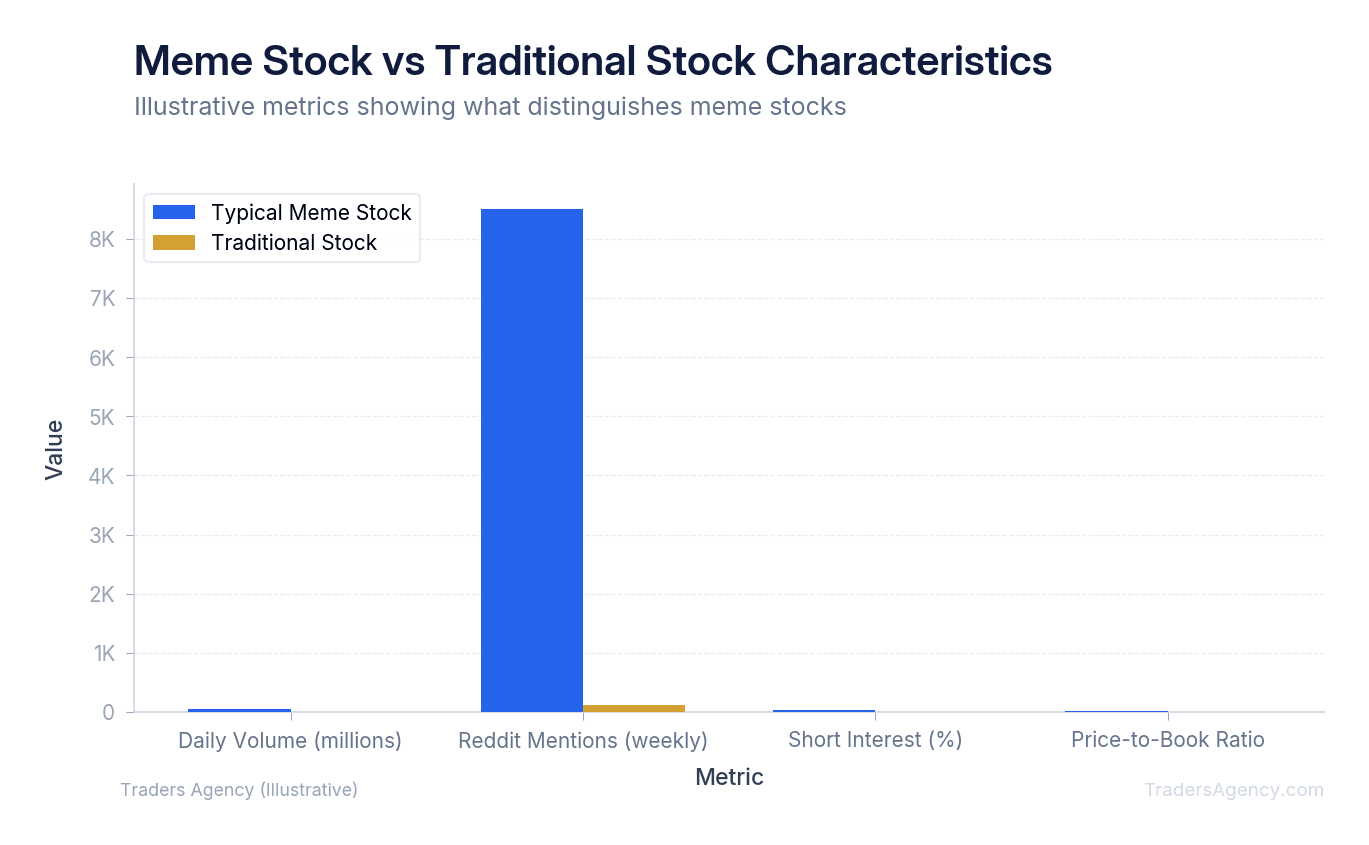
Our team looks for specific data points when evaluating these speculative setups. Here is exactly what we watch for:
- Abnormal Trading Volume: The stock will trade millions of shares above its average daily volume. If a stock normally trades 500,000 shares a day and suddenly trades 20 million shares in a single session, retail momentum is likely building.
- High Short Interest: We look for stocks where more than 20% of the float is sold short. This means many traders are betting against the company, creating the perfect setup for a massive price squeeze.
- Viral Social Dominance: The ticker symbol will dominate conversations on platforms like Reddit, X (formerly Twitter), and StockTwits. The discussion will focus heavily on punishing short sellers rather than analyzing company balance sheets or future earnings potential.
What Is a Short Squeeze and How Does It Drive Meme Stock Volatility?
To understand these massive rallies, you need to understand the concept of a short squeeze. Traders often borrow shares of struggling companies and sell them, hoping to buy them back later at a lower price. This practice is called short selling.
If retail traders suddenly buy the stock and drive the price up, those short sellers start losing money rapidly. To stop their losses, the short sellers are forced to buy shares back at the current high market price.
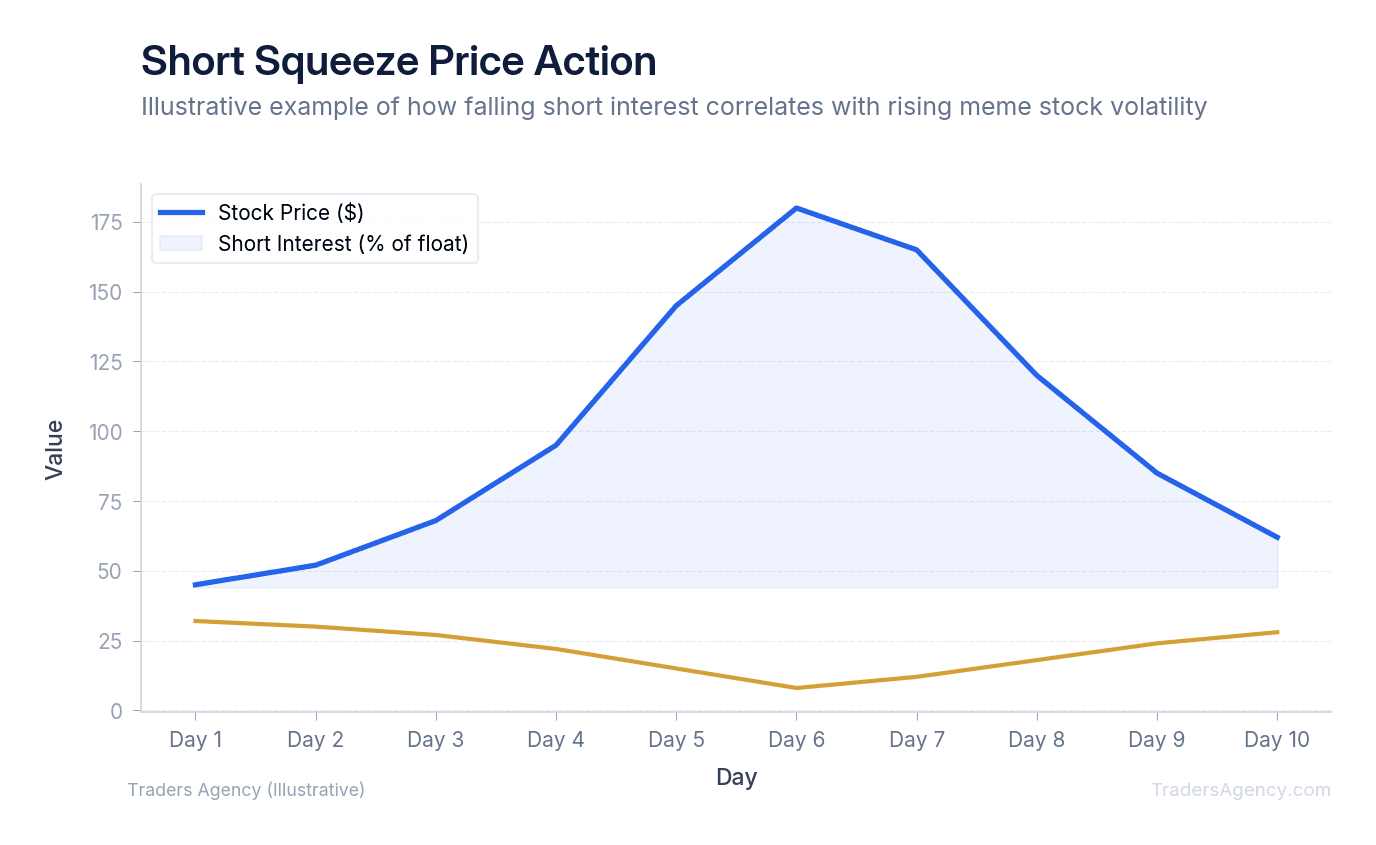
This creates a powerful feedback loop. Retail traders buy, pushing the price higher. Short sellers are forced to buy to cover their positions, pushing the price even higher. This forced buying is the primary engine behind extreme meme stock volatility.
Key Concept: A short squeeze occurs when rising prices force short sellers to buy back shares to limit their losses. This forced buying adds fuel to the rally, accelerating the price spike far beyond what normal demand would produce.
Want expert trading insights delivered daily?
Join thousands of traders who rely on Traders Agency for market analysis and trade ideas.
Join Traders AgencyFamous Examples of Meme Stocks
Let's look at concrete examples to see how this plays out in the real world. We'll use the historic GameStop (GME) and AMC Entertainment (AMC) events from early 2021 to illustrate the setup, execution, and outcome.
The GameStop (GME) Setup
In mid-2020, GME was trading around $4 per share. The company was struggling, and short interest had exceeded 100% of the available float. Retail traders on social media noticed this extreme short interest and began building a coordinated buying campaign.
The Execution and Squeeze
By January 2021, retail traders started buying shares and call options aggressively. On January 12, the stock closed at $19.95. Just two weeks later, on January 28, the massive influx of retail buying and forced short covering pushed the price to an intraday high of $483 per share.
The AMC Secondary Rally
A similar pattern occurred with AMC. In early May 2021, the stock was trading near $10 per share. Driven by the exact same social media momentum and short squeeze mechanics, the price exploded to an all-time high of $72.62 by early June.
The Inevitable Outcome
The best-case scenario happened for early buyers who secured profits near the top. The worst-case scenario devastated late buyers. By mid-February 2021, GME had crashed back down to around $40 per share. We stress to our members: if you buy at the peak of a viral trend, you risk losing the majority of your capital in a matter of days.
| Stock | Pre-Squeeze Price | Peak Price | Post-Crash Price | Peak-to-Crash Loss |
|---|---|---|---|---|
| GME | $4.00 | $483.00 | $40.00 | -91.7% |
| AMC | $10.00 | $72.62 | ~$30.00 | -58.7% |
Watch Out: Late buyers in meme stock rallies often suffer devastating losses. The SEC has issued multiple investor alerts warning that prices driven by social media hype can reverse violently once momentum fades. Never chase a stock that has already made a parabolic move.
How to Size Your Position for Speculative Trades
Because meme stock volatility can wipe out a trading account quickly, strict risk management is mandatory. We treat these trades as highly speculative momentum plays, not long-term investments.
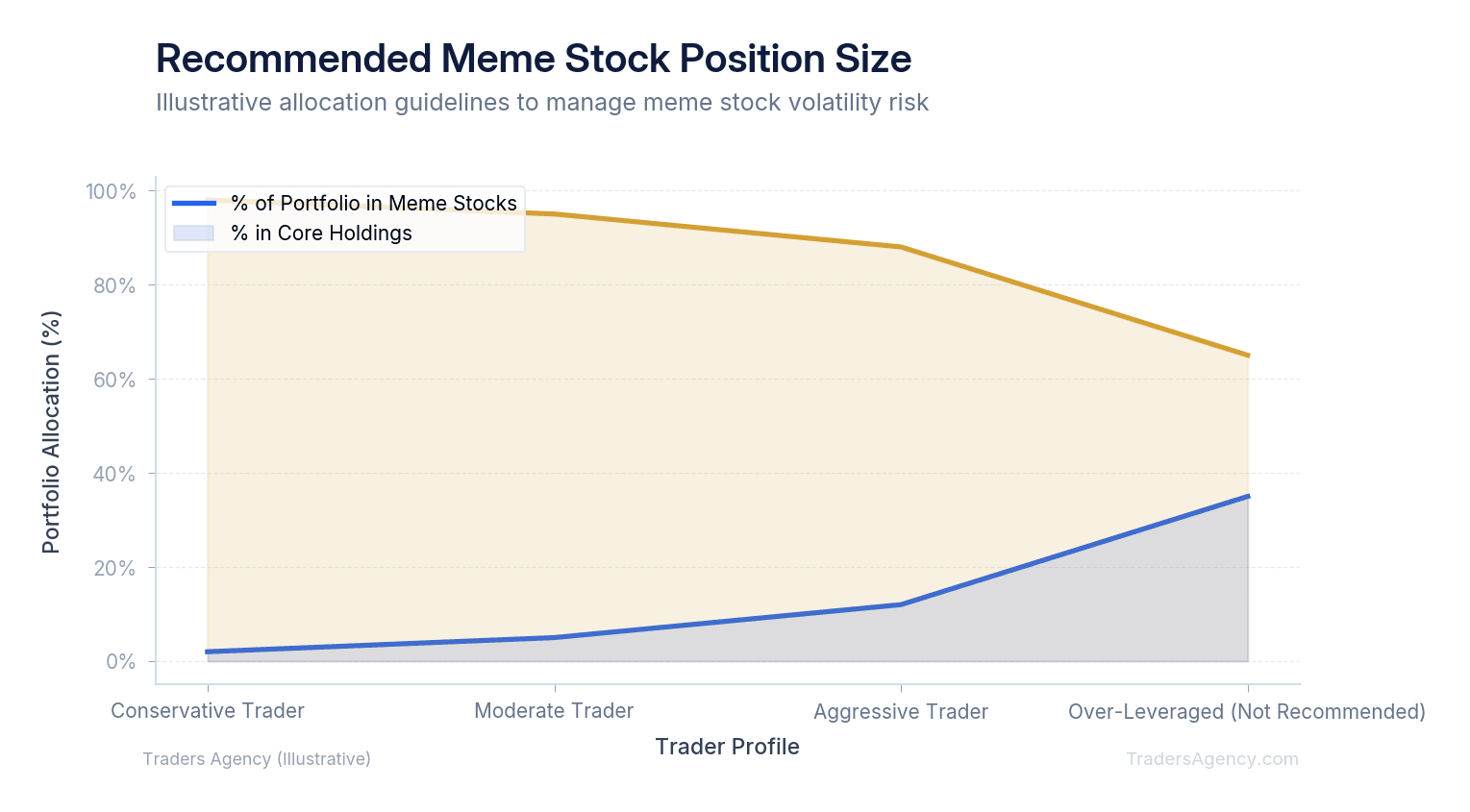
Our team recommends allocating no more than 1% to 2% of your total account equity to a single meme stock trade. If you have a $10,000 trading account, your maximum risk on one of these setups should be $100 to $200.
Using Options for Risk Definition
Instead of buying shares outright, many experienced traders use options to define their risk. Here's how the math works:
| Approach | Capital Required | If Stock Drops to $20 | Maximum Loss |
|---|---|---|---|
| Buy 100 shares at $50 | $5,000 | -$3,000 | Full investment ($5,000) |
| Buy 1 call option, $55 strike, $2.00 premium | $200 | -$200 | Capped at $200 |
With the options approach, your maximum possible loss is strictly capped at that $200 premium, no matter how far the stock price falls. Your breakeven point would be $57 (the $55 strike plus the $2 premium). This is why we prefer defined-risk strategies for speculative setups.
Setting Clear Exits
You must know your exit plan before you enter the trade. We teach traders to use trailing stop losses to protect profits as the stock rises:
- Enter the trade with a defined risk amount. For example, buy a meme stock at $20 with a stop loss at $18, risking $2 per share.
- Trail your stop as the price moves in your favor. If the stock spikes to $40, raise your stop loss to $32 (protecting $12 per share in profit).
- Let the stop take you out. This ensures you walk away with a guaranteed gain even if the price suddenly collapses. Never override your stop because you "feel" the stock will keep going.
Are Meme Stocks a Good Investment?
Meme stocks are generally not a good long-term investment because their inflated prices are disconnected from the company's actual financial value. They can, however, provide short-term trading opportunities for experienced speculators who use strict risk management and understand momentum mechanics.
We tell our members to stay away from these stocks if they cannot actively monitor the market during trading hours. The price can drop 30% or more in a single afternoon. If you're at work and cannot watch your charts, these fast-moving assets are entirely inappropriate for your portfolio.
You should also avoid these trades if you're prone to emotional decision-making. The fear of missing out often tricks beginners into buying at the exact moment the smart money is selling. Stick to your trading plan, keep your position sizes small, and never risk money you cannot afford to lose.
Risk Warning: Meme stocks can lose 50% or more of their value in a single trading session. Only trade these setups with capital you can afford to lose entirely, and always use defined-risk strategies like options or hard stop losses to protect your account.
Our education team publishes new strategy guides and market analysis every week. If you want to learn how we approach high-volatility setups with discipline and defined risk, our membership gives you the tools, training, and community to trade with confidence.
Want expert trading insights delivered daily?
Join thousands of traders who rely on Traders Agency for market analysis and trade ideas.
Join Traders AgencyKey Takeaways
- Meme stock prices are driven by social media coordination and community momentum, not earnings, revenue, or profit margins , making traditional valuation methods useless for timing entries and exits.
- Meme stocks can lose 50% or more of their value in a single trading session, which means position sizing and defined-risk strategies like options or hard stop losses are non-negotiable.
- Short squeezes are a core mechanical driver of meme stock volatility: when heavily shorted stocks spike, short sellers are forced to buy shares to cover losses, accelerating the price move.
- Spotting a meme stock early requires monitoring unusual volume spikes, social media chatter velocity, and short interest data before the mainstream financial press picks up the story.
- Treat meme stock exposure like a speculative ticket, not a business investment. Only allocate capital you can afford to lose entirely, and define your maximum loss before entering the trade.
DISCLAIMER: Traders Agency does not offer financial advice. The information provided is for educational purposes only and should not be considered financial advice. Traders Agency is not responsible for any financial losses or consequences resulting from the use of the information provided. Trading carries inherent risks and may not be suitable for all individuals. You are advised to conduct your own research and seek personalized advice before making any investment decisions, recognizing the potential risks and rewards involved.
See more from Traders Agency on Google
Make us a preferred source and our market analysis will appear more prominently in your Google Search, Top Stories, and AI results.
Add to Preferred Sources