
You've probably watched a long option position slowly bleed value as expiration approaches. We see traders struggle with this constantly. Instead of fighting the clock, our team prefers to put time on our side. Selling options premium is one of the most consistent income strategies we teach, and once you understand the mechanics, you'll wonder why you ever paid for options in the first place. In this guide, we'll walk you through how to become the seller, collect upfront income, select the right strike prices, and protect your capital every step of the way.
What Is Selling Options Premium and How Does It Work?
Bottom Line: Selling options premium works because time decay and probability are structurally on the seller's side, not the buyer's. The edge compounds when you combine high implied volatility entry points with disciplined strike selection and defined-risk structures. The strategy is not passive income with no downside, but traders who manage size carefully and stay consistent can use theta as a reliable tailwind.
Selling options premium is the process of writing an options contract to open a position, which immediately credits your brokerage account with cash. Think of it this way: you're acting as the insurance provider for the market. If the option expires worthless, you keep the entire premium as your maximum profit.
When you buy an option, you need the underlying stock to move significantly in your direction to make money. When you sell an option, you can profit if the stock moves in your direction, stays completely flat, or even moves slightly against you. You're getting paid to take on a specific obligation.
Here's the statistical reality that makes this strategy so compelling: a massive percentage of options held to expiration expire out of the money. This creates a structural advantage for the premium seller. You're essentially acting like a casino, collecting small, consistent edges over time rather than hoping for a single massive payout.
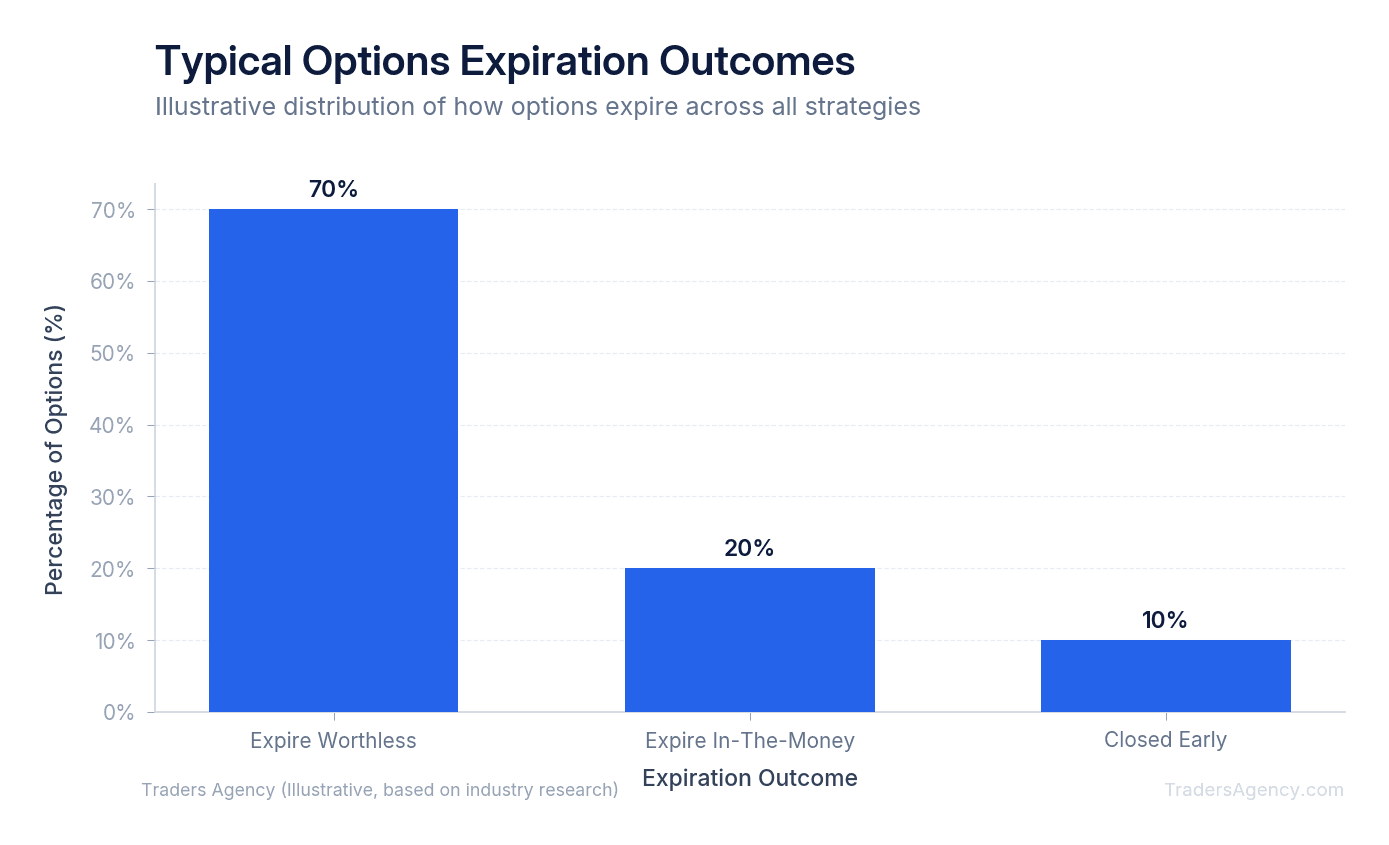
Key Concept: When you sell an option, you collect premium upfront and profit from time decay. You don't need the stock to make a big move. You just need it to not move against you past your strike price by expiration.
The Statistical Edge: Why Do Options Expire Worthless?
Options expire worthless because they are decaying assets with a strict time limit. The market prices in potential future volatility, but actual stock movements often fall short of these expectations. When you sell premium, you position yourself to profit directly from this natural erosion of time value.
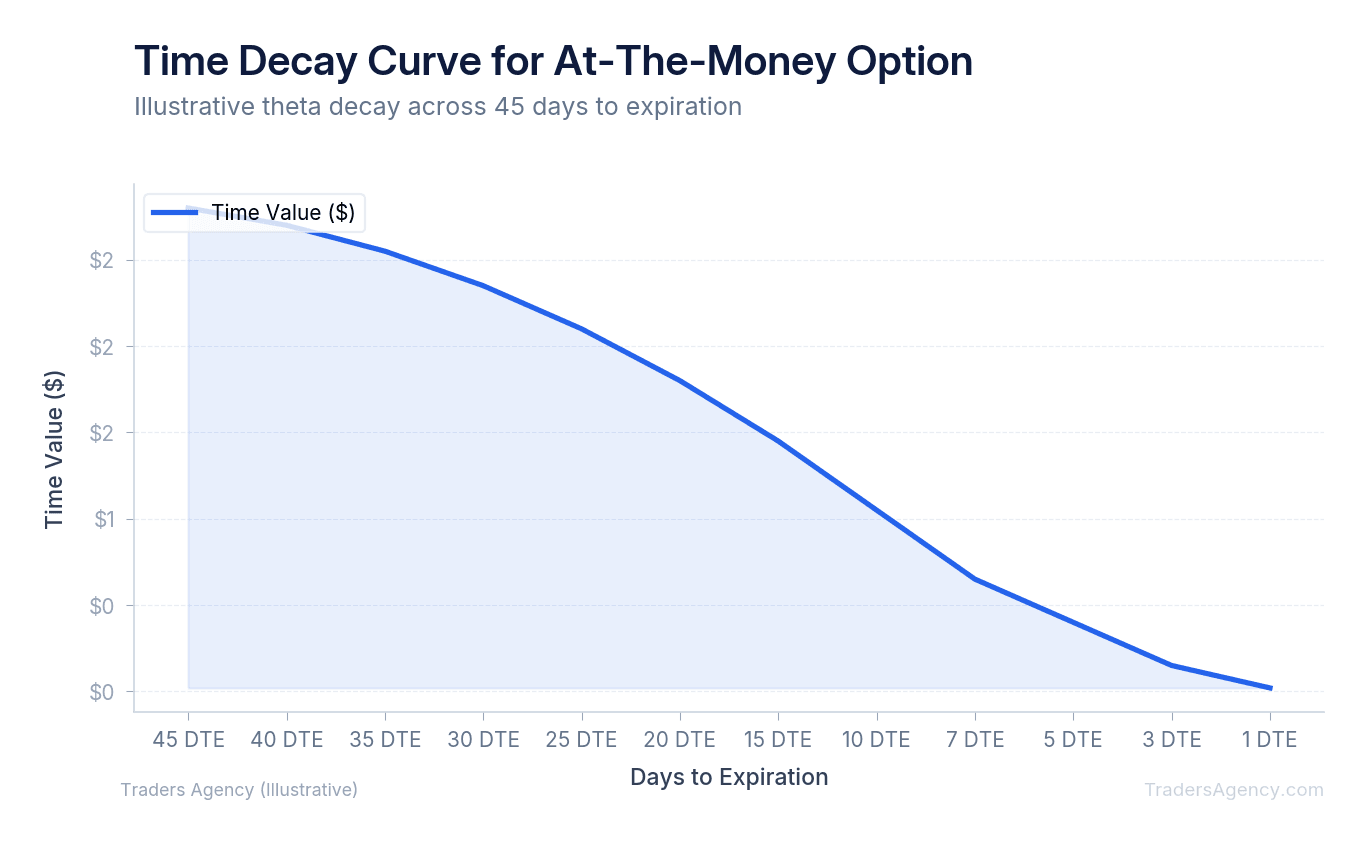
This erosion is measured by a Greek metric called theta. Theta represents how much value an option loses with each passing day. For option buyers, theta is a constant penalty. For premium sellers, theta is your primary profit engine.
Here's what makes the timing so important: time decay is not linear. An option loses value slowly when it's months away from expiration. As expiration approaches, that decay accelerates rapidly, especially in the final 7 to 10 days. We teach our members to target this specific window of rapid decay to maximize their return on capital.
The Best Strategies for Selling Options Premium
The best strategies for selling options premium rely on defined risk and stock ownership. We teach our members to focus on two primary setups: selling covered calls against stock they already own, and writing cash-secured puts to acquire stock at a discount while collecting upfront income.
The Covered Call
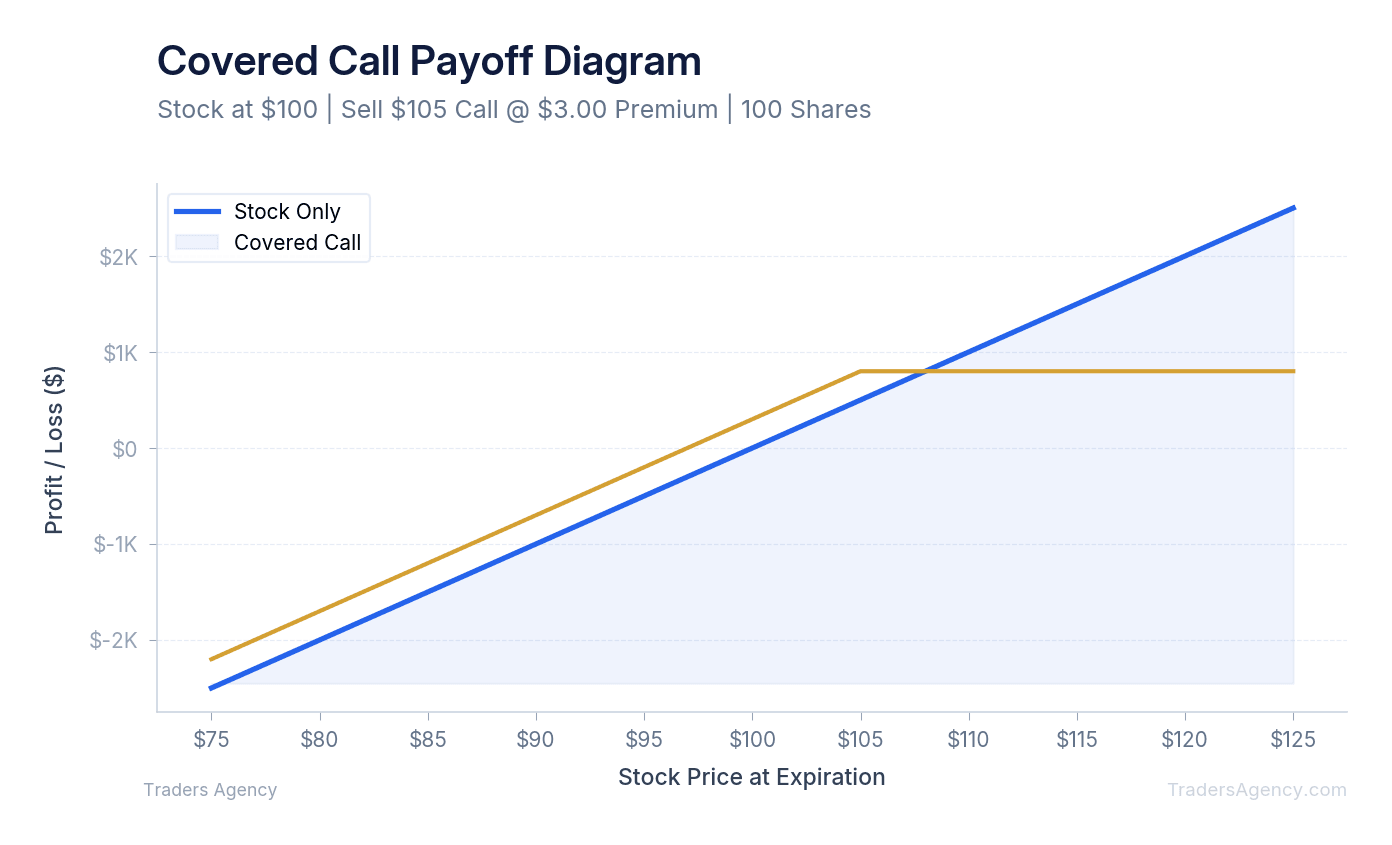
The covered call is one of the most common ways investors generate yield from their existing holdings. You buy 100 shares of a stock and sell one call option against those shares. You collect the premium immediately. If the stock stays below your chosen strike price, you keep the shares and the premium. You can learn more about options strategies and investor education at the Cboe Options Exchange.
Here's a real-world example. Imagine you own 100 shares of Microsoft (MSFT) trading at $330. You sell the $345 strike call expiring in 30 days and collect a $3.00 premium. That puts $300 directly into your account.
| Parameter | Value |
|---|---|
| Stock | MSFT at $330 |
| Call Sold | $345 strike, $3.00 premium |
| Premium Collected | $300 |
| Max Profit | $1,800 ($1,500 stock gain + $300 premium) |
| Breakeven | $327.00 (stock price minus premium) |
If MSFT rallies to $350, you must sell your shares at $345. You miss out on the final $5.00 of the rally, but you still keep the $300 premium and the $1,500 capital gain from the stock appreciation. That's a solid outcome.
The Cash-Secured Put
The cash-secured put works in reverse. You sell a put option at a strike price where you actually want to buy the stock. You must keep enough cash in your account to purchase 100 shares if assigned. If the stock stays above your strike, you keep the premium and move on to the next trade.
Want expert trading insights delivered daily?
Join thousands of traders who rely on Traders Agency for market analysis and trade ideas.
Join Traders AgencyStep-by-Step: Executing a Cash-Secured Put
Executing a cash-secured put requires selecting a target stock, choosing a strike price below the current market value, and determining an expiration date. You collect the premium upfront and wait to see if the stock drops to your strike price before the contract expires.
Let's walk through a specific example using Apple (AAPL). Assume AAPL is currently trading at $150 per share. You want to own the stock, but you'd prefer to pay $140.
Here are the exact steps our team follows to execute this trade:
- Identify the target: We select AAPL because it's a highly liquid stock we want to hold long-term.
- Choose the expiration: We look 30 to 45 days out. This is the sweet spot where theta decay begins to accelerate.
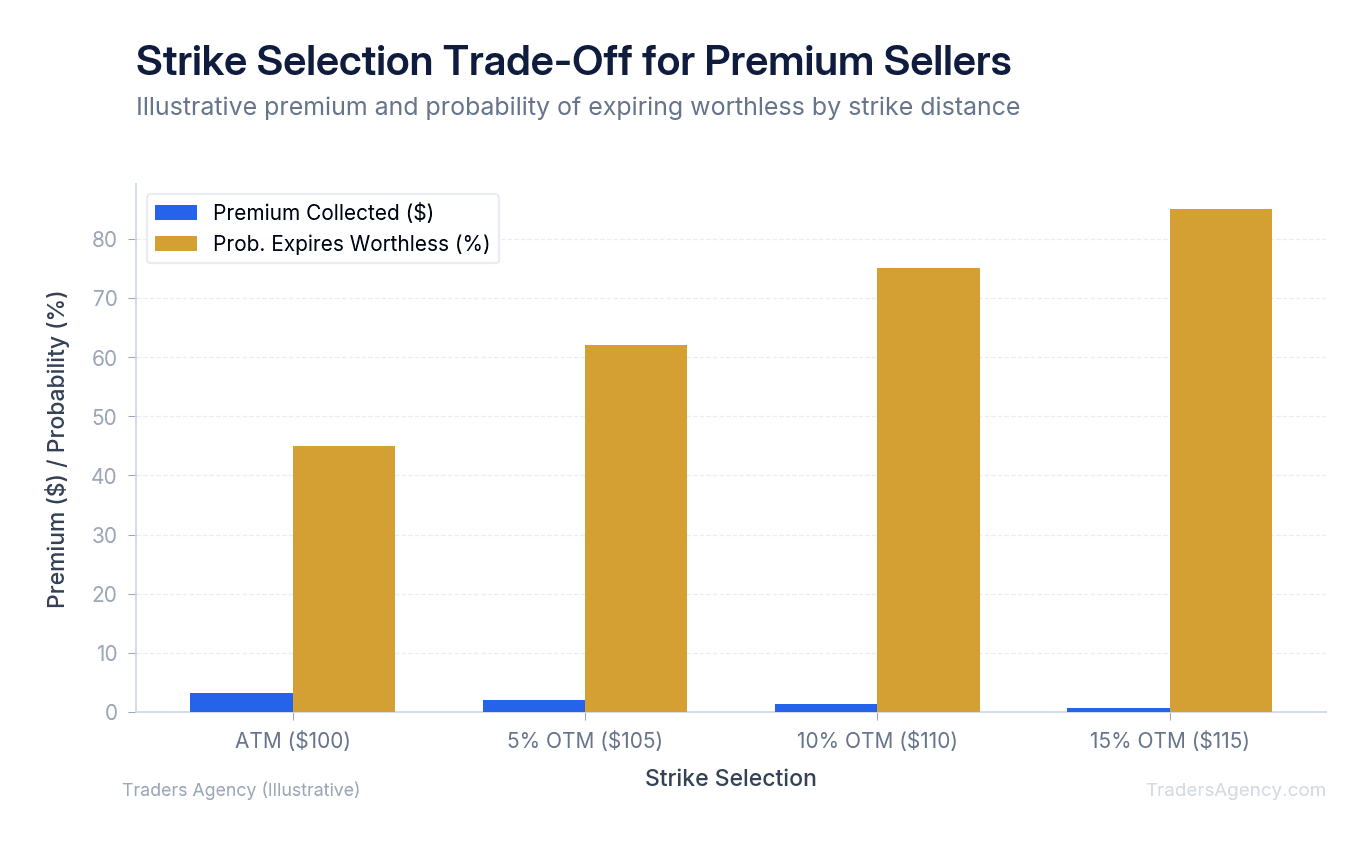
- Select the strike: We choose the $140 strike put, which sits roughly 6.7% below the current price.
- Collect the premium: The market pays us $2.50 per share for this put. Since options trade in 100-share blocks, we collect $250 in total premium.
- Secure the cash: We must hold $14,000 in our account to cover the potential purchase of 100 shares at $140.
- Monitor and manage: If the option drops to 80% to 90% of its value quickly, we consider buying it back early and freeing up our capital for the next trade.
| Scenario | AAPL Price at Expiration | Outcome |
|---|---|---|
| Best Case | Above $140 | Option expires worthless. Keep $250 premium (1.8% return on reserved cash). |
| Assigned at Strike | $140 | Buy 100 shares at $140. Effective cost basis: $137.50 after premium. |
| Assigned Below Strike | $135 | Buy 100 shares at $140. Breakeven is $137.50. Unrealized loss of $2.50/share, but you own a quality stock at a discount. |
Key Concept: Your breakeven price on a cash-secured put is the strike price minus the premium collected. In this example, that's $140 - $2.50 = $137.50. You're effectively getting paid to place a limit order below the market.
How Do Theta and Vega Affect Options Premium Sellers?
Theta and vega dictate how an option's price changes before expiration. Theta measures daily time decay, which directly benefits premium sellers as the contract loses value. Vega measures sensitivity to implied volatility (IV), meaning sellers profit when volatility drops and option prices deflate after the trade is opened.
Implied volatility is the market's expectation of future price movement. When the market panics, implied volatility spikes. This makes options much more expensive. As a premium seller, you want to sell when options are expensive and buy them back when they're cheap.
We prefer to initiate short premium trades in high-volatility environments. Once the market calms down, vega drops. This causes the option premium to shrink rapidly, allowing you to close the position for a profit well before expiration. This is one of the most powerful edges available to disciplined premium sellers.
When Should You Sell Premium (And When Should You Avoid It)?
You should sell options premium when implied volatility is elevated and you're comfortable holding the underlying asset. We look for stocks trading in predictable ranges or established uptrends. The goal is to collect steady income without taking on excessive directional risk.
Here's when to stay on the sidelines:
- Low-volatility periods: When IV is compressed, the premium you collect is too small to justify the risk.
- Before earnings announcements: Earnings are binary events. A stock can easily gap 10% to 20% overnight. The premium you collect will rarely compensate you for the risk of a massive overnight move against your position.
- Highly uncertain macro events: Fed decisions, geopolitical shocks, and major economic data releases can create unpredictable price action that overwhelms your premium buffer.
Watch Out: Never sell options right before an earnings announcement unless you have a specific, well-tested strategy for earnings plays. The overnight gap risk on a single event can erase weeks of carefully collected premium income.
What Are the Most Common Mistakes When Selling Options Premium?
We see the same errors over and over from traders who are new to selling premium. Here are the biggest ones to avoid:
- Trading illiquid options: If you trade options with wide bid-ask spreads, you give up a massive portion of your edge to market makers. We only sell premium on stocks with high volume and tight spreads.
- Ignoring earnings dates: Always check the earnings calendar before opening a position. A surprise report can blow through your strike overnight.
- Holding to squeeze out every penny: If you sell a put for $2.00 and it drops to $0.20 within two weeks, buy it back. You've captured 90% of the profit in a fraction of the time. Leaving the trade open to extract the last $0.20 is a poor return on your locked-up capital and exposes you to unnecessary late-stage risk.
- Oversizing positions: Getting aggressive with position size is the fastest way to blow up a premium-selling account. One bad trade shouldn't threaten your portfolio.
How Should Options Sellers Manage Risk and Position Sizing?
Risk management for selling options premium requires strict position sizing and a clear understanding of margin requirements. We recommend allocating no more than 5% of your total portfolio to any single short premium trade. This protects your account from catastrophic losses if a stock experiences an unexpected, aggressive move.
Selling options premium can be highly consistent, but the losses on a single bad trade can wipe out weeks of steady gains. You must cap your exposure. If a cash-secured put is challenged, we teach our members how to roll the option. Rolling involves buying back the current option at a loss and simultaneously selling a new option with a later expiration date. This maneuver often allows you to collect additional premium while giving the stock more time to recover.
For traders with larger accounts, portfolio margin offers significant capital efficiency. Standard margin requires you to hold a fixed percentage of the underlying stock's value. Portfolio margin calculates risk based on the actual maximum loss of your entire portfolio. This allows experienced traders to sell more premium with less locked-up capital. You can review the SEC's margin education resources for a deeper understanding of margin requirements.
However, increased buying power means increased responsibility. Just because your broker allows you to sell ten cash-secured puts doesn't mean you should. We prefer to keep at least 30% to 40% of our account in cash. This cash buffer protects us during market corrections and provides the liquidity needed to manage challenged positions.
Risk Warning: Selling options carries significant risk. A single large adverse move can generate losses that exceed many months of collected premium. Always use defined-risk strategies, maintain adequate cash reserves, and never risk more than you can afford to lose on any single trade.
Selling premium is one of the most reliable income strategies we teach at Traders Agency. When you combine the statistical edge of time decay with disciplined strike selection, proper position sizing, and smart volatility timing, you put yourself on the right side of probability. Start small, stay consistent, and let theta do the heavy lifting.
Want expert trading insights delivered daily?
Join thousands of traders who rely on Traders Agency for market analysis and trade ideas.
Join Traders AgencyKey Takeaways
- Options sellers collect premium upfront and keep it entirely if the contract expires worthless, making time decay a structural advantage rather than a liability.
- A statistically significant percentage of options held to expiration expire out of the money, giving premium sellers a built-in probability edge on every trade.
- Unlike buyers who need a strong directional move to profit, sellers can win if the stock moves in their favor, stays flat, or even moves slightly against them.
- Volatility timing matters: selling premium when implied volatility is elevated means collecting more income and giving the position more cushion if the underlying moves.
- Defined-risk strategies and strict position sizing are non-negotiable because a single large adverse move can erase many months of collected premium.
DISCLAIMER: Traders Agency does not offer financial advice. The information provided is for educational purposes only and should not be considered financial advice. Traders Agency is not responsible for any financial losses or consequences resulting from the use of the information provided. Trading carries inherent risks and may not be suitable for all individuals. You are advised to conduct your own research and seek personalized advice before making any investment decisions, recognizing the potential risks and rewards involved.
See more from Traders Agency on Google
Make us a preferred source and our market analysis will appear more prominently in your Google Search, Top Stories, and AI results.
Add to Preferred Sources