
You have probably watched Bitcoin rally and thought about adding it to your portfolio. Many traders want exposure to digital assets without the hassle of managing crypto wallets, memorizing private keys, or opening unregulated exchange accounts. A spot vs futures Bitcoin ETF comparison is essential because these two fund types track the digital currency using completely different methods. A spot ETF holds actual Bitcoin, while a futures ETF holds derivative contracts that agree to buy Bitcoin at a later date. We will walk you through exactly how these funds operate behind the scenes, reveal the hidden costs involved, cover the tax implications, and help you determine which vehicle makes the most sense for your specific trading style.
What Is a Spot Bitcoin ETF and How Does It Actually Hold Bitcoin?
Bottom Line: For most traders, a spot Bitcoin ETF is the cleaner vehicle: the price tracks actual Bitcoin, custody is handled professionally, and there are no roll costs eating into returns. Futures ETFs serve a narrow tactical purpose for short-term trades but become expensive liabilities the longer you hold them. The single most important habit is sizing every position with the weekend gap risk in mind, because Bitcoin does not wait for market hours to move.
A spot Bitcoin ETF is an exchange-traded fund that purchases and securely stores actual Bitcoin on behalf of its shareholders. When you buy shares of a spot ETF, the fund managers buy the equivalent amount of digital currency, meaning the fund's price directly mirrors Bitcoin's real-time market value.
These funds completely remove the technical barriers of crypto investing. You do not need to open a separate account on a crypto exchange. You simply buy shares through your standard brokerage account just like you would buy shares of Apple or Microsoft.
Funds like IBIT and FBTC use professional custodians to hold the digital coins in highly secure, offline storage vaults. Think of it like a traditional gold ETF that stores physical gold bars in a secure vault. The fund issues shares that represent a fractional claim on that stored asset.
Authorized participants work behind the scenes to ensure the ETF's share price rarely deviates from the actual price of Bitcoin. If the ETF price drops below the value of the underlying Bitcoin, these participants buy the discounted shares and redeem them for the actual coins, bringing the price back in line.
Key Concept: Spot Bitcoin ETFs provide the most direct exposure to Bitcoin price movements without requiring you to manage private keys. When comparing a spot Bitcoin ETF vs direct ownership, the ETF provides traditional brokerage convenience but charges a small annual management fee (typically 0.20% to 0.25%).
What Is a Bitcoin Futures ETF and How Do CME Contracts Work?
A Bitcoin futures ETF is a fund that does not own actual Bitcoin. Instead, it buys futures contracts traded on the Chicago Mercantile Exchange (CME). These contracts are legal agreements to buy or sell Bitcoin at a specific price on a future date.
Before spot ETFs were approved by regulators, futures ETFs were the only way to trade Bitcoin in a traditional brokerage account. The most popular example is the Bitcoin futures ETF BITO, which launched in 2021. Instead of buying digital coins, the managers of this fund buy paper contracts that track the price of Bitcoin.
These futures contracts expire on a monthly basis. This creates a unique challenge for the fund managers. Because the contracts expire, the fund cannot simply buy and hold them forever. The managers must constantly sell the contracts that are about to expire and buy new contracts that expire the following month.
This continuous cycle of selling and buying is called rolling the contracts. Because CME contracts use margin, the futures ETF does not need to put up the full cash value of the Bitcoin it controls. Instead, the fund holds a large portion of its assets in cash or short-term Treasury bills while using a fraction of its capital to secure the futures contracts. This structural difference completely changes how the fund performs over long periods.
How Does Contango Drag Impact Futures ETF Returns?
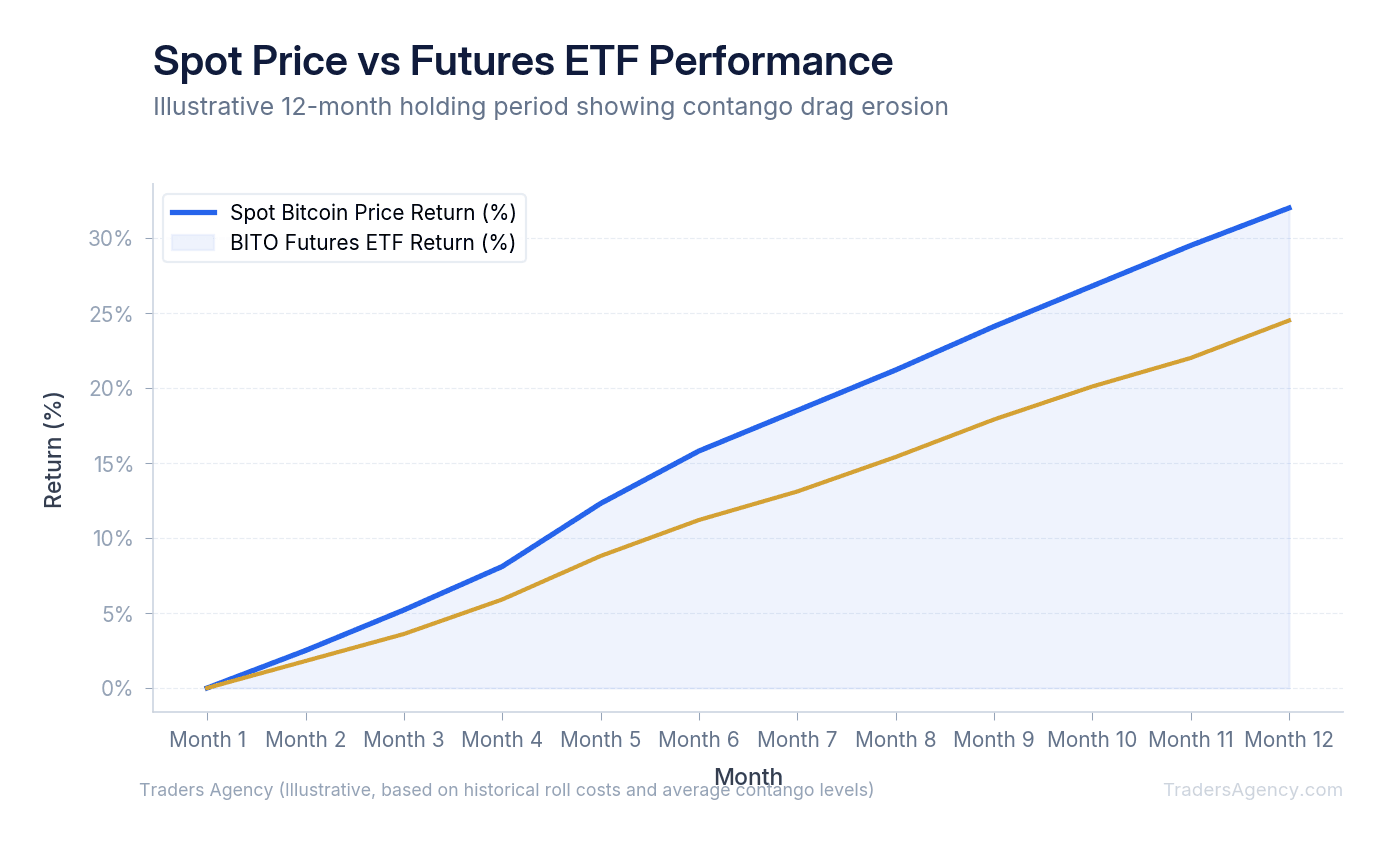
Contango drag occurs when a futures ETF must sell an expiring contract and buy the next month's contract at a higher price. This constant rolling process slowly erodes the fund's capital, causing the futures ETF to underperform the actual price of Bitcoin over time.
In the futures market, contracts that expire further out in time usually cost more than contracts expiring soon. This upward-sloping price curve is a market condition known as contango. When a fund rolls its contracts in a contango market, it is forced to sell low and buy high every single month.
A contango drag scenario means you are paying a hidden premium just to maintain your market exposure. If the next month's contract is 1% more expensive, the fund loses 1% of its purchasing power during the roll. Over a full year, these small monthly losses compound into a massive drag on your returns.
This is exactly why a futures ETF will almost always underperform the actual price of Bitcoin during a long bull market. The fund is constantly bleeding small amounts of capital just to keep its positions open.
Watch Out: Contango drag is invisible in daily price action but devastating over months. A futures ETF can lose 3% to 5% annually to roll costs alone, even when Bitcoin's price is flat. This hidden cost compounds year after year.
How Do You Actually Trade a Spot vs Futures Bitcoin ETF?
To understand how these mechanics affect your trading account, we will walk through a specific one-year trade. We are comparing a spot ETF and a futures ETF side by side using realistic market data.
- Step 1: The Setup. Imagine Bitcoin is currently trading at exactly $50,000. You decide to allocate $10,000 of your portfolio to a spot fund like IBIT. Your trading partner decides to allocate $10,000 to a futures fund like BITO. Both of you plan to hold the position for exactly 12 months.
- Step 2: The Execution. Over the next year, the price of Bitcoin steadily rises. By the end of the 12 months, Bitcoin is trading at $60,000, which is exactly a 20% increase. During this same period, the futures market remains in contango. The futures ETF has to roll its contracts 12 times. These roll costs average out to a 3.5% loss over the year.
- Step 3: The Outcome. Your spot ETF directly tracks the price of Bitcoin. Your investment grows by 20%, minus the fund's 0.21% management fee. Your final account balance is roughly $11,979. Your partner's futures ETF attempts to track the price but suffers from structural drag. Their investment grows by the base 20%, but loses 3.5% to contango and another 0.95% to management fees. Their final balance is roughly $11,555.
| Parameter | Spot ETF (IBIT) | Futures ETF (BITO) |
|---|---|---|
| Initial Investment | $10,000 | $10,000 |
| Bitcoin Price Change | +20% | +20% |
| Management Fee | 0.21% | 0.95% |
| Contango Drag | 0% | 3.5% |
| Final Balance (Bull) | $11,979 | $11,555 |
| Final Balance (Bear, -20%) | $7,979 | $7,555 |
By simply choosing the spot ETF, you outperformed your partner by over $400 on a $10,000 trade. In a bear market where Bitcoin drops by 20%, the futures ETF actually accelerates your losses because you suffer the price drop plus the contango drag.
Want expert trading insights delivered daily?
Join thousands of traders who rely on Traders Agency for market analysis and trade ideas.
Join Traders AgencyWhat Are the Fee and Tax Differences Between Spot and Futures Bitcoin ETFs?
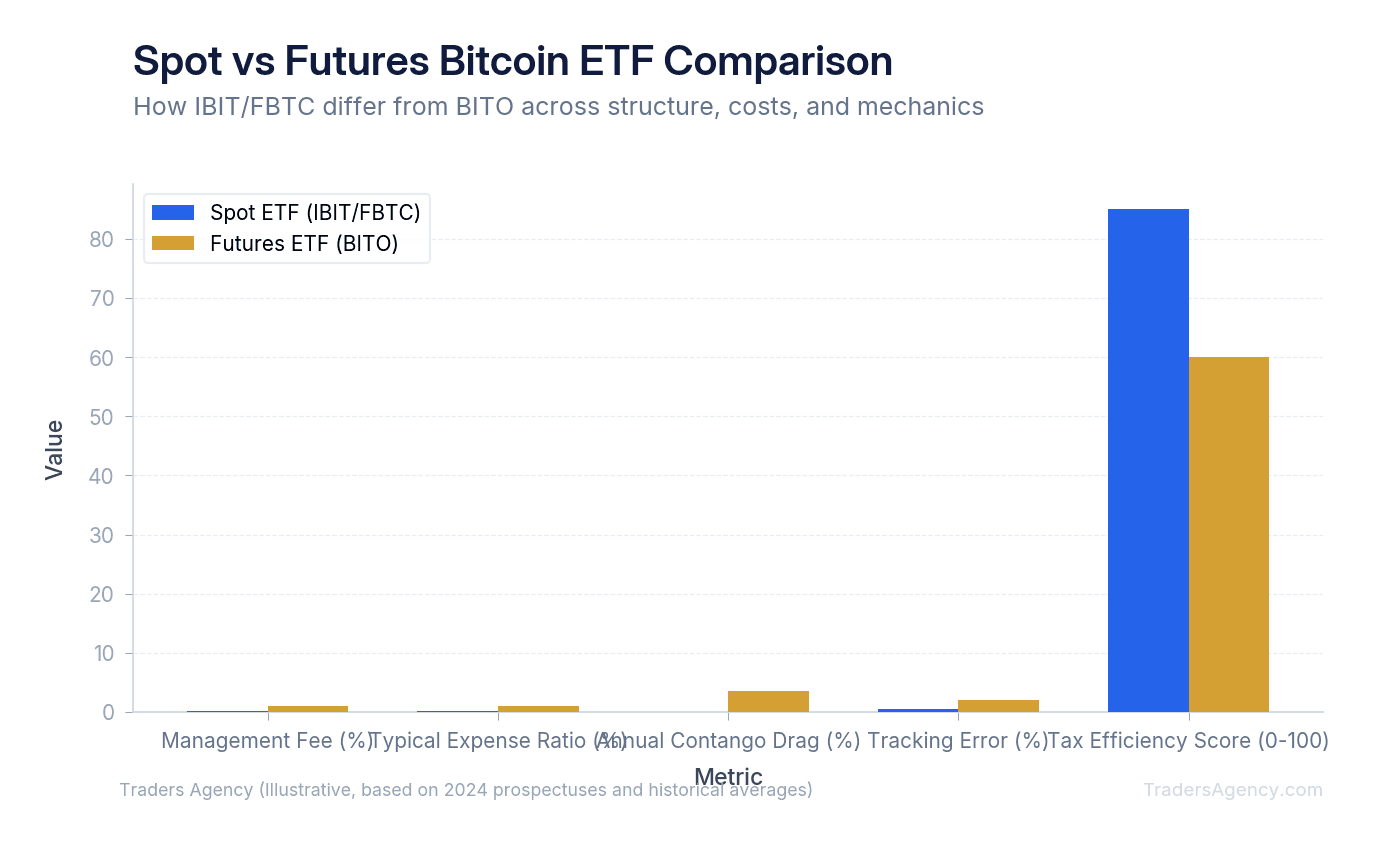
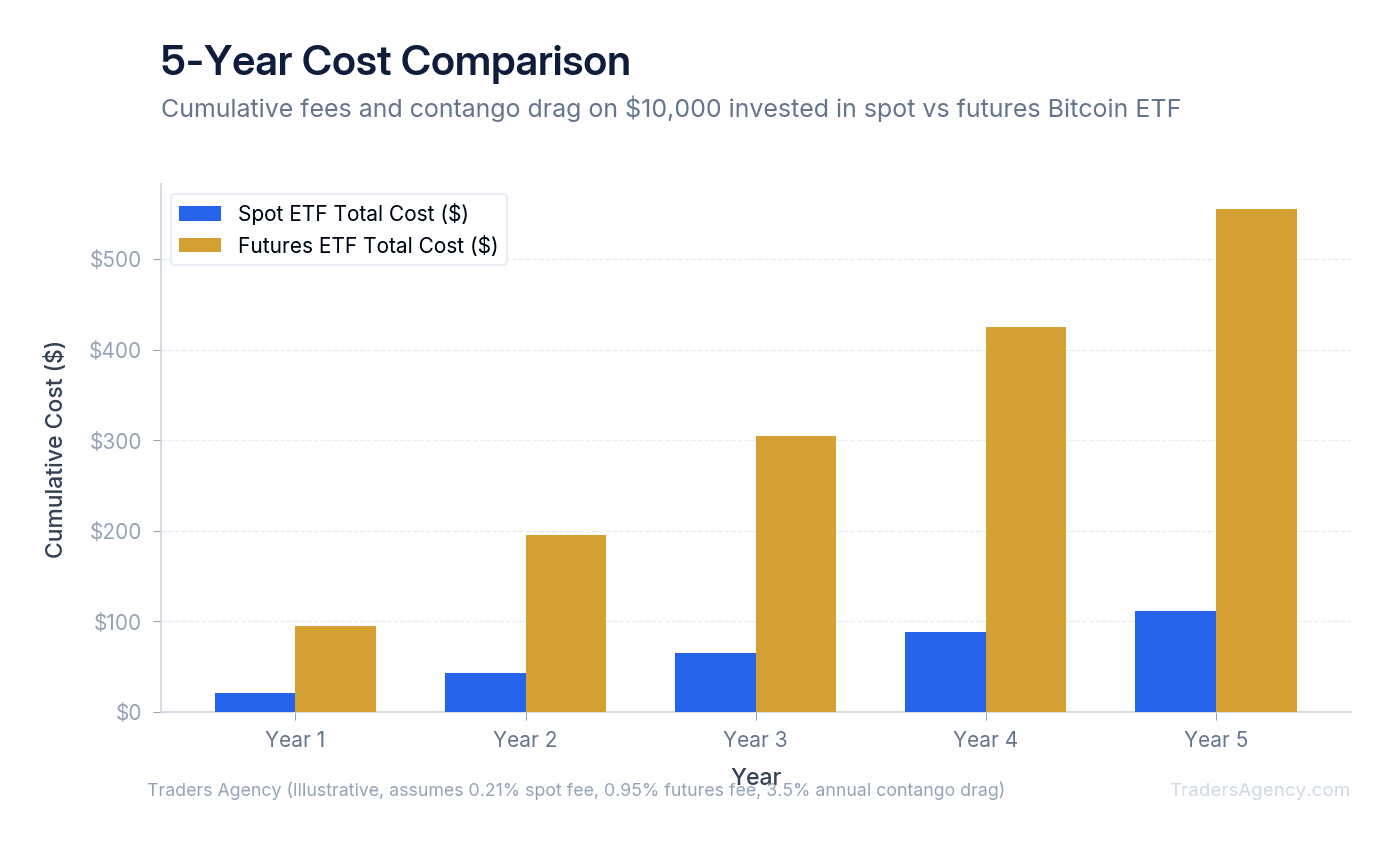
The fee and tax treatment differences between these ETFs significantly impact your net returns. Spot ETFs generally charge lower management fees around 0.20%, while futures ETFs often charge near 0.95%. The gap is substantial over time.
When looking at a Bitcoin ETF fee comparison, the numbers heavily favor spot products. Funds like IBIT and FBTC charge between 0.21% and 0.25% annually. In contrast, the largest futures ETF charges 0.95%. This higher fee is required because actively managing and rolling futures contracts is much more expensive than simply holding digital coins in a vault.
The Bitcoin ETF tax treatment is another major factor for retail traders. Regular spot ETFs are treated like standard stocks for tax purposes. You only pay capital gains taxes when you finally sell your shares. If you hold the shares for more than a year, you qualify for lower long-term capital gains rates.
Futures ETFs like BITO operate differently because they are structured as commodity pools. Instead of receiving a standard 1099, shareholders receive a Schedule K-1 tax form. Gains from futures contracts held by the fund are taxed under the 60/40 rule: 60% of gains are treated as long-term capital gains and 40% as short-term, regardless of how long you held your shares. While this blended rate can sometimes be favorable, the K-1 filing adds complexity and you may owe taxes on gains even in years you did not sell your shares.
Key Concept: Spot Bitcoin ETFs only trigger taxes when you sell. Futures Bitcoin ETFs issue K-1 forms and can generate taxable gains every year from their contract activity, even if you hold your shares and never sell. This makes futures ETFs more complex for tax filing purposes.
Which Bitcoin ETF Is Better for Buy-and-Hold vs Active Trading?
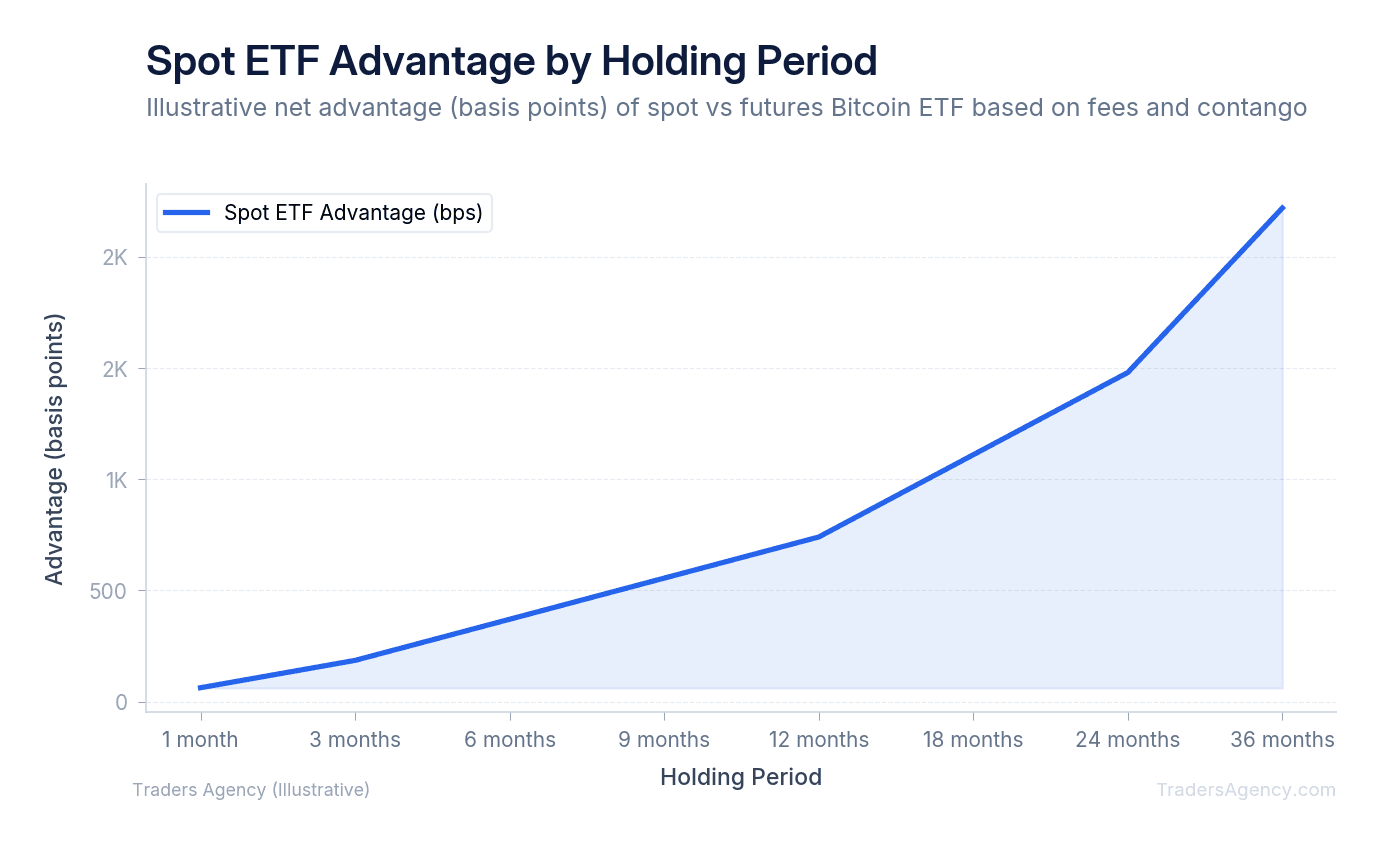
A spot Bitcoin ETF is better for long-term buy-and-hold investors because it avoids the compounding losses of contango drag. A futures ETF is better suited for short-term active traders who need high liquidity or want to trade options on the fund itself.
When evaluating a spot vs futures Bitcoin ETF, our team recommends matching the specific fund to your intended holding period.
The Buy-and-Hold Investor
We prefer to use spot ETFs for any trade we plan to hold for more than a few weeks. The Bitcoin ETF tracking error in a spot fund is incredibly low. If Bitcoin goes up 50% over five years, the spot ETF will closely match that exact return minus the small management fee. You avoid the heavy roll costs and complex tax filings entirely.
The Active Short-Term Trader
Futures ETFs still have a place in the market for very active traders. If you are day trading or swing trading over a three-day period, contango drag will not affect you. The daily roll cost is mathematically insignificant over 72 hours.
Futures ETFs like BITO have well-developed options markets. If you want to sell covered calls or buy short-term puts on Bitcoin, futures ETFs offer strong liquidity for options traders. Spot ETFs like IBIT have rapidly growing options markets as well, so check current volume and open interest before choosing your vehicle for derivative strategies.
How Do Bitcoin ETFs Fit Into a Broader Trading Portfolio?
Adding a Bitcoin ETF to your portfolio requires strict risk management and a clear understanding of market correlations. Bitcoin is a highly volatile asset that can experience massive price swings in a single trading session.
Historically, Bitcoin traded independently of traditional equity markets. Today, it frequently moves in tandem with high-growth technology stocks and the Nasdaq 100. If the broader stock market experiences a heavy sell-off, you should expect your Bitcoin ETF to drop as well.
Remember that actual Bitcoin trades 24 hours a day, seven days a week. However, your Bitcoin ETF only trades during standard stock market hours. If Bitcoin crashes on a Saturday, you cannot sell your ETF shares until the market opens on Monday morning. This creates gap risk, where the ETF might open significantly lower than its previous closing price.
Our team teaches members to treat Bitcoin as a high-beta growth asset. It offers excellent upside potential, but it requires strict rules to protect your trading capital.
Risk Management Rules for Crypto ETFs
Here is what we teach our members about sizing these specific trades:
- Limit your allocation: Keep your total crypto exposure to 1% to 5% of your overall trading portfolio.
- Use hard stops: Always place a stop loss on your ETF positions. We prefer a 10% to 15% trailing stop to protect against sudden crypto market crashes.
- Avoid long-term futures: Never hold a futures ETF for a multi-year investment. The guaranteed roll costs will destroy your potential profits.
- Monitor the fees: Always check the expense ratio before buying a new spot ETF, as providers frequently adjust their fees to compete for your capital.
Watch Out: Bitcoin ETFs only trade during standard market hours, but Bitcoin itself trades around the clock. Weekend crashes can create significant gap-down risk on Monday morning. Always size your positions with this in mind.
Want expert trading insights delivered daily?
Join thousands of traders who rely on Traders Agency for market analysis and trade ideas.
Join Traders AgencyKey Takeaways
- A spot Bitcoin ETF holds actual Bitcoin in offline custody vaults, so its price tracks Bitcoin's real-time market value directly with no derivative lag.
- A futures Bitcoin ETF holds contracts to buy Bitcoin at a later date, which means traders absorb roll costs every time expiring contracts are replaced with new ones, a guaranteed drag on returns.
- Holding a futures ETF long-term is a losing strategy by design: roll costs compound over time and will erode profits even when Bitcoin's price rises.
- Bitcoin ETFs only trade during standard market hours while Bitcoin trades 24/7, meaning a weekend crash can produce a significant gap-down when markets open Monday morning.
- Expense ratios on spot ETFs like IBIT and FBTC are actively adjusted as providers compete for capital, so checking the current fee before buying is a necessary step, not a formality.
DISCLAIMER: Traders Agency does not offer financial advice. The information provided is for educational purposes only and should not be considered financial advice. Traders Agency is not responsible for any financial losses or consequences resulting from the use of the information provided. Trading carries inherent risks and may not be suitable for all individuals. You are advised to conduct your own research and seek personalized advice before making any investment decisions, recognizing the potential risks and rewards involved.
See more from Traders Agency on Google
Make us a preferred source and our market analysis will appear more prominently in your Google Search, Top Stories, and AI results.
Add to Preferred Sources