
You've probably seen the massive headlines about cryptocurrency over the past year. Many new investors want to participate in the digital asset market but feel intimidated by complicated crypto exchanges and digital wallets. We get it. A Bitcoin ETF offers a simpler path into the market, but understanding how it works can still feel overwhelming. That's exactly why we put together this guide. By the time you finish reading, you'll understand the mechanics, costs, and risks of Bitcoin ETFs, and you'll know the exact steps to execute a trade safely through your existing brokerage account.
What Is a Bitcoin ETF?
Bottom Line: Bitcoin ETFs solve the biggest barrier to crypto investing by removing the need for digital wallets and unregulated exchanges. The January 2024 SEC approval made this a legitimate, accessible option for everyday investors. Understanding the cost differences between funds and applying basic position management are the two most practical things you can do before placing your first trade.
A Bitcoin ETF is an exchange-traded fund that tracks the price of Bitcoin, allowing you to buy shares through a standard brokerage account without ever managing a digital wallet. It's a regulated investment vehicle that trades on traditional stock exchanges like the NYSE or Nasdaq. Instead of buying digital currency on a crypto exchange, you buy shares of a fund that holds the actual cryptocurrency. This structure gives you direct price exposure with the familiar protections of a traditional brokerage.
Before these funds existed, investors had to rely on complex futures contracts or unregulated exchanges to trade cryptocurrency. That changed when the SEC approved the first spot Bitcoin ETFs in January 2024. This approval opened the doors for everyday retail traders to access the digital asset market safely.
Key Concept: The word "spot" means the fund holds the actual asset and tracks its current market price. This is very different from a futures ETF, which tracks derivative contracts that must be rolled forward periodically and often leads to performance drag over long holding periods.
When you buy a spot fund, you're getting direct exposure to the current market price of Bitcoin. The fund managers purchase the digital currency and place it in highly secure storage facilities. They then issue shares that represent a tiny fraction of that stored currency.
How Do Spot Bitcoin ETFs Work?
Spot Bitcoin ETFs work by purchasing and storing actual Bitcoin in secure digital vaults managed by regulated custodians. When you buy a share of the ETF, you're buying a fractional representation of that stored cryptocurrency. The fund's share price moves up and down directly with the asset's market price.
Here's a concrete example of how the tracking mechanism functions. If Bitcoin goes up by 5% in a single trading day, the price of your ETF shares should also go up by approximately 5%. The fund managers work with large financial institutions to create and redeem shares based on market demand. This continuous creation and redemption process keeps the ETF share price closely aligned with the actual value of the digital assets in the vault. If the share price ever drifts too high, institutions create new shares to bring the price back in line.
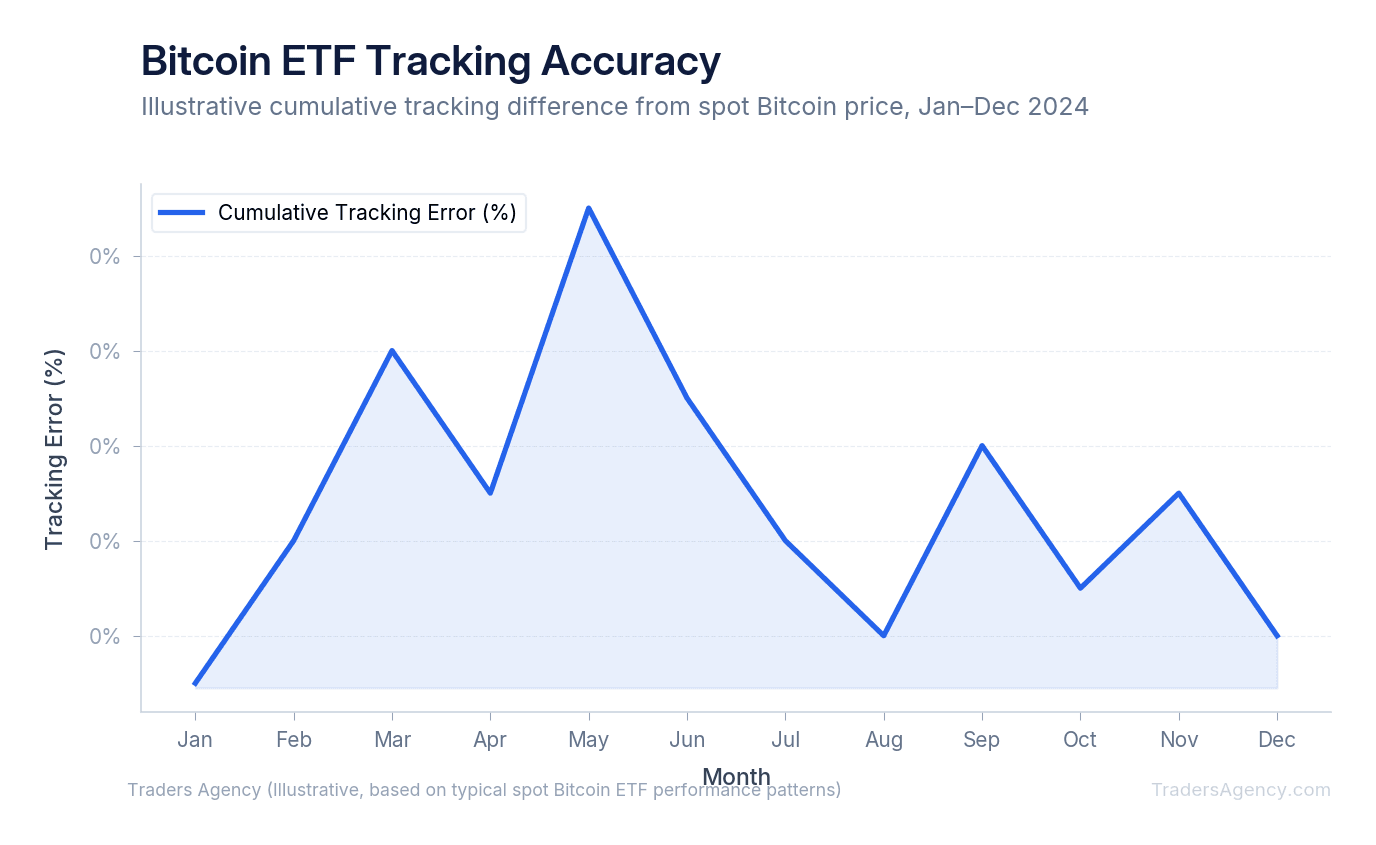
However, the tracking is rarely perfect. We teach our members to watch for tracking error, which is the slight difference between the fund's performance and the actual asset's performance. These minor discrepancies happen because the fund has to pay management fees and trading costs. Over a long period, these small fees slowly reduce the total return of the fund compared to the raw asset. You should expect your fund to underperform the actual cryptocurrency by a fraction of a percent each year due to these operational costs.
What Is the Difference Between a Spot Bitcoin ETF and Owning Bitcoin Directly?
Many new traders ask us whether they should just buy the cryptocurrency directly. Owning the asset directly requires you to open an account with a specialized crypto exchange like Coinbase or Kraken. You then have to manage a digital wallet and secure a private key.
A private key is a complex password that controls access to your funds. If you lose that private key, your investment is gone forever. There is no customer service hotline to call if you forget your password or send your funds to the wrong address.
Our team prefers the Bitcoin ETF route for traders who want simplicity and security. When you buy an ETF, your shares are held safely in your existing brokerage account alongside your regular stocks and bonds. You don't have to worry about hackers stealing your digital wallet or memorizing complex security phrases. The fund's custodian handles all the institutional-grade security and cold storage requirements.
Watch Out: The cryptocurrency market trades 24 hours a day, seven days a week. ETF shares only trade during standard stock market hours (9:30 AM to 4:00 PM Eastern Time). If Bitcoin crashes on a Saturday, you cannot sell your ETF shares until the stock market opens on Monday morning. This creates the risk of weekend price gaps, where the ETF opens significantly lower than it closed on Friday.
| Feature | Bitcoin ETF | Direct Bitcoin Ownership |
|---|---|---|
| Where You Buy | Standard brokerage account | Crypto exchange |
| Security | Custodian-managed cold storage | You manage your own private key |
| Trading Hours | Market hours only (Mon-Fri) | 24/7 |
| Tax Reporting | Standard 1099-B form | Complex multi-wallet tracking |
| Annual Fees | Expense ratio (0.25%+) | None (exchange fees per trade) |
| Weekend Gap Risk | Yes | No |
Want expert trading insights delivered daily?
Join thousands of traders who rely on Traders Agency for market analysis and trade ideas.
Join Traders Agency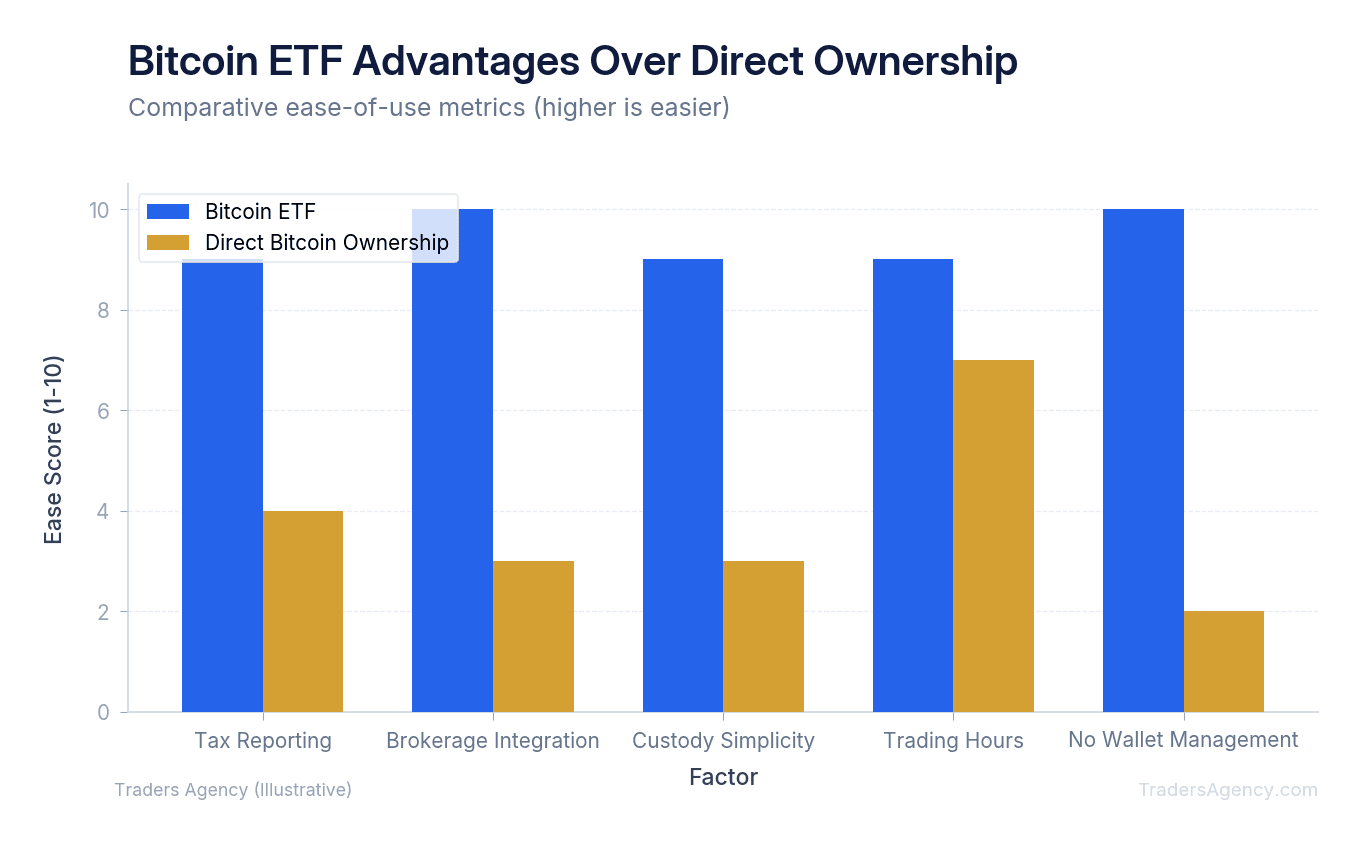
The Major Bitcoin ETFs: IBIT, FBTC, and GBTC Compared
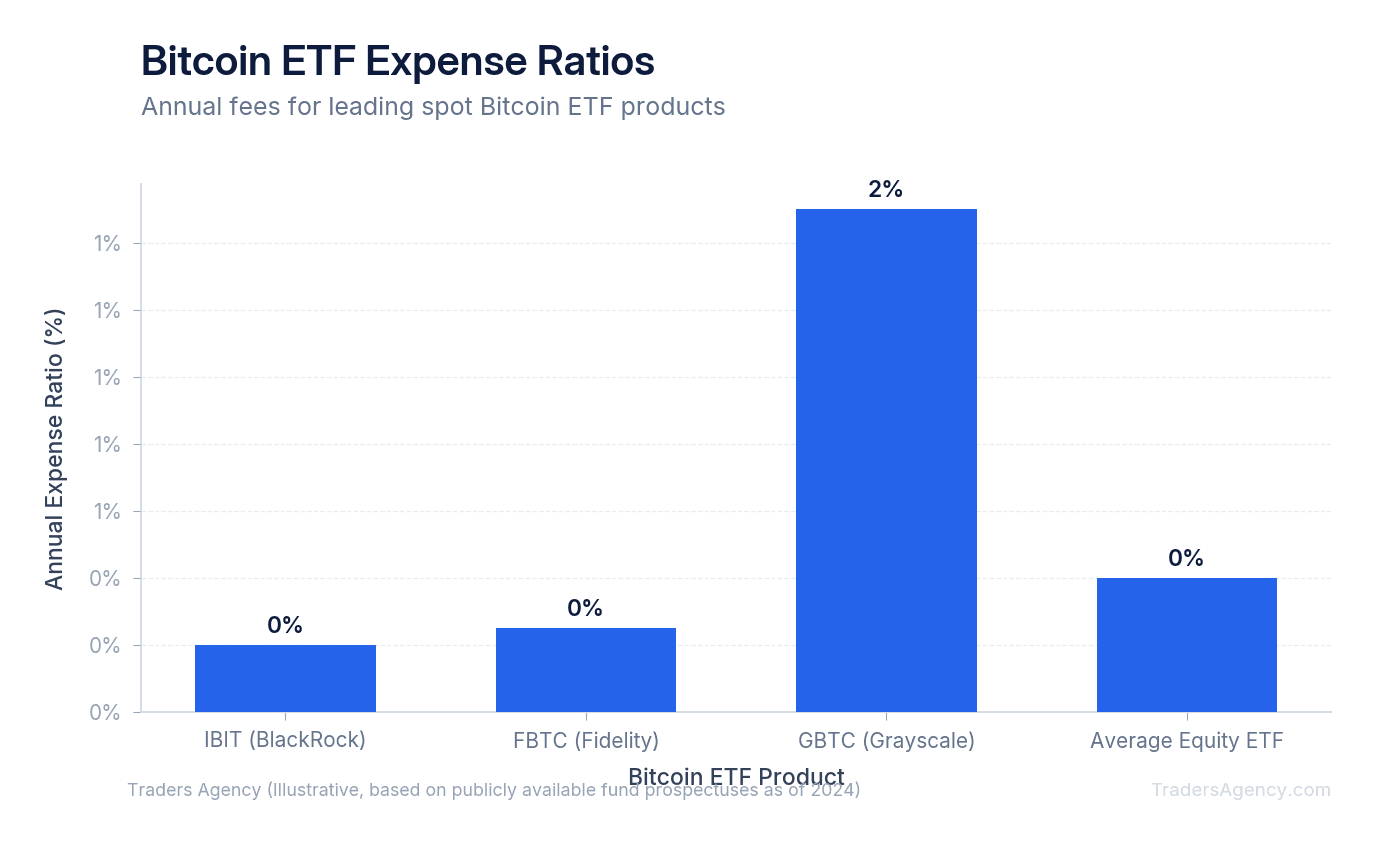
When you open your brokerage platform, you'll see several different ticker symbols for these funds. The three most popular options are IBIT (iShares Bitcoin Trust), FBTC (Fidelity Wise Origin Bitcoin Fund), and GBTC (Grayscale Bitcoin Trust). While they all hold the exact same underlying asset, they charge different management fees.
This fee is known as the expense ratio, and it's automatically deducted from the fund's assets over the course of the year. For example, if a fund has an expense ratio of 0.25%, you'll pay $25 in annual fees for every $10,000 you invest. Comparing expense ratios is one of the most reliable ways to choose between similar funds. We recommend paying close attention to these fees because they directly impact your long-term returns.
| Fund | Ticker | Approximate Expense Ratio | Daily Liquidity |
|---|---|---|---|
| iShares Bitcoin Trust | IBIT | ~0.25% | Very High |
| Fidelity Wise Origin Bitcoin Fund | FBTC | ~0.25% | Very High |
| Grayscale Bitcoin Trust | GBTC | ~1.50% | High |
IBIT and FBTC launched with very competitive expense ratios, often around 0.25%. In contrast, older funds like GBTC historically charged much higher fees, sometimes up to 1.5%. If you hold a high-fee fund for several years, those costs will eat into your trading profits significantly.
Beyond fees, you should also look at daily trading volume. High trading volume means you can buy and sell shares instantly without facing a wide bid-ask spread. IBIT and FBTC currently offer excellent liquidity, making them our preferred choices for active traders. You can review the official filings for these funds on the SEC's EDGAR database.
How Are Bitcoin ETFs Taxed?
Bitcoin ETFs are taxed exactly like traditional stock ETFs. If you hold the shares in a standard brokerage account, you'll pay short-term or long-term capital gains taxes when you sell them for a profit. If held in a tax-advantaged retirement account like an IRA, taxes are deferred or eliminated.
This familiar tax structure is a significant advantage for retail traders. When you trade cryptocurrency directly on a digital exchange, every single transaction or swap can trigger a complicated taxable event. Tracking the cost basis across multiple digital wallets can become a nightmare.
With an ETF, your brokerage provides a standard 1099-B tax form at the end of the year. This form clearly lists your cost basis, your sale price, and your total profit or loss. Here's a quick example:
| Parameter | Value |
|---|---|
| Shares Purchased | 100 shares of IBIT |
| Purchase Price | $35 per share |
| Sale Price (1 year later) | $45 per share |
| Total Capital Gain | $1,000 |
| Tax Treatment | Long-term capital gains rate |
We prefer this straightforward reporting because it saves our members hours of accounting headaches during tax season.
Watch Out: Be aware of the wash sale rule. If you sell your ETF shares at a loss and buy them back within 30 days, you cannot claim that loss on your current year's taxes. Tax rules around digital assets are evolving quickly, so consult a qualified tax professional for the most current guidance. Because ETFs are classified as traditional securities, the standard 30-day wash sale restriction applies fully.
Should You Add a Bitcoin ETF to Your Portfolio?
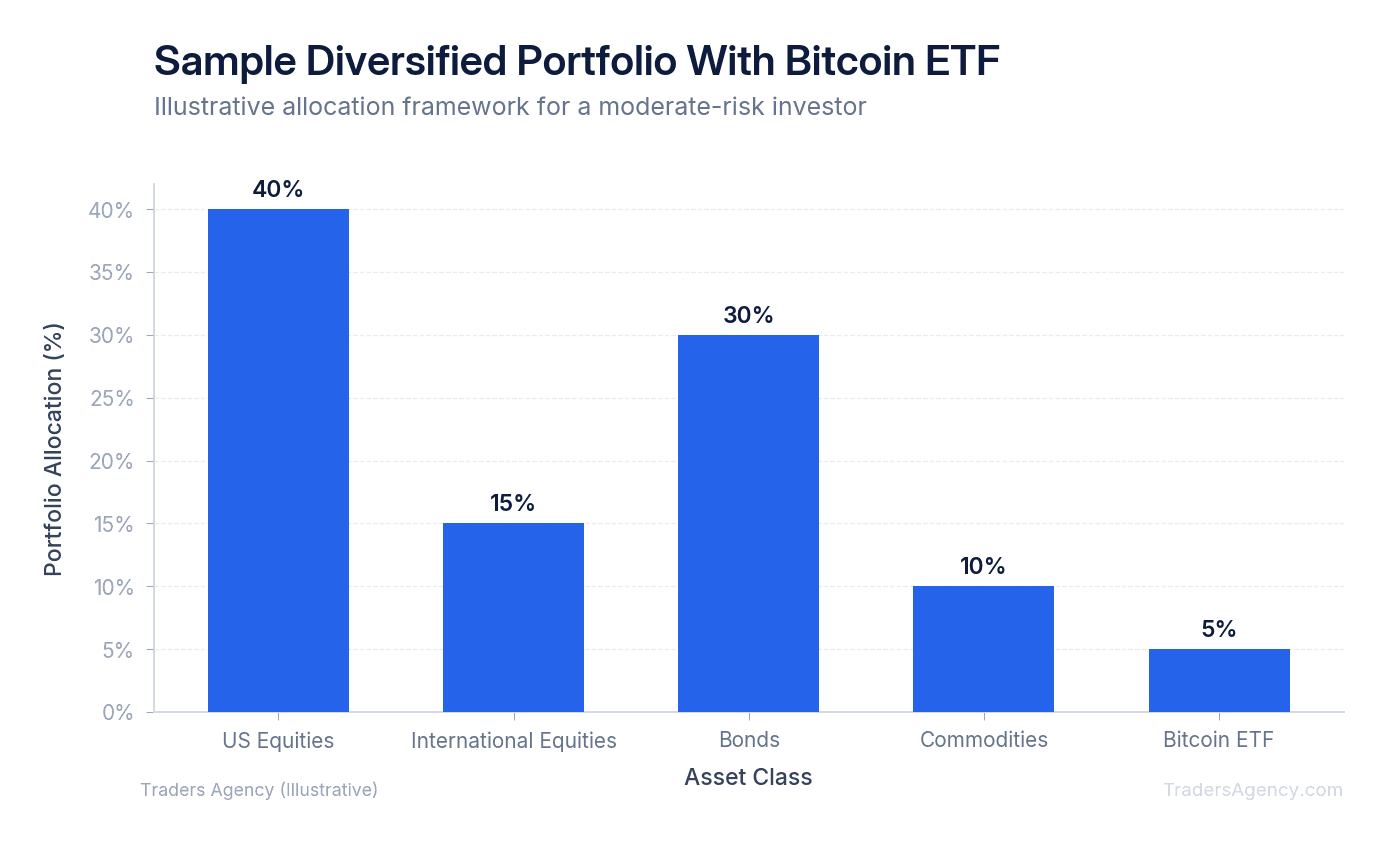
Adding a Bitcoin ETF to your portfolio depends on your personal risk tolerance and investment timeline. Because cryptocurrency is highly volatile, these funds are best used as a small, speculative allocation within a broadly diversified portfolio of traditional stocks and bonds.
Our team teaches a strict approach to position sizing when dealing with volatile assets. We rarely allocate more than 1% to 5% of a total portfolio to cryptocurrency products. This conservative sizing protects your account from massive drawdowns.
Here's the math. If the digital asset market drops by 40% in a single month, a 2% portfolio allocation means your total account only drops by 0.8%. You can easily recover from a 0.8% drop, but recovering from a massive portfolio loss is mathematically exhausting.
Key Concept: Cryptocurrency often behaves like a high-beta technology stock. When interest rates are low and investors feel optimistic, these assets tend to rally. When the stock market panics, digital assets usually fall right alongside traditional equities. Do not expect Bitcoin to act as a safe haven during a stock market crash.
You should avoid these funds entirely if you need the invested money within the next three years. The price swings are simply too violent for short-term cash management or emergency funds. Always consider the broader market context before buying.
How Do You Buy a Bitcoin ETF Through Your Brokerage Account?
If you decide this strategy fits your risk profile, executing the trade is very straightforward. You don't need any special permissions or separate accounts. Here is the exact process we teach our members for entering a position.
- Fund Your Brokerage Account. Make sure you have settled cash available in your standard trading account. You can use any major platform like Charles Schwab, Fidelity, or Vanguard. Check your available buying power before planning your trade.
- Choose Your Preferred Ticker. Select the specific fund you want to trade based on its expense ratio and trading volume. We generally look at IBIT or FBTC because they offer low fees and high daily liquidity. High daily trading volume ensures you can enter and exit the position easily without wide bid-ask spreads.
- Determine Your Position Size. Calculate your maximum dollar allocation based on the 1% to 5% rule we covered earlier. If you have a $100,000 portfolio, a 2% allocation means you'll invest exactly $2,000. Divide that dollar amount by the current share price to determine how many shares to buy.
- Place a Limit Order. We always recommend using a limit order rather than a market order. A limit order ensures you only pay your specified price or better. Because these funds can experience sudden intraday price spikes, a limit order protects you from overpaying during a volatile trading session.
- Set Your Stop Loss. Once your order fills, immediately place a stop loss order to protect your capital. A stop loss is an automated order that sells your shares if the price drops to a specific level. If the market turns against you, this automated order will trigger and cap your maximum loss. We usually place our stop loss below a recent level of technical support.
| Step | Action | Example |
|---|---|---|
| Position Size | 2% of portfolio | $2,000 on a $100K account |
| Ticker | Low-fee, high-volume fund | IBIT at $35/share |
| Shares to Buy | $2,000 ÷ $35 | 57 shares |
| Order Type | Limit order | Limit at $35.00 |
| Stop Loss | Below recent support | Stop at $31.50 (10% risk) |
That's the entire process. Once your position is live, monitor it alongside the rest of your portfolio. Review your allocation periodically and adjust your stop loss as the price moves in your favor. If Bitcoin rallies and your allocation grows beyond your target percentage, consider trimming the position to lock in profits and rebalance back to your original plan.
Our education team publishes new strategy guides and market analysis every week. If you found this guide helpful, we encourage you to explore the full library of resources available to our members.
Want expert trading insights delivered daily?
Join thousands of traders who rely on Traders Agency for market analysis and trade ideas.
Join Traders AgencyKey Takeaways
- The SEC approved the first spot Bitcoin ETFs in January 2024, giving retail investors regulated access to Bitcoin price exposure through standard brokerage accounts for the first time.
- A spot Bitcoin ETF holds actual Bitcoin, not futures contracts, which means the share price tracks the real-time price of the asset rather than a derivative.
- You can buy a Bitcoin ETF through any brokerage that supports ETF trading, using the same order types you would use for a stock: market, limit, or stop orders.
- Major options include IBIT (BlackRock), FBTC (Fidelity), and GBTC (Grayscale), each with different fee structures and liquidity profiles worth comparing before you buy.
- Once a position is open, managing allocation matters: if Bitcoin rallies and grows beyond your target portfolio percentage, trimming the position to rebalance is a practical risk control step.
DISCLAIMER: Traders Agency does not offer financial advice. The information provided is for educational purposes only and should not be considered financial advice. Traders Agency is not responsible for any financial losses or consequences resulting from the use of the information provided. Trading carries inherent risks and may not be suitable for all individuals. You are advised to conduct your own research and seek personalized advice before making any investment decisions, recognizing the potential risks and rewards involved.
See more from Traders Agency on Google
Make us a preferred source and our market analysis will appear more prominently in your Google Search, Top Stories, and AI results.
Add to Preferred Sources