
You've probably seen this happen on your own charts. Silver sits quietly for weeks, barely moving a few cents a day. Then, seemingly out of nowhere, the metal spikes 5% in a single session. This asset is notorious for its aggressive price swings and sudden trend changes. We're going to walk you through exactly how to trade this unique market. By the end of this guide, you'll know how to execute specific setups, manage your risk properly, and choose the correct trading vehicle for your portfolio. Our team relies on practical, repeatable systems, and we're sharing those exact frameworks with you today.
What Makes Silver Different From Other Tradable Assets?
Bottom Line: Silver rewards traders who understand its dual identity as both a safe-haven metal and an industrial commodity. The practical edge comes from waiting for clean technical setups rather than chasing parabolic moves, and from sizing risk appropriately given silver's outsized volatility relative to gold. Master those two disciplines and the asset's aggressive swings become an opportunity rather than a liability.
Silver is a unique commodity because it acts as both a precious metal and an industrial component. Unlike gold, which is primarily a store of value, silver derives over half of its global demand from industrial applications like solar panels, electric vehicles, and medical electronics.
Our team recommends treating silver as a hybrid asset. When equity markets panic, silver often catches a safe-haven bid alongside gold. However, when manufacturing data shows economic expansion, silver can rally entirely on industrial demand. You have to monitor both macroeconomic fear and industrial consumption to understand the full picture.
This dual identity creates exceptionally high volatility. Silver routinely experiences daily price moves that are two to three times larger than gold.
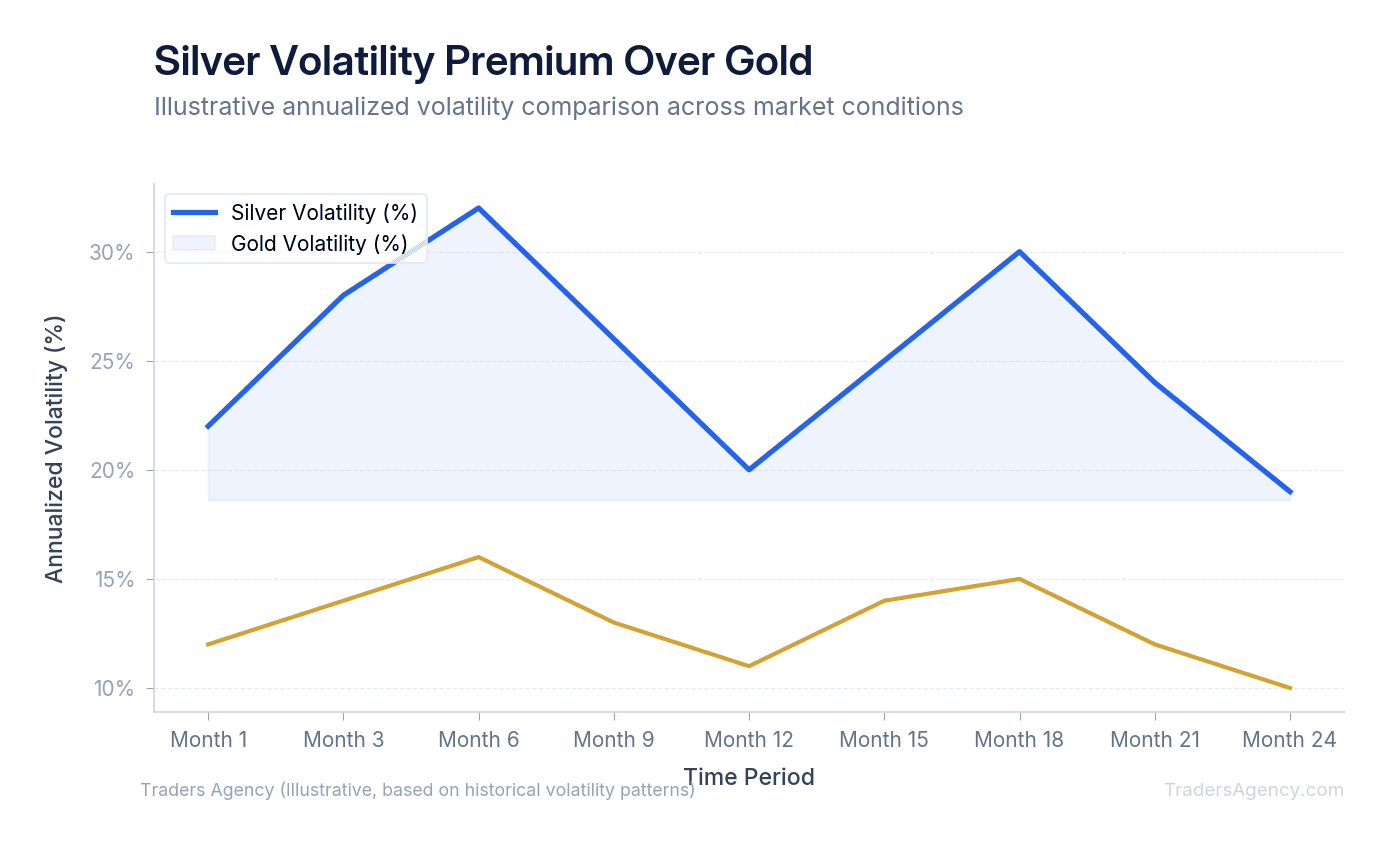
Historical data from the CME Group shows that silver futures frequently exhibit annualized volatility exceeding 25%. This means your position sizing must be significantly smaller than what you might use for broad market index funds. If you size a silver trade the same way you size a utility stock trade, the normal daily fluctuations will quickly force you out of your position.
Key Concept: Silver is a hybrid asset driven by both safe-haven demand and industrial consumption. This dual identity creates volatility that is two to three times greater than gold, which means smaller position sizes and wider stop losses are essential.
What Is the Best Strategy for Trading Silver?
The best strategy for trading silver depends entirely on current market volatility and your specific timeframe. We prefer to use trend-following systems during periods of high industrial demand, while relying on range-bound strategies when the metal is stuck in consolidation.
There is no single perfect approach that works in every environment. Successful traders adapt their methods to the current market phase.
We teach our members to identify the market context before deploying capital. If silver is breaking out of a multi-month consolidation pattern, a momentum approach works best. If it is chopping sideways between clear support and resistance levels, you should trade the edges of the range. We'll break down how to execute both of these approaches below.
What Are the Best Trend-Following and Momentum Breakout Strategies for Silver?
Silver is famous for its massive, sustained trends. When this metal breaks a major technical level on high volume, it rarely looks back.
We look for periods where silver has traded in a tight, narrow range for at least three months. Once the price closes above the upper boundary of that range, we initiate a long position. We pair this price action with the Relative Strength Index (RSI). We want to see the RSI push above 60, confirming that buyers have taken control of the momentum.
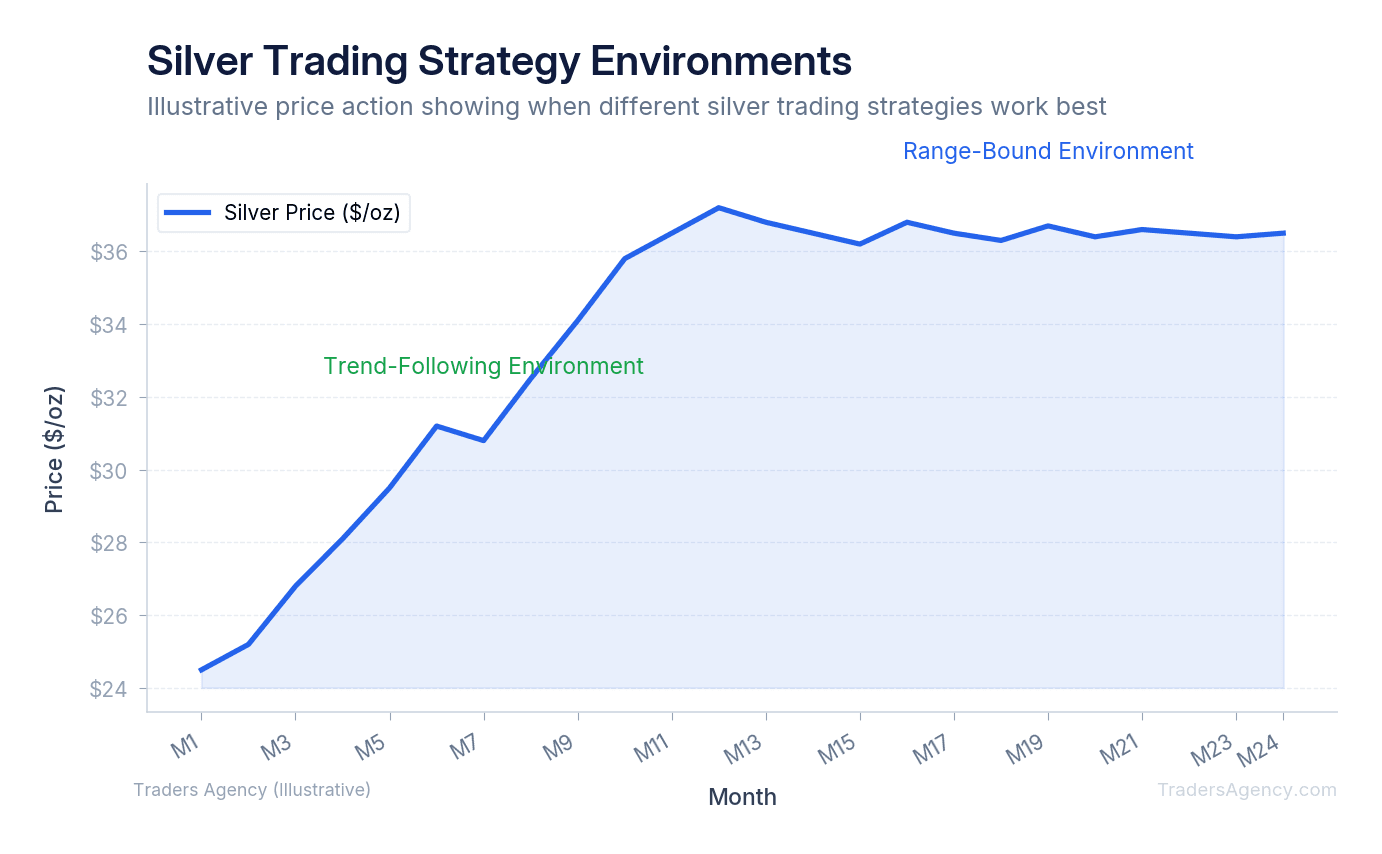
Momentum breakouts require strict discipline. You are buying strength, which means you must be prepared to cut losses quickly if the breakout fails and falls back into the previous range.
The Momentum Breakout Setup: Step by Step
- Identify the Setup: We want to see the iShares Silver Trust (SLV) consolidate between $20.00 and $22.00 for at least eight weeks. We wait patiently for a daily candle to close above $22.20 with trading volume exceeding the 20-day average.
- Execute the Trade: Once the daily candle closes at $22.25, we buy SLV shares the following morning at the market open. We immediately place a hard stop-loss order at $21.50, which sits just below the recent breakout level. Our initial profit target is $24.50, offering a risk-to-reward ratio of roughly 1-to-3.
- Manage the Outcome: In the best-case scenario, strong industrial demand news pushes SLV directly to $24.50 within two weeks. The worst-case scenario is a false breakout where the price immediately reverses, triggering our stop loss for a manageable loss. The most likely case is a choppy climb toward the target, requiring you to hold through minor daily pullbacks.
| Scenario | Exit Price | Result |
|---|---|---|
| Best Case | $24.50 | +10% gain |
| Most Likely | $23.50 - $24.50 | +5.5% to +10% gain (choppy climb) |
| Worst Case | $21.50 (stop loss) | -3.4% loss |
How Do You Trade a Range-Bound Silver Market?
A range-bound silver strategy involves buying the metal at established support levels and selling it at established resistance levels. Traders use this approach when silver lacks a clear macroeconomic trend and simply bounces between two specific price points.
Silver spends roughly 70% of its time consolidating. If you only know how to trade breakouts, you will sit on the sidelines for most of the year.
To trade a range, we identify a support floor where buyers consistently step in and a resistance ceiling where sellers consistently take profits. We use the Stochastic Oscillator to confirm our entries. We want to buy when the indicator shows oversold conditions near support.
The Range-Bound Setup: Step by Step
- Identify the Setup: Assume SLV has been bouncing between $18.00 support and $20.00 resistance for six months. The price drops to $18.10, and the Stochastic Oscillator dips below 20, signaling oversold conditions.
- Execute the Trade: We buy SLV at $18.10. We place a tight stop loss at $17.60, just below the established support floor. We place a limit order to sell our position and take profits at $19.80, just shy of the resistance ceiling.
- Manage the Outcome: If the range holds, the price bounces off support and hits our $19.80 target over the next few weeks. If the support level breaks due to a sudden drop in commodity prices, our stop loss takes us out at $17.60.
| Scenario | Exit Price | Result |
|---|---|---|
| Best Case | $19.80 | +9.4% profit |
| Worst Case | $17.60 (stop loss) | -2.8% loss |
Watch Out: Range-bound strategies fail when a major fundamental event breaks the established support or resistance. Always check the economic calendar for upcoming Fed announcements, jobs reports, and manufacturing data before entering a range trade in silver.
Want expert trading insights delivered daily?
Join thousands of traders who rely on Traders Agency for market analysis and trade ideas.
Join Traders AgencyHow Does the Gold-Silver Ratio Mean Reversion Strategy Work?
The gold-silver ratio measures how many ounces of silver it takes to buy one single ounce of gold. When this ratio stretches too far above or below its historical average of 60, traders can execute a mean reversion strategy by shorting the expensive metal and buying the cheap one.
This is one of the most reliable silver trading strategies because it relies on mathematical relationships rather than directional guessing. You do not need to know if the broader market is going up or down.
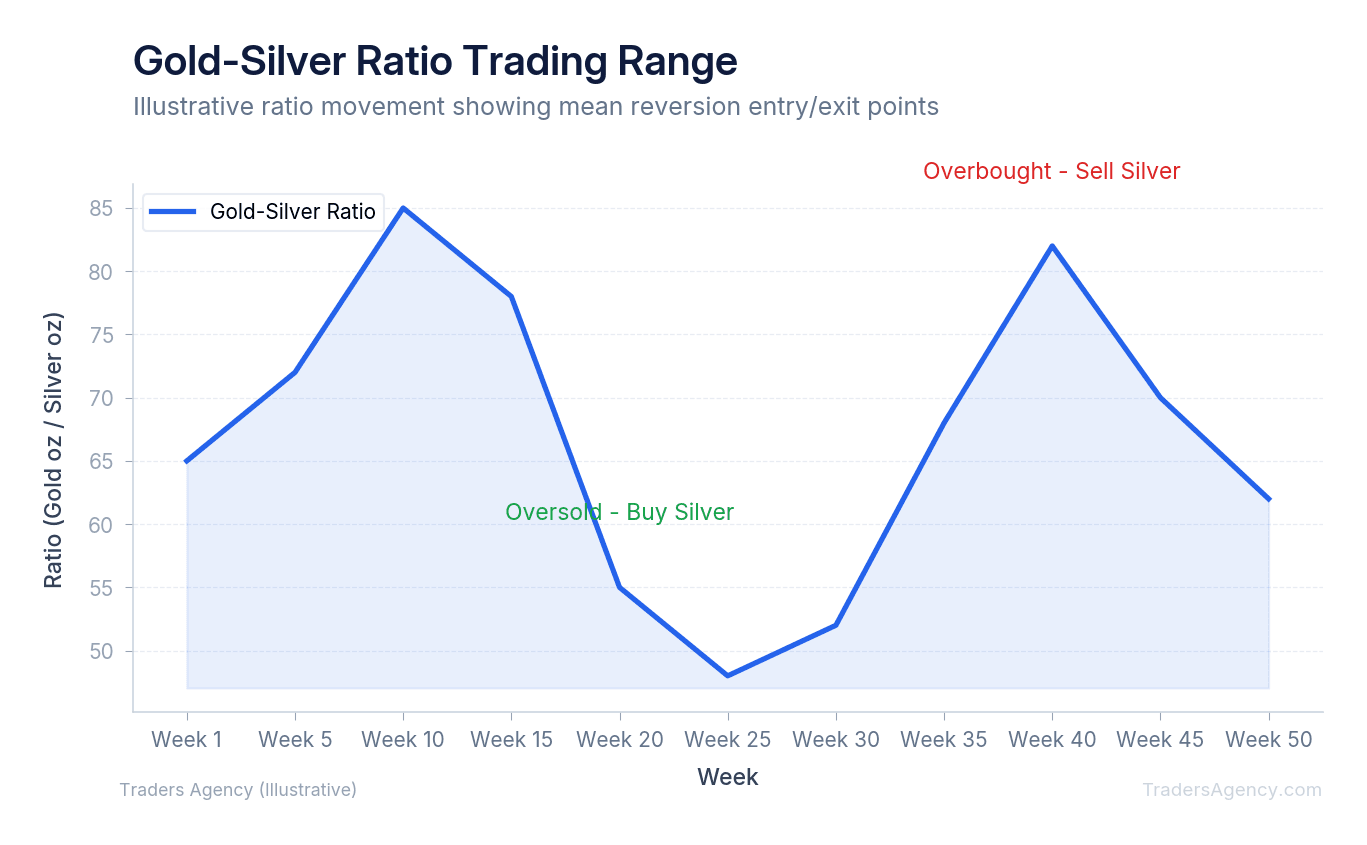
When the ratio hits 85, silver is historically cheap compared to gold. When the ratio drops to 40, silver is historically expensive compared to gold.
The Ratio Trade: Step by Step
- Identify the Setup: Assume the gold-silver ratio reaches 85. This tells us silver is deeply undervalued relative to gold. We want to position ourselves for the ratio to drop back toward the historical mean of 60.
- Execute the Trade: We buy silver and short gold simultaneously. We might purchase 100 shares of SLV at $20.00 and short 10 shares of SPDR Gold Trust (GLD) at $180.00. We are only betting that silver will outperform gold in the coming months.
- Manage the Outcome: If the ratio compresses back to 70, our silver position will gain more value than our gold position loses, resulting in a net profit. The risk here is that the ratio continues to expand to 95, meaning silver keeps underperforming gold. This would result in a net loss on the spread. Managing margin requirements is essential when holding paired trades.
| Parameter | Value |
|---|---|
| Entry Signal | Gold-silver ratio reaches 85 |
| Long Leg | 100 shares SLV at $20.00 |
| Short Leg | 10 shares GLD at $180.00 |
| Target | Ratio compresses to 70 |
| Risk | Ratio expands to 95 (net loss on the spread) |
Key Concept: The gold-silver ratio mean reversion strategy is a pairs trade. You are not betting on the direction of precious metals overall. You are betting that the historical relationship between gold and silver will return to normal. This makes it a market-neutral approach.
How Do You Choose the Right Silver Trading Vehicle?
Choosing the right trading vehicle depends on your account size, risk tolerance, and desired holding period. Traders can choose between physical-backed ETFs, futures contracts, or silver mining stocks, each offering different levels of liquidity and volatility.
Here are the primary options available to retail traders.
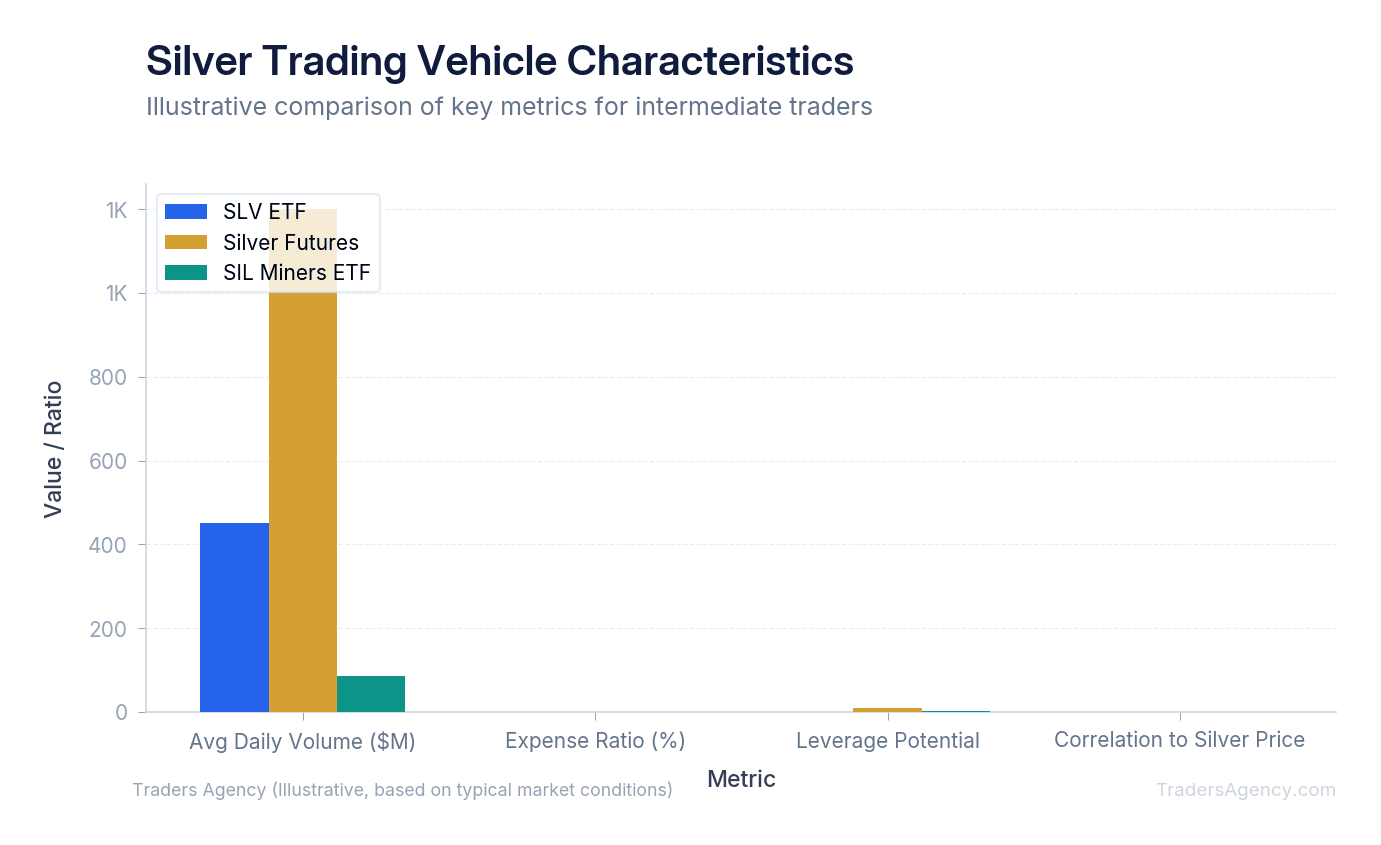
The iShares Silver Trust (SLV) is the most straightforward vehicle. It tracks the physical price of silver and is highly liquid. We prefer SLV for swing trades lasting a few weeks to a few months. You can also trade options on SLV, which allows for advanced strategies like covered calls to generate income during flat markets.
Silver futures (SI) offer massive purchasing power. A single standard contract controls 5,000 ounces of silver. Futures trading involves substantial risk and requires strict margin management. A small drop in the price of silver can result in large losses in a futures account. We only suggest futures for advanced, well-capitalized day traders. You can find more information on futures margin requirements at the CME Group.
Silver mining ETFs, like the Global X Silver Miners ETF (SIL), offer indirect exposure. Miners often act like a high-beta play on physical silver. If physical silver goes up 2%, mining stocks might jump 5%. The downside is that you take on company-specific risks. A mining company can suffer from poor earnings, labor strikes, or mine closures, causing the stock to drop even if silver prices are rising.
| Vehicle | Best For | Volatility | Key Risk |
|---|---|---|---|
| SLV (ETF) | Swing trades, options strategies | Moderate-High | Tracking error over long periods |
| SI (Futures) | Day trading, large accounts | Very High | Margin calls, contract expiration |
| SIL (Mining ETF) | High-beta silver exposure | High | Company-specific risk, earnings misses |
Practical Application and Risk Management
You need to know exactly when to apply these silver trading strategies. Market context dictates everything.
We deploy trend-following strategies when macroeconomic conditions favor industrial expansion. If manufacturing data is strong, companies need more silver for electronics and solar panels. This creates a fundamental tailwind that supports technical breakouts.
Conversely, you should avoid breakout strategies during periods of low volume or summer trading months. When silver is chopping between tight support and resistance, false breakouts will trigger your stop losses repeatedly.
To succeed, you must align your technical setups with the broader market environment. Here is how our team integrates risk management into every silver trade:
- Position Sizing: Because silver is highly volatile, we limit our silver exposure to a maximum of 5% of total trading capital. If you have a $10,000 account, you should never risk more than $500 on a single silver trade.
- Stop Losses: We always use hard stop losses placed just below major moving averages, such as the 50-day SMA. Mental stops do not work in a market that can drop 3% in an hour.
- Correlation Checks: We always check the US Dollar Index (DXY). Silver typically moves inversely to the dollar. If the dollar is breaking out to new highs, we avoid taking long positions in silver.
Risk Warning: Silver can move 3-5% in a single session during periods of high volatility. Always use hard stop-loss orders and never risk more than 5% of your total trading capital on any single silver position. Mental stops are not sufficient for this market.
What Are the Most Common Mistakes Traders Make With Silver?
Even experienced traders lose money in silver if they fail to respect its unique characteristics. The metal's aggressive intraday swings can easily shake out weak hands. Here are the most common errors we see traders make:
- Ignoring the US Dollar: Silver is priced in US dollars. If you trade silver without looking at a dollar chart, you are flying blind. A strong dollar makes silver more expensive for foreign buyers, which typically drives the price down.
- Oversizing positions: Treating silver like a slow-moving utility stock is a recipe for disaster. A 4% daily drop is completely normal for silver. Size your trades so a normal pullback does not trigger a margin call or cause emotional panic.
- Forgetting industrial demand: Many traders treat silver exactly like gold. They forget that a slowdown in the technology or green energy sectors can crush silver prices, even if gold is holding steady.
- Chasing parabolic moves: Silver tends to spike violently and then crash just as fast. Buying after a 15% weekly run usually results in buying the exact top. Always wait for a proper technical setup or a healthy pullback to support.
Patience pays off when trading precious metals. Wait for the market to come to your levels, execute your plan without hesitation, and always protect your capital first.
The Traders Agency education team publishes new strategy guides and market analysis every week.
Want expert trading insights delivered daily?
Join thousands of traders who rely on Traders Agency for market analysis and trade ideas.
Join Traders AgencyKey Takeaways
- Silver derives over half of its global demand from industrial applications including solar panels, electric vehicles, and medical electronics, making it behave differently from gold in economic expansions.
- Silver's daily price moves are routinely two to three times larger than gold's, which creates both higher profit potential and higher risk on every trade.
- Treat silver as a hybrid asset: monitor macroeconomic fear indicators for safe-haven demand AND manufacturing or green energy data for industrial demand simultaneously.
- Buying after a 15% weekly spike typically means buying the top. Wait for a confirmed technical setup or a pullback to support before entering a momentum trade.
- A slowdown in technology or green energy sectors can crush silver prices even when gold is holding steady, so sector-specific data matters as much as broad market sentiment.
DISCLAIMER: Traders Agency does not offer financial advice. The information provided is for educational purposes only and should not be considered financial advice. Traders Agency is not responsible for any financial losses or consequences resulting from the use of the information provided. Trading carries inherent risks and may not be suitable for all individuals. You are advised to conduct your own research and seek personalized advice before making any investment decisions, recognizing the potential risks and rewards involved.
See more from Traders Agency on Google
Make us a preferred source and our market analysis will appear more prominently in your Google Search, Top Stories, and AI results.
Add to Preferred Sources