
You hold shares of a company you believe in, but the market looks shaky. You want to keep your stock for the long haul, but you also want to sleep at night without worrying about a sudden crash. A protective put strategy is an options trading technique where you own shares of a stock and simultaneously buy a put option on those same shares to limit your downside risk. We use this method as an insurance policy for our stock portfolio.
Many new traders panic during market selloffs and sell their shares at the worst possible time. By using options for protection, you can ride out the turbulence. You maintain your ownership in the company while strictly capping how much money you can lose.
By the end of this guide, we'll show you exactly how to set up this trade. You'll learn the mechanics, see a real-world example with specific numbers, and understand exactly when to apply this technique to your own account.
What Is a Protective Put Strategy?
Bottom Line: A protective put is most valuable when you have conviction in a stock but face genuine near-term uncertainty, giving you a defined worst-case loss without forcing you to sell. The real discipline is knowing when the cost of protection is worth paying and when repeated premiums are quietly dragging down your returns. Use it selectively, size it correctly, and treat the premium as a business expense rather than a mistake.
A protective put strategy involves holding a long position in a stock while purchasing a put option for the same asset. This combination guarantees you can sell your shares at the option's strike price before expiration. It provides a strict floor on potential losses while allowing unlimited upside profit.
Think of this like buying homeowner's insurance. You own the house (the stock) because you want to live in it and hope its value increases. You buy an insurance policy (the put option) just in case a fire destroys the property.
If the house never catches fire, you simply lose the money you paid for the insurance premium. If the market crashes, your put option gains value and offsets the losses on your stock shares.
Key Concept: A standard equity option contract covers 100 shares of the underlying stock. You need to buy exactly one put option for every 100 shares you want to protect. If you own 300 shares, you must buy three put contracts to fully hedge your position.
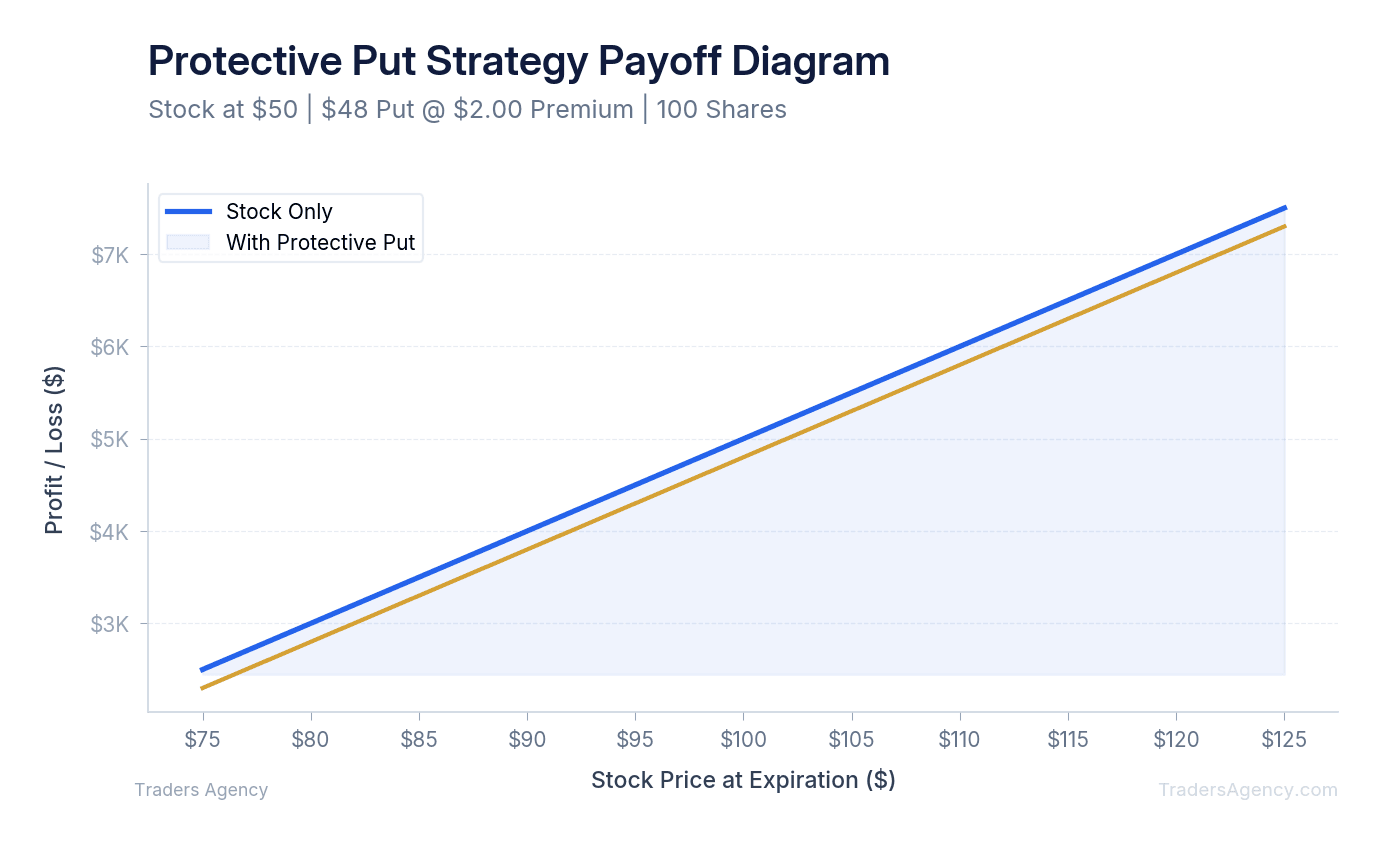
This strategy requires paying cash upfront. You must have enough capital in your account to cover the cost of the option premium.
How Does a Protective Put Work?
A protective put works by locking in a minimum sale price for your stock. You pay an upfront premium to buy the put option contract. If the stock price falls below your chosen strike price, the option gains value to offset your stock losses dollar for dollar.
The cost of your protection depends on how much risk you want to eliminate. A put option with a strike price very close to the current stock price will cost more. A put option with a strike price far below the current stock price will cost less.
We always weigh the premium cost of the option against the potential dollar loss of holding the stock without any protection. You have to decide if the cost of the insurance is worth the peace of mind.
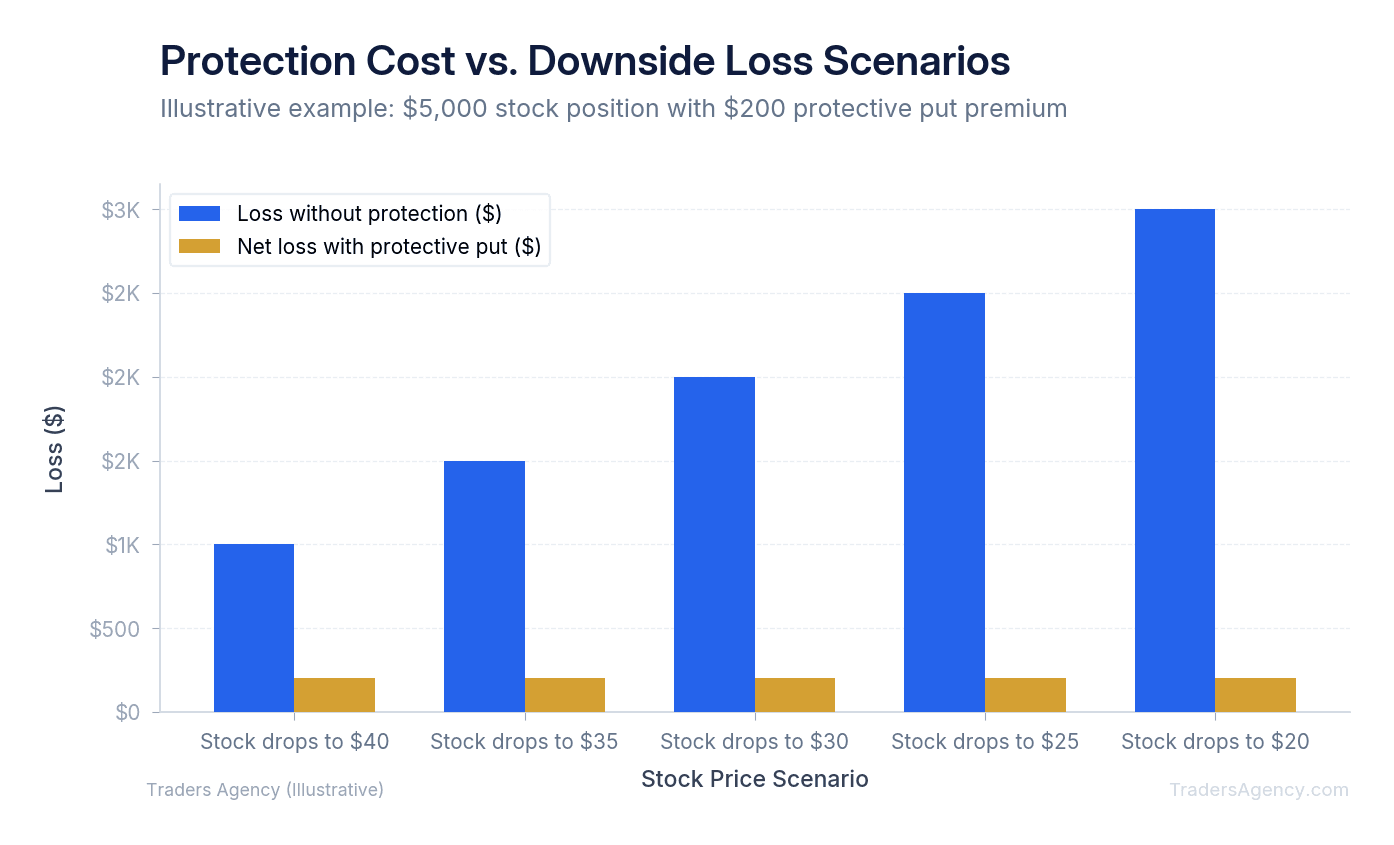
If you buy protection every single month, those premium costs will eat into your long-term profits. We teach our members to use this tool strategically rather than constantly.
How Do You Set Up a Protective Put Trade?
Here's a concrete example using ticker symbol XYZ. Assume you already own 100 shares of XYZ currently trading at $150 per share. Your total stock investment is $15,000. Earnings season is approaching, and you want to protect your capital from a sudden 20% drop.
Trade Setup Parameters
| Parameter | Value |
|---|---|
| Stock | XYZ at $150.00 |
| Shares Owned | 100 |
| Total Stock Investment | $15,000 |
| Put Strike Price | $140 |
| Put Premium | $3.00 per share ($300 total) |
| Expiration | 60 days |
| Total Capital Committed | $15,300 |
- Identify the Setup: You decide to buy a put option to protect your position. You look at the options chain for XYZ and find a contract expiring in 60 days. You select a put option with a $140 strike price. The market asks a $3.00 premium per share for this contract. This strike price means you are willing to accept a $10 drop in the stock price before your insurance kicks in.
- Execute the Trade: You buy one XYZ $140 put contract. Since each contract controls 100 shares, your total cost for the option is $300 ($3.00 x 100). Your total capital committed is now $15,300, which includes your original $15,000 stock value plus the $300 insurance premium. The trade is now live in your account.
- Evaluate the Outcome: We evaluate options strategies by looking at three specific scenarios at expiration. See the table below for the full breakdown.
Outcome Scenarios at Expiration
| Scenario | Stock Price at Expiration | Stock Value | Put Option Value | Net Position Value | Profit / Loss |
|---|---|---|---|---|---|
| Best Case (Stock rises) | $170 | $17,000 | $0 (expires worthless) | $16,700 | +$1,700 |
| Breakeven | $153 | $15,300 | $0 (expires worthless) | $15,000 | $0 |
| Worst Case (Stock crashes) | $100 | $10,000 | $4,000 (exercise at $140) | $13,700 | -$1,300 (max loss) |
Key Concept: Your breakeven price equals your original stock purchase price plus the option premium. In this example: $150 + $3.00 = $153.00. Your maximum loss is capped at $1,300 no matter how far the stock falls.
Want expert trading insights delivered daily?
Join thousands of traders who rely on Traders Agency for market analysis and trade ideas.
Join Traders AgencyUnderstanding the Greeks: Time and Volatility
To master the protective put strategy, you must understand how time and volatility affect your option's price. We teach our members to watch two specific options Greeks: Theta and Delta.
Theta represents time decay. Options are decaying assets. Every day that passes, your put option loses a small amount of its value, assuming the stock price remains flat.
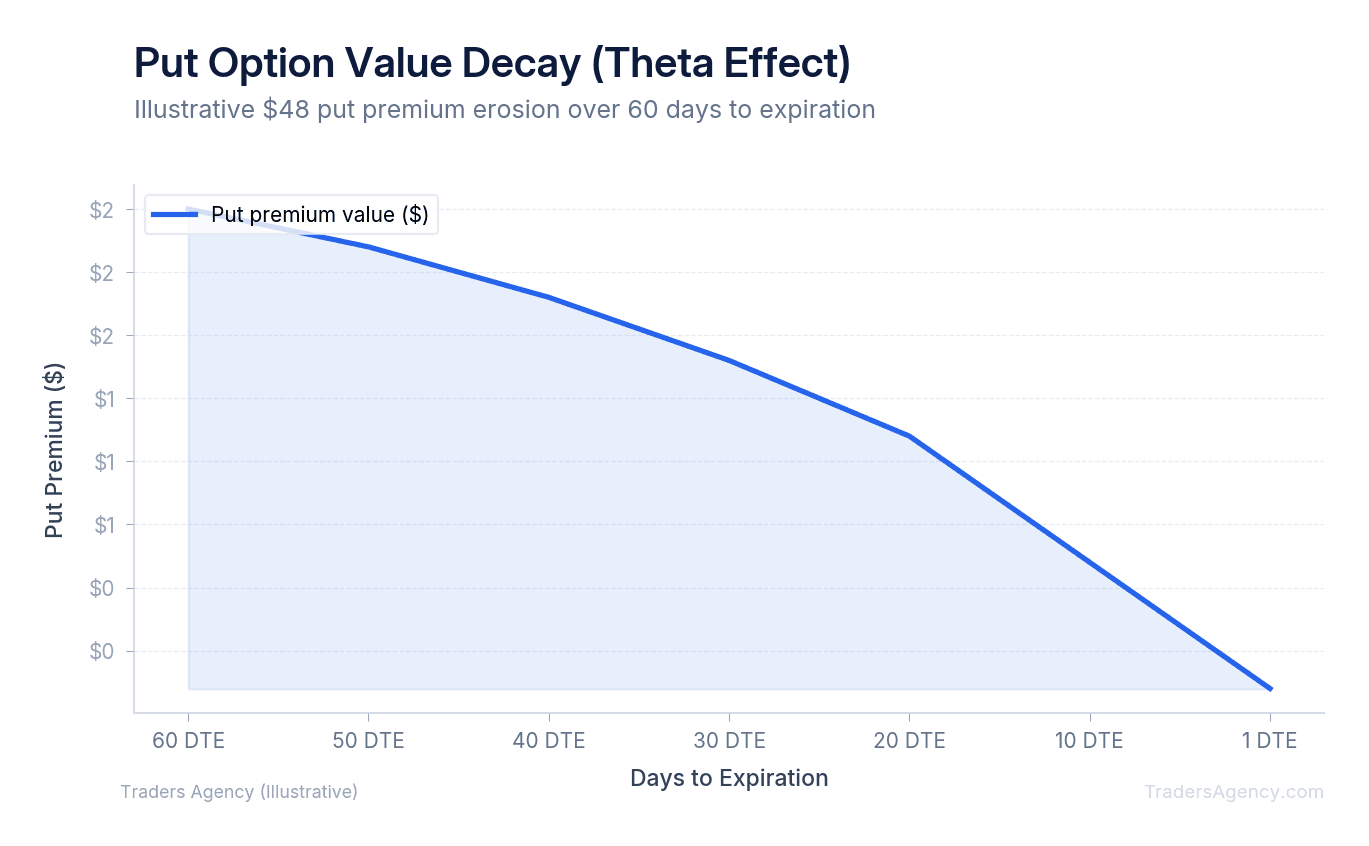
Time decay accelerates rapidly in the final 30 days before expiration. Because you are buying the option, Theta works against you. This is why we generally prefer buying protection with at least 45 to 60 days until expiration.
Delta measures how much the option price changes for every $1 move in the underlying stock. A put option has a negative delta. If your put has a -0.30 delta, the option will gain roughly 30 cents for every $1 the stock drops.
As the stock falls closer to your strike price, the delta increases toward -1.00. This means your protection kicks in stronger exactly when you need it most.
When Should You Use a Protective Put?
You should use a protective put when you are bullish on a stock long-term but fear short-term downside risk. It is ideal before major events like earnings reports, economic data releases, or when you have large unrealized profits you want to safeguard.
We prefer to buy protection when implied volatility is relatively low. Implied volatility measures the market's expectation of future price swings. When volatility is low, option premiums are cheaper.
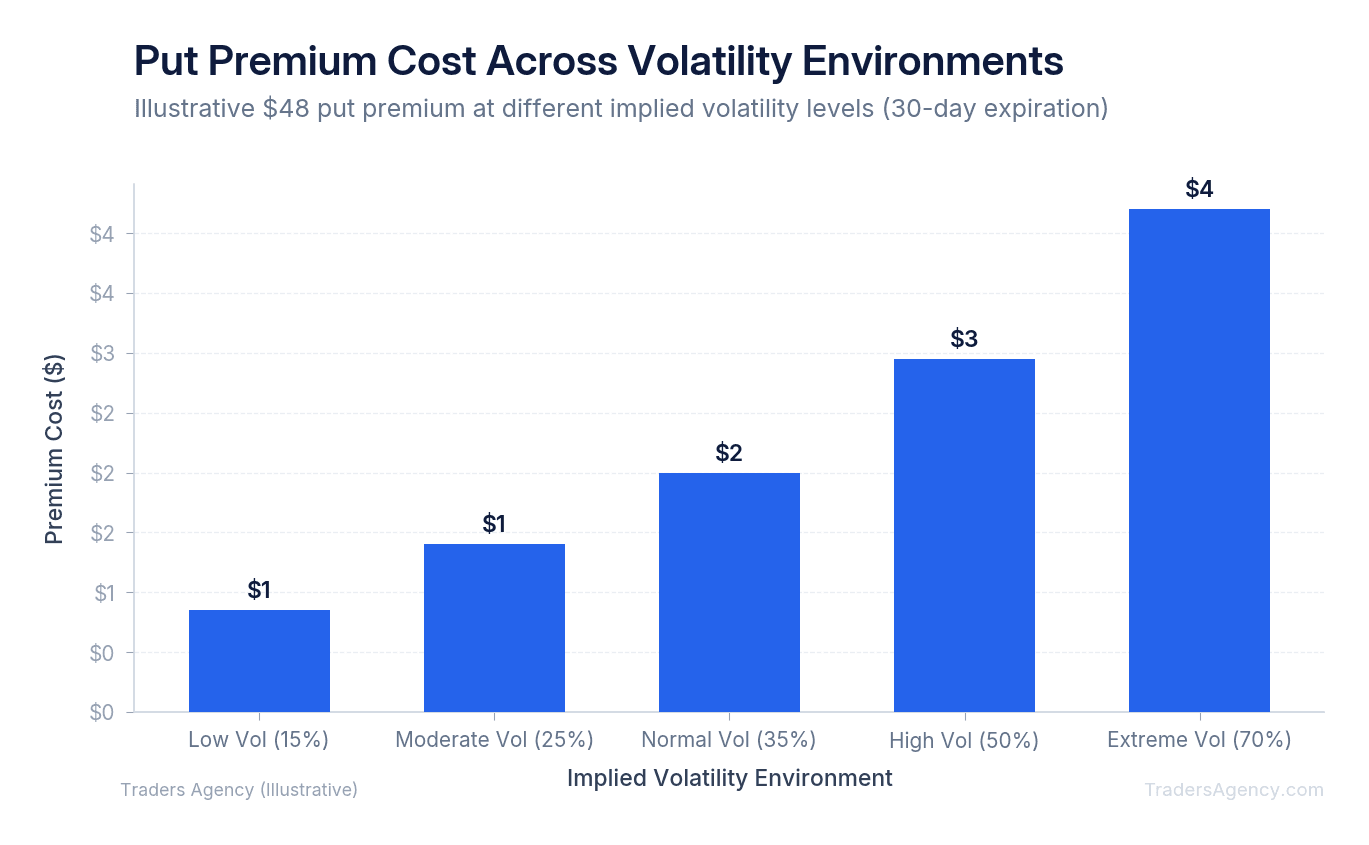
If you wait until the market is already crashing to buy a put, the implied volatility will be extremely high. You will overpay for the insurance. Buying options in high-volatility environments significantly increases your breakeven point, which is why timing matters. You can learn more about how options pricing works on the Cboe Options Exchange website.
Watch Out: Here are common mistakes that will cost you money with this strategy:
- Buying protection too frequently, which drags down your long-term portfolio returns.
- Purchasing puts with expirations that are too short, exposing you to rapid time decay.
- Buying strikes that are too close to the current price, making the premium cost prohibitively expensive.
- Protecting small positions where the option fees outweigh the actual risk.
Is a Protective Put Bullish or Bearish?
A protective put is fundamentally a bullish strategy. You own the underlying stock because you expect its price to rise over time. The put option simply acts as a temporary hedge against bearish short-term movements, so you do not suffer catastrophic losses during temporary market downturns.
Many new traders confuse buying a put outright with a protective put. Buying a standalone put is a strictly bearish trade. You want the stock to drop.
When you combine the long put with long stock, your overall position still benefits from upward price movement. Your upside potential is technically unlimited, minus the cost of the option premium. We view this as a bullish posture with a safety net.
What Is the Difference Between a Covered Put and a Protective Put?
The difference between a covered put and a protective put lies in the stock position and the option type. A protective put involves owning long stock and buying a put option. A covered put involves shorting a stock and selling a put option to generate income.
These two strategies serve completely different purposes. We use protective puts for risk management and capital preservation on assets we own. You pay money to reduce your risk.
Conversely, traders use covered puts when they have a bearish outlook. They short the stock to profit from a decline, and they sell the put to collect premium. A covered put carries significantly more risk because shorting stock has theoretically unlimited loss potential if the share price skyrockets.
| Feature | Protective Put | Covered Put |
|---|---|---|
| Stock Position | Long (own shares) | Short (borrowed shares) |
| Option Action | Buy a put | Sell a put |
| Market Outlook | Bullish | Bearish |
| Purpose | Risk management | Income generation |
| Risk Level | Defined (capped loss) | High (unlimited upside risk on short stock) |
How Much of Your Portfolio Should You Hedge With Protective Puts?
Before executing any options trade, you must establish strict risk management rules. We teach our members to look at the entire portfolio rather than just a single stock position.
When applying a protective put strategy, you need to consider your maximum allocation. We generally advise against spending more than 2% to 5% of your total portfolio value on option premiums in a given year. If you spend too much on insurance, you will guarantee a negative return for your portfolio.
You also need to select the right strike price for your risk tolerance:
- At-the-money (ATM) puts: These strike prices are very close to the current stock price. They offer maximum protection but cost the most money.
- Out-of-the-money (OTM) puts: These strike prices are below the current stock price. They act as disaster insurance. They cost much less, but you have to absorb larger losses before the protection activates.
Our preferred approach is to buy OTM puts that are roughly 10% below the current stock price. This setup protects against severe market crashes while keeping the premium costs reasonable.
When Should You Adjust or Close a Protective Put Position?
Once you enter a protective put strategy, you cannot simply ignore it. You must manage the position as the market moves and expiration approaches. We recommend evaluating your position when the option reaches 21 days to expiration. At this point, time decay accelerates rapidly.
- Rolling the Put Option: If you still want protection after your current option nears expiration, you can roll the put. This means selling your expiring contract and using the proceeds to buy a new put option with a later expiration date. Rolling allows you to maintain continuous protection. However, it requires paying another premium, which increases your total cost basis on the stock. You must track these cumulative costs carefully.
- Monetizing the Put: If the stock price drops sharply, your put option will surge in value. You have a choice to make. You can sell the put option to lock in the profit from the hedge. We call this monetizing the put. You take the cash from the profitable option trade and keep your stock shares. You can even use that cash to buy more shares at the newly discounted price, lowering your average cost per share.
- Letting the Option Expire: If the stock price rises significantly, your put option will expire worthless. This is an acceptable outcome. You achieved your primary goal. Your stock gained value, and you enjoyed peace of mind during the holding period. You accept the loss of the premium as the standard cost of doing business.
Risk Warning: Options trading involves risk and is not appropriate for all investors. A protective put reduces your downside exposure, but the premium you pay is a guaranteed cost. If you repeatedly buy puts on positions that never decline, those cumulative premiums will significantly reduce your overall returns. Always size your hedges relative to your total portfolio.
Want expert trading insights delivered daily?
Join thousands of traders who rely on Traders Agency for market analysis and trade ideas.
Join Traders AgencyKey Takeaways
- A protective put guarantees you can sell your shares at the strike price before expiration, creating a hard floor on losses no matter how far the stock drops.
- The premium paid for the put is a guaranteed cost. If the stock never declines, that premium is lost, which means repeated hedging on positions that never fall will erode overall returns.
- The strategy works like homeowner's insurance: you keep full ownership of the stock and capture all upside gains, while the put option limits the damage if the position moves against you.
- When the put expires worthless because the stock rose, that is an acceptable outcome. The premium was the cost of protection, not a failed trade.
- Position sizing matters: hedges should be sized relative to your total portfolio, not applied indiscriminately to every holding.
DISCLAIMER: Traders Agency does not offer financial advice. The information provided is for educational purposes only and should not be considered financial advice. Traders Agency is not responsible for any financial losses or consequences resulting from the use of the information provided. Trading carries inherent risks and may not be suitable for all individuals. You are advised to conduct your own research and seek personalized advice before making any investment decisions, recognizing the potential risks and rewards involved.
See more from Traders Agency on Google
Make us a preferred source and our market analysis will appear more prominently in your Google Search, Top Stories, and AI results.
Add to Preferred Sources