You have probably seen this happen on social media. A trader posts a screenshot showing massive overnight gains on a technology index fund, and you wonder how they pulled it off. The answer often involves day trading leveraged ETFs, a strategy that amplifies both profits and losses. Day trading leveraged ETFs is a short-term trading approach where traders buy and sell funds that use financial derivatives to multiply the daily returns of an underlying index. We will walk you through exactly how these funds work, why they behave differently than regular stocks, and how to trade them safely. Our team recommends learning the mechanics before risking a single dollar. By the end of this guide, you will understand the math behind popular tickers like TQQQ and SOXL. You will also know why holding them for the long term carries unique risks, and how to apply strict risk management to your trades.
What Are Leveraged ETFs and How Do TQQQ and SOXL Work?
Bottom Line: Day trading leveraged ETFs can amplify short-term gains, but the daily reset mechanic and volatility decay make them genuinely dangerous to hold beyond a single session. The core lesson here is that understanding the math behind funds like TQQQ and SOXL is not optional preparation, it is the minimum requirement before placing a trade. Strict risk management and the ability to exit before the close are non-negotiable when trading these instruments.
Leveraged ETFs are specialized funds that use financial derivatives and debt to amplify the daily returns of an underlying index. For example, a 3x leveraged ETF aims to deliver three times the daily performance of its benchmark. If the benchmark goes up 1%, the ETF goes up 3%.
Key Concept: A 3x leveraged ETF multiplies the daily return of its benchmark index by three. This amplification resets every single trading day, which has major implications for anyone holding longer than one session.
We teach our members to focus heavily on the specific benchmarks these funds track. The ProShares UltraPro QQQ (TQQQ) seeks daily investment results that correspond to three times the daily performance of the Nasdaq-100 Index. This means it heavily tracks major technology companies like Apple, Microsoft, and Amazon. If the Nasdaq-100 drops by 2% in a single day, TQQQ will drop by approximately 6%.
On the other hand, the Direxion Daily Semiconductor Bull 3X Shares (SOXL) tracks the NYSE Semiconductor Index. This fund provides triple exposure to companies that design and manufacture computer chips. The semiconductor sector is highly cyclical and volatile. Companies in this space experience massive price swings based on supply chain news and earnings reports. When you apply a 3x multiplier to this already volatile sector, the price action becomes extreme.
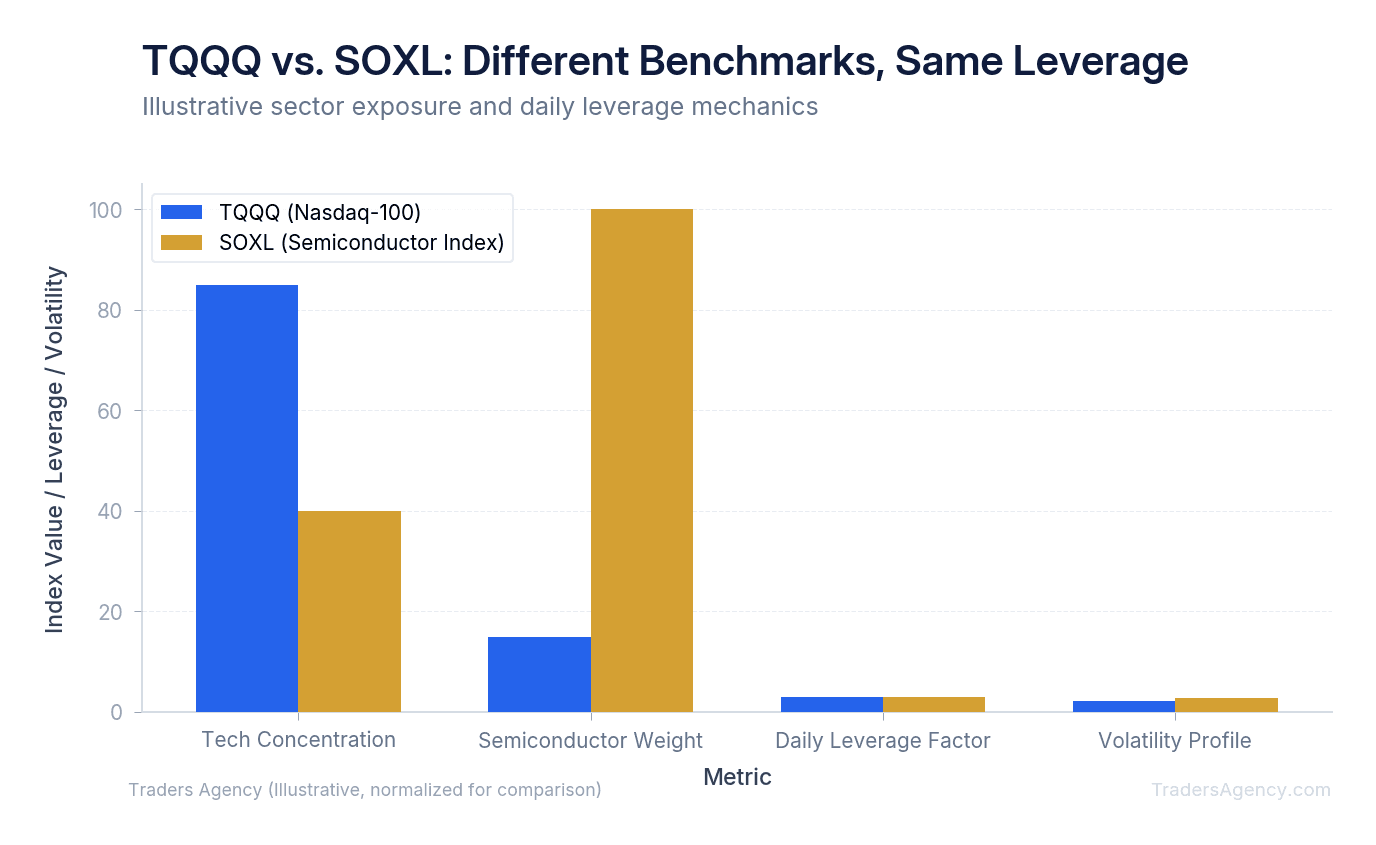
These funds are designed strictly for short-term intraday amplification. The Securities and Exchange Commission (SEC) explicitly warns retail investors that leveraged ETFs are typically designed to achieve their stated objectives on a daily basis, not over months or years. Holding them longer than a single trading session introduces complex mathematical risks.
Why Does Holding a Leveraged ETF Longer Than One Day Get Complicated?
The daily reset mechanic is a structural feature where a leveraged ETF recalculates its exposure at the end of every trading day. This means the fund must buy or sell assets daily to maintain its target exposure ratio, causing long-term performance to drift from the underlying index.
This daily recalculation is the core reason why these funds do not behave like traditional stocks. Every single afternoon, the fund managers adjust their derivative positions. They do this to ensure the fund can deliver its exact 3x multiplier for the very next day.
Because of this reset, your returns compound daily. In a market that moves straight up, this daily compounding can actually work in your favor, generating returns higher than exactly three times the index. However, markets rarely move in a straight line. When prices chop up and down, the daily reset creates a severe mathematical drag on your portfolio.
What Is Volatility Decay and Why Does TQQQ Underperform 3x QQQ Over Time?
Volatility decay is the mathematical loss of value that occurs when a leveraged ETF experiences price swings over multiple days. Because the fund resets daily, the compounding effect during volatile, sideways markets erodes the fund's value, causing it to underperform a simple multiple of its benchmark.
We prefer to explain this with a simple numerical example. Imagine an index starts at $100. A 3x leveraged ETF tracking it also starts at $100.
On day one, the index drops 10% to $90. The 3x ETF drops 30% to $70.
On day two, the index rebounds by 11.11% to get back to $100. The 3x ETF goes up by 33.33% (three times 11.11%). However, 33.33% of $70 is only $23.33.
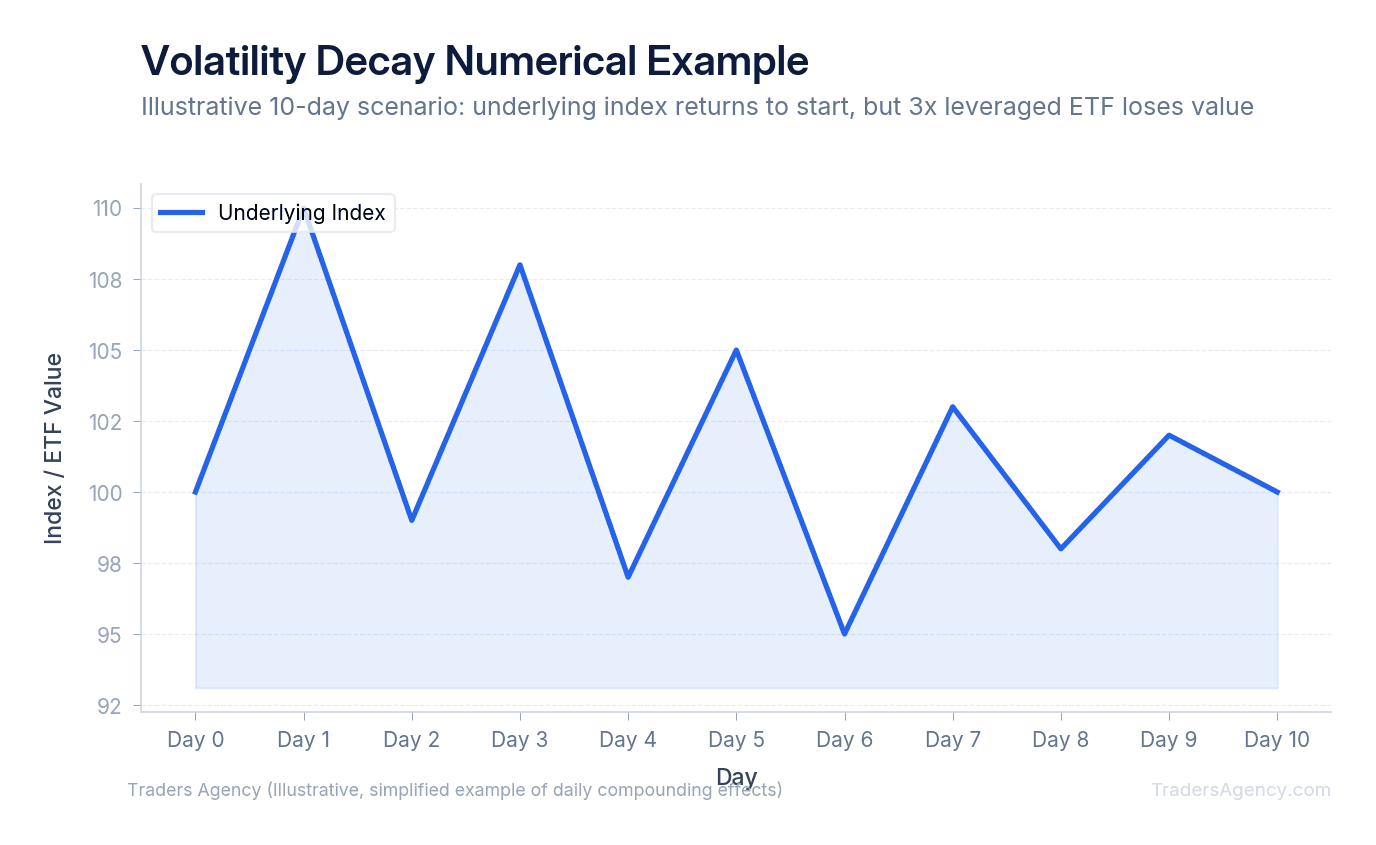
Your 3x ETF is now sitting at $93.33, even though the underlying index is back to exactly where it started. This is volatility decay in action. You lost nearly 7% of your capital simply because the market moved down and then back up.
| Day | Index Value | Index Change | 3x ETF Value | 3x ETF Change |
|---|---|---|---|---|
| Start | $100.00 | , | $100.00 | , |
| Day 1 | $90.00 | -10.00% | $70.00 | -30.00% |
| Day 2 | $100.00 | +11.11% | $93.33 | +33.33% |
| Net Index Change: 0% | Net ETF Loss: -6.67% | |||
Over weeks and months, this decay eats away at your capital. This mathematical reality is why TQQQ often underperforms a theoretical 3x return of the regular QQQ over long periods of market turbulence.
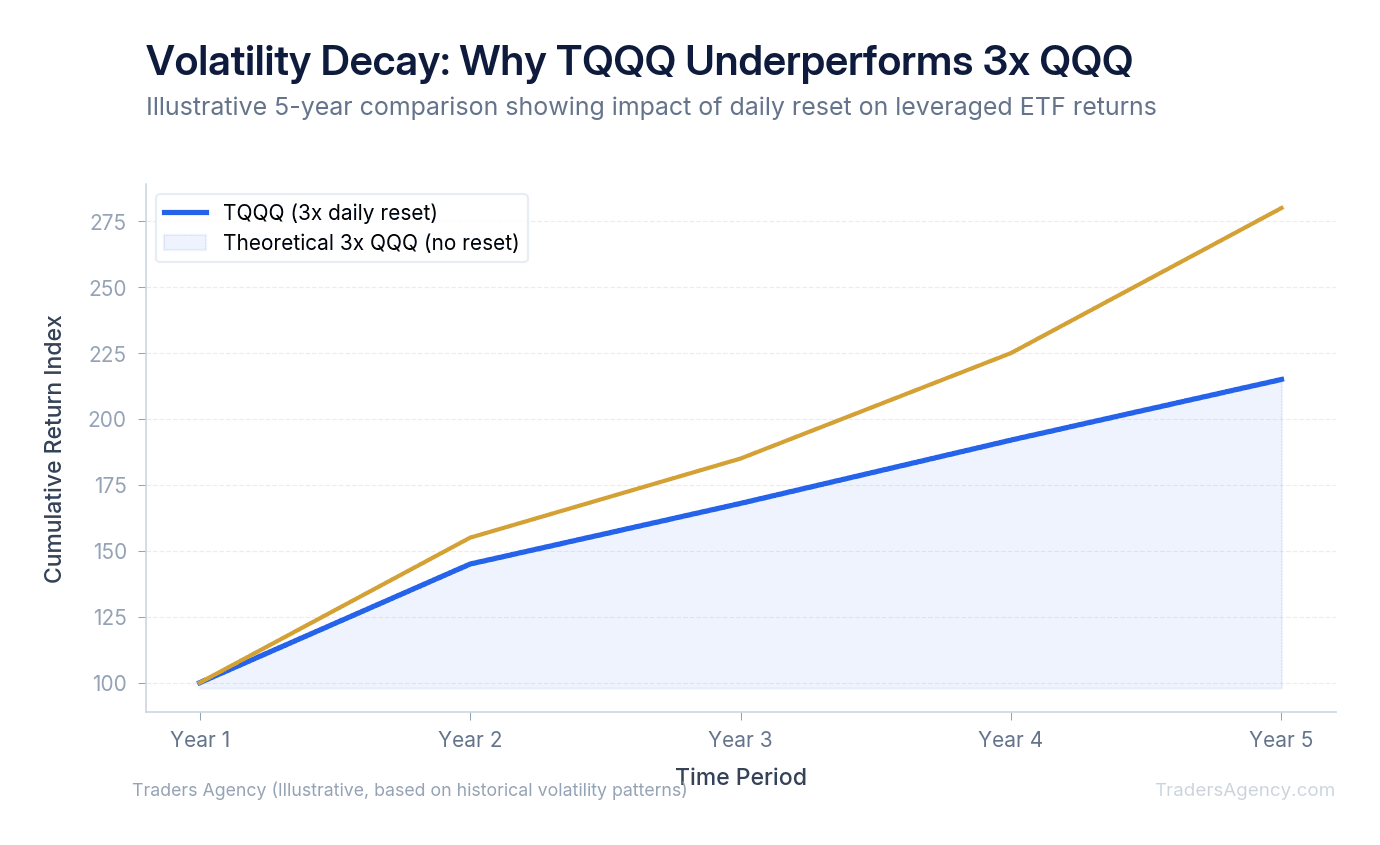
Watch Out: Volatility decay is invisible on any single trading day. It only reveals itself over time. If you hold a 3x leveraged ETF through a choppy market for weeks, you can lose money even if the underlying index ends up flat. This is the number one reason we discourage buy-and-hold strategies with these instruments.
Want expert trading insights delivered daily?
Join thousands of traders who rely on Traders Agency for market analysis and trade ideas.
Join Traders AgencyCan You Succeed at Day Trading Leveraged ETFs Like TQQQ?
Yes, you can day trade leveraged ETFs like TQQQ, and many short-term traders prefer them for their high intraday liquidity and outsized price movements. Day trading leveraged ETFs allows you to capture significant percentage gains from small intraday index movements without holding positions overnight.
Our team recommends using these instruments exactly as they were designed: for short-term trades. When you buy and sell within the same trading session, you avoid the risks of the daily reset and overnight gap-downs. You are simply trading the intraday momentum of the Nasdaq-100 or the semiconductor sector.
However, retail traders with small accounts must watch out for the Pattern Day Trader (PDT) rule. If your account balance is under $25,000, you are limited to three day trades within a rolling five-business-day period. If you execute four or more day trades within that window, your broker will flag your account.
This means your account could be restricted for 90 days unless you bring the balance above $25,000. Because of this rule, you cannot freely jump in and out of TQQQ multiple times a day without risking a temporary account restriction. You must be highly selective with your entries. We tell our members to treat their limited day trades like precious commodities.
Step-by-Step: A Day Trading Strategy for TQQQ
A reliable day trading strategy for TQQQ involves identifying the broader market trend, waiting for a short-term pullback to a key support level, entering the trade with a tight stop loss, and securing profits before the market closes. Here is a concrete example of how you might execute this trade using specific numbers to illustrate the mechanics.
- Step 1: Confirm the Intraday Trend. You need to confirm the Nasdaq-100 is in an intraday uptrend. Pull up a 5-minute chart and look for the index making higher highs and higher lows. Wait for a minor pullback to a known support level, such as the Volume Weighted Average Price (VWAP). Never buy while the price is actively crashing.
- Step 2: Execute the Entry. The Nasdaq-100 hits support and shows signs of bouncing. You buy 100 shares of TQQQ at $40.00 per share, risking a total of $4,000. You immediately place a stop-loss order at $39.20. This means your maximum risk on the trade is $80 (a 2% drop in the ETF, representing roughly a 0.67% drop in the underlying index).
- Step 3: Manage the Exit. The index bounces off support and rallies 1.5% over the next two hours. Because TQQQ is triple-leveraged, your shares rise by approximately 4.5%. The price of TQQQ hits $41.80. You sell your 100 shares, securing a profit of $180. In the worst-case scenario, the index breaks support and drops. Your stop-loss triggers at $39.20, capping your loss at $80. By closing the trade before the 4:00 PM bell, you eliminate overnight risk entirely.
| Trade Parameter | Value |
|---|---|
| Ticker | TQQQ |
| Entry Price | $40.00 per share |
| Shares | 100 |
| Total Position Size | $4,000 |
| Stop-Loss | $39.20 |
| Max Risk | $80 (2% of position) |
| Target Exit (Best Case) | $41.80 |
| Profit (Best Case) | +$180 |
| Loss (Worst Case) | -$80 |
Is Day Trading or Holding a Leveraged ETF the Better Approach for Managing Risk?
Comparing day trading versus holding reveals vastly different risk profiles. Day traders face strict intraday stop losses, while long-term holders of leveraged ETFs expose themselves to massive drawdowns, sometimes losing over 70% of their value during severe market corrections.
We always remind traders that amplification works in both directions. During the 2022 bear market, the Nasdaq-100 dropped roughly 33%. A traditional buy-and-hold investor in the regular QQQ experienced a painful but manageable loss.
Meanwhile, buy-and-hold investors in TQQQ saw their portfolios decimated, dropping by nearly 80% from peak to trough. SOXL holders experienced even worse drawdowns due to the extreme volatility of the semiconductor sector. Recovering from an 80% loss requires a 400% gain just to break even.
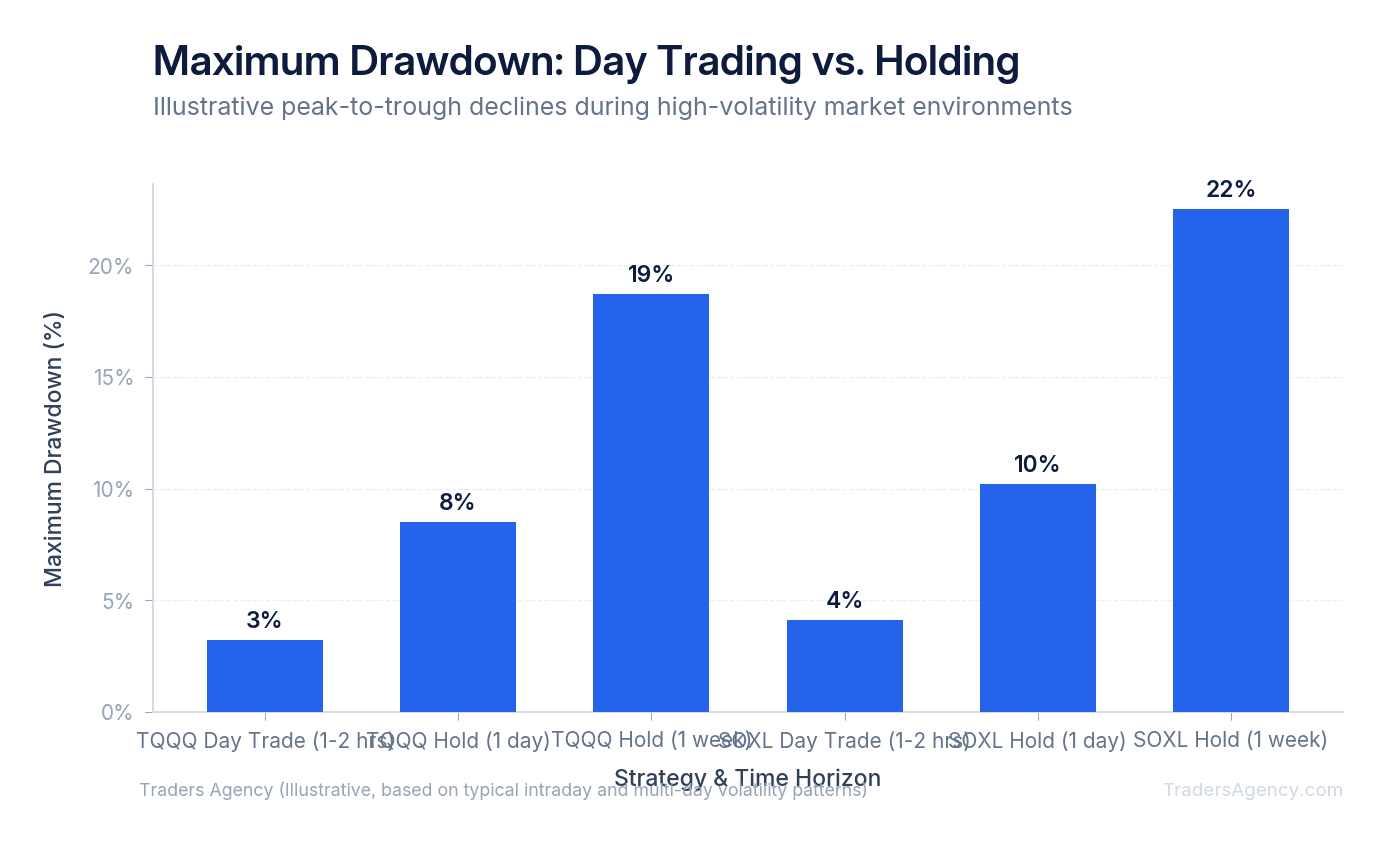
When you are day trading leveraged ETFs, your risk management relies on strict position sizing and hard stop losses. We suggest risking no more than 1% to 2% of your total account equity on any single leveraged ETF trade. If you have a $10,000 account, your maximum loss on a TQQQ trade should never exceed $100 to $200. Stop losses are non-negotiable. We never enter a trade without knowing exactly where we will exit if the market turns against us.
Key Concept: An 80% drawdown requires a 400% gain to recover. This is the math that destroys buy-and-hold investors in leveraged ETFs. Day traders sidestep this problem entirely by closing every position before the bell.
How Do You Know When to Stay Away from Leveraged ETFs?
You should stay away from leveraged ETFs during periods of high market unpredictability, ahead of major economic announcements, or if you cannot actively monitor your positions. These funds require constant attention and are unsuitable for passive, set-and-forget investment strategies.
Not every market environment is appropriate for 3x amplification. We teach our members to identify specific conditions where trading these funds becomes too dangerous. Here is our checklist of when to avoid TQQQ and SOXL:
- Ahead of major data releases. Do not hold these funds through Federal Reserve interest rate decisions or major inflation reports like CPI data. The immediate price spikes can blow past your stop-loss orders, causing larger losses than you planned for.
- During choppy, directionless markets. If the index is trading in a tight, sideways range, volatility decay will slowly drain your account. You need clear directional momentum to make these funds work for you.
- When you cannot watch the screen. If you have a busy day at work and cannot monitor your charts, do not open a leveraged position. These funds can drop 5% in a matter of minutes.
- If you are out of day trades. If you are restricted by the PDT rule and cannot close a bad trade before the end of the day, do not take the trade in the first place. Being forced to hold a losing TQQQ position overnight is a recipe for disaster.
Watch Out: These tools are powerful, but they require intense discipline. Treat them as specialized instruments for specific intraday opportunities, not as core holdings for your retirement account. If you cannot commit to active monitoring and strict stop losses, these funds are not for you.
Want expert trading insights delivered daily?
Join thousands of traders who rely on Traders Agency for market analysis and trade ideas.
Join Traders AgencyKey Takeaways
- A 3x leveraged ETF like TQQQ resets its amplification every single trading day, meaning a 1% gain in the underlying index produces a 3% gain in the ETF for that session only.
- Volatility decay causes TQQQ to underperform a true 3x multiple of QQQ over time, even in markets that trend upward, because daily compounding works against holders during choppy price action.
- The PDT rule creates a specific danger with leveraged ETFs: if you cannot close a losing TQQQ position before the end of the day, you are forced into an overnight hold on a fund that can drop 5% in minutes.
- Day trading leveraged ETFs requires active monitoring and strict stop losses on every trade. These are not suitable as core holdings or retirement account positions.
- TQQQ and SOXL are designed for intraday opportunities tied to specific index moves, not as long-term buy-and-hold instruments, and treating them otherwise exposes traders to compounding drawdown risk.
DISCLAIMER: Traders Agency does not offer financial advice. The information provided is for educational purposes only and should not be considered financial advice. Traders Agency is not responsible for any financial losses or consequences resulting from the use of the information provided. Trading carries inherent risks and may not be suitable for all individuals. You are advised to conduct your own research and seek personalized advice before making any investment decisions, recognizing the potential risks and rewards involved.
See more from Traders Agency on Google
Make us a preferred source and our market analysis will appear more prominently in your Google Search, Top Stories, and AI results.
Add to Preferred Sources