
You've probably seen a stock chart go completely vertical in a matter of hours, defying all fundamental logic and trapping short sellers in massive losses. These explosive, parabolic moves aren't random. They're driven by gamma squeeze mechanics: hidden structural forces rooted in options market plumbing. A gamma squeeze is a rapid upward price movement caused by market makers aggressively buying underlying stock to hedge their short options positions as out-of-the-money call options suddenly become in-the-money. We're going to walk you through the exact institutional order flow that creates this feedback loop, show you how to spot the early warning signs using options chain data, and give you a concrete framework for managing risk when the inevitable reversal hits.
How Does a Gamma Squeeze Work?
Bottom Line: Gamma squeezes are not random price spikes. They follow a predictable sequence driven by dealer hedging mechanics that you can track in real time using options chain data. Traders who understand this structure can identify setups early, anticipate when buying pressure will peak, and exit before the reversal hits rather than chasing the move at its most dangerous point.
A gamma squeeze works through a forced buying feedback loop initiated by options market makers. When traders buy massive amounts of out-of-the-money call options, market makers take the other side of the trade. As the stock price rises, these dealers must buy the underlying shares to remain delta-neutral, which pushes the stock price even higher.
To understand this process, we need to look at the market from the perspective of an institutional liquidity provider. When you buy a call option, a market maker is usually selling it to you. This leaves the dealer with a short call position, which carries negative delta and negative gamma. Market makers don't want directional risk. They run complex algorithms to maintain a delta-neutral portfolio.
They hedge their short call position by buying shares of the underlying stock. The exact amount of stock they need to buy is determined by the option's delta. If an option has a delta of 0.20, the dealer buys 20 shares of stock for every contract they sell.
Key Concept: Gamma is the rate of change of delta. When a stock price moves toward the strike price of a heavily traded option, gamma accelerates. This means the dealer's delta changes rapidly, forcing them to buy more shares at an increasing rate to maintain their neutral hedge.
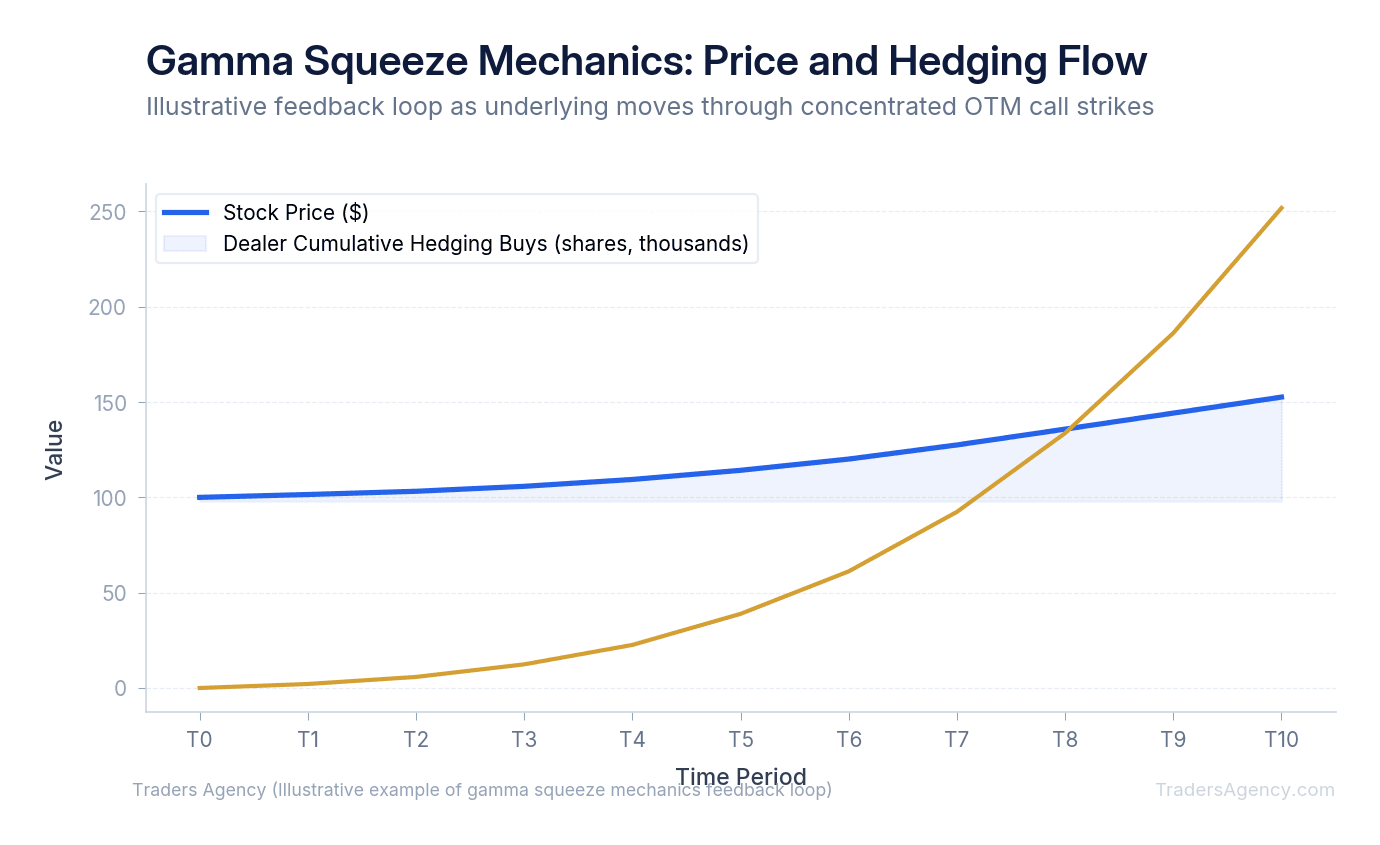
This creates a self-reinforcing cycle. The dealer buys stock, the price goes up, delta increases due to gamma, and the dealer must buy even more stock. We refer to this as a hedging cascade. These dynamic hedging requirements, well documented by the Cboe (Chicago Board Options Exchange), can temporarily disconnect a stock from its fundamental valuation. The buying isn't based on earnings or company outlook. It's a strict mathematical requirement forced by the options clearing structure.
What Are the Six Phases of a Gamma Squeeze Lifecycle?
To trade these events successfully, you must understand the complete lifecycle. Our education team separates this process into six distinct phases. If you can identify which phase a stock is currently in, you can size your positions appropriately and avoid buying at the absolute top.
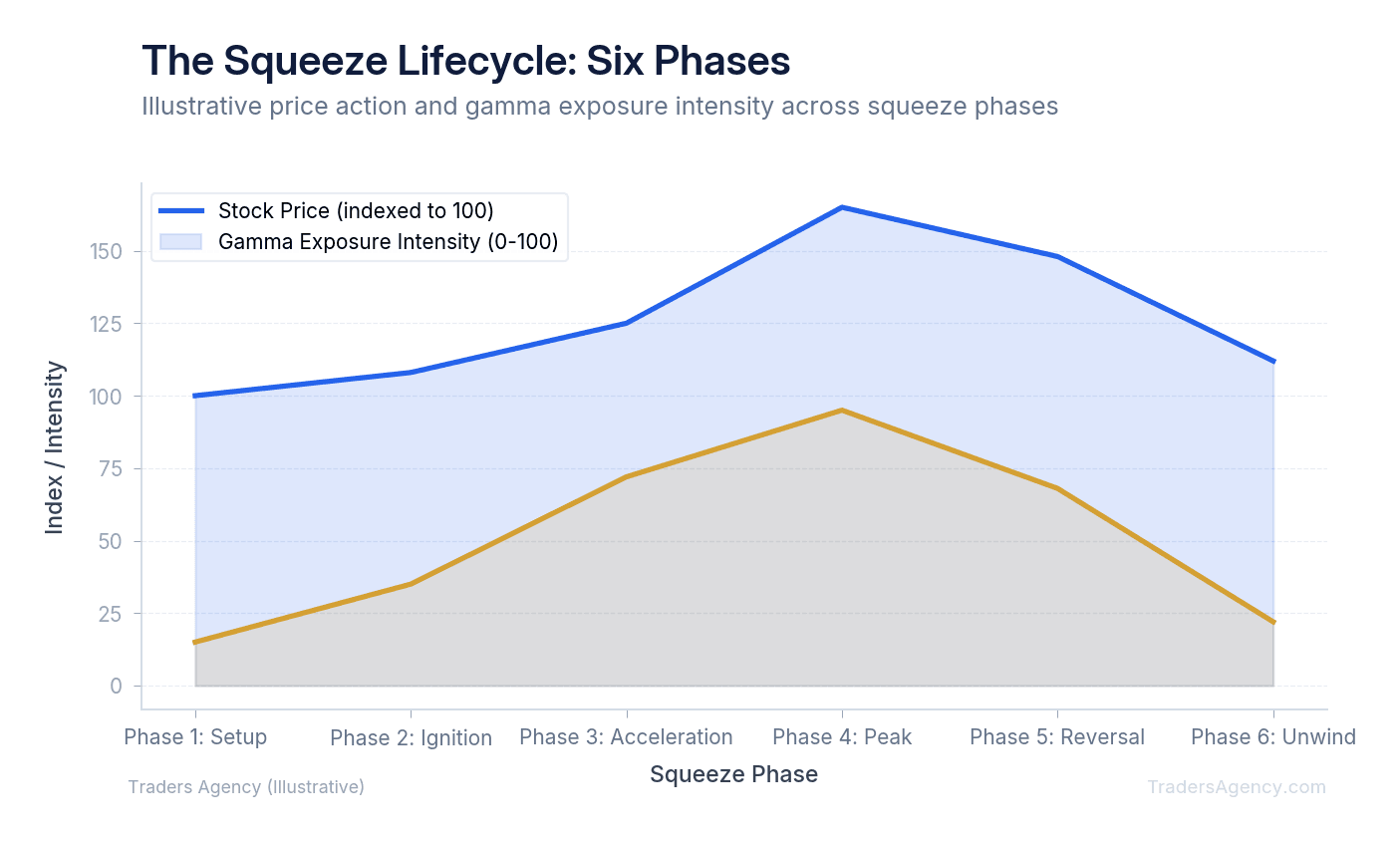
- The Accumulation Phase: Traders begin buying cheap, out-of-the-money (OTM) call options in massive volume. The stock price remains relatively stable during this period. Open interest builds significantly at specific upside strike prices. Market makers sell these calls and buy a small amount of stock to hedge the initial low delta.
- The Initial Spark: A news event, a sudden surge in buying volume, or a technical breakout pushes the stock price higher. The underlying asset begins moving toward the heavily concentrated strike prices. Market makers notice their delta exposure increasing as the options gain value.
- The Hedging Cascade: Dealers begin buying shares in large blocks to neutralize their risk. This institutional buying pressure accelerates the upward price movement. The stock price crosses major strike levels, turning OTM options into in-the-money (ITM) options. Retail traders see the momentum and buy even more calls. Dealers sell these additional calls and must buy more stock to hedge.
- The Gamma Peak: The stock price goes parabolic. Gamma reaches its absolute maximum level as the bulk of the open interest becomes at-the-money (ATM). Implied volatility spikes to extreme levels, making options incredibly expensive. The bid-ask spreads on the options chain widen significantly as market makers try to price in the extreme risk.
- The Expiration or Unwind: Traders begin taking profits by selling their calls, or the options reach their expiration date. When traders sell their calls, market makers buy them back. This removes the dealers' short gamma exposure. The mechanical requirement to hold long stock disappears.
- The Reversal: With the short gamma exposure gone, dealers no longer need their long stock hedges. They dump their shares onto the open market to flatten their inventory. The stock price crashes back down, often just as violently as it rose, leaving late buyers with massive losses.
Watch Out: Phase 4 (the Gamma Peak) is where most retail traders pile in. By the time a squeeze is making headlines, you're likely buying at the worst possible entry. Our approach is to identify setups during Phase 1 or Phase 2, well before the crowd arrives.
Delta Squeeze vs. Gamma Squeeze: What's the Difference?
The main difference between a delta squeeze and a gamma squeeze is the derivative force driving the buying pressure. A delta squeeze occurs when market makers buy stock linearly to hedge standard directional exposure. A gamma squeeze involves exponential buying pressure because the rate of change (gamma) forces accelerating stock purchases as price rises.
We often see traders confuse these two concepts. A delta squeeze is essentially a standard short squeeze applied to options. If traders buy deep ITM calls, dealers buy stock to hedge the high delta, but the hedging ratio remains relatively stable. If the stock moves up one dollar, the dealer might only need to buy a few more shares.
A gamma squeeze relies on the explosive nature of options that are right at the money. Gamma is highest when an option is at-the-money and close to expiration. This brings us to the amplifying role of zero-days-to-expiration (0DTE) options.
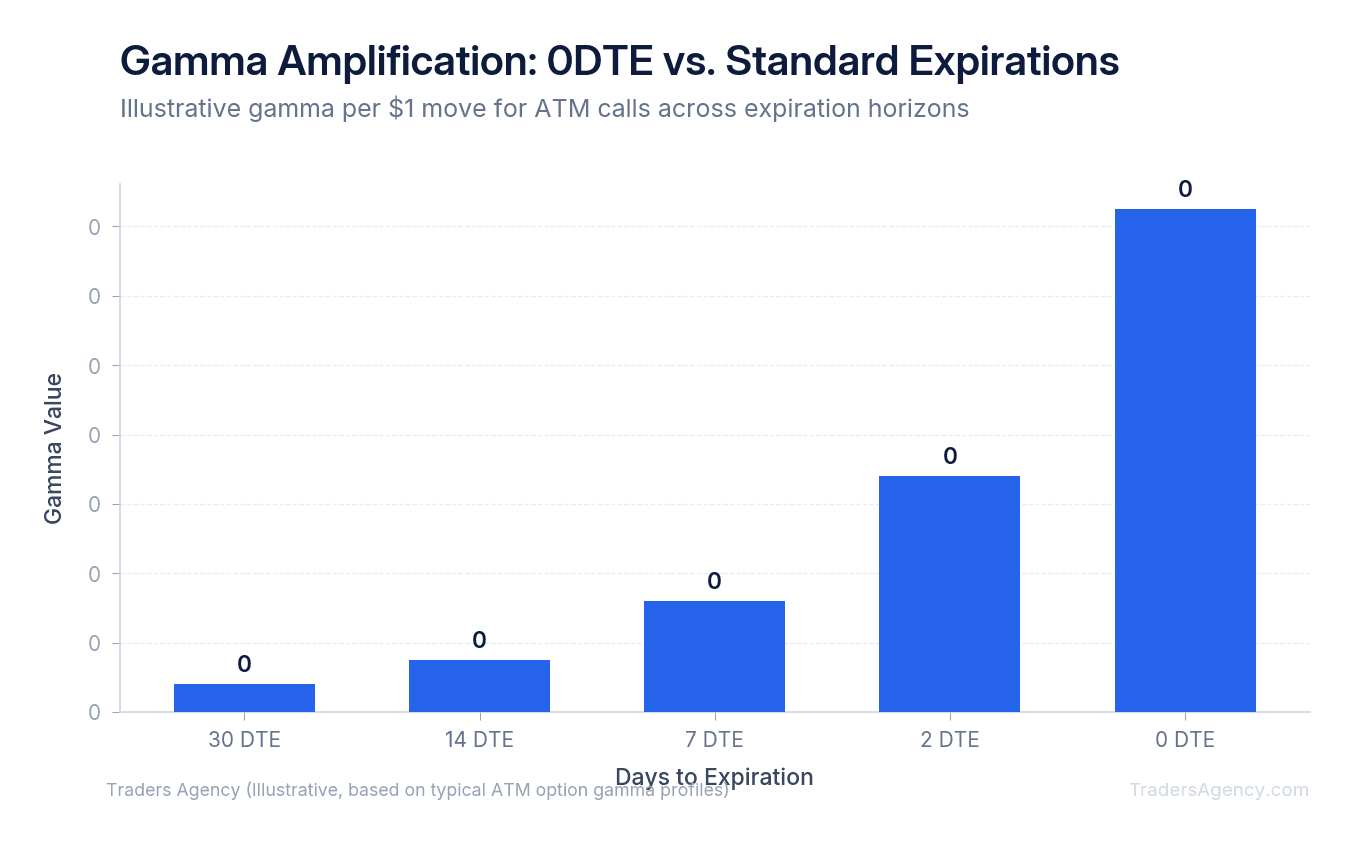
Modern markets are heavily influenced by 0DTE volume. Options expiring the same day have massive gamma because almost no time value remains. A small price move forces an immediate, violent delta adjustment from market makers. We monitor 0DTE volume closely because it acts as rocket fuel for gamma squeeze mechanics.
When comparing delta squeeze vs. gamma squeeze, remember this: gamma is the accelerator pedal. Delta tells the dealer how many shares to buy right now. Gamma tells the dealer how many additional shares they'll need to buy if the stock moves one more dollar. In a true gamma squeeze, the dealer is constantly chasing the price upward, always one step behind the required hedge.
| Feature | Delta Squeeze | Gamma Squeeze |
|---|---|---|
| Buying Pressure | Linear, proportional to price move | Exponential, accelerating with price move |
| Options Involved | Deep ITM calls (high delta) | ATM and near-ATM calls (high gamma) |
| Hedging Behavior | Stable, gradual share purchases | Aggressive, cascading share purchases |
| Time Sensitivity | Moderate | Extreme (amplified near expiration) |
| 0DTE Impact | Minimal | Maximum |
Want expert trading insights delivered daily?
Join thousands of traders who rely on Traders Agency for market analysis and trade ideas.
Join Traders AgencyHow Do You Identify a Gamma Squeeze Before It Starts?
You can't predict every explosive move, but you can identify the structural conditions that make them possible. We teach our members to look for specific data points in the options chain. A reliable gamma squeeze indicator requires analyzing open interest, implied volatility, and dealer positioning.
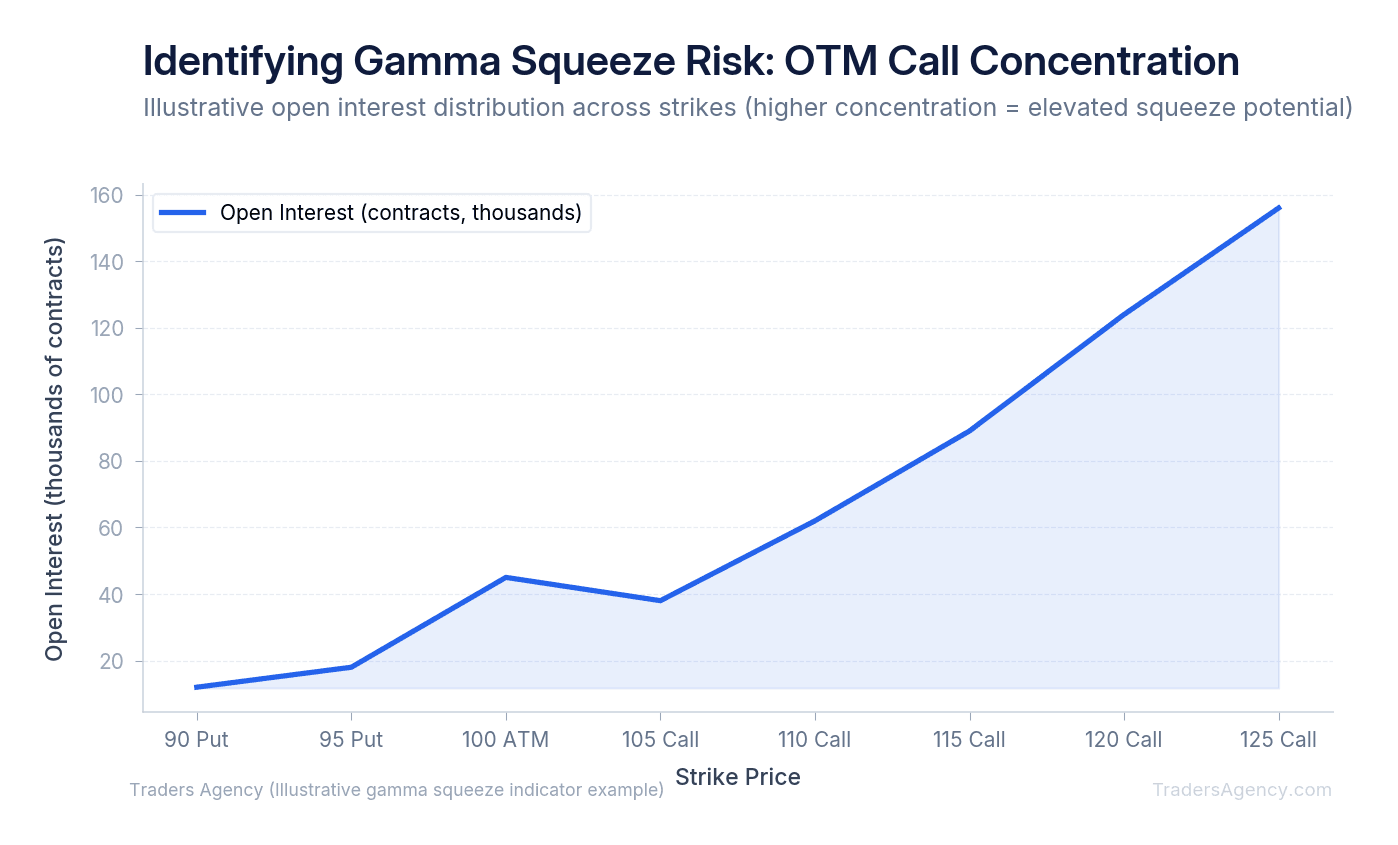
- Extreme Call Skew: Look at the open interest across the options chain. You want to see massive concentration of open interest in OTM calls compared to puts. If a stock is trading at $50 and there are 100,000 call contracts open at the $60 strike, that's a prime setup. This tells us exactly where the market makers have their largest short gamma exposure.
- High Short Interest: Gamma squeezes often overlap with traditional short squeezes. When heavily shorted stocks experience a gamma squeeze, the buying pressure is doubled. Market makers are buying to hedge, and short sellers are buying to cover their underwater positions. We look for stocks with a short interest above 20% of the free float.
- Elevated Implied Volatility on OTM Calls: Watch the implied volatility (IV) surface. If the IV of OTM calls is significantly higher than the IV of at-the-money options, it shows aggressive demand for upside leverage. This volatility skew indicates that traders are willing to overpay for the right to buy the stock at higher prices.
- Approaching Expiration Dates: The most violent squeezes happen during monthly options expiration weeks (OpEx). As Friday approaches, gamma increases exponentially for options near the current stock price. Our team recommends tracking the third Friday of every month for maximum structural volatility. The decay of time value (theta) forces market makers to hedge more aggressively as the expiration bell approaches.
What Does a Gamma Squeeze Look Like in Practice?
Let's walk through a concrete gamma squeeze example using a hypothetical setup. Assume XYZ Corp is trading at $40 per share. It has a high short interest, and a massive wave of retail traders decide to buy the $50 strike call options expiring this Friday.
Monday: The Setup
Traders buy 50,000 contracts of the $50 strike calls. At this point, the options are far out-of-the-money. The delta is low, perhaps 0.10. Market makers sell these calls and hedge by buying 500,000 shares of XYZ stock (50,000 contracts × 100 shares × 0.10 delta). The premium paid by the retail traders is $0.50 per share, meaning they risk $50 per contract.
Wednesday: The Spark
Positive news hits, and XYZ jumps to $45. The $50 calls are now much closer to the money. Because of gamma, the delta on those options increases from 0.10 to 0.40.
Market makers now need to be long 2,000,000 shares to stay hedged (50,000 contracts × 100 shares × 0.40 delta). They already own 500,000 shares, so they must immediately buy 1,500,000 more shares on the open market.
This massive purchase of 1.5 million shares pushes XYZ stock to $48. The delta increases again to 0.60. Market makers must buy another 1,000,000 shares.
Thursday: The Parabolic Move
XYZ hits $52. The options are now in-the-money. Delta approaches 0.90. Market makers have been forced to buy 4.5 million shares in total, driving the stock price to irrational heights entirely through mechanical hedging requirements.
| Day | Stock Price | Option Delta | Shares Dealers Must Hold | New Shares Purchased |
|---|---|---|---|---|
| Monday | $40 | 0.10 | 500,000 | 500,000 |
| Wednesday (pre-news) | $45 | 0.40 | 2,000,000 | 1,500,000 |
| Wednesday (post-hedge) | $48 | 0.60 | 3,000,000 | 1,000,000 |
| Thursday | $52 | 0.90 | 4,500,000 | 1,500,000 |
Profit and Loss Breakdown
If you're holding the $50 calls you bought for $0.50 per share ($50 total premium per contract), they might now be worth $5.00 per share ($500 per contract) due to intrinsic value and the massive spike in implied volatility. That's a 900% gain.
| Scenario | Stock Price at Expiration | Option Value | Profit/Loss per Contract |
|---|---|---|---|
| Squeeze Succeeds | $55.00 | $5.00+ | +$450 or more (900%+) |
| Breakeven | $50.50 | $0.50 | $0 |
| Squeeze Fails | Below $50.00 | $0.00 | -$50 (100% loss) |
Your max gain is theoretically unlimited as long as the stock keeps rising before expiration. Your max loss is the entire premium paid. If the stock never reaches your breakeven point ($50 strike + $0.50 premium = $50.50) by expiration, the options expire worthless for a 100% loss.
What Happens After a Gamma Squeeze?
After a gamma squeeze peaks, the stock price typically experiences a violent crash. This happens because the underlying options are either sold for profit or reach expiration. When the options are closed, market makers unwind their hedges by aggressively selling the millions of shares they previously bought.
Understanding what happens after a gamma squeeze is essential for your risk management. The upward momentum is entirely artificial. It's not driven by earnings, fundamentals, or long-term investment demand. It's driven by a temporary mechanical requirement.
Once the initial trigger disappears, the buying stops instantly. If Friday expiration passes, in-the-money options are automatically exercised (unless the holder instructs otherwise) or settled. The market makers no longer have short call exposure. They're now holding millions of shares of overpriced stock that they don't want.
They immediately dump these shares on the market. We consistently see stocks lose 50% to 80% of their squeeze gains in the days following a major event. This drop is accelerated by IV crush. As the event concludes, implied volatility collapses. Even if the stock price stays relatively flat, the value of any remaining call options will plummet because the volatility premium evaporates.
Risk Warning: Do not wait for the stock to start dropping before you exit. By the time the reversal begins, bid-ask spreads will widen dramatically and you won't be able to exit at a favorable price. We prefer to scale out of positions as implied volatility reaches historical extremes.
How Long Can a Gamma Squeeze Last?
A gamma squeeze typically lasts anywhere from a few days to two weeks. The duration is strictly limited by the expiration dates of the options driving the event. Once the heavily traded options expire, the mechanical hedging requirements vanish, and the squeeze abruptly ends.
The timeline is highly predictable if you know where to look. Check the options chain to see which expiration date holds the highest concentration of open interest. If the majority of the volume is in weekly options, the squeeze will likely terminate by Friday afternoon. If the volume is concentrated in monthly options, the squeeze might build over a two-week period.
You must also factor in the behavior of the traders holding the long calls. If they start taking profits early, the squeeze will end prematurely. When retail traders sell their calls to lock in gains, market makers buy those calls back, reducing their short gamma exposure and allowing them to sell their long stock hedges.
Position Sizing and Risk Management
Trading a gamma squeeze is inherently dangerous. You are playing with structural market fire. Here's our framework for staying in the game:
- Cap Your Allocation: We teach our members to allocate no more than 1% to 2% of their total account capital to these speculative setups. If you're buying OTM calls to participate in the upside, treat the premium paid as a total potential loss.
- Skip Traditional Stop-Losses on Options: During a gamma squeeze, implied volatility fluctuations can cause options prices to swing wildly. A brief dip in IV can trigger your stop-loss even if the stock price is moving in your favor. Instead, set price alerts on the underlying stock and manually manage your exits based on the stock's price action and the options chain data.
- Scale Out in Stages: Don't try to sell everything at the top. We recommend selling one-third of your position when you've doubled your money, another third at 3x to 5x, and letting the final third ride with the understanding that it could go to zero.
- Never Short an Active Squeeze: The theoretical risk is infinite. Even professional hedge funds have suffered catastrophic losses by attempting to step in front of a mechanical hedging cascade. Wait for the options to expire and the structure to break before attempting to trade the downside reversal.
- Monitor Expiration Dates Religiously: Your exit plan should be anchored to the options expiration calendar. If the open interest driving the squeeze expires on Friday, you should be mostly out of the trade by Thursday at the latest.
Key Concept: The SEC consistently warns retail traders about the immense risks of buying short-dated OTM options during periods of high volatility. Our position sizing rules exist to keep you in the game for the long run, not just one trade.
By understanding gamma squeeze mechanics, you gain a massive advantage over traders who are simply chasing green candles. You can read the options chain, anticipate the dealer hedging flows, and plan your entries and exits based on hard data rather than emotion. You'll know exactly why the stock is moving, who is forced to buy, and exactly when the music is going to stop.
Our education team publishes new strategy guides and market analysis every week. If you found this breakdown useful, you'll get even more value inside the membership.
Want expert trading insights delivered daily?
Join thousands of traders who rely on Traders Agency for market analysis and trade ideas.
Join Traders AgencyKey Takeaways
- A gamma squeeze is triggered when market makers, who are short call options, must buy underlying shares to stay delta-neutral as the stock price rises, creating a self-reinforcing buying loop.
- The feedback loop accelerates as out-of-the-money calls move closer to at-the-money, because gamma is highest near the strike price, forcing dealers to hedge more aggressively with each tick higher.
- Options chain data gives early warning signs before the squeeze ignites: watch for unusual call volume in near-term out-of-the-money strikes combined with rising open interest.
- The squeeze lifecycle has six distinct phases, meaning the move is not random. Traders who map where they are in the cycle can time exits before the forced buying exhausts itself.
- Risk management is critical because the reversal, when dealer hedging demand dries up, can be just as violent as the initial squeeze. Position sizing must account for both directions.
DISCLAIMER: Traders Agency does not offer financial advice. The information provided is for educational purposes only and should not be considered financial advice. Traders Agency is not responsible for any financial losses or consequences resulting from the use of the information provided. Trading carries inherent risks and may not be suitable for all individuals. You are advised to conduct your own research and seek personalized advice before making any investment decisions, recognizing the potential risks and rewards involved.
See more from Traders Agency on Google
Make us a preferred source and our market analysis will appear more prominently in your Google Search, Top Stories, and AI results.
Add to Preferred Sources