
Margin requirements are the minimum amount of cash or approved securities you must hold in your brokerage account to trade with borrowed money. These rules protect the broker from default while allowing you to increase your buying power. They dictate exactly how much of a trade you must fund yourself, and understanding them is the difference between confident position sizing and a surprise liquidation notice.
You've probably seen your account balance show a buying power number that is much higher than your actual cash. We're going to walk you through exactly how this works. By the end of this guide, you'll understand how to calculate your limits, read your broker's platform, and avoid account liquidation.
Our team prefers to teach this concept using concrete numbers. We want you to feel completely confident before you ever place a trade using borrowed funds.
What Are Margin Requirements and Why Do They Matter?
Bottom Line: Margin requirements are not just a regulatory formality. They directly control how much you can trade, how much risk you carry, and whether your broker can liquidate your positions without warning. The core lesson here is that knowing your broker's specific thresholds, not just the regulatory minimums, is what separates disciplined position sizing from avoidable account blowups.
Margin requirements act as a safety deposit when you borrow funds from your broker to buy stock. Instead of paying the full price, you pay a percentage, and the broker covers the rest. This matters because it amplifies both your potential profits and your potential losses on every single trade.
When you open a standard brokerage account, you're usually trading in a cash account. You can only spend the exact cash you have deposited. If you apply for margin privileges, your broker allows you to borrow money against the value of your investments.
The Securities and Exchange Commission (SEC) and the Financial Industry Regulatory Authority (FINRA) set strict rules for these accounts. The most common standard is Regulation T, often called Reg T margin. This rule states that you can borrow up to 50% of the purchase price of eligible securities.
This creates two distinct phases of a trade. The initial margin requirement is the amount you need to open the position. The maintenance margin requirement is the amount you must keep in the account to hold the position open.
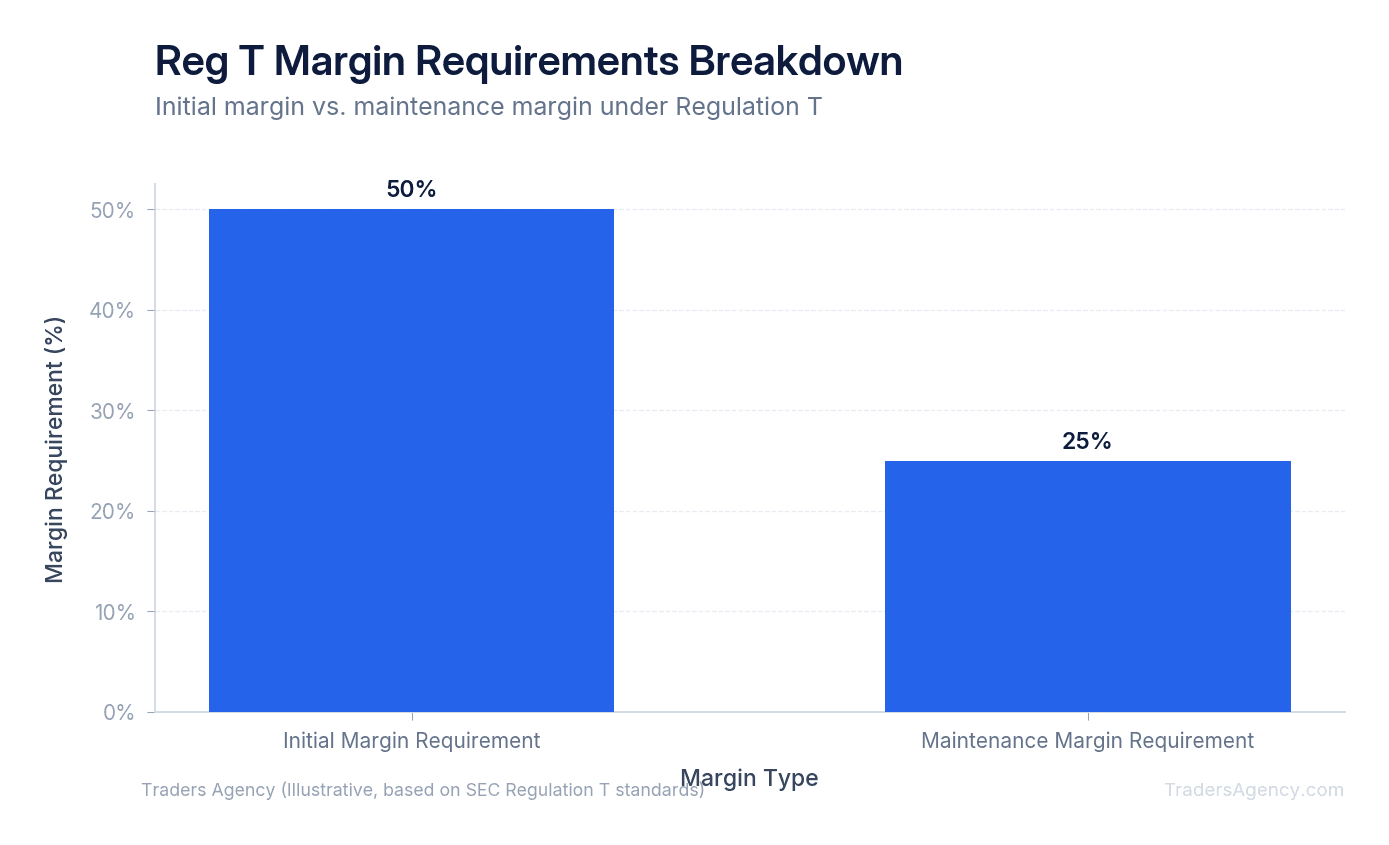
Key Concept: Think of margin like buying a house. The initial requirement is your down payment. The maintenance requirement ensures the property doesn't lose so much value that the bank's loan is at risk. The same logic applies to your brokerage account.
How Does Buying Power Work in a Margin Account?
Buying power represents the total dollar amount you can spend on securities, combining your cash with available borrowed funds. In a standard margin account, your overnight buying power is typically twice your cash balance. This means a $10,000 deposit gives you $20,000 in total purchasing capacity.
Here's a specific example. Assume you deposit $10,000 in cash into a new account. You want to buy shares of a company trading at $100 per share.
| Account Type | Cash Deposited | Buying Power | Shares You Can Buy at $100 |
|---|---|---|---|
| Cash Account | $10,000 | $10,000 | 100 shares |
| Margin Account (2:1) | $10,000 | $20,000 | 200 shares |
In the margin account, you supply half the funds and the broker supplies the other half.
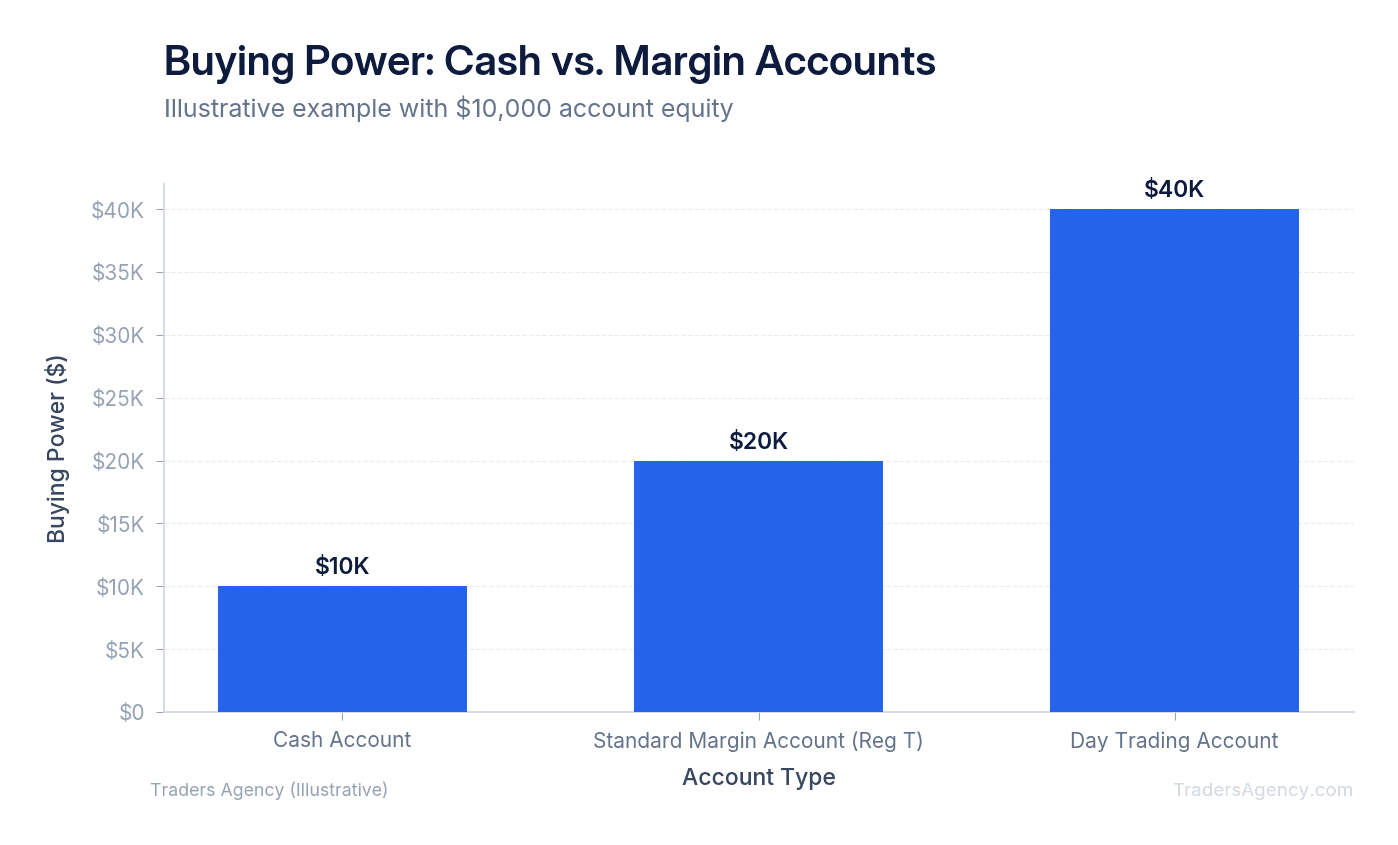
This 2:1 ratio applies to standard overnight positions under Reg T rules. However, not all stocks qualify for this treatment. Highly volatile stocks or penny stocks often have higher requirements. Your broker might demand 100% cash for a stock trading under $3.00 per share.
What Does a 25% Margin Requirement Mean?
A 25% margin requirement means your actual account equity must not fall below one-quarter of the total current value of your margin investments. If your equity drops below this threshold due to market losses, your broker will issue a margin call, requiring you to deposit more cash immediately.
This is the maintenance phase we mentioned earlier. Here's the math so you can see exactly how a margin call happens:
- Open the position: You buy $20,000 worth of stock using your $10,000 cash and $10,000 borrowed from the broker. Your account equity is $10,000.
- The market drops: The total value of your shares falls from $20,000 down to $12,000.
- Calculate your equity: You still owe the broker their original $10,000 loan. Your actual equity is now only $2,000 ($12,000 total value minus $10,000 loan).
- Check the maintenance threshold: The broker requires 25% of the current $12,000 position value. That equals $3,000.
- Margin call triggered: Since your equity is only $2,000, you are short by $1,000. The broker issues a margin call for that exact shortage.
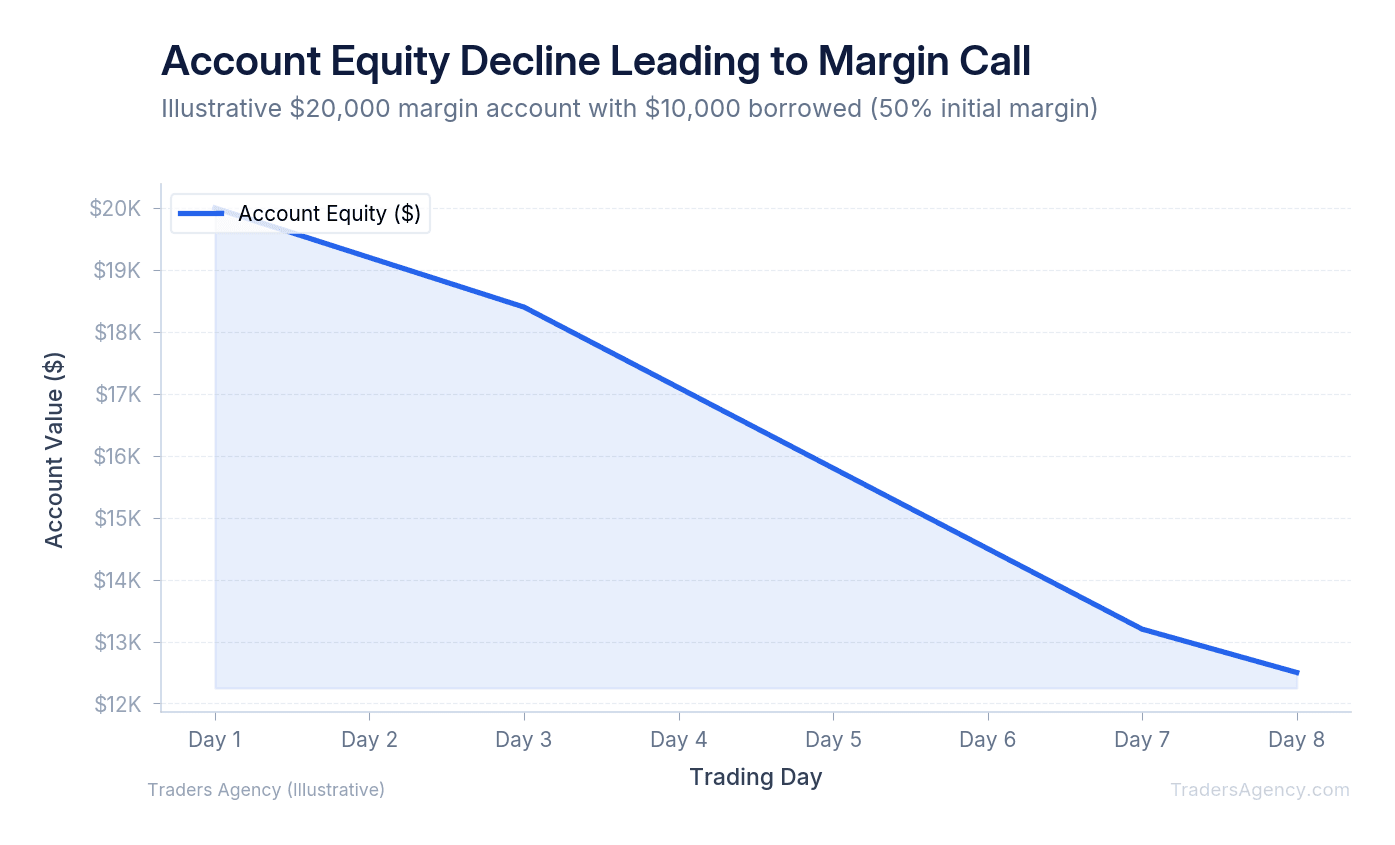
Watch Out: If you do not deposit the required funds after a margin call, your broker will sell your shares without asking for your permission. They can liquidate any position in your account at any time to cover the shortfall. You have no say in which positions they close or at what price.
Want expert trading insights delivered daily?
Join thousands of traders who rely on Traders Agency for market analysis and trade ideas.
Join Traders AgencyWhat Is the Difference Between Day Trading Margin and a Standard Margin Account?
Day trading margin provides active traders with significantly higher buying power for positions opened and closed within the same day. Under FINRA rules, pattern day traders receive intraday buying power equal to four times their maintenance margin excess, compared to the standard two times limit for overnight positions.
To qualify for this 4:1 intraday buying power, you must be classified as a Pattern Day Trader (PDT). This happens when you execute four or more day trades within five business days.
Once flagged as a PDT, you must maintain a minimum account equity of $25,000 at all times. If your balance dips to $24,999, your account will be restricted to cash-only trading until you deposit more funds.
| Account Type | Buying Power Ratio | $25,000 Account Buying Power | Minimum Equity |
|---|---|---|---|
| Standard Margin (Overnight) | 2:1 | $50,000 | No specific minimum |
| Day Trading Margin (Intraday) | 4:1 | $100,000 | $25,000 |
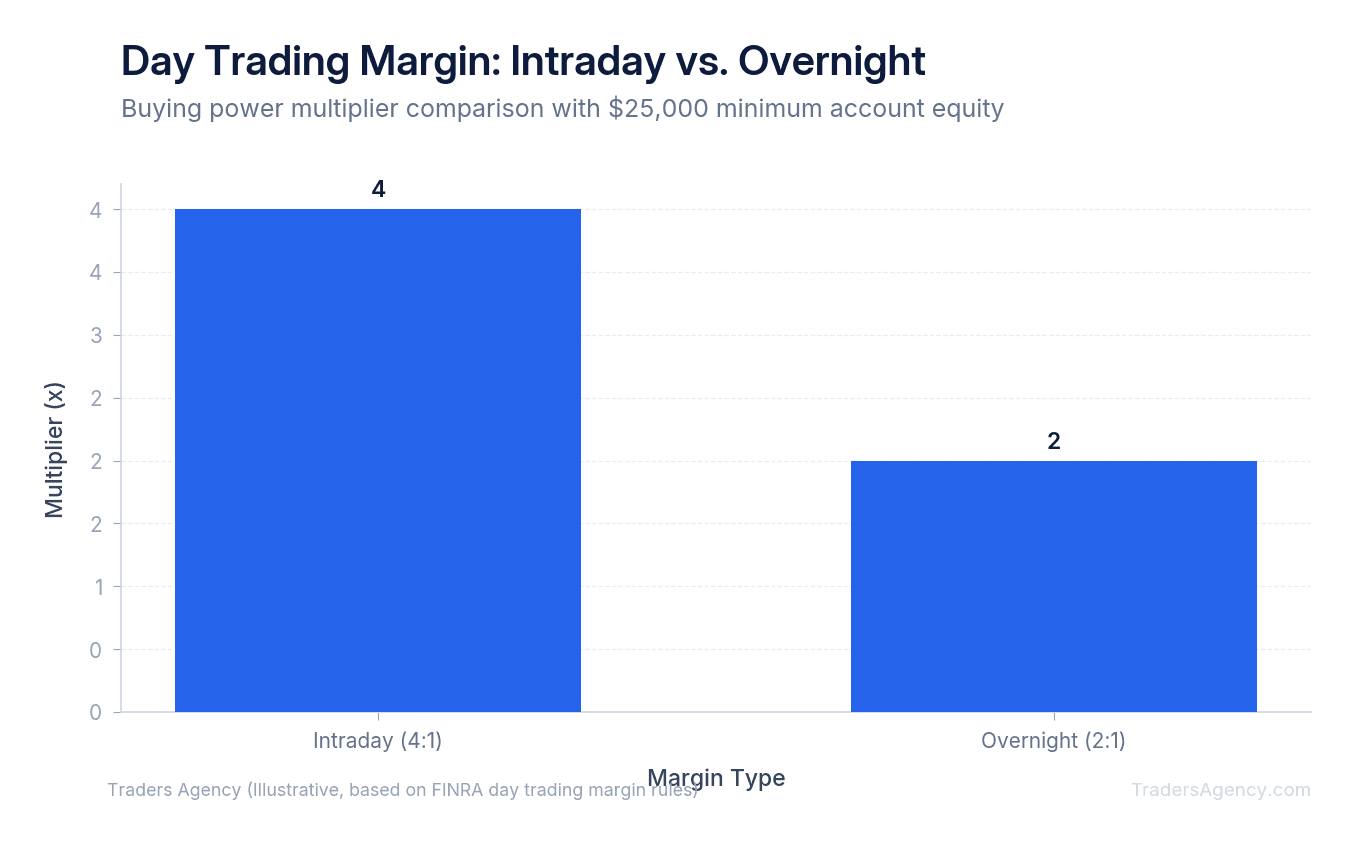
We teach our members to be very careful with intraday buying power. If you buy $100,000 of stock with a $25,000 account, a mere 1% drop in the stock price wipes out $1,000 of your capital. You must close these positions before the market closes, or you'll face massive overnight margin calls.
How to Check Your Balances on a Brokerage Platform
Finding your exact limits can be confusing because brokers use different terminology. We recommend checking your balances every single morning before you place a trade. Here's the step-by-step process we teach our beginners for reading their platform interface:
- Locate the Account Balances Tab: Log into your broker and find the main dashboard. Look for a tab labeled "Balances," "Account Info," or "Portfolio." This page contains your real-time equity figures.
- Identify Your Cash vs. Margin Equity: Find the line item labeled Cash Balance. This is your actual uninvested money. Next, find Margin Equity or Net Liquidating Value. This shows what your account would be worth if you sold every position and paid back all loans right now.
- Check Available Funds for Trading: Look for Stock Buying Power or Available to Trade. This is the most important number on your screen. It tells you exactly how much you can spend on new positions today. If you're a day trader, you'll see a separate line for Day Trade Buying Power.
- Verify Maintenance Requirements: Look for a field labeled Maintenance Requirement or Margin Used. Compare this number to your total equity. If they're close together, you're approaching a margin call and need to reduce your positions or add funds.
Options Margin: Defined vs. Undefined Risk
Options trading has its own margin rules that differ from standard stock margin. The requirements depend on whether your trade has defined or undefined risk.
When you execute a defined risk trade, like buying a call or put option, your maximum loss is capped at the premium you pay. Because your loss is limited to the premium, there is no need for margin on long options. You must pay 100% of the option premium in cash.
However, if you execute an undefined risk trade, like selling a naked call option, the rules change significantly. Since your potential losses are theoretically unlimited, the broker requires a large safety net.
| Trade Type | Risk Profile | Margin Requirement |
|---|---|---|
| Buying a Call or Put | Defined risk | 100% of premium (no margin allowed) |
| Selling a Covered Call | Defined risk | Must own 100 shares of underlying stock |
| Selling a Naked Call | Undefined risk | 20% of underlying price + premium - OTM amount |
| Credit Spread | Defined risk | Width of spread minus premium received |
Watch Out: We strongly advise beginners to avoid undefined risk trades entirely until they have years of experience. A single naked call gone wrong can wipe out an entire account in a matter of hours.
What Margin Mistakes Do Beginners Most Commonly Make?
Trading with borrowed money is a powerful tool, but it requires strict discipline. We see new traders make the same errors repeatedly. Our team recommends treating your buying power as a limit, not a target. Just because your broker offers you $50,000 in purchasing capacity does not mean you should use all of it.
Here are the specific rules we follow to manage risk:
- Never max out your buying power: Keep at least 30% to 50% of your available margin in reserve. This buffer protects you from immediate margin calls if the market gaps down overnight.
- Use strict stop losses: When trading on margin, a small percentage drop in the stock price causes a large percentage drop in your account equity. Set automatic stop orders to cut losses early.
- Watch out for earnings announcements: Brokers frequently raise maintenance requirements on specific stocks right before earnings reports. A stock that normally requires 25% maintenance might suddenly require 50% or even 100%, triggering an unexpected margin call.
- Know your broker's specific rules: Every brokerage can set requirements higher than the regulatory minimums. Just because FINRA says 25% doesn't mean your broker won't demand 40% on certain positions. Read the fine print.
Key Concept: Understanding margin requirements gives you a distinct advantage in the market. It allows you to size your positions correctly and avoid catastrophic liquidations. Take the time to calculate your limits manually before your broker forces you to learn the hard way.
Want expert trading insights delivered daily?
Join thousands of traders who rely on Traders Agency for market analysis and trade ideas.
Join Traders AgencyKey Takeaways
- Margin requirements set the minimum percentage of a trade you must fund yourself. Your broker covers the rest, which amplifies both gains and losses on every position.
- FINRA sets a 25% maintenance margin minimum, but individual brokers can and often do require more. Some demand 40% or higher on specific positions, so reading your broker's fine print is non-negotiable.
- A cash account limits you to your deposited funds only. Margin privileges change that by letting you borrow against the value of your existing holdings.
- Failing to understand your actual buying power limits is one of the fastest ways to trigger an unexpected margin call and forced liquidation.
- Calculating your margin limits manually before placing a trade is the practical safeguard against learning these rules the hard way through a liquidation notice.
DISCLAIMER: Traders Agency does not offer financial advice. The information provided is for educational purposes only and should not be considered financial advice. Traders Agency is not responsible for any financial losses or consequences resulting from the use of the information provided. Trading carries inherent risks and may not be suitable for all individuals. You are advised to conduct your own research and seek personalized advice before making any investment decisions, recognizing the potential risks and rewards involved.
See more from Traders Agency on Google
Make us a preferred source and our market analysis will appear more prominently in your Google Search, Top Stories, and AI results.
Add to Preferred Sources