
You buy a long-term call option on a stock you believe in, but the stock trades sideways for months. Time decay eats away at your premium, and you're left holding a losing position despite picking a strong company. Sound familiar? Professional traders avoid this trap by using multi-leg strategies that put time decay on their side. One of the most effective tools in that arsenal is the diagonal spread. In this guide, we'll walk you through exactly how this strategy works, show you a concrete example with real numbers, and help you understand when to use it and when to stay away.
What Is a Diagonal Spread?
Bottom Line: A diagonal spread is most effective when you have a moderate directional bias but want to reduce the cost of holding a long option through repeated short-term premium collection. The strategy demands discipline: position sizing, defined exit rules, and a willingness to close losing trades early are what separate profitable use from costly mistakes. Master those habits first, and the mechanics of the spread become a genuine edge.
A diagonal spread is a two-leg options strategy that involves buying a longer-term option and selling a shorter-term option at a different strike price. Traders use this setup to reduce the capital required for a directional trade while generating income from the short-term option's rapid time decay.
Our team prefers this strategy when we have a moderate directional bias on a stock. Instead of simply buying a call or put outright, we sell a near-term option against it. This creates a synthetic covered position without requiring the massive capital needed to buy 100 shares of the underlying stock.
Think of it like renting out a room in a house you just leased. You pay a large upfront cost for the long-term lease, but you collect smaller, frequent rent payments from a short-term tenant to lower your overall monthly expense. By the time your lease is up, those smaller payments have significantly reduced your total cost.
Key Concept: A diagonal spread combines different strike prices and different expiration dates in a single trade. The long option provides directional exposure, while the short option generates income through accelerated time decay.
What Is the Difference Between a Diagonal Spread and a Calendar Spread?
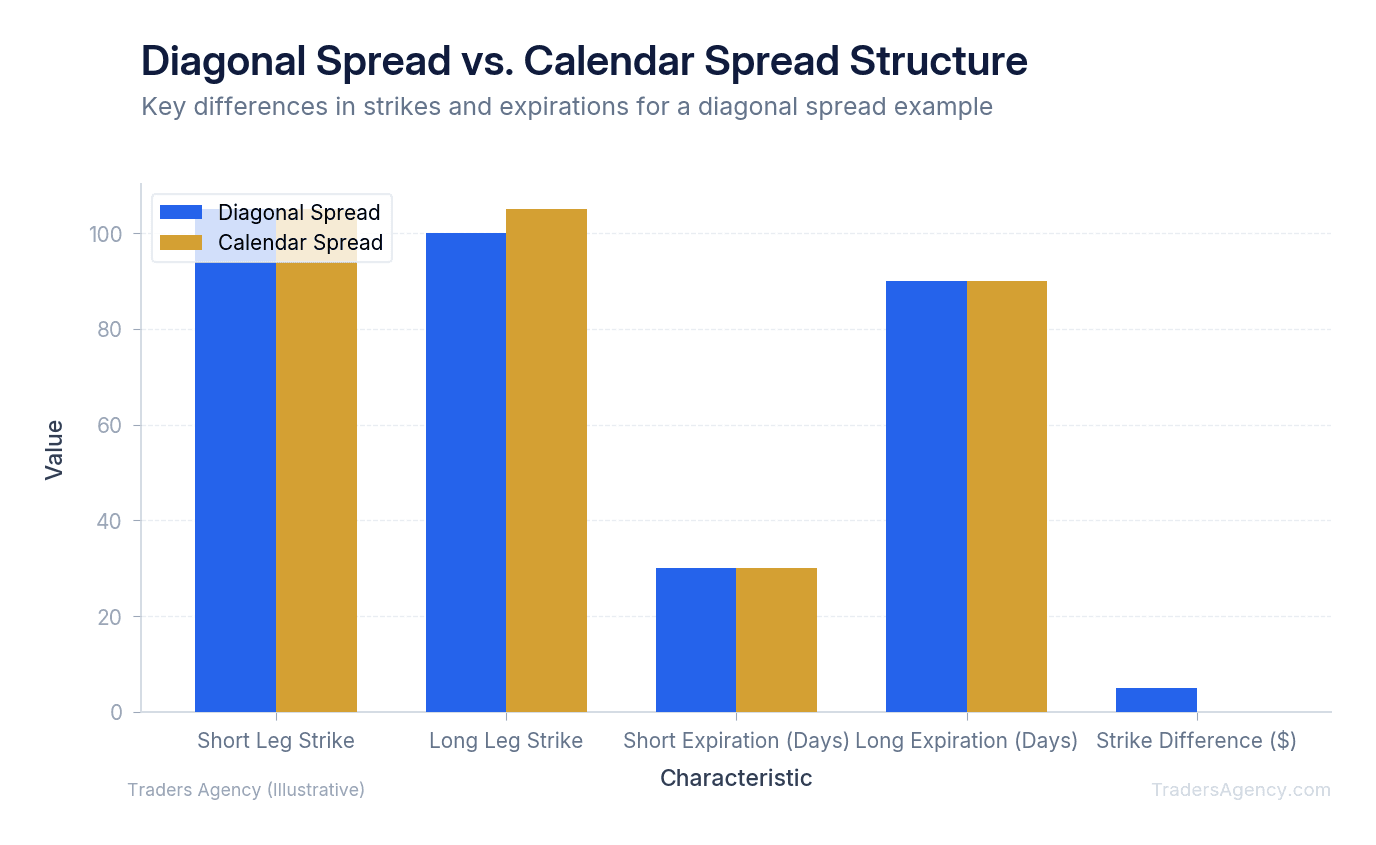
The main difference in a diagonal spread vs. calendar spread lies in the strike prices. A calendar spread uses the exact same strike price for both the long and short options across different expirations. A diagonal spread uses different strike prices and different expirations, creating a directional bias.
When you trade a calendar spread, you want the underlying stock to stay pinned near your chosen strike price. It's primarily a neutral strategy designed to profit from time decay and increases in implied volatility. We teach our members to use calendar spreads in sideways markets where we don't expect a major price breakout.
A diagonal spread, on the other hand, benefits from the stock moving in a specific direction. Because you're selecting different strike prices, your maximum profit zone shifts up or down the options chain. Comparing a diagonal spread vs. calendar spread ultimately comes down to your directional assumption on the underlying asset. If you expect a steady climb, the diagonal spread is the superior choice.
| Feature | Diagonal Spread | Calendar Spread |
|---|---|---|
| Strike Prices | Different for each leg | Same for both legs |
| Expiration Dates | Different for each leg | Different for each leg |
| Directional Bias | Yes (bullish or bearish) | Neutral |
| Best Market Condition | Slow, steady trend | Sideways, low volatility |
| Primary Profit Driver | Direction + time decay | Time decay + volatility |
What Is the Difference Between a Diagonal Spread and a Vertical Spread?
The difference between a diagonal spread and a vertical spread comes down to expiration dates. A vertical spread uses different strike prices but the exact same expiration date for both options. A diagonal spread uses different strike prices and different expiration dates, adding a time decay advantage to the trade.
A vertical spread is a defined-risk, defined-reward trade that plays out entirely within a single expiration cycle. You buy a call and sell a higher strike call expiring on the exact same day. Your profit depends almost entirely on the stock reaching your short strike by expiration. Once that day passes, the trade is completely over.
With a diagonal spread, the differing expiration dates introduce a dynamic element. The short-term option decays much faster than the long-term option. This allows you to potentially sell multiple short-term options against your single long-term option over several months, continuously lowering your cost basis.
Want expert trading insights delivered daily?
Join thousands of traders who rely on Traders Agency for market analysis and trade ideas.
Join Traders AgencyDiagonal Spread Example with Real Numbers
A practical diagonal spread example involves buying a long-term in-the-money call and selling a short-term out-of-the-money call. We'll walk through a specific scenario using a hypothetical tech stock, Ticker: XYZ, currently trading at $100 per share. Our outlook is moderately bullish on XYZ over the next three months.
Step-by-Step Trade Setup
- Establish the Long Leg: We buy the 90-day expiration, $90 strike call for a premium of $12.00. Because options contracts represent 100 shares, this leg costs us $1,200 total. This option is deep in-the-money, meaning it will closely track the stock's upward movement.
- Sell the Short Leg: We sell the 30-day expiration, $105 strike call for a premium of $2.00. We collect $200 immediately into our account. Our net debit for this trade is $10.00 per share, meaning we pay $1,000 out of pocket to enter the position.
- Calculate Maximum Risk and Reward: Your maximum loss is limited to the net debit paid: $1,000. This worst-case scenario occurs if XYZ drops significantly and the long call eventually expires worthless after all short call premiums have been collected. Your maximum profit for the first 30 days occurs if XYZ closes exactly at $105 on the short call's expiration date. The short call expires worthless, you keep the entire $200 premium, and your long call retains maximum time value plus intrinsic value.
| Parameter | Value |
|---|---|
| Underlying Stock | XYZ at $100 |
| Long Leg | $90 strike call, 90-day expiration, $12.00 premium |
| Short Leg | $105 strike call, 30-day expiration, $2.00 premium |
| Net Debit | $10.00 per share ($1,000 total) |
| Max Loss | $1,000 (net debit paid) |
| Max Profit Zone | XYZ at $105 at short call expiration |
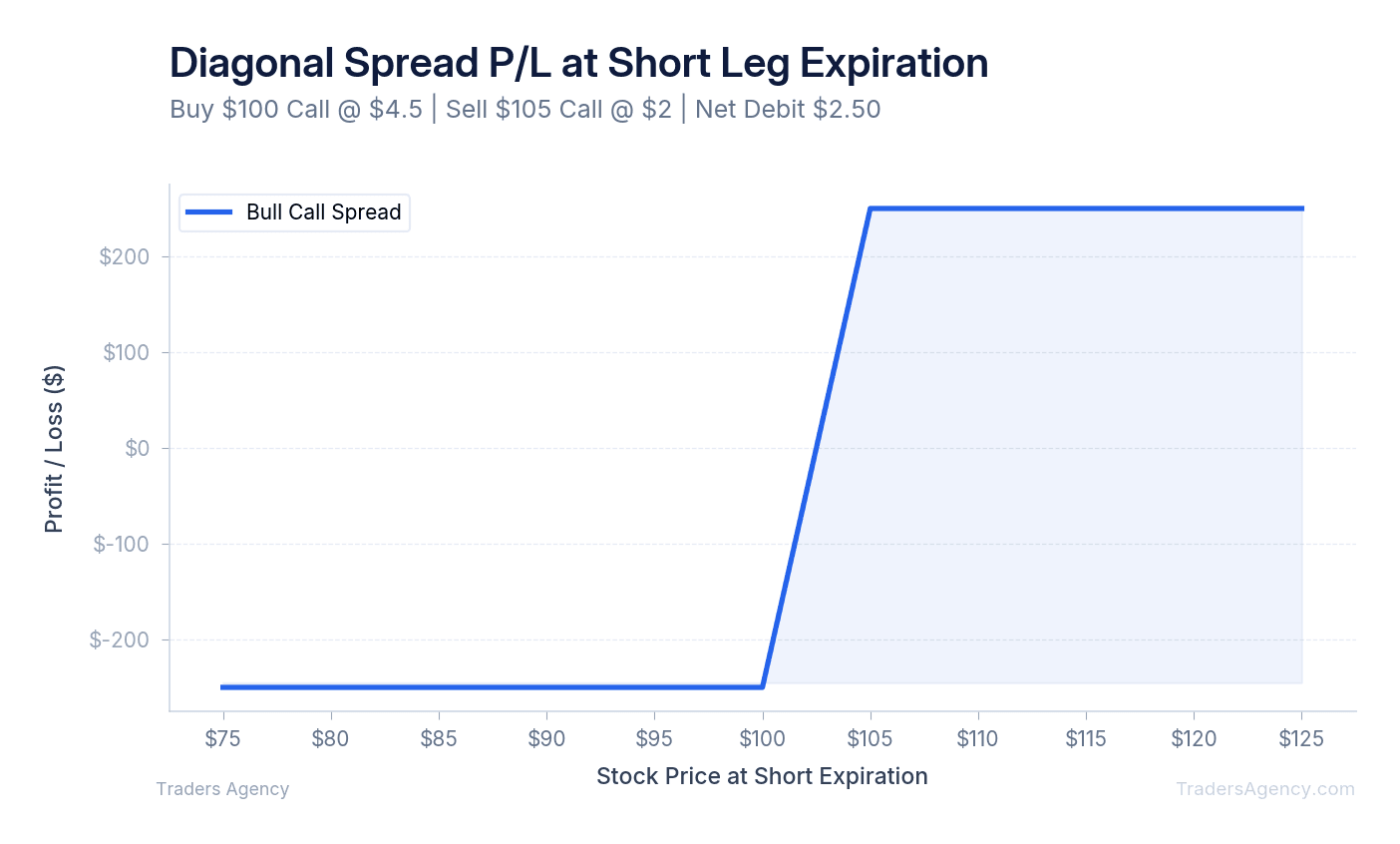
Calculating an exact breakeven point is complex because the long option still has 60 days of time value remaining when the short option expires. However, your breakeven will always be lower than if you had simply purchased the $90 strike call by itself.
How Do Greeks Affect a Diagonal Spread?
Options Greeks heavily influence diagonal spreads because the two legs have different expiration cycles. Here's how each Greek impacts your position:
Delta measures your directional exposure. In a bullish diagonal spread, your long in-the-money call has a high positive delta, while your short out-of-the-money call has a lower positive delta. Because you are short that call, it contributes negative delta to the position. This results in a net positive delta, meaning the overall position profits as the stock price rises.
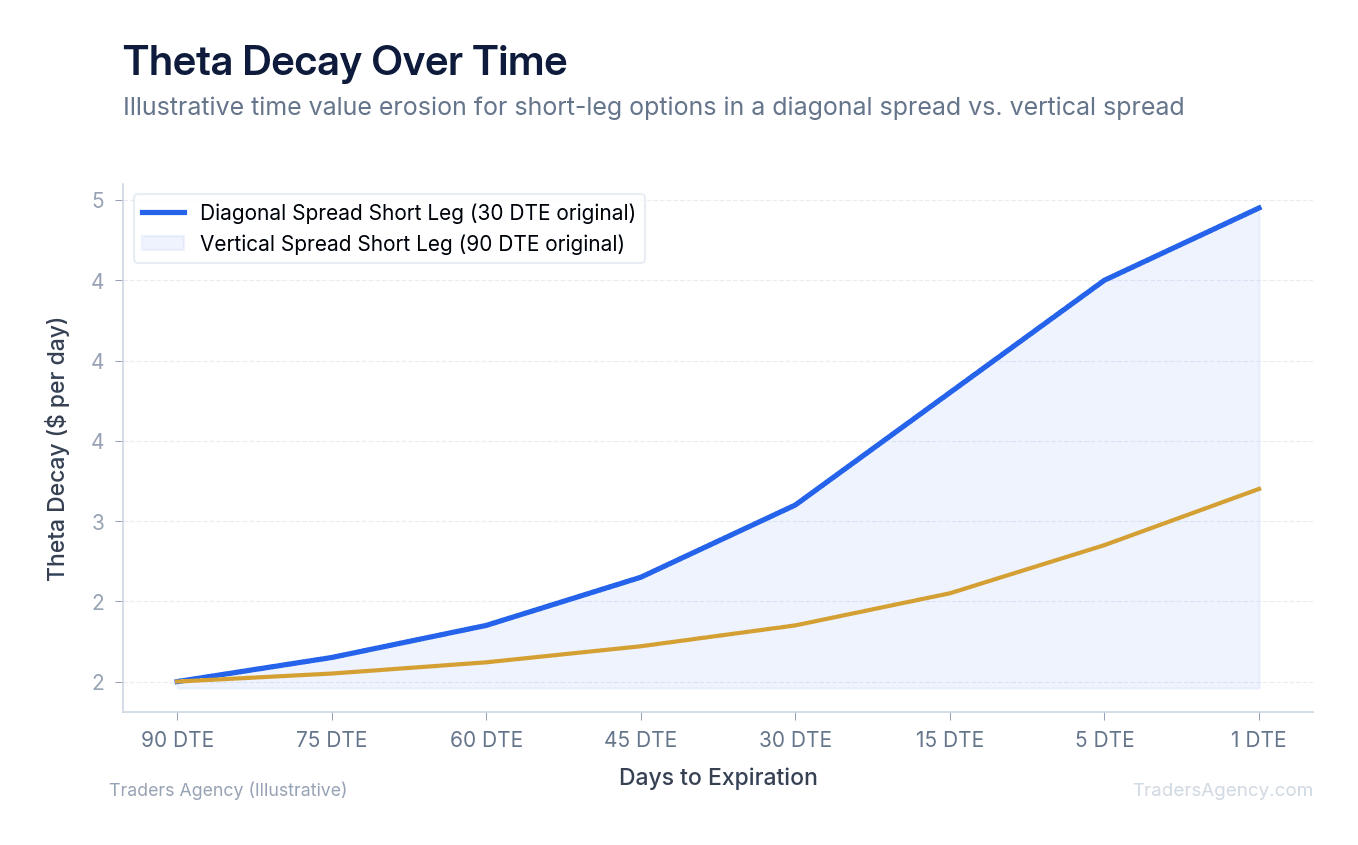
Theta is your best friend in this strategy. Options lose value as expiration approaches, but this decay is not linear. The 30-day short option loses its time value much faster than the 90-day long option. This differential in theta decay is the primary engine that offsets the cost of your long position.
Vega measures sensitivity to implied volatility. Because longer-term options have higher vega, a diagonal spread is generally long vega and benefits from an overall increase in implied volatility. The long option gains more value from a volatility spike than the short option loses. However, volatility behaves differently across expiration cycles, so careful monitoring is required.
Key Concept: The theta differential between the fast-decaying short leg and the slower-decaying long leg is the core profit engine of a diagonal spread. This is what makes the strategy so effective for income generation.
Are Diagonal Spreads Profitable?
Diagonal spreads are highly profitable when the underlying stock moves slowly in your predicted direction or trades sideways near the short strike. Because you collect premium from the short-term option, you can lower your breakeven point and generate consistent returns, making diagonal spreads for income a popular strategy among experienced options traders.
The true profit potential unlocks when you actively manage the short leg. Let's return to our previous example. If XYZ stock stays at $100, the short call expires worthless after 30 days. You still own the long call with 60 days left. You can then sell another 30-day short call against it, collecting another premium.
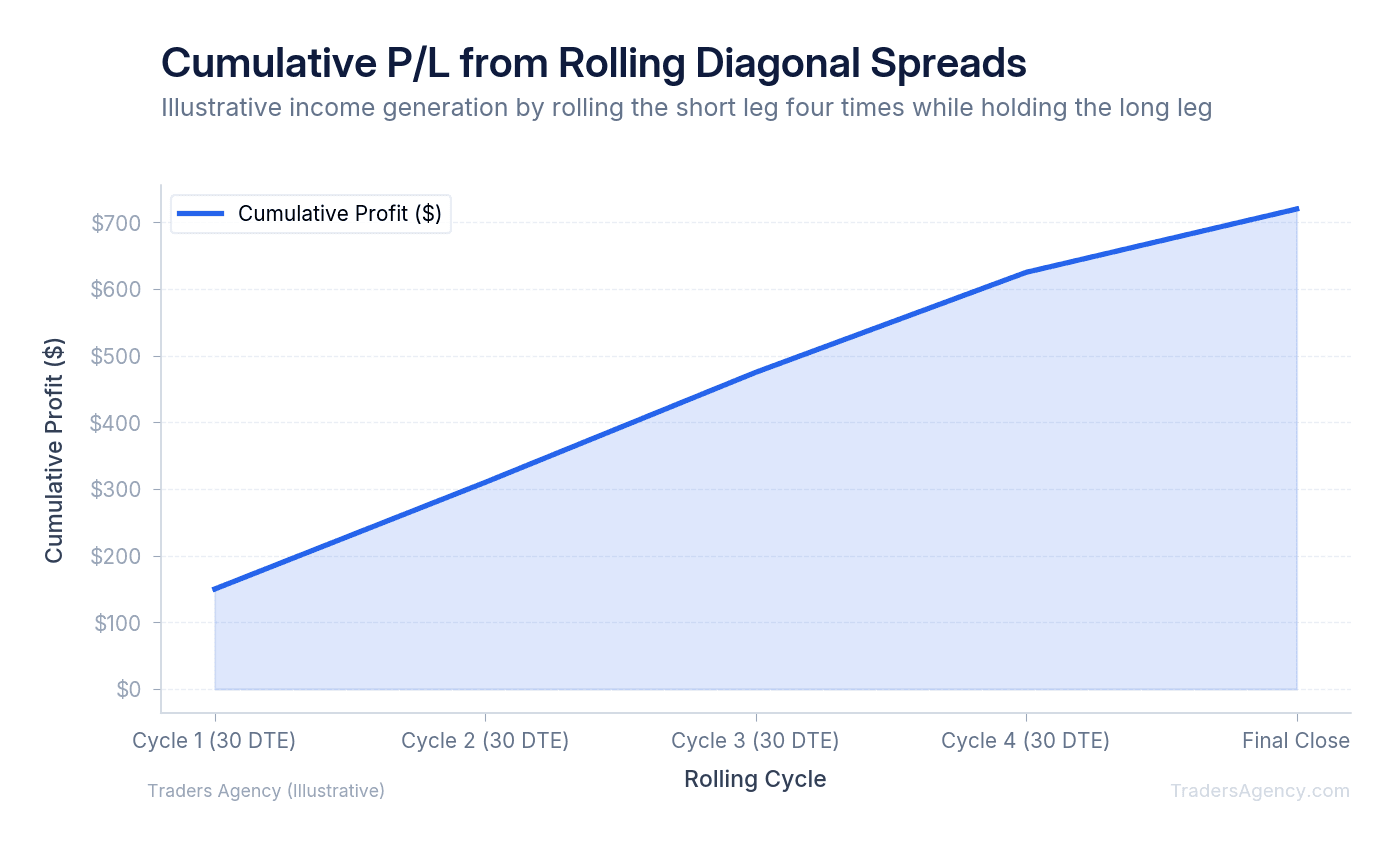
By repeating this process, you continuously collect premium. We regularly use diagonal spreads for income in accounts where we want to generate cash flow without tying up the massive capital required for traditional covered calls. If managed correctly, the accumulated premiums can sometimes pay for the entire cost of the long option.
Watch Out: Profitability is never guaranteed. If the stock price drops sharply, the premium collected from the short calls will not be enough to offset the capital loss on the expensive long call. Always have a stop-loss plan in place before entering the trade.
Is a Diagonal Spread the Same as a PMCC?
A Poor Man's Covered Call (PMCC) is a specific type of diagonal spread, but not all diagonal spreads are PMCCs. A PMCC specifically requires buying a deep in-the-money long call with a high delta and selling an out-of-the-money short call to simulate a traditional covered call position.
To qualify as a true PMCC, we typically look for a long call with a delta of 0.80 or higher. This ensures the long option behaves very similarly to 100 shares of the underlying stock. The short call usually has a delta around 0.30 or lower, giving it a high probability of expiring worthless.
You might be wondering: what is another name for a diagonal spread? Depending on the broker or trading platform, you might see them referred to as a calendar-vertical spread or a time spread with a directional bias.
If you buy a slightly out-of-the-money long call and sell an even further out-of-the-money short call, you're trading a standard diagonal spread. It has a directional bias, but it doesn't mimic stock ownership closely enough to be called a PMCC. Both are valid strategies, but they serve different risk profiles.
When Should You Use a Diagonal Spread, and When Should You Avoid It?
You should use a diagonal spread when you have a moderate directional bias and expect implied volatility to remain stable or rise. You should avoid this strategy during major binary events like earnings announcements, where sudden price spikes can blow past your short strike and cap your upside potential. The CBOE's options education resources provide additional background on multi-leg options risk, and we strongly recommend understanding these risks before placing your first trade.
Here is the exact criteria our team uses when setting up this trade:
- Identify a slow-moving trend: Look for stocks with consistent, moderate momentum rather than explosive volatility.
- Select the right expirations: Give your long leg at least 60 to 90 days to expiration. Keep your short leg between 14 and 30 days to maximize rapid time decay.
- Manage the strikes: Ensure the premium collected from the short option provides a meaningful reduction in your net debit. We look to collect at least 15% of the long option's cost.
- Plan for adjustments: If the stock blasts past your short strike, be prepared to roll the short call up and out in time, or simply close the entire position to capture your profit.
Risk Management Rule: We recommend allocating no more than 2% to 5% of your total account capital to any single diagonal spread. If the stock breaks below your technical support levels, close the trade and cut your losses early. Do not hold onto a losing long call just because you're collecting pennies on the short side.
Risk management is completely non-negotiable. Have a clear plan for both your entry and your exit before you place the trade. The diagonal spread is a powerful strategy when used with discipline, but no strategy works if you ignore your rules.
Want expert trading insights delivered daily?
Join thousands of traders who rely on Traders Agency for market analysis and trade ideas.
Join Traders AgencyKey Takeaways
- A diagonal spread combines a longer-term option purchase with a shorter-term option sale at a different strike price, letting you collect time decay income while holding a directional position.
- The strategy works like subletting a leased property: the short-term option premiums you collect chip away at the cost of your longer-term option over time.
- Traders Agency recommends allocating no more than 2% to 5% of total account capital to any single diagonal spread to limit downside exposure.
- If the stock breaks below key technical support levels, the guidance is to close the trade immediately rather than holding the long call while collecting small premiums on the short side.
- The diagonal spread differs from a calendar spread in strike price selection: a calendar spread uses the same strike on both legs, while a diagonal spread uses different strikes to add a directional component.
DISCLAIMER: Traders Agency does not offer financial advice. The information provided is for educational purposes only and should not be considered financial advice. Traders Agency is not responsible for any financial losses or consequences resulting from the use of the information provided. Trading carries inherent risks and may not be suitable for all individuals. You are advised to conduct your own research and seek personalized advice before making any investment decisions, recognizing the potential risks and rewards involved.
See more from Traders Agency on Google
Make us a preferred source and our market analysis will appear more prominently in your Google Search, Top Stories, and AI results.
Add to Preferred Sources