
You've probably seen this happen on your trading screen. A relatively unknown stock suddenly spikes 200% in a single afternoon on massive volume. We're going to walk you through exactly why this happens and how you can trade it with a clear plan.
Retail investor market impact is the measurable effect that non-professional, individual traders have on asset prices and market liquidity through collective buying or selling. In this guide, we'll teach you the mechanics behind these massive moves. By the time you finish reading, you'll know how to spot retail-driven momentum, understand the options market mechanics that fuel it, and apply strict risk management to protect your capital.
What Is Retail Investor Market Impact and Why Does It Matter?
Bottom Line: Retail traders move markets today because their collective order flow is large enough to force institutional hedging activity, creating self-reinforcing price moves. Understanding the options mechanics behind these spikes, and knowing when volume and sentiment signal a move is still early versus exhausted, is what separates traders who profit from these setups from those who buy the top. The edge is not just spotting the momentum but having a rule-based exit plan before you enter.
Retail investor market impact is the combined force of individual traders directing capital into specific stocks, which forces institutional market makers to adjust their positions. This collective action creates rapid price appreciation, elevated volatility, and temporary imbalances in the supply and demand of shares.
Our team tracks this daily because retail participation has grown massively. Ten years ago, individual traders accounted for a tiny fraction of daily volume. Today, that number regularly exceeds 20% of total market volume. This shift forces us to adapt our trading strategies constantly.
When you ask why retail traders move markets, the answer lies in modern market structure. Zero-commission brokers and payment for order flow mean retail orders are bundled and executed at lightning speed. Market makers absorb this flow and must hedge their own risk immediately.
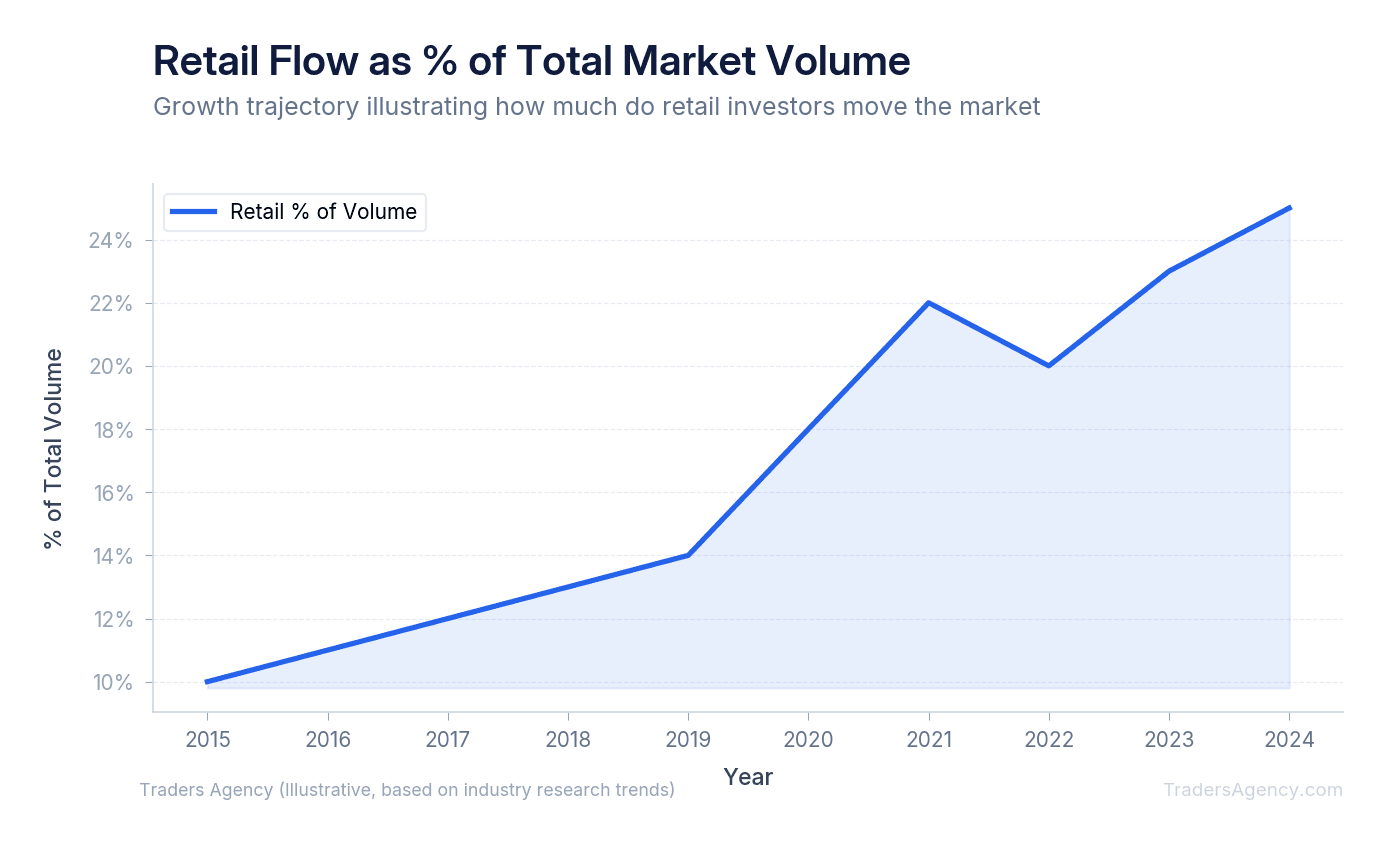
This rapid execution creates a feedback loop. Retail traders buy shares, the stock price ticks up, and momentum scanners alert other traders to join the buying. We view this as a structural market inefficiency that educated traders can exploit.
Key Concept: Retail investor market impact is strongest in low-float, high-short-interest stocks where concentrated buying triggers forced hedging by market makers. This mechanical process, not hype, is what drives the biggest moves.
Do Retail Traders Actually Move the Market?
Yes. Retail traders absolutely move the market, primarily through the aggressive purchasing of short-dated call options. When thousands of individuals buy these options simultaneously, market makers must buy the underlying stock to hedge their risk, creating a self-fulfilling price spike.
This mechanical process is known as gamma exposure. We teach our members that you cannot understand retail investor market impact without understanding gamma. When you buy a call option, someone has to sell it to you. Usually, that seller is an institutional market maker.
The market maker does not want to take a directional bet on the stock. If you buy a $50 strike call on a stock trading at $45, the market maker will buy a certain number of shares to remain neutral. As the stock price gets closer to $50, the market maker is forced to buy even more shares. This accelerating buying pressure is what creates explosive moves.
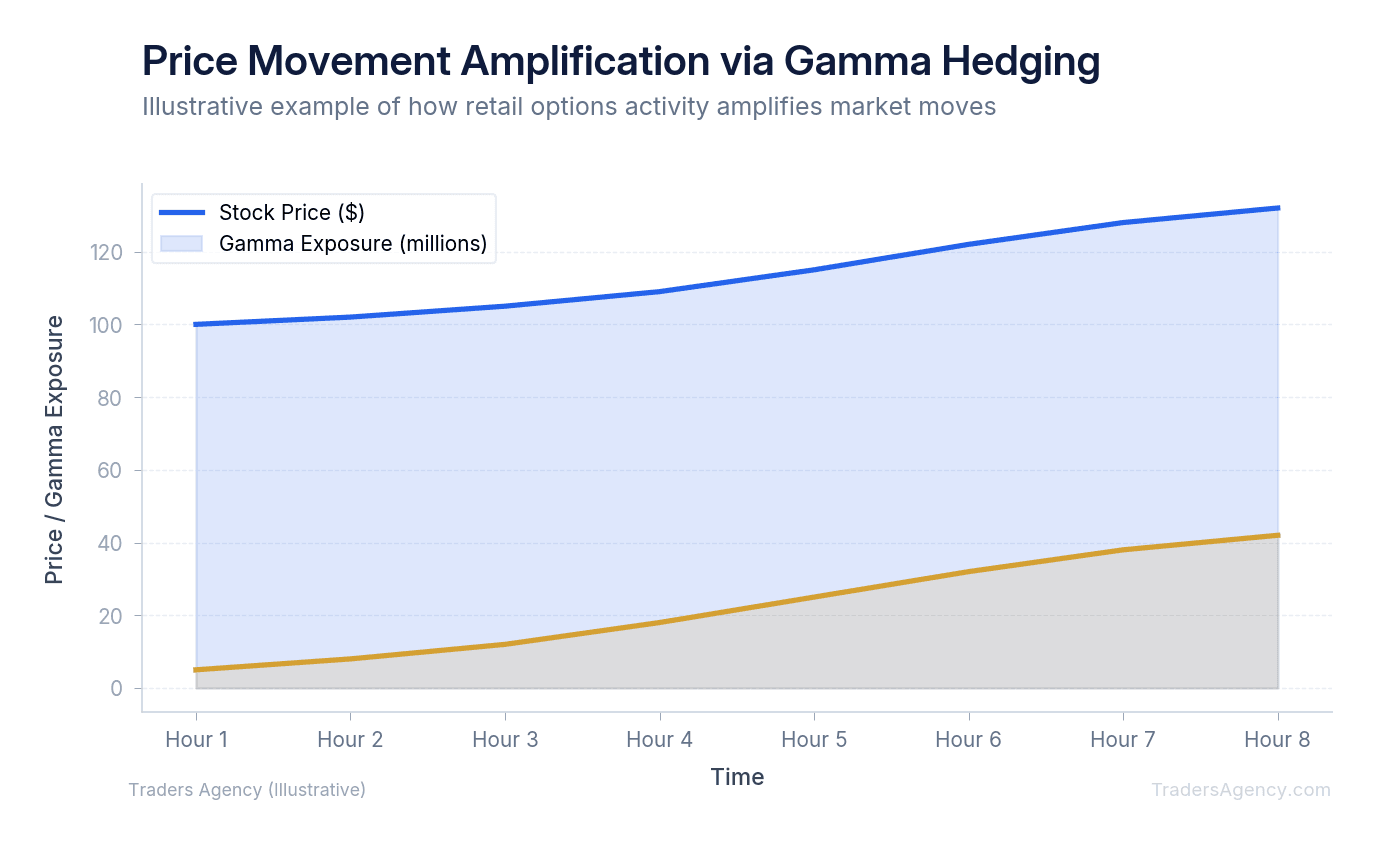
Concentrated options volume in illiquid stocks frequently forces these mechanical price adjustments. Educational materials from the Cboe (Chicago Board Options Exchange) explain how market makers follow mathematical formulas to balance their books. The market maker isn't making a bet. They're simply managing risk through a hedging algorithm.
This creates a massive opportunity for traders who know how to read the options chain. By identifying where the heaviest call volume is concentrated, we can predict where market makers will be forced to buy shares.
Historical Examples of Coordinated Retail Buying
The dynamics we saw during the meme stock era have permanently altered how we view volume anomalies. We prefer to look at the data rather than the hype.
In a typical scenario, a stock with a low float of 10 million shares suddenly trades 50 million shares in a single day. This turnover means the entire tradable supply of the company changed hands five times. This is the clearest footprint of coordinated retail action.
Online trading communities often focus on highly shorted stocks. The combination of market makers buying to hedge options and short sellers buying to cover their losses creates an explosive upward move.
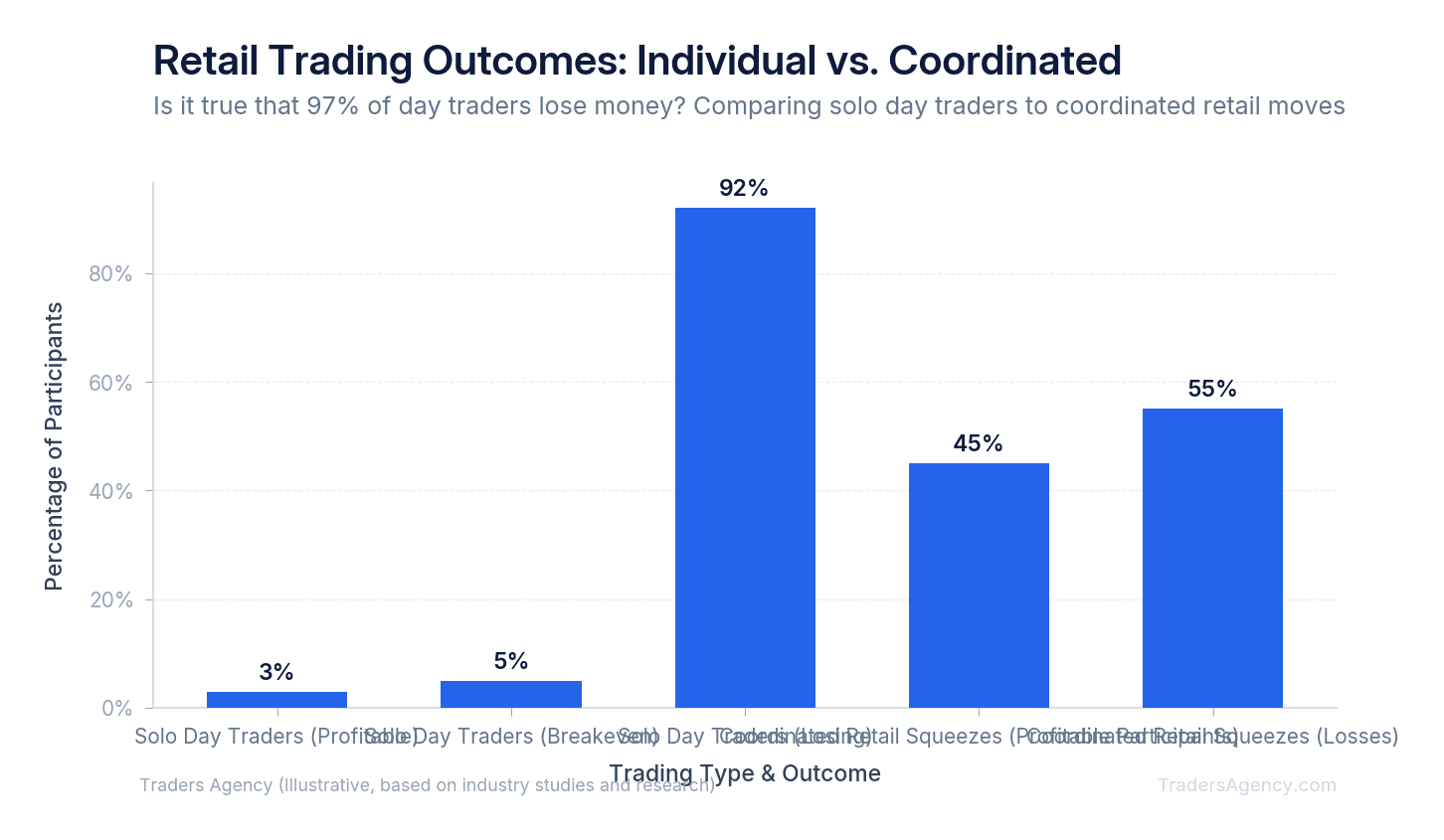
When people ask how much retail investors actually move the market, we point to these low-float, high-short-interest setups. In large-cap stocks like AAPL or MSFT, retail impact is minimal. In small-cap stocks with high short interest, retail traders can dictate the price action for days or even weeks.
Watch Out: Studies consistently show that the vast majority of active day traders fail to beat the market over the long term. The high failure rate is often due to poor risk management and chasing extended stocks. Always have a plan before you enter a trade.
Want expert trading insights delivered daily?
Join thousands of traders who rely on Traders Agency for market analysis and trade ideas.
Join Traders AgencyHow Do You Identify a Retail-Driven Market Move Before It Peaks?
We want to show you exactly how to trade these setups. This is not about guessing which stock will be popular next. It's about reading the tape and managing your risk with precision.
Step 1: Spot the Initial Setup
First, you need to find the right conditions. We look for stocks trading under $20 per share with a short interest above 20%. The stock must also have an active options chain.
Without options, the gamma squeeze mechanic cannot happen. We use basic stock screeners to filter for these specific criteria every morning before the opening bell.
Step 2: Track the Options Chain
Next, we monitor the options volume relative to open interest. If a stock typically trades 1,000 contracts a day and suddenly trades 50,000 contracts in the first hour, you have a confirmed anomaly.
We specifically watch the out-of-the-money calls expiring that same week. If the stock is at $10 and we see massive volume on the $15 calls expiring on Friday, we know market makers are being forced to hedge.
Step 3: Execute the Trade
Here's where discipline matters most. We see the massive options volume and the high short interest on ticker XYZ trading at $10. We do not buy the stock blindly at the market open.
Instead, we wait for a pullback to a key intraday support level, such as the Volume Weighted Average Price (VWAP). If the stock dips to the VWAP at $10.50, that becomes our entry point.
| Parameter | Value |
|---|---|
| Ticker | XYZ |
| Entry Price | $10.50 (at VWAP pullback) |
| Position Size | 1,000 shares |
| Stop Loss | $9.50 |
| Maximum Loss | $1,000 |
| Target Price | $15.00 |
| Potential Gain | $4,500 |
| Risk-to-Reward Ratio | 1:4.5 |
This gives us an excellent risk-to-reward ratio. We're risking one dollar to make more than four dollars. That's the kind of setup we wait for.
The 3-5-7 Rule: Risk Management for Volatile Setups
The 3-5-7 rule is a risk management framework where a trader risks 3% of their account on a standard trade, aims for a 5% return, and sets a hard stop loss at 7% below their entry price.
Our team modifies this rule slightly for highly volatile retail-driven stocks. Because these assets move so quickly, a standard stop loss might get skipped during a rapid sell-off. We prefer to reduce our position size dramatically when trading these specific setups.
Key Concept: If your total account size is $50,000, risking 3% means putting $1,500 on the line. In a normal market environment, this is acceptable. In a retail-driven short squeeze, we recommend risking no more than 1% (or $500) due to the extreme volatility. Protect your downside first.
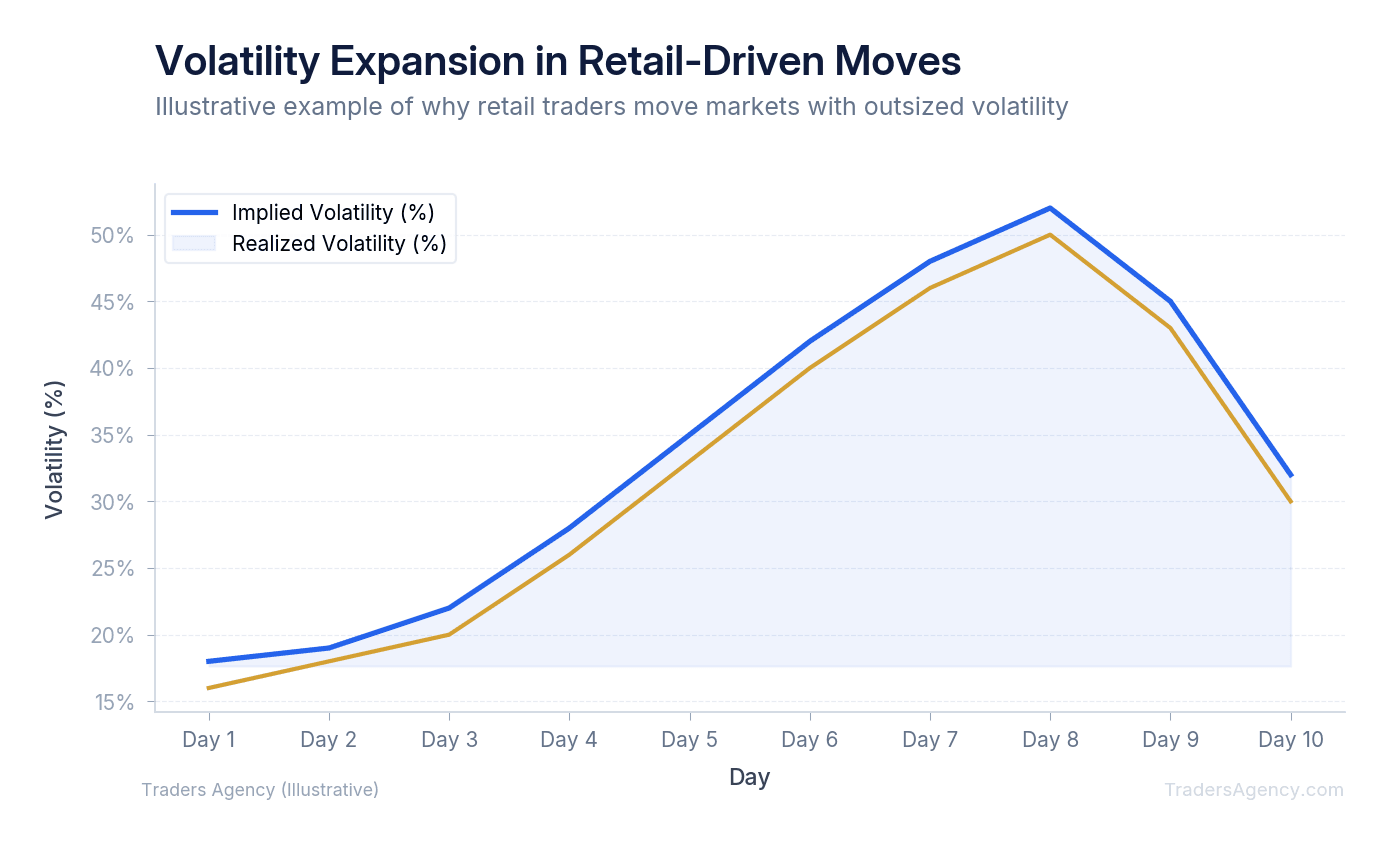
The SEC frequently publishes investor bulletins warning about the dangers of highly volatile momentum stocks. We agree with their assessment entirely. You must have a strict exit plan before you enter the trade.
When Should You Follow Retail Flow and When Should You Stay Away?
Not every retail-driven move is worth trading. You have to know when to participate and when to sit on your hands. We teach our members to eliminate the fear of missing out entirely.
Here's when we recommend avoiding a retail-driven move:
- The stock has already moved up more than 100% in a single day.
- The implied volatility on the options chain is so high that premiums are prohibitively expensive.
- The company has announced a secondary stock offering, which will flood the market with new shares.
- You cannot find a logical technical support level to place your stop loss.
The best time to follow retail flow is early in the cycle. If you catch the volume anomaly in the first hour of the trading session, before the general public notices, your odds of success improve dramatically.
To safely trade retail investor market impact, you must treat it as a short-term momentum strategy. These are not long-term investments. Once the coordinated buying pressure stops, the stock almost always crashes back to its original price.
Our approach to profit-taking is straightforward: if the stock hits our target, we sell half our position immediately. We then move our stop loss up to our breakeven point on the remaining shares. This guarantees a profitable trade while leaving room for further upside.
Risk Warning: Retail-driven momentum trades carry extreme risk. Prices can reverse violently without warning. Never risk more than you can afford to lose, always use a stop loss, and treat every one of these setups as a short-term trade with a defined exit plan.
Want expert trading insights delivered daily?
Join thousands of traders who rely on Traders Agency for market analysis and trade ideas.
Join Traders AgencyKey Takeaways
- Retail traders now account for more than 20% of total daily market volume, up from a negligible share a decade ago, which means institutional market makers are forced to react to retail order flow in real time.
- Retail-driven price spikes are partly mechanical: when individual traders pile into short-dated call options, market makers must buy the underlying stock to hedge their exposure, accelerating the move.
- A practical exit rule from the article: sell half your position when price hits your target, then move your stop loss to breakeven on the remaining shares to lock in profit while staying exposed to further upside.
- Zero-commission brokers and payment for order flow have structurally changed how retail orders reach the market, concentrating buying pressure in ways that were not possible for individual traders ten years ago.
- Retail momentum trades can reverse violently without warning, which is why the article treats every setup as a short-term trade requiring a defined stop loss before entry, not after.
DISCLAIMER: Traders Agency does not offer financial advice. The information provided is for educational purposes only and should not be considered financial advice. Traders Agency is not responsible for any financial losses or consequences resulting from the use of the information provided. Trading carries inherent risks and may not be suitable for all individuals. You are advised to conduct your own research and seek personalized advice before making any investment decisions, recognizing the potential risks and rewards involved.
See more from Traders Agency on Google
Make us a preferred source and our market analysis will appear more prominently in your Google Search, Top Stories, and AI results.
Add to Preferred Sources