
A YOLO trade is a highly aggressive, concentrated market position where a trader allocates a massive portion of their portfolio to a single high-conviction idea. You've probably seen these explosive plays documented across social media. We understand the appeal of a massive win. However, surviving these aggressive setups requires a strict YOLO trades risk management strategy, and that's exactly what we're going to teach you.
We'll walk you through how to structure these high-risk trades without blowing up your account. These are not standard investments, and they require a completely different set of rules.
By the end of this guide, you will understand:
- How to define your maximum acceptable loss before entering a trade
- The mathematical difference between stock risk and options risk
- How to scale out of volatile positions to protect your capital
- The psychological traps that destroy inexperienced traders
What Is YOLO Trading?
Bottom Line: YOLO trades are not inherently reckless if you treat them as a structured strategy with hard rules around position sizing, stop losses, and instrument selection. The math has to work before you enter, not after. One uncontrolled loss can permanently end a trading account, so the entire framework exists to keep you in the game long enough for the wins to matter.
Key Concept: YOLO trading is a high-risk investment approach where an individual places a heavily concentrated trade on a single stock or options contract, often risking a large percentage of their total account. These trades rely on massive short-term price movements and require strict risk controls to prevent total capital loss.
The term stands for "you only live once." Retail traders often use this approach during earnings events, short squeezes, or major news announcements. We teach our members that these setups demand precise execution and emotional discipline.
If you search for a YOLO trades risk management review online, you'll find countless stories of traders who ignored basic math and lost everything. Regulatory bodies like the SEC frequently warn retail participants about the dangers of concentrated, unhedged positions. You must treat these setups as calculated risks rather than lottery tickets.
A proper YOLO trades risk management strategy separates professional speculation from outright gambling. When you allocate capital to a highly volatile ticker, you are accepting a higher probability of loss in exchange for outsized return potential. We always assume the worst-case scenario will happen, and we plan our exits accordingly.
Developing a YOLO Trades Risk Management Strategy
The foundation of any aggressive trading plan is capital preservation. You cannot participate in the market if your account balance hits zero. We require our traders to establish firm rules before they ever look at a chart.
Your strategy must dictate exactly how much capital you are allowed to risk on a single idea. It must also define the specific instruments you will use to execute the trade. We never enter a volatile setup without knowing exactly where we will take profits and where we will cut losses.
What Is the 3-5-7 Rule in Risk Management?
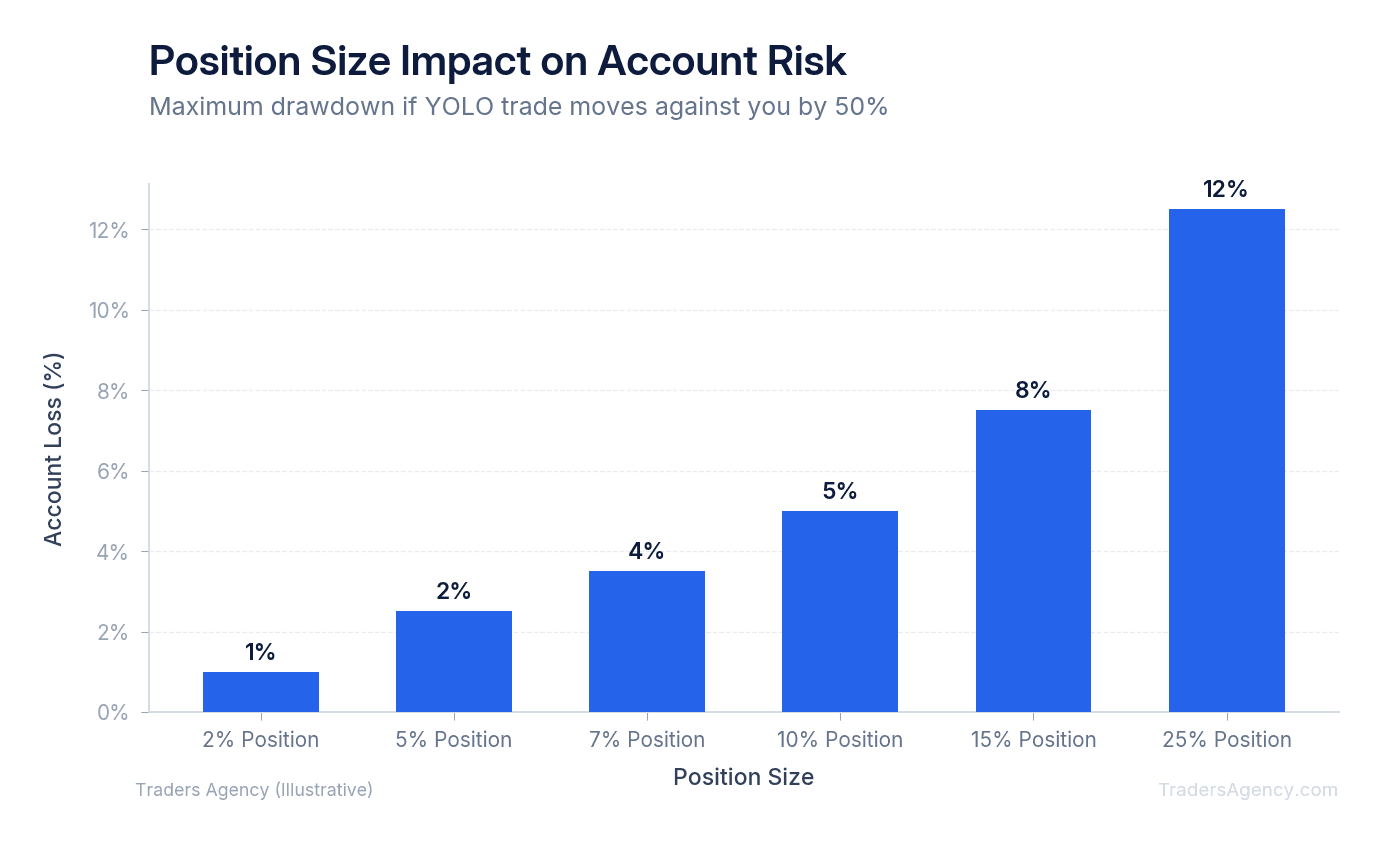
Key Concept: The 3-5-7 rule is a portfolio allocation framework that limits maximum capital exposure based on trade conviction. Traders allocate 3% of their account to standard setups, 5% to high-probability trades, and a maximum of 7% to aggressive, high-conviction speculative plays.
We prefer to use this framework to keep our accounts safe during volatile market conditions. When you're looking for the best risk management for trading, position sizing is your primary defense. A true YOLO trade might tempt you to risk half of your capital on one stock. We strongly advise against this.
If you limit your absolute maximum risk to 7% of your total portfolio, you ensure that a total loss on a single trade will not end your trading career. Here's the math on a $100,000 account:
| Parameter | Value |
|---|---|
| Account Size | $100,000 |
| Maximum YOLO Risk (7%) | $7,000 |
| Remaining Capital After Total Loss | $93,000 |
| Account Survival Status | Still trading the next day |
This mathematical boundary is non-negotiable for long-term survival.
What Is the Difference Between Options Risk and Stock Risk in YOLO Trades?
Buying thousands of shares of a volatile stock exposes you to massive downside gaps. If a company announces a secondary offering overnight, the stock might open 40% lower the next morning. Stop losses cannot protect you from overnight price gaps.
This is why our team prefers defined-risk options strategies for aggressive directional bets. Instead of buying 1,000 shares of a $50 stock (risking $50,000), you can use options to cap your maximum loss. A long call option or a vertical debit spread defines your exact risk at the moment of entry.
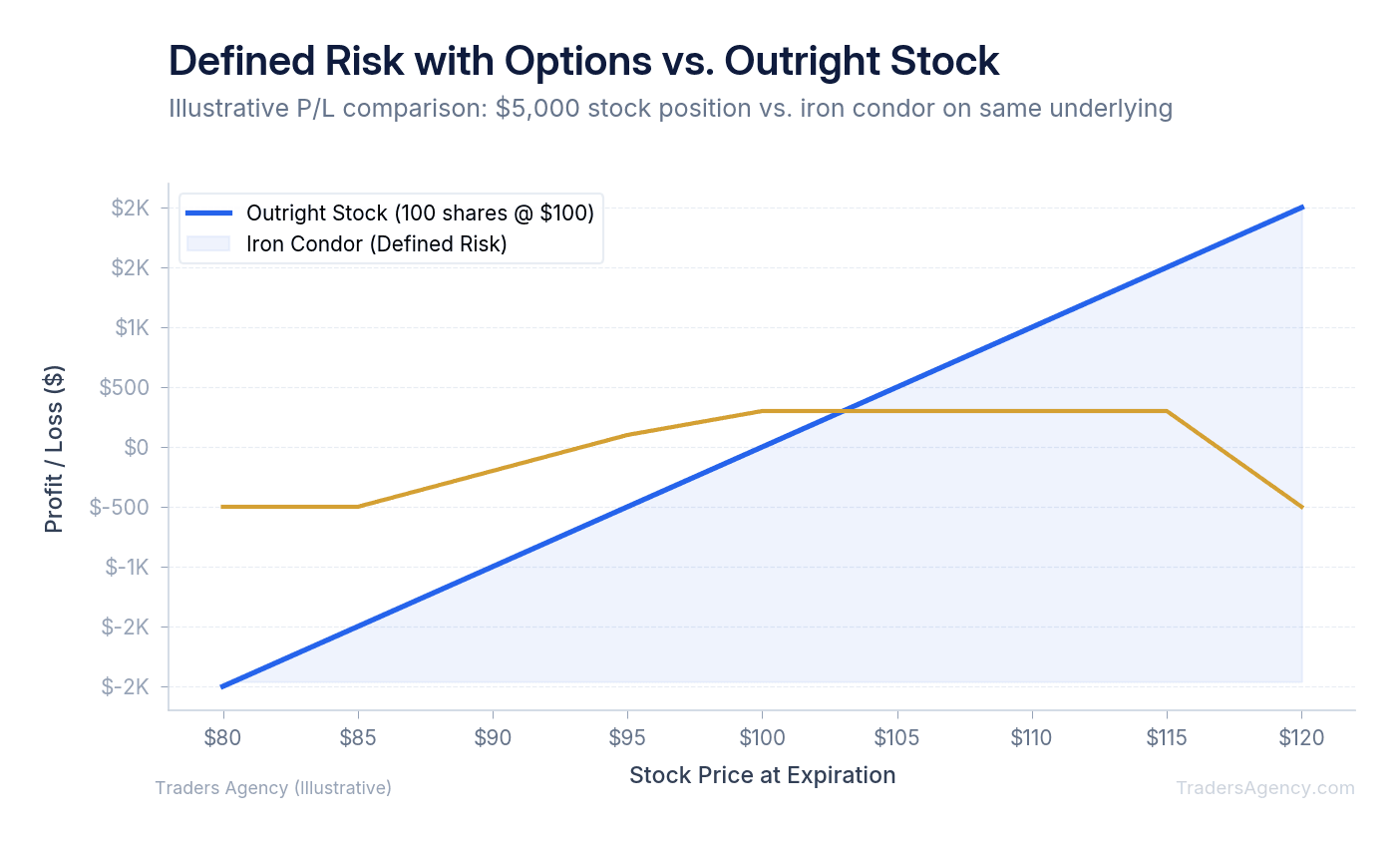
Here's a specific example using options. Assume ticker XYZ is trading at $100. You expect a massive breakout.
| Approach | Capital at Risk | Loss if XYZ Drops to $50 |
|---|---|---|
| Buy 100 shares at $100 | $10,000 | -$5,000 |
| Buy $105 strike call at $3.00 premium | $300 | -$300 (premium only) |
Your total cost and maximum risk on the options trade is exactly $300. If XYZ crashes to $50, the stock buyer loses $5,000. You only lose your $300 premium.
This structural advantage is the core of any effective YOLO trades risk management strategy. You gain exposure to the upside while mathematically capping your downside risk. We teach our members to always know their maximum loss before the market opens.
Want expert trading insights delivered daily?
Join thousands of traders who rely on Traders Agency for market analysis and trade ideas.
Join Traders AgencyHow Do You Manage Risk on a YOLO Trade Without Killing the Upside?
We often see traders jump into aggressive positions without a plan. If you want to know how to mitigate risks in YOLO trading, you need a repeatable process. Here is the exact sequence we teach our members to follow.
- Identify the Setup and Event. You need a specific reason for the trade. This could be a pending FDA approval, a major earnings report, or a documented short interest above 20%. Do not trade purely on emotion or social media hype. Write down the exact market event and the date it occurs.
- Structure the Trade for Defined Risk. Choose an instrument that caps your downside. As we discussed, we prefer debit spreads or long options over outright stock. If you buy a call debit spread, you buy a lower strike call and sell a higher strike call. This reduces your upfront cost and defines your maximum potential loss before you even click the buy button.
- Calculate Your Position Size. Apply the 3-5-7 rule to your current account balance. If your account is $50,000, your maximum risk for a YOLO trade is $3,500. If your chosen options strategy costs $500 per contract, you can buy a maximum of 7 contracts. Never round up or break this rule.
- Establish Firm Exit Criteria. You must know your exit point before you enter. Set a specific profit target based on technical resistance levels. If your option premium doubles from $2.00 to $4.00, sell half the position to cover your initial cost. Let the remaining contracts run with zero original capital at risk.
Watch Out: Never enter an aggressive trade without writing down your exit plan first. If you don't have a profit target and a maximum loss threshold defined before you click "buy," you are gambling, not trading.
How Do You Set Stop Losses on Speculative Plays?
Setting stop losses on speculative plays requires placing orders at technical support levels rather than arbitrary percentages. You must identify the price point where your original trade thesis is proven wrong, place your stop just below that level, and size your position accordingly.
Volatile stocks will easily trigger tight stop losses during normal intraday swings. If you set a generic 5% stop loss on a stock that routinely moves 10% a day, you will get stopped out before the real move happens. You have to give the trade room to breathe.
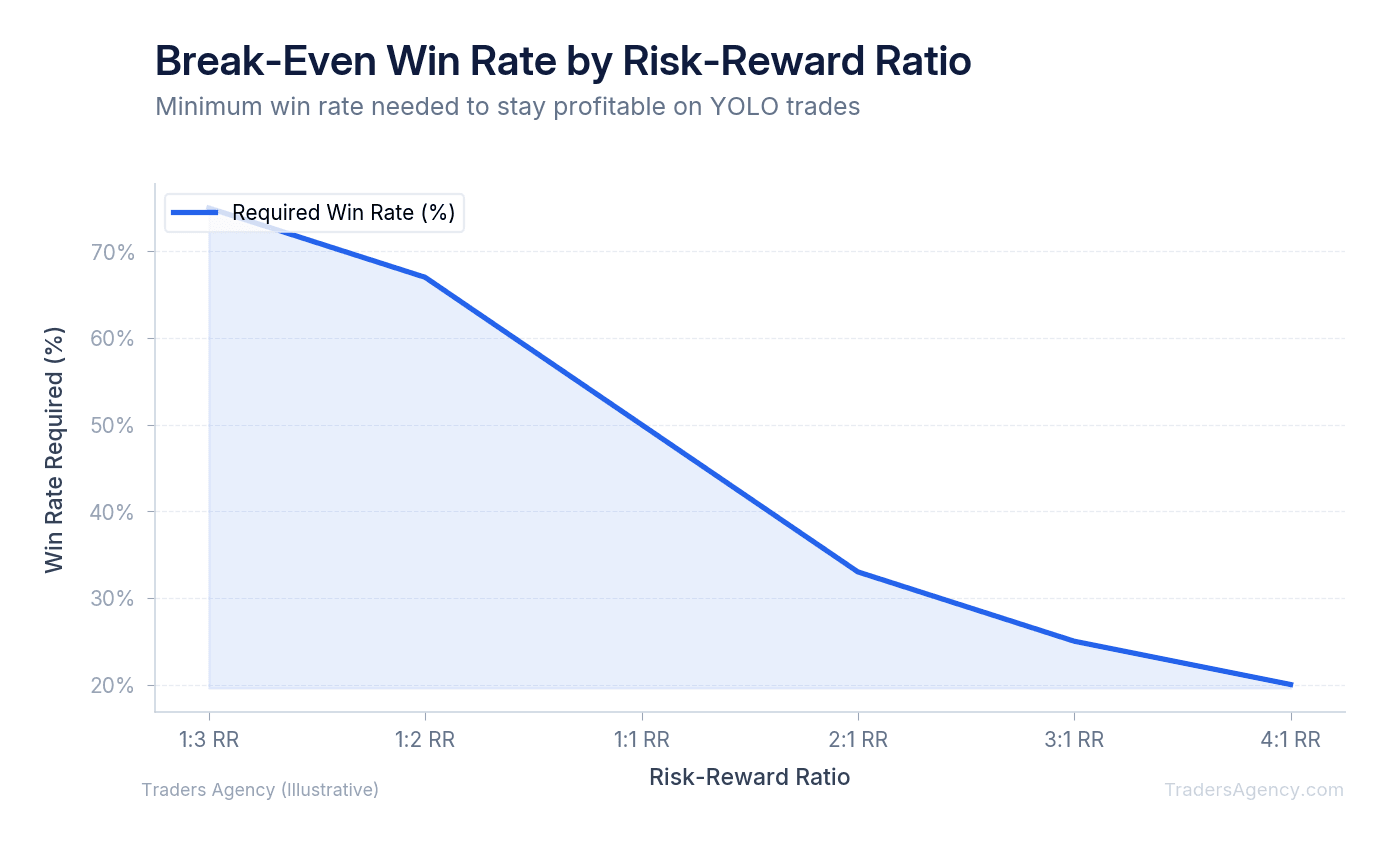
We recommend sizing down your position so you can afford a wider stop. Here's the math:
| Parameter | Value |
|---|---|
| Entry Price | $20.00 |
| Nearest Major Support | $16.00 |
| Risk Per Share | $4.00 |
| Maximum Allowed Loss | $400 |
| Maximum Position Size | 100 shares |
This mathematical approach removes emotion from the equation. You are trading the chart, not your feelings about your account balance.
For options trades, stop losses can be tricky due to rapid premium decay. We often treat the entire premium paid as our stop loss. If we spend $500 on a speculative call option, we accept that the $500 might go to zero. This is why strict position sizing is your ultimate safety net.
Why Do Most YOLO Trade Success Stories Leave Out the Losses?
Social media platforms are highlight reels for traders. When you browse a YOLO trades thread online, you are only seeing the massive winners. Traders rarely post screenshots of the trades that wiped out their savings or triggered margin calls.
This phenomenon is known as survivorship bias, and it creates a highly dangerous false sense of probability. You might see ten posts showing 500% gains and assume those results are common. The reality is that for every massive winner posted online, there are hundreds of silent losers.
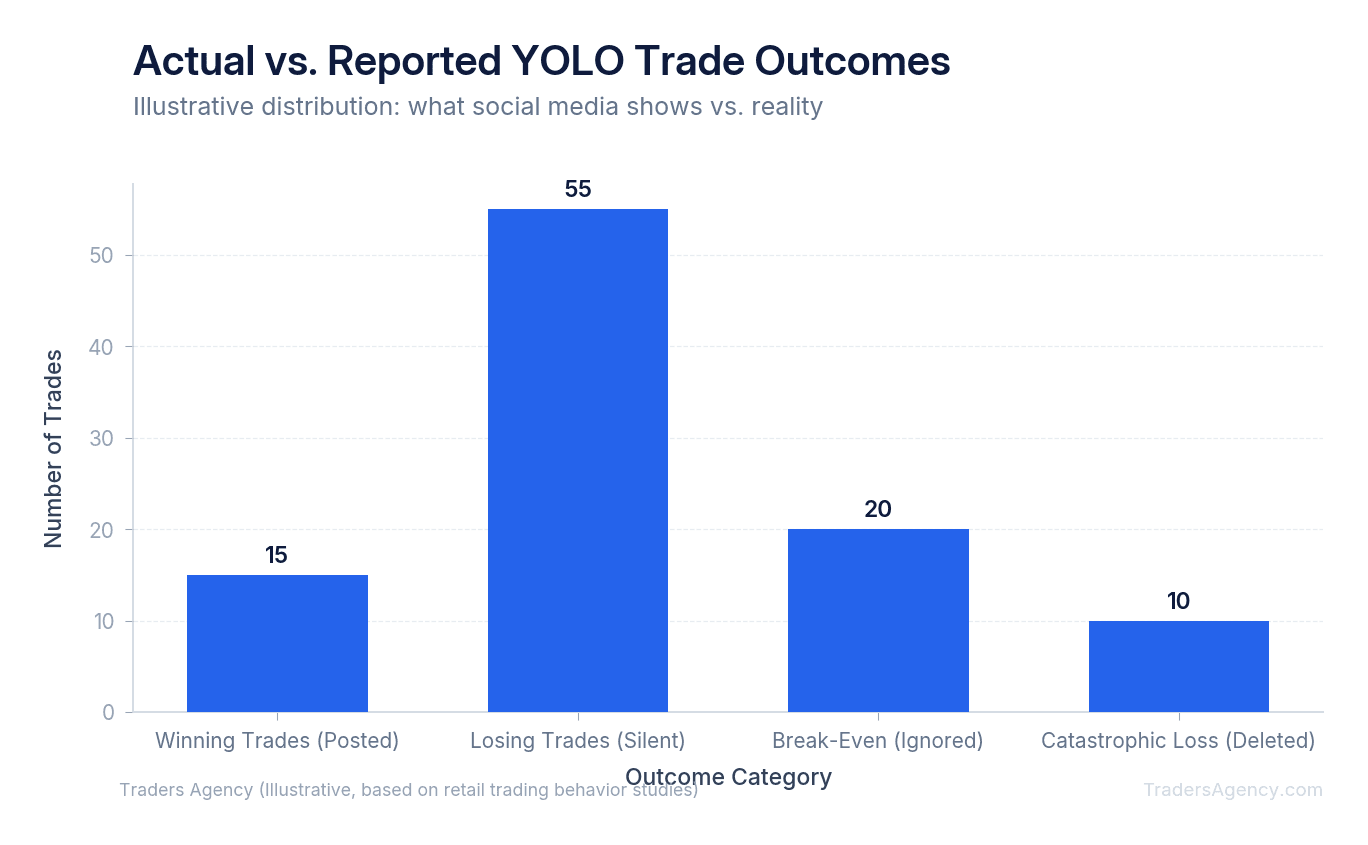
The Chicago Board Options Exchange (Cboe) provides extensive data on options expiration. A large percentage of out-of-the-money options expire worthless. You must base your YOLO trades risk management strategy on statistical reality, not internet folklore.
Do not let screenshots of other people's profits dictate your risk tolerance. Your only job is to protect your own capital. If you follow the math, respect your stop losses, and use defined-risk instruments, you can participate in aggressive market moves safely.
Risk Warning: Consistency keeps you in the game. A single massive win feels great, but a single massive loss can end your trading journey entirely. Trade defensively, size your positions correctly, and never risk capital you cannot afford to lose.
Want expert trading insights delivered daily?
Join thousands of traders who rely on Traders Agency for market analysis and trade ideas.
Join Traders AgencyKey Takeaways
- Define your maximum acceptable loss before entering any YOLO trade, not after the position moves against you.
- Options carry mathematically different risk than outright stock positions: a contract can expire worthless and go to zero, while a stock position rarely does the same overnight.
- Scaling out of volatile positions in stages protects realized gains without requiring a perfect exit call.
- Survivorship bias distorts how YOLO trades appear on social media. Screenshots show the wins, not the account-ending losses that outnumber them.
- Defined-risk instruments like options spreads let aggressive traders participate in large moves while capping the worst-case loss to a known dollar amount.
DISCLAIMER: Traders Agency does not offer financial advice. The information provided is for educational purposes only and should not be considered financial advice. Traders Agency is not responsible for any financial losses or consequences resulting from the use of the information provided. Trading carries inherent risks and may not be suitable for all individuals. You are advised to conduct your own research and seek personalized advice before making any investment decisions, recognizing the potential risks and rewards involved.
See more from Traders Agency on Google
Make us a preferred source and our market analysis will appear more prominently in your Google Search, Top Stories, and AI results.
Add to Preferred Sources