
Enterprise value vs market cap comes down to one question: how much would it actually cost to buy an entire company? Market cap only tells you the price of the stock itself. Enterprise value adds in debt and subtracts cash, giving you the real acquisition price a buyer would pay. By the end of this guide, you'll know how to calculate both figures, where to pull the numbers from, and when relying on market cap alone could lead you straight into a bad decision.
What Is Enterprise Value?
Bottom Line: Enterprise value vs market cap matters most when comparing companies with different debt and cash levels, since two firms with identical market caps can carry very different real-world price tags. Checking both figures, pulled from actual filings rather than headline numbers, keeps you from underestimating the true cost or risk of a company.
Enterprise value (EV) is the total value of a company, including its debt, minus its cash. Think of it as the price tag for buying the whole business, not just the shares that trade on an exchange.
Here's why that matters. If you bought every outstanding share of a company, you wouldn't just own the stock. You'd also inherit all of its debt, and you'd gain access to all of its cash sitting in the bank.
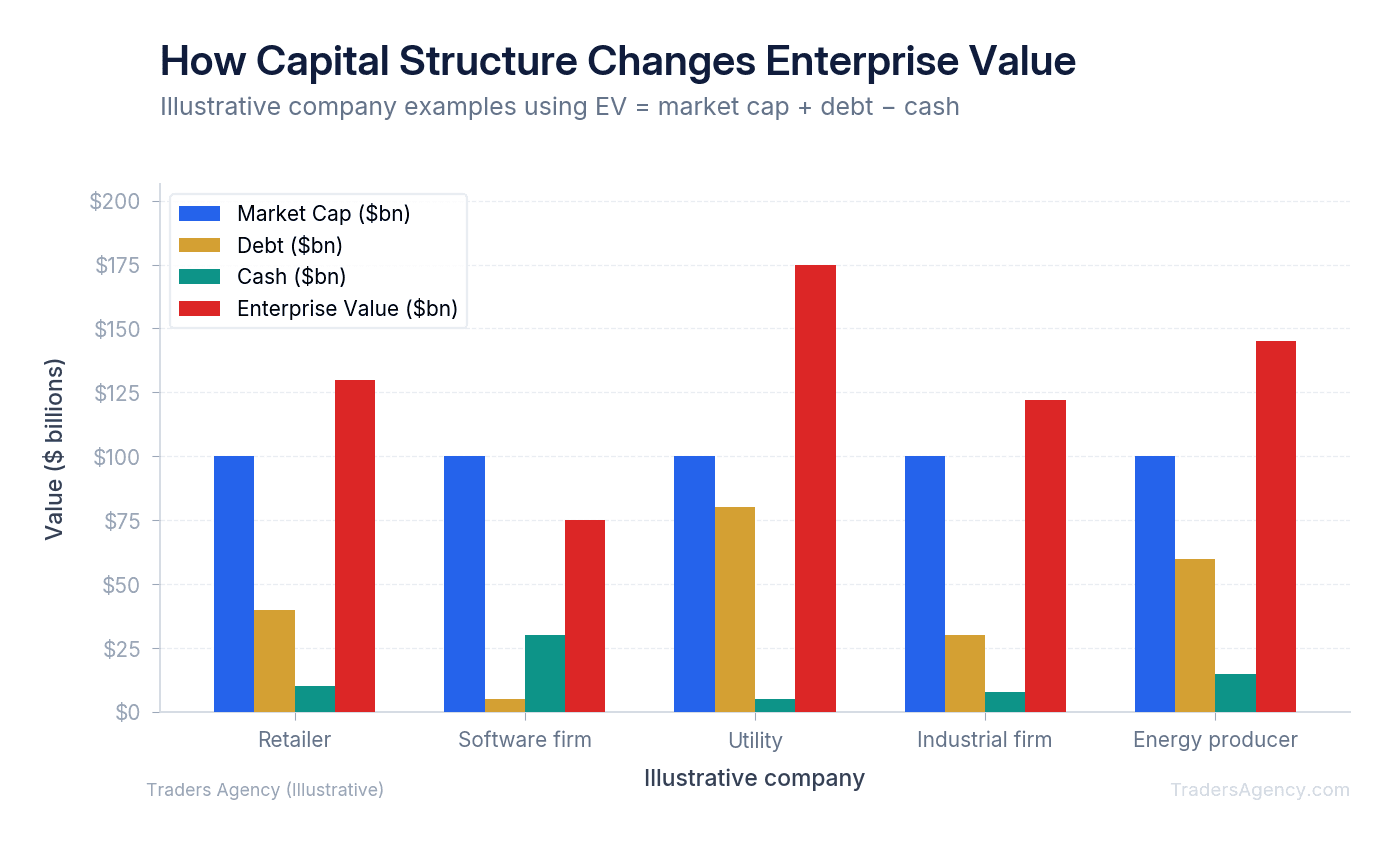
A company with $10 billion in market cap but $4 billion in debt is a far bigger financial commitment than a company with the same market cap and no debt at all. Enterprise value captures that difference. Market cap does not.
Key Concept: Market cap is the price of the equity. Enterprise value is the price of the entire business, equity plus debt, minus the cash a buyer would inherit.
How Do You Calculate Enterprise Value?
The enterprise value formula is simple once you know where to find the inputs:
Enterprise Value = Market Cap + Total Debt − Cash and Cash Equivalents
Here's the step-by-step process we teach our members:
- Step 1: Find Market Cap – Multiply the current share price by total shares outstanding. Most financial websites and broker platforms display this number directly, so you rarely need to calculate it by hand.
- Step 2: Find Total Debt – Add short-term debt and long-term debt together. You'll find both line items on the balance sheet inside a company's 10-K (annual report) or 10-Q (quarterly report), both filed with the SEC and available free on the SEC's EDGAR database.
- Step 3: Find Cash and Cash Equivalents – Look for "cash and cash equivalents" near the top of the balance sheet, in the current assets section. Some analysts also fold short-term investments into this figure.
- Step 4: Do the Math – Add debt to market cap, then subtract cash. That's your enterprise value.
A Worked Example
Say Company A reports the following on its most recent filing:
| Input | Value |
|---|---|
| Market Cap | $50 billion |
| Total Debt (short-term + long-term) | $15 billion |
| Cash and Cash Equivalents | $8 billion |
| Enterprise Value | $57 billion ($50B + $15B − $8B) |
That $57 billion, not the $50 billion market cap, is the number a buyer would actually need to account for in a full acquisition.
If you'd rather not run the math manually every time, most stock screeners and financial data sites include an enterprise value vs market cap calculator feature that pulls balance sheet figures automatically and displays both numbers side by side.
Enterprise Value vs Market Cap: What's the Difference?
Market cap measures only the value of a company's equity, the shares owned by stockholders. Enterprise value measures the value of the entire business, including the claims of both stockholders and lenders. That's the core difference behind enterprise value vs market cap.
This is also where enterprise value vs equity value tends to confuse newer traders, so let's clear it up. Market cap and equity value are essentially the same thing: the value of ownership claims on the company. Enterprise value sits one level above that, because it adds the claims debt holders have on the business too.
Put together, enterprise value vs market cap vs equity value looks like this:
- Equity value (market cap): what stockholders own
- Enterprise value: what stockholders own, plus what lenders are owed, minus cash on hand
- The gap between them: driven almost entirely by a company's debt and cash position
Why is cash subtracted from enterprise value? Because cash reduces the real cost of buying a company. A buyer who acquires a business with $8 billion sitting in the bank can put that cash to work the moment the deal closes, effectively lowering their net cost. That's why cash is treated as a negative in the formula.
Want expert trading insights delivered daily?
Join thousands of traders who rely on Traders Agency for market analysis and trade ideas.
Join Traders AgencyWhen Should You Use Enterprise Value Instead of Market Cap?
Use enterprise value any time debt or cash levels differ significantly between the companies you're comparing. This matters most across industries, or when a company has taken on heavy borrowing to fund growth and acquisitions.
Enterprise value less than market cap happens when a company holds more cash than debt. That's common among cash-rich technology companies, where large reserves push EV below the market cap figure. In this scenario, market cap actually overstates the real cost of buying the company.
The opposite is just as common. Highly leveraged companies in capital-intensive sectors like utilities, airlines, or telecom often carry enterprise values well above market cap, because their debt loads are large relative to the cash on hand.
This is also why EV/EBITDA is often preferred over the P/E ratio when comparing leveraged companies. P/E only looks at earnings relative to equity value, ignoring debt entirely. EV/EBITDA accounts for the full capital structure, making it a fairer way to compare a heavily indebted company against a debt-free one.
What Is a Good Enterprise Value?
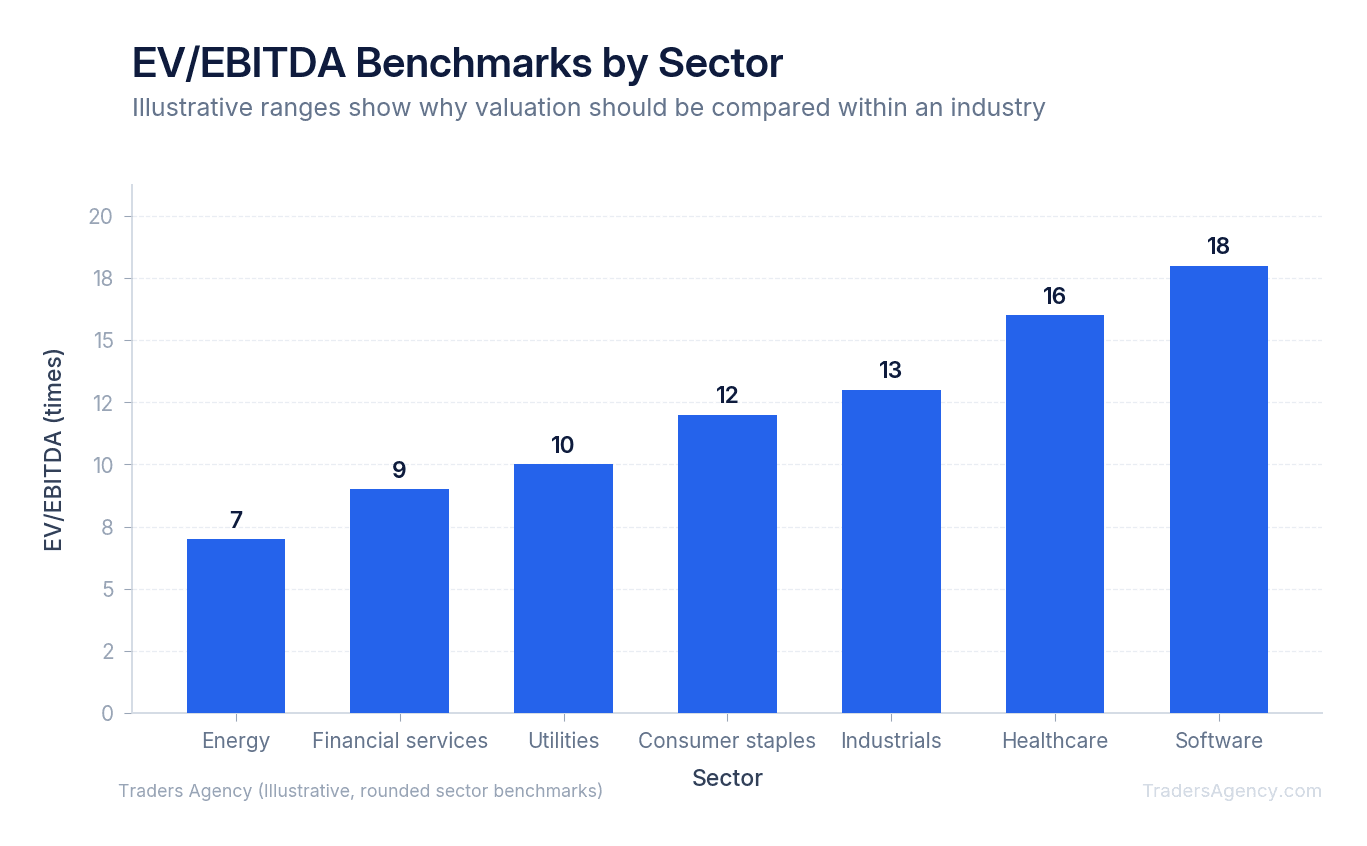
There's no single "good" enterprise value in dollar terms, since it depends entirely on company size. What matters far more is the EV/EBITDA multiple, which lets you compare companies of different sizes on equal footing.
As a rough guide we share with our members: software and technology companies often trade at higher EV/EBITDA multiples, sometimes in the 15 to 18 times range, reflecting expected growth. Energy and industrial companies tend to trade lower, often closer to 7 to 9 times, reflecting slower growth and heavier capital needs.
A multiple that looks cheap in one sector can be expensive in another, so always compare within the same industry rather than across unrelated ones.
Is Enterprise Value the Same as Market Cap?
No, enterprise value is not the same as market cap. Market cap reflects only the value of a company's shares, while enterprise value adds debt and subtracts cash to reflect the true cost of owning the entire business.
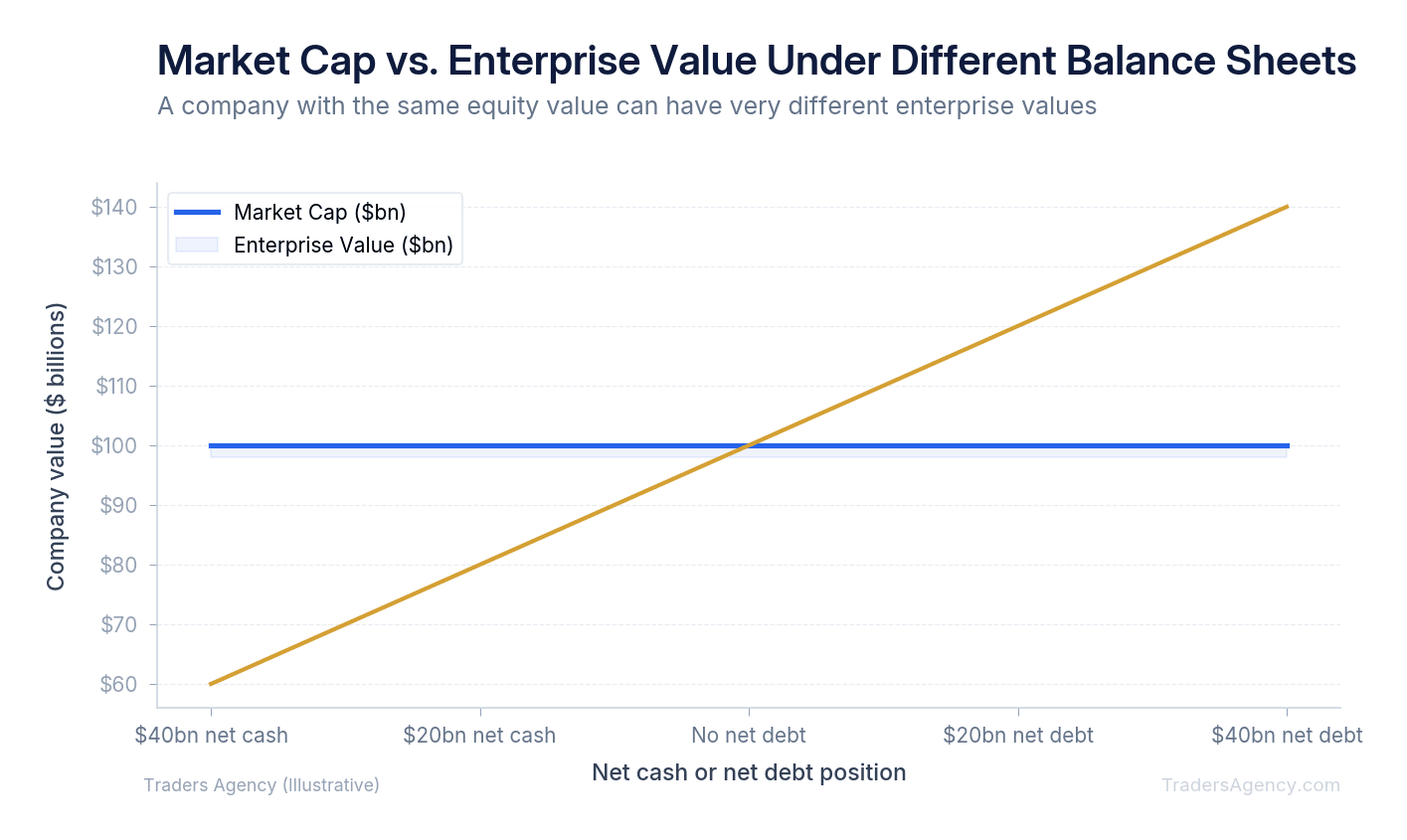
The two numbers are identical only when debt and cash offset each other exactly, which includes the rare case of a company with zero debt and zero cash. That balance almost never holds for a business of any real size. For most companies, expect a visible gap between the two.
When Does Enterprise Value Change the Decision?
Here's a scenario where relying on market cap alone would mislead you. Company B and Company C both carry a market cap of $20 billion.
| Metric | Company B | Company C |
|---|---|---|
| Market Cap | $20 billion | $20 billion |
| Total Debt | $1 billion | $9 billion |
| Cash | $6 billion | $500 million |
| Enterprise Value | $15 billion | $28.5 billion |
Even though both companies look identical by market cap, Company C is a far more expensive and far more leveraged business once you account for enterprise value. A trader comparing these two on market cap alone would miss that difference completely.
What Are Common Mistakes to Avoid?
When comparing enterprise value vs market cap, watch out for these errors:
- Comparing EV/EBITDA multiples across unrelated sectors instead of within the same industry
- Forgetting to include short-term debt and focusing only on long-term debt
- Using stale balance sheet figures instead of the most recent 10-Q or 10-K
- Ignoring preferred stock or minority interests, which some analysts also add into the EV formula
- Assuming a lower market cap always means a cheaper company, without checking debt levels
Watch Out: Never build a comparison off a single headline market cap figure from a news article. Pull both debt and cash directly from the company's latest SEC filing or a reliable financial data screener before you draw any conclusion.
Once you get in the habit of checking enterprise value alongside market cap, the picture of what a company is actually worth becomes much clearer. Two businesses can wear the same price tag on the surface and represent completely different levels of cost and risk underneath it.
Want expert trading insights delivered daily?
Join thousands of traders who rely on Traders Agency for market analysis and trade ideas.
Join Traders AgencyDISCLAIMER: Traders Agency does not offer financial advice. The information provided is for educational purposes only and should not be considered financial advice. Traders Agency is not responsible for any financial losses or consequences resulting from the use of the information provided. Trading carries inherent risks and may not be suitable for all individuals. You are advised to conduct your own research and seek personalized advice before making any investment decisions, recognizing the potential risks and rewards involved.
See more from Traders Agency on Google
Make us a preferred source and our market analysis will appear more prominently in your Google Search, Top Stories, and AI results.
Add to Preferred Sources