
Ratio spreads and backspreads are built from an unequal number of long and short contracts at different strikes inside the same expiration. A ratio spread sells more options than it buys, which produces a position that profits inside a narrow range but carries open-ended risk beyond it. A backspread flips that ratio, buying more than it sells, which caps risk but demands a bigger directional or volatility move to pay off. We teach these as advanced tools for traders who already have vertical spreads down cold and want tighter control over their Greeks exposure. By the time you finish this guide, you'll know how to structure both sides, read the payoff diagrams, and handle the margin mechanics that trip up most first-timers.
What Is a Ratio Spread?
Bottom Line: Ratio spreads collect extra premium by selling more contracts than they buy, but leave an uncovered short with open-ended risk if price moves too far. Backspreads flip this by buying more than they sell, capping risk but requiring a larger move to profit, so the choice between them depends on matching structure, Greeks, and margin needs to the trader's outlook and risk tolerance.
A ratio spread is an options position where you sell more contracts than you buy, typically in a 2:1 or 3:1 ratio, at different strikes in the same expiration cycle.
That's the core of the structure: you're financing a long option with premium collected from two or more short options, often for a net credit or a very small debit. The extra short premium is where the edge comes from. It's also where the uncapped risk comes from.
Key Concept: A ratio spread sells more options than it buys. You get a credit and a defined profit zone, but at least one short contract sits uncovered beyond the spread, which means the risk on that side is open-ended.
Call Ratio Spread Example
Here's how a call ratio spread would look on a stock trading at $120:
| Parameter | Value |
|---|---|
| Underlying | Stock at $120 |
| Long Leg | Buy 1 call, $120 strike, $5.00 premium |
| Short Leg | Sell 2 calls, $130 strike, $2.50 each |
| Net Cost | Roughly breakeven at entry ($5.00 paid, $5.00 collected) |
| Max Profit | Stock closes exactly at $130 at expiration |
| Breakevens | Near $120 (lower) and around $140 (upper) |
| Max Loss | Theoretically unlimited above the upper breakeven |
Depending on implied volatility skew, that entry may come through as a small credit or a small debit. Either way, the tradeoff is the one every trader needs to internalize before touching this structure: limited reward, undefined risk on one side.
What Is a Backspread?
A backspread is the mirror image. You buy more options than you sell, usually in a 1:2 or 1:3 ratio, again at different strikes in the same expiration.
Where a ratio spread is a "sell premium and cap the upside" trade, a backspread is a "pay a little to own a lot of convexity" trade. You're positioned to benefit from a large move or a volatility spike, and your maximum loss is typically capped and known before you ever click the button.
Call Backspread Example
Using the same underlying at $120:
| Parameter | Value |
|---|---|
| Underlying | Stock at $120 |
| Short Leg | Sell 1 call, $120 strike, $5.00 premium |
| Long Leg | Buy 2 calls, $130 strike, $2.50 each |
| Net Cost | Close to breakeven, sometimes a small net debit |
| Max Loss | Limited, greatest with the stock at $130 at expiration (the long strike) |
| Max Profit | Theoretically unlimited to the upside (two uncapped long calls) |
| Below the Short Strike | Loss capped at the net debit paid, or you keep the credit if entered for one |
That's the essential distinction between the two structures: one caps upside and leaves risk open, the other caps risk and leaves upside open.
What's the Difference Between a Call Ratio Spread and a Put Ratio Spread?
The call version of a ratio spread expresses a neutral to moderately bullish view. It profits most when the stock drifts up toward the short strike without blowing through it. The put version does the same job on the downside.
A put ratio spread might sell two puts at a strike below the current price and buy one put at a higher strike, collecting credit while betting the stock holds above a certain level or declines only moderately. The risk profile mirrors the call version: capped profit near the short strike, with large losses if the stock falls hard through the lower breakeven. On the put side that loss is bounded by the stock reaching zero, so it is very large rather than literally unlimited.
Put backspreads run the same logic in reverse, buying more puts than sold to capture a sharp decline while keeping max loss defined. We choose between call and put versions based on where our directional and volatility assumptions point.
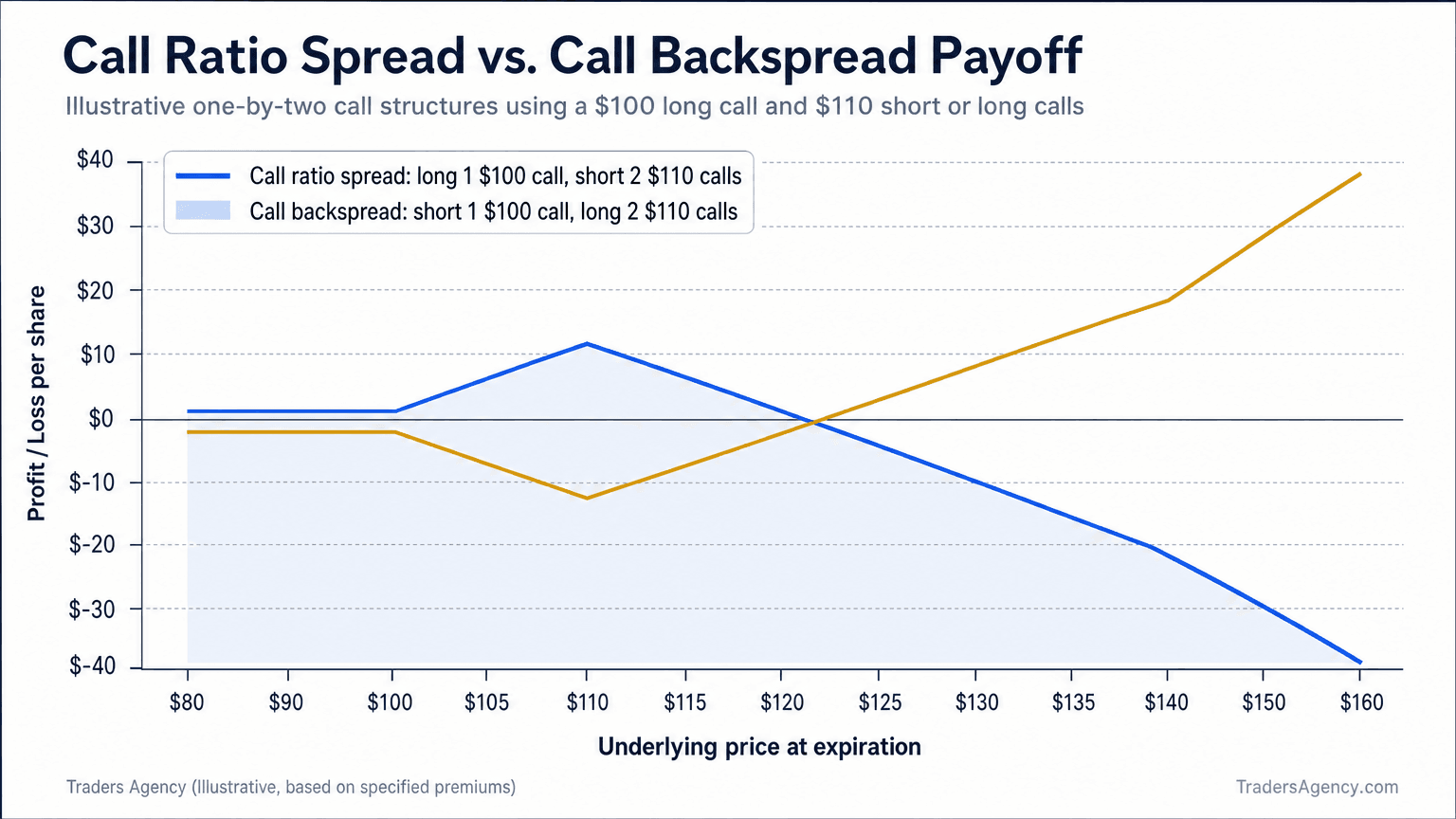
Look at how the ratio spread's payoff line flattens and then drops sharply past the upper breakeven, while the backspread's line stays flat near the strikes and then climbs without limit. That single image captures the entire risk tradeoff between these two structures.
Want expert trading insights delivered daily?
Join thousands of traders who rely on Traders Agency for market analysis and trade ideas.
Join Traders AgencyWhat Is the Directional Assumption for a Ratio Spread?
A ratio spread's directional assumption is neutral to mildly directional. You expect the underlying to move toward the short strike but not blast through it before expiration.
This is why magnitude matters as much as direction here. Getting the size of the move wrong is what generates the losses, not just picking the wrong side. A stock that rallies too hard past your short call strike turns a well-designed credit trade into an open-ended loser in a hurry. Backspreads flip that assumption completely. They want a large move in one direction or a volatility expansion, which is why traders reach for them heading into earnings and other binary events.
Put Ratio Spread vs Put Backspread Comparison
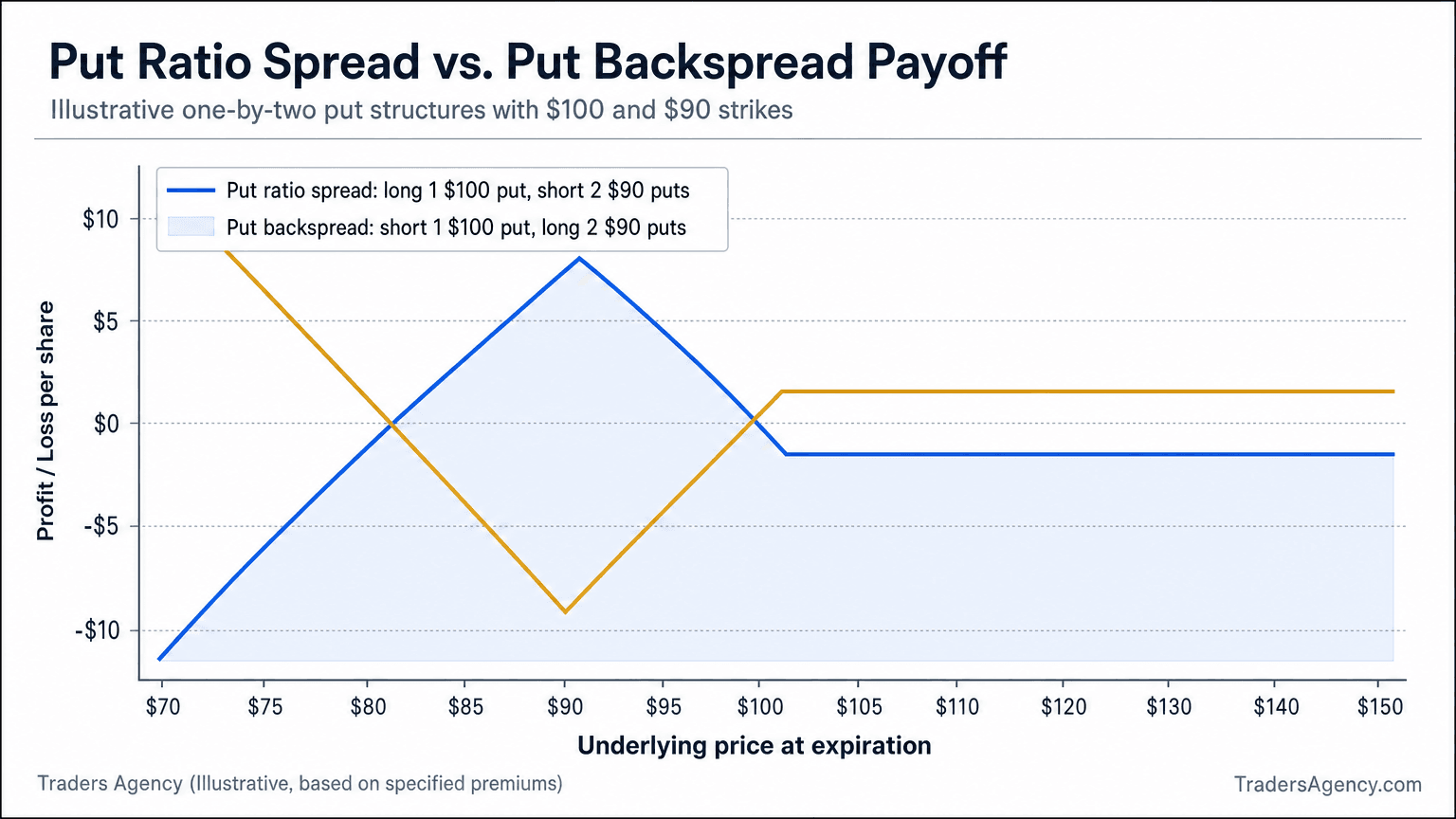
The put ratio spread profits inside a defined band above the lower strike and loses heavily on a sharp decline, bounded only by the stock reaching zero. The put backspread caps loss in that same band and gains sharply on that same decline, with its maximum gain limited by that same zero floor. The exact opposite risk shape.
How Do Ratio Spreads and Backspreads Affect Delta, Theta, and Vega?
Because these are unbalanced positions, the Greeks behave differently than they do in a standard vertical spread, and that difference is the entire reason to build one.
A call ratio spread usually starts with a small positive to roughly flat delta near the current price, but that delta turns clearly negative as the stock rises past the short strikes, since you're now net short more calls than you own. Theta works in your favor inside the profitable zone, because time decay erodes two short options faster than it erodes your single long option. Vega is negative overall, so a volatility spike hurts the position even with no price movement at all.
A call backspread runs the opposite exposure: negative theta in the flat zone near the strikes, since you're paying for two long options that decay against you while the stock sits still, but positive vega, so rising implied volatility helps you before the stock moves an inch.
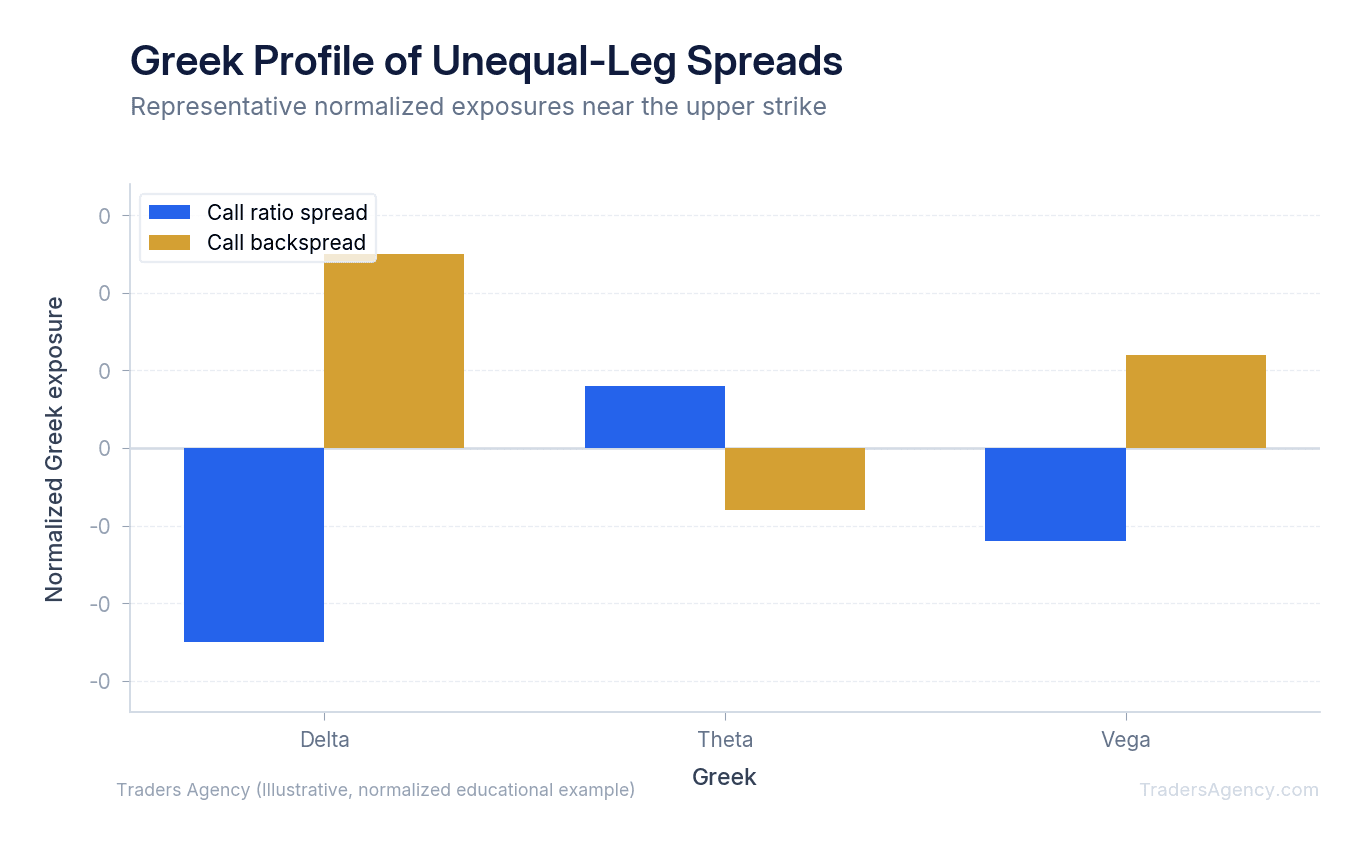
Remember This: Ratio spreads sell volatility and collect theta. Backspreads buy volatility and pay theta. Choosing between them often comes down to your read on implied volatility relative to where it's headed, not just your read on price direction.
What Are the Margin Implications of Ratio Spreads and Backspreads?
The unequal-leg structure creates margin requirements that catch a lot of traders off guard, especially anyone coming from balanced vertical spreads.
Because a ratio spread leaves one or more short options uncovered past the defined range, most brokers require margin as if you were holding a naked short option on the excess contracts. That requirement can be substantial, and it varies by broker, by underlying volatility, and by whether your account is even approved for uncovered options trading. A backspread usually requires far less margin, since the long options you own on the excess side reduce risk rather than add to it. Many brokers only require the debit paid or a modest defined-risk amount. Contract specifications and margin conventions for listed options are published by the exchanges, and we recommend checking the current details at Cboe before structuring anything unfamiliar.
Step-by-Step: How We Approach These Trades
- Step 1: Read the Volatility Environment. Check where implied volatility sits relative to its own history. High IV with an expected contraction favors the ratio spread. Low IV with an expected expansion favors the backspread.
- Step 2: Define the Move You Expect. Write down both the direction and the magnitude. A ratio spread needs a drift toward the short strike. A backspread needs a move well past it.
- Step 3: Select Strikes and Ratio. Place the short strike where you believe price stalls, then choose a 2:1 or 3:1 ratio that brings the net cost close to zero without stacking more naked exposure than you can carry.
- Step 4: Confirm Margin and Approval Level. Pull the actual margin number from your broker before entry, not after. Uncovered legs can require multiples of what a vertical spread ties up.
- Step 5: Stress-Test the Payoff. Calculate profit and loss at several prices above and below your breakevens, and at several points in time, not just at expiration.
- Step 6: Set Exits Before You Enter. Decide your profit target near the short strike and your hard exit level on the underlying, then trade the plan.
Risk Management Guidelines We Follow
- Size uncapped-risk trades small. Never let a ratio spread's naked exposure represent more than a small slice of total account risk.
- Set a hard stop on the underlying's price, not just the option's price. Gap risk on ratio spreads outruns mental stops.
- Favor backspreads when implied volatility is historically low, because you're buying convexity cheaply.
- Favor ratio spreads when implied volatility is historically high and you expect compression, because you're selling inflated premium.
- Always know your exact max loss before entry. For ratio spreads, turn "unlimited" into a real number by pricing the loss at several stress-test levels.
Watch Out: The short side of a ratio spread carries open-ended loss potential. A single fast move through your short strikes can erase many months of collected credits. Treat position sizing and a firm exit level on the underlying as non-negotiable parts of the trade, not optional extras.
Quick Reference: Ratio Spread and Backspread Definitions
| Feature | Ratio Spread | Backspread |
|---|---|---|
| Structure | Sell more than you buy | Buy more than you sell |
| Strikes / Expiration | Different strikes, same expiration | Different strikes, same expiration |
| Entry Cost | Net credit or small debit | Net debit or small credit |
| Profit | Capped near the short strike | Uncapped on a large move |
| Risk | Uncapped or large defined risk | Capped and known at entry |
| Theta | Positive in the profit zone | Negative near the strikes |
| Vega | Negative (short volatility) | Positive (long volatility) |
| Ideal Environment | Elevated IV, range-bound expectation | Low IV, expectation of a large move |
Both structures sit among the more advanced multi-leg strategies, and the margin and Greek behavior above is exactly why. Our team recommends running the payoff math on paper, or in a simulated account, before you put real capital behind either one. The uncapped side of a ratio spread is unforgiving to anyone who hasn't stress-tested it first.
Want expert trading insights delivered daily?
Join thousands of traders who rely on Traders Agency for market analysis and trade ideas.
Join Traders AgencyDISCLAIMER: Traders Agency does not offer financial advice. The information provided is for educational purposes only and should not be considered financial advice. Traders Agency is not responsible for any financial losses or consequences resulting from the use of the information provided. Trading carries inherent risks and may not be suitable for all individuals. You are advised to conduct your own research and seek personalized advice before making any investment decisions, recognizing the potential risks and rewards involved.
See more from Traders Agency on Google
Make us a preferred source and our market analysis will appear more prominently in your Google Search, Top Stories, and AI results.
Add to Preferred Sources