
A gap trading strategy is a method of trading price openings that occur above or below the prior session's close, using the size, type, and volume behind that gap to forecast whether price will continue in that direction or reverse to fill the void. Gaps form when overnight news, earnings, or an order flow imbalance pushes the opening print away from where the previous session ended. For advanced traders, gap trading is less about spotting a gap and more about correctly classifying it and reacting with the right structure and risk framework.
You've probably watched a stock gap up 6% on an earnings beat, only to spend the entire session grinding back down to unchanged. You've also probably watched the opposite: a gap that just keeps running, where every attempt to fade it gets steamrolled. The difference between those two outcomes isn't random, and we're going to show you how to read it.
By the end of this guide, you'll know how to classify the four major gap types, apply gap-fill probability logic to your entries, build a pre-market volume confirmation workflow, and structure a multi-leg risk framework for trading gaps at size. We wrote this for traders who already understand order flow, volume profile, and basic options mechanics, so we'll move quickly and go deep.
What Is Gap Trading?
Bottom Line: A gap trading strategy works only when traders classify the gap type first and confirm it with pre-market volume before deciding whether to fade it or ride the continuation. Treating every gap the same way, or entering without a volume-confirmed structure and multi-leg risk plan, is what separates the traders who get steamrolled from those who read the move correctly.
Gap trading is the practice of entering positions based on the price discontinuity between one session's close and the next session's open, then trading either the continuation of that move or its reversal back toward the prior price. It works because gaps represent a sudden repricing of information, and markets need time to fully absorb that repricing.
The mechanics look simple on the surface. A stock closes at $50.00. Overnight news drops. The stock opens the next session at $53.50. That $3.50 difference is the gap. What happens next, whether price runs to $58 or slides back to $50.20, depends entirely on the type of gap, the volume behind the open, and where that gap sits relative to the stock's broader structure.
We teach traders to treat gaps the way institutional desks do: as information events, not just price events. A gap tells you that new information has entered the market faster than liquidity can process it, and the first 30 to 90 minutes of trading is essentially price discovery happening in real time. That's the window most gap traders operate in, and it's also the window where the majority of retail mistakes happen.
Key Concept: A gap is a liquidity failure, not a price prediction. The opening print tells you information arrived faster than the market could absorb it. Your job is to classify what kind of information it was before you take a side.
What Are the Different Types of Gaps in Trading?
There are four primary types of gaps in trading: common, breakaway, runaway (also called measuring gaps), and exhaustion gaps. Each one signals a different stage of a trend and carries a different probability of filling.
1. Common Gaps
These occur with no major news driver, usually inside an established trading range, and tend to fill quickly, often within the same session. They're low-conviction and mostly ignorable for directional trades, though we do find them useful as range-boundary confirmation.
2. Breakaway Gaps
A breakaway gap occurs at the end of a consolidation pattern and marks the start of a new trend, typically on a volume surge well above the stock's average. This is the gap type we care about most, because it often precedes sustained directional moves.
3. Runaway (Measuring) Gaps
These appear mid-trend, not at the start or end, and signal that a trend has enough momentum to accelerate rather than stall. We use the distance from the trend's origin to the runaway gap to project a rough measured move target.
4. Exhaustion Gaps
An exhaustion gap shows up near the end of an extended trend, often on a final volume spike, and frequently reverses hard within one to three sessions. These are the gaps most likely to trap late continuation buyers.
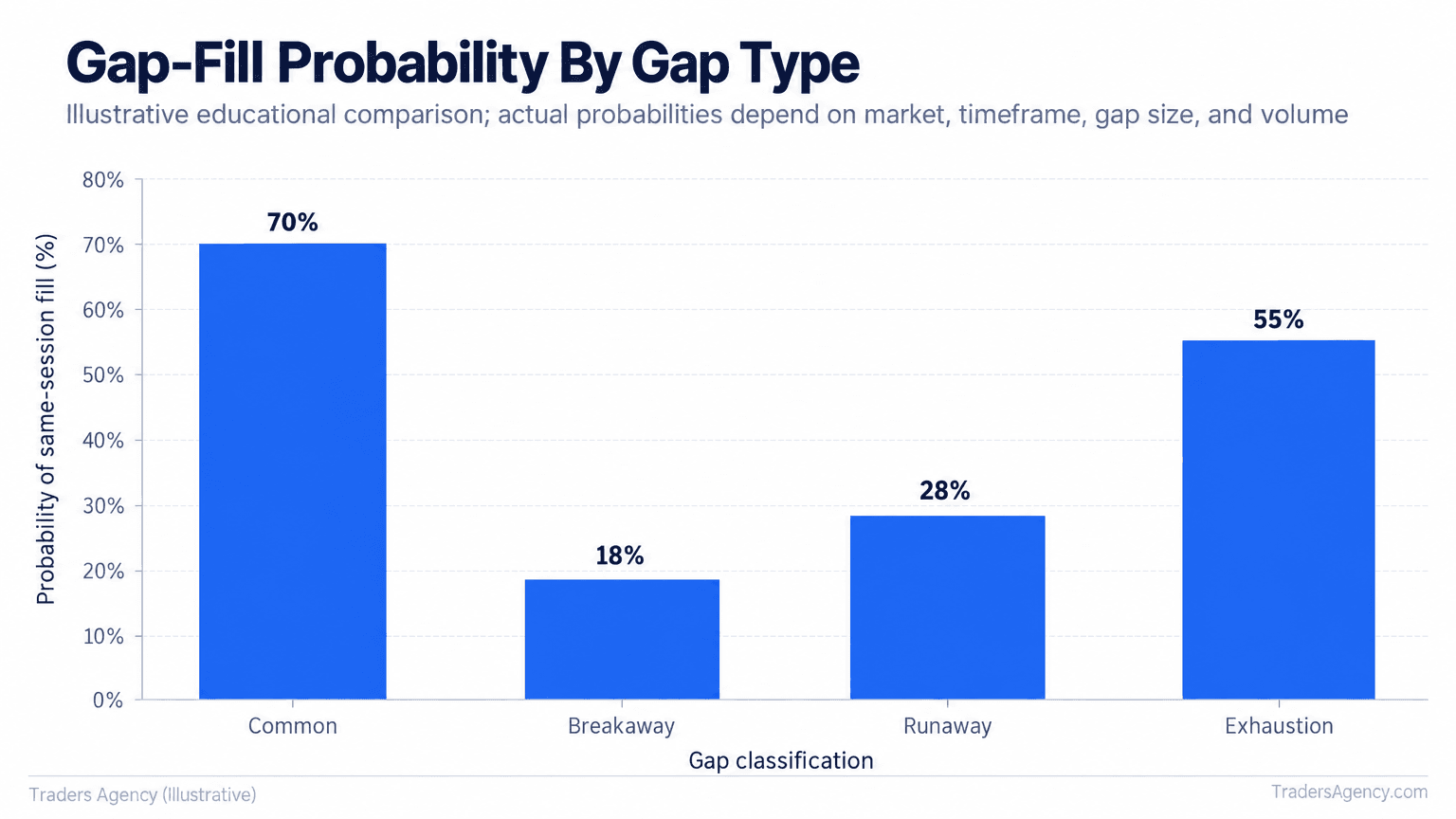
What Is the Gap Fill Probability for Each Gap Type?
What is a gap fill in trading? A gap fill occurs when price retraces back to the level where the prior session closed, effectively closing the price void left by the opening move. Gap fills matter because they give you a specific, measurable price target to plan entries and exits around.
Here's how we rank fill tendency across the four types:
| Gap Type | Typical Fill Behavior | Preferred Setup |
|---|---|---|
| Common | Fills at the highest rate, often same session | Fade toward prior close |
| Breakaway | Fills far less often; backed by real volume and fresh positioning | Gap and go continuation |
| Runaway | Rarely fills during the active trend phase | Continuation with measured move target |
| Exhaustion | May not fill immediately, but often round-trips within a few sessions | Fade after confirmation of failure |
Common gaps fill most often because they lack the informational weight to sustain a directional move. Breakaway gaps hold because they mark genuine structural shifts. Runaway gaps rarely fill during the trend, since filling them would contradict the very momentum that created them. Exhaustion gaps sit in between: they hang on briefly, then give it all back once the trend loses steam.
The chart above is illustrative, not a statistical guarantee. Use it as a probability-weighting framework, not a certainty. This is exactly the nuance that separates the best gap trading strategy from the generic "buy the gap" advice repeated across gap trading strategy PDF downloads and forum threads without any backtesting behind it.
Want expert trading insights delivered daily?
Join thousands of traders who rely on Traders Agency for market analysis and trade ideas.
Join Traders AgencyFade the Gap vs Gap and Go: Which Setup Wins?
Fading the gap means shorting a gap-up (or buying a gap-down) on the expectation of a reversal toward the prior close. Gap-and-go means entering in the direction of the gap on the expectation of continuation. Neither setup wins universally. The correct choice depends entirely on gap type, volume, and where the gap sits within the broader trend structure.
Setup A: Gap and Go Example
XYZ closes at $40.00 and gaps up to $43.20 pre-market on a guidance raise, with pre-market volume already running at 4x the 20-day average by 9:00 AM. That's a breakaway gap profile: fresh driver, heavy volume, and a clean break above a multi-week consolidation range between $37 and $40.
- Step 1: Classify the gap. Confirm the volume surge, verify the news quality, and mark the consolidation range being broken.
- Step 2: Wait for structure. Let the first 5-minute candle close above the pre-market high before touching the position.
- Step 3: Enter long with a stop placed just under the opening print, roughly $42.60.
- Step 4: Set the target using the $3.00 height of the prior consolidation range ($37 to $40) projected off the $43.20 opening print, since price gapped clean through the $40 breakout level. That puts the target near $46.20.
- Step 5: Manage the runner. Trail the stop behind each higher opening-range retest instead of exiting all at once.
| Scenario | What Happens | Result |
|---|---|---|
| Best Case | Volume stays elevated, gap never fills | Price runs to $46.20+ in one to two sessions |
| Most Likely | Midday chop, partial retest of the opening range | Continuation into the close |
| Worst Case | Bull trap on light real volume behind the pre-market print | Stopped out under $42.60, roughly 1.5% against the entry price |
Setup B: Fade the Gap Example
Now take ABC, which closes at $25.00 and gaps up to $27.10 on unconfirmed rumor-driven news with pre-market volume barely above average. There's no consolidation breakout and no measured move structure, just a headline-driven pop. This profile reads as a common gap or, if ABC has already run hard into the print, an exhaustion gap.
- Step 1: Wait for the open. Do not pre-position a fade in the pre-market session.
- Step 2: Confirm failure. The first 15 minutes should print a lower high than the opening print with declining volume.
- Step 3: Enter short with a stop above the pre-market high.
- Step 4: Target the gap fill at the prior close of $25.00.
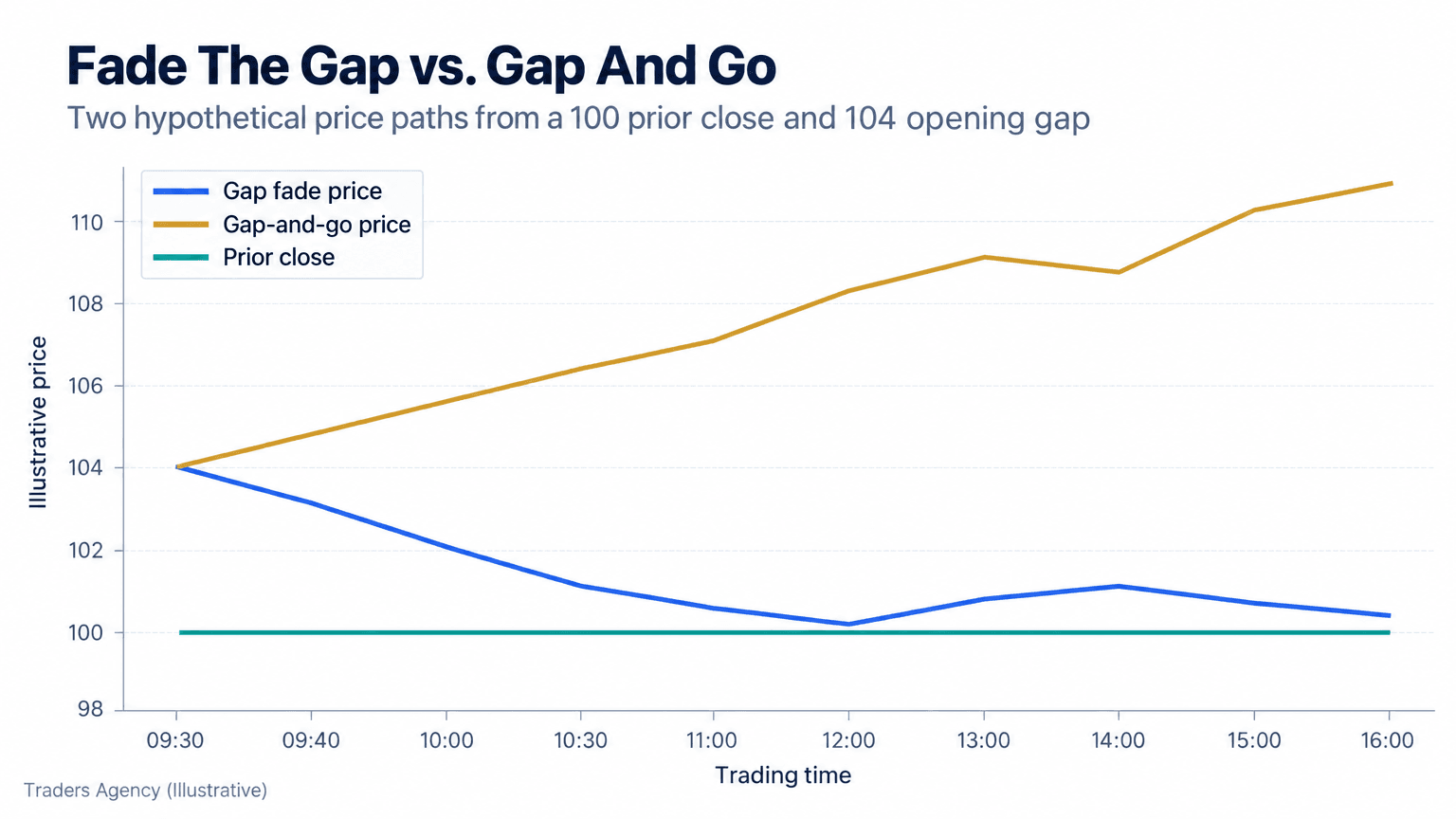
The differentiator between these two setups isn't the direction of the gap. It's the volume, the news quality, and where the stock sat in its own structure before the gap ever happened.
How Does Volume Confirm a Gap Continuation Signal?
Volume confirmation is the process of using pre-market and opening-range volume data to determine whether a gap has enough real participation behind it to sustain continuation, rather than being a thin, easily reversed print. Skip this step and gap-and-go trades on low-conviction gaps become a coin flip.
Our Pre-Market Assessment Workflow
We run this checklist before every gap trade, in this order:
- Compare pre-market volume to the 20-day average traded by that same pre-market hour. Anything under 2x average is a caution flag.
- Check the news quality. Earnings beats, guidance changes, and regulatory decisions carry more weight than unconfirmed rumors or thin sympathy plays. Original filings on SEC EDGAR are the fastest way to verify what actually got announced.
- Map the gap against recent structure. Is this breaking out of a range (breakaway), extending a trend (runaway), or capping an extended move (exhaustion)?
- Watch the first 5-minute and 15-minute candle volume relative to the opening print. Fading volume on continuation attempts is a red flag for gap and go. Rising volume on pushes back in the gap's direction is a red flag for fade setups.
- Confirm relative volume (RVOL) is elevated across the sector, not just the single name. Sector-wide expansion suggests a real informational event rather than an isolated liquidity anomaly.
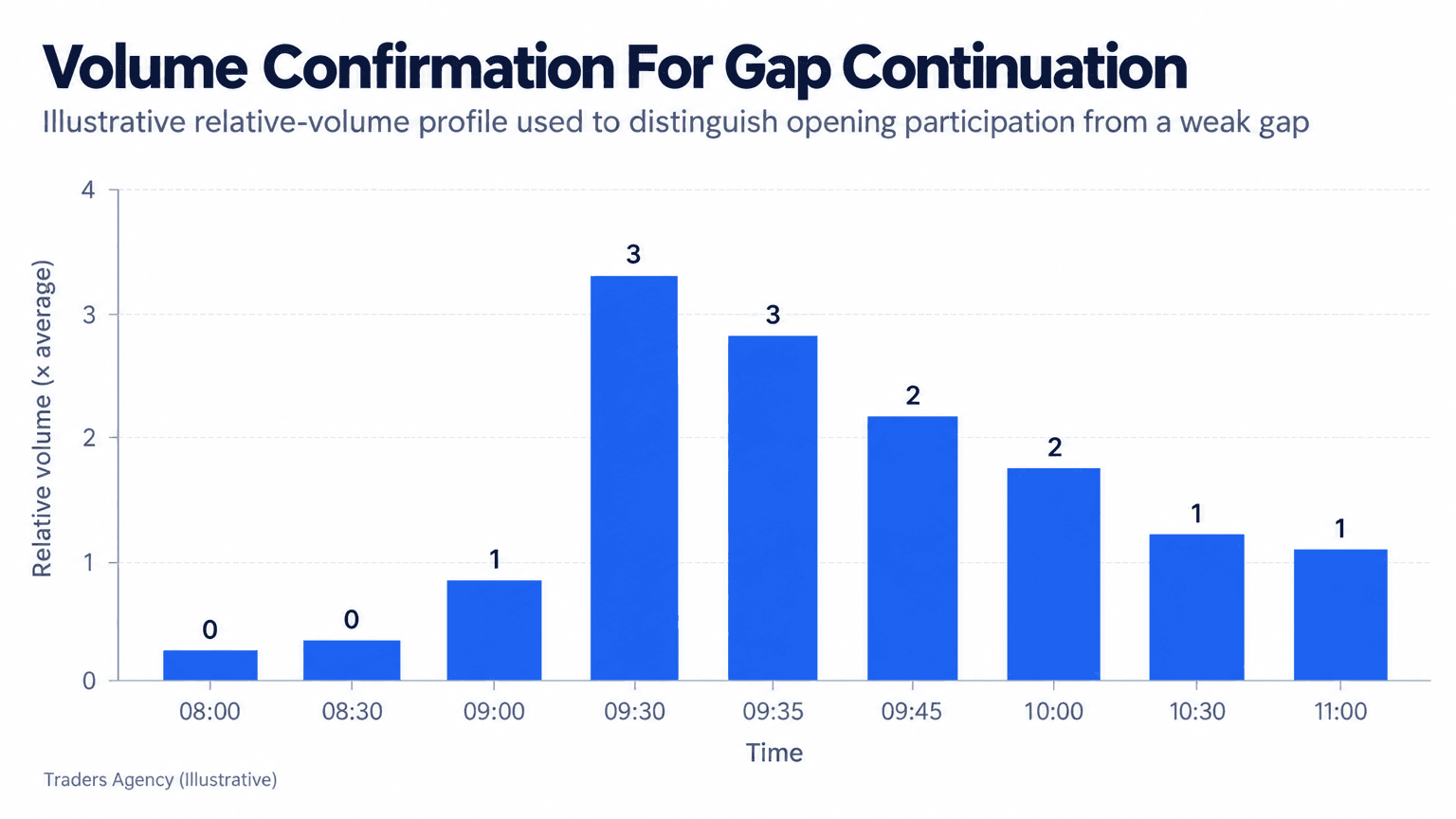
This same workflow applies to an overnight gap trading strategy, where you're assessing futures volume and after-hours prints before the cash session even opens. Index and equity futures data from the CME Group gives you a head start on classifying the gap while most retail traders aren't even watching yet.
How Does Gap Trading Work on Advanced Timeframes?
On longer timeframes, gap trading shifts from a single-session event into a multi-day structural signal, where weekly gaps on indices or futures contracts can mark trend inflection points rather than intraday noise. The core logic doesn't change, but the holding period and risk sizing do.
A daily chart gap that holds for three or more consecutive sessions without filling carries far more weight than an intraday gap that never survives the opening 30 minutes. On weekly charts, gaps are rarer and tend to align with major fundamental shifts, sector rotations, or macro events, which makes them useful confirmation tools for swing and position traders layering gap analysis on top of moving averages or volume profile nodes. Adding 50-day or 200-day moving average context builds real conviction: a breakaway gap that also clears a major moving average on strong volume is a materially stronger signal than the same gap printing inside a choppy range.
How Should You Manage Risk on Multi-Leg Gap Trades?
We rarely enter a gap trade as a single all-in position, and neither do institutional desks. Instead, we scale in using a structured, multi-leg approach that limits exposure during the highest-uncertainty period: the first 15 to 30 minutes after the open.
Our Three-Leg Framework
- Probe entry (1/3 of intended size): taken immediately at confirmation, using a tight stop tied to the opening range low or high.
- Confirmation add (1/3 of intended size): added only after the first 15-minute candle closes in the direction of the trade with volume holding above the pre-market average.
- Trailing runner (final 1/3): added on a successful retest of the opening range, managed with a trailing stop rather than a fixed target so the strongest gaps can run.
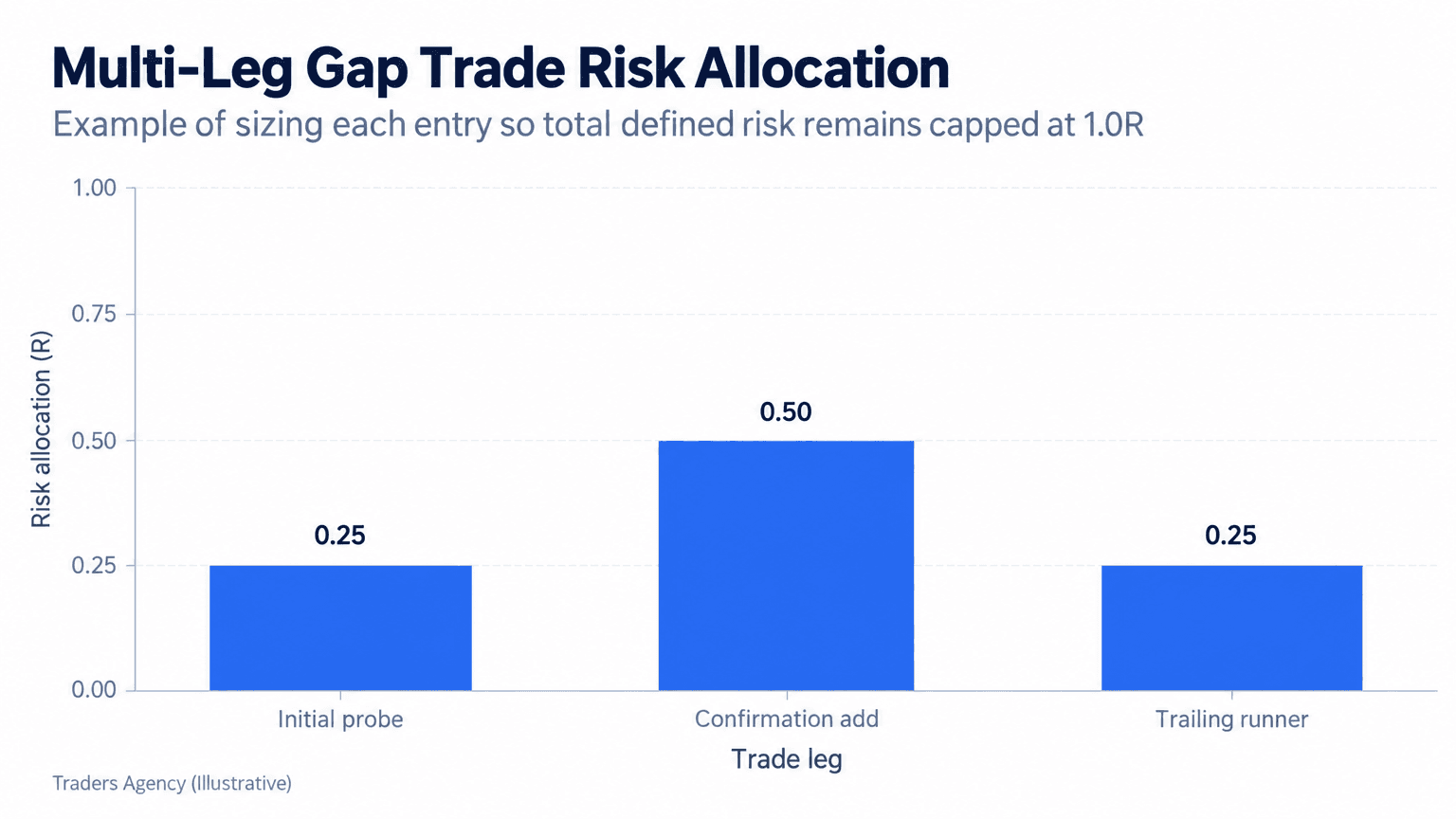
Watch Out: Total risk across all three legs should never exceed your standard 1R (one unit of risk) for the trade, even though you're deploying capital in stages. Staging entries is only protective if the combined risk stays capped. The single biggest gap trading mistake we see is a full-size entry into a gap that turns out to be a low-volume trap.
Is Gap Trading Profitable?
Gap trading can be profitable when you apply disciplined gap classification, volume confirmation, and strict risk controls. It is not inherently profitable just because a gap exists. The edge comes from correctly identifying which gap type you're looking at and matching your setup, fade or continuation, to that classification.
Traders who blindly buy every gap up or short every gap down without this framework tend to see inconsistent results, since common gaps and failed exhaustion gaps tend to favor a fill rather than continuation. The real question isn't whether gap trading works as a category. It's whether your process separates high-probability continuation setups from high-probability fade setups before you risk capital.
When Should You Use a Gap Trading Strategy?
Gap trading works best on liquid, high-volume names with clear pre-market data, real news drivers, and identifiable structure on the daily chart heading into the open. It's a poor fit for thinly traded stocks, low-float names with erratic pre-market prints, or gaps without any discernible fundamental reason behind them.
Don't force a gap trade when pre-market volume is ambiguous, or when the broader market (SPX futures, sector ETFs) is gapping in the opposite direction of your target stock. Fighting the tape rarely pays. This strategy pairs well with volume profile analysis and moving average context, and it should occupy a defined, capped portion of your overall trading capital rather than becoming your entire approach. Size each gap trade based on the volatility of the individual name, using ATR-based stops instead of fixed dollar stops, since gap volatility varies enormously across sectors and market caps.
Remember This: Classify first, then choose your side. Breakaway and runaway gaps favor continuation. Common and exhaustion gaps favor the fill. Volume is what tells you which one you're actually looking at.
Frequently Asked Questions
Can I make $1,000 a day day trading?
It's possible on certain days with sufficient capital, volatility, and a working edge, but it is neither consistent nor guaranteed. Fixed daily targets like this tend to push traders into overtrading and oversized positions.
What is the 3-5-7 rule in trading?
The 3-5-7 rule is a risk management guideline where a trader risks no more than 3% of capital on any single trade, keeps total exposure across open trades under 5%, and ensures winning trades secure at least 7% more profit than the amount risked on losing trades.
Is gap trading profitable?
Gap trading can be profitable when you correctly classify gap type, confirm with volume, and apply disciplined risk management. It is not automatically profitable and requires a defined process rather than reactive entries.
Which trading strategy is most successful?
No single strategy is universally most successful. Results depend on market conditions, timeframe, and execution discipline. Gap trading, trend following, and mean reversion all work in different environments when applied with sound risk management.
What is a gap fill in trading?
A gap fill happens when price returns to the level of the prior session's close after an opening gap, erasing the price void the gap created.
What is the best gap trading strategy for beginners moving to advanced setups?
There is no single best gap trading strategy, but a volume-confirmed breakaway gap approach combined with staged position entries tends to offer the clearest risk-to-reward profile for traders stepping up from basic to advanced execution.
Our education team publishes new strategy guides and market analysis every week.
Want expert trading insights delivered daily?
Join thousands of traders who rely on Traders Agency for market analysis and trade ideas.
Join Traders AgencyDISCLAIMER: Traders Agency does not offer financial advice. The information provided is for educational purposes only and should not be considered financial advice. Traders Agency is not responsible for any financial losses or consequences resulting from the use of the information provided. Trading carries inherent risks and may not be suitable for all individuals. You are advised to conduct your own research and seek personalized advice before making any investment decisions, recognizing the potential risks and rewards involved.
See more from Traders Agency on Google
Make us a preferred source and our market analysis will appear more prominently in your Google Search, Top Stories, and AI results.
Add to Preferred Sources