
You've probably seen this play out on financial news channels. A stock hits an all-time high, and commentators argue about whether it's "too expensive" or still a bargain. You might look at a stock trading at $150 per share and compare it to another trading at $10 per share. But price alone doesn't tell you which company is the better value. That's where the price-to-earnings ratio comes in, and once you have the PE ratio explained in simple terms, it becomes one of the most powerful tools in your investing toolkit.
The price-to-earnings ratio (P/E ratio) is a fundamental valuation metric that measures a company's current share price relative to its per-share earnings. It's the most common tool investors use to determine if a stock is overvalued, undervalued, or priced fairly.
We're going to walk you through exactly how this metric works and how to apply it to your own trading. By the end of this guide, you'll know how to calculate it, where to find the data, and how to use it to compare different stocks. Our team relies on this metric as a foundational building block for fundamental analysis.
What Is the Price-to-Earnings Ratio? PE Ratio Explained
Bottom Line: The P/E ratio gives investors a consistent, comparable way to assess whether a stock's price reflects its actual earnings power. Its real value comes from using it as a starting point, not a final answer: layering in the PEG ratio, debt levels, and cash flow analysis builds a far more reliable picture of a stock's true worth. Master the metric, respect its limits, and it becomes one of the most practical tools in fundamental analysis.
The price-to-earnings ratio is a valuation tool that tells you how much money you're paying for one dollar of a company's earnings. If a stock has a P/E ratio of 15, you're paying $15 for every $1 of profit the company generates annually. This gives you a standardized way to compare companies of different sizes.
Think of it like buying a local business. If a neighborhood coffee shop generates $100,000 in profit every year, and the owner wants to sell it to you for $1,000,000, you're paying ten times the annual earnings. The P/E ratio of that coffee shop is 10. It would take you ten years of those exact profits to earn back your initial investment.
Key Concept: The P/E ratio tells you how many dollars investors are willing to pay for each dollar of a company's annual earnings. A P/E of 20 means the market is paying $20 for every $1 of profit.
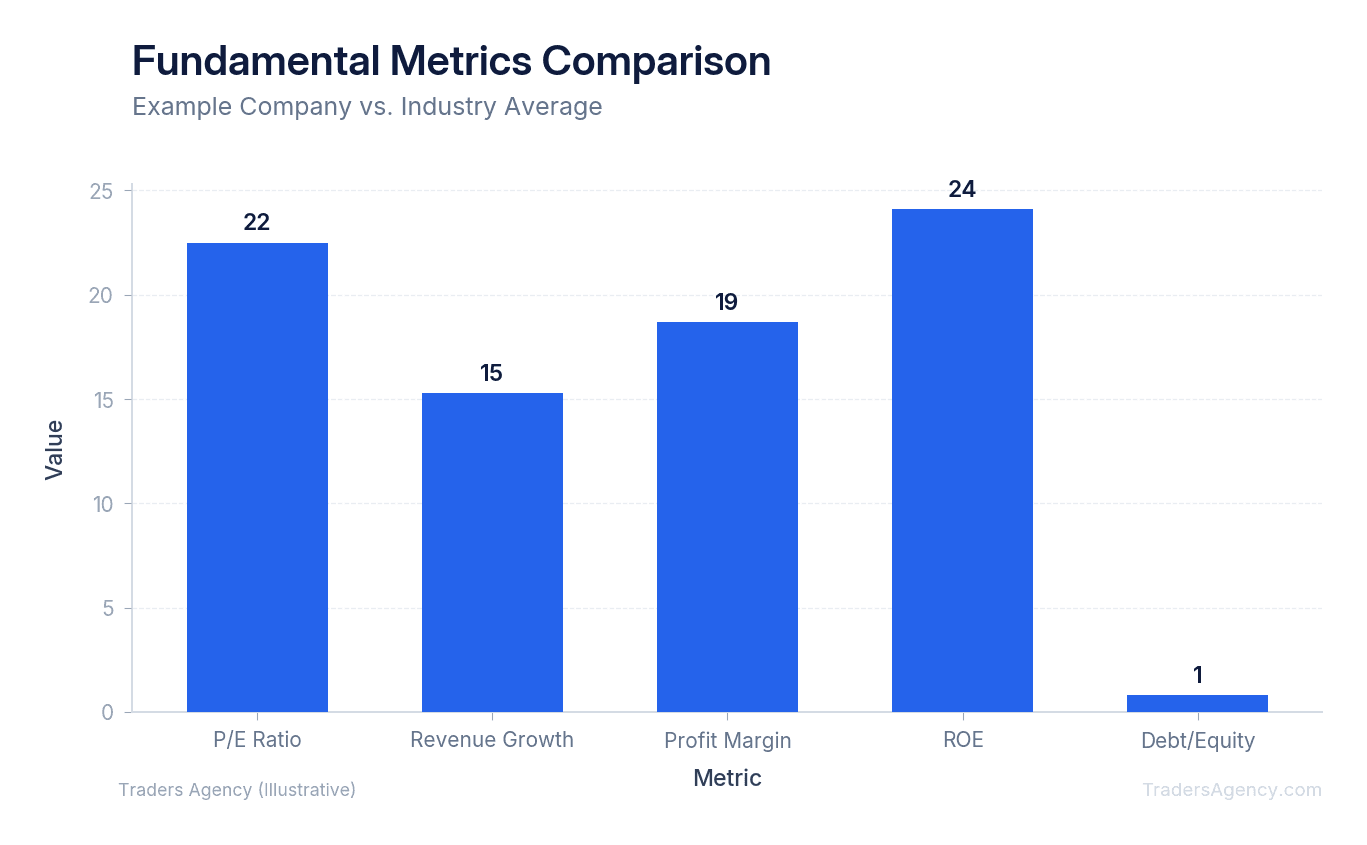
When looking at the P/E ratio in practical terms, remember that it reflects market expectations. A lower P/E ratio often suggests a stock is undervalued, while a higher P/E ratio implies investors expect higher future growth. Investors are willing to pay more today for a company they believe will generate massive profits tomorrow.
How Do You Calculate the P/E Ratio?
You calculate the P/E ratio by dividing the current market price of one share of stock by the company's earnings per share (EPS). The formula is straightforward: Market Value per Share ÷ Earnings per Share = P/E Ratio. You can find this data on any standard financial screener or directly in company filings through the SEC EDGAR database.
Here's how we teach our members to run the calculation:
- Step 1: Gather Your Data. You want to evaluate a hypothetical company, TechCorp, to see if its valuation aligns with your trading strategy. You need two pieces of information: the current stock price and the earnings per share. You check your trading platform and see TechCorp is currently trading at $120 per share. You look up the company's financial statements and find its EPS for the past year is $4.00.
- Step 2: Run the Calculation. Take the current share price and divide it by the earnings per share. You don't need complex spreadsheet models for this step. Formula: $120 ÷ $4.00.
- Step 3: Interpret the Result. The calculation gives you a result of 30. TechCorp has a P/E ratio of 30. This means investors are currently willing to pay $30 for every $1 of TechCorp's earnings. You can now take this number and compare it to TechCorp's direct competitors to see if it's trading at a premium or a discount.
| Parameter | Value |
|---|---|
| Company | TechCorp |
| Current Share Price | $120.00 |
| Earnings Per Share (EPS) | $4.00 |
| P/E Ratio | 30 |
| Interpretation | Investors pay $30 for every $1 of earnings |
Trailing vs. Forward P/E: Which Should You Use?
Trailing P/E uses historical earnings from the past 12 months, providing a factual but backward-looking metric. Forward P/E uses projected earnings for the next 12 months, offering a future outlook that relies on analyst estimates which may not be perfectly accurate. Both metrics serve a specific purpose in fundamental analysis. With the PE ratio explained in both its trailing and forward forms, you can make more informed comparisons.
The Trailing P/E is calculated using the earnings from the last four quarters. We prefer to use this when we want hard, verifiable data. Because it relies on actual reported earnings, a company can't inflate this number with overly optimistic forecasts. However, past performance does not guarantee future results.
The Forward P/E is calculated using projected earnings. Wall Street analysts publish consensus estimates for what they believe a company will earn over the next year. If a company is expected to grow its profits significantly, its Forward P/E will be lower than its Trailing P/E.
Our team recommends looking at both numbers side by side. If a stock has a Trailing P/E of 40 but a Forward P/E of 15, the market expects massive earnings growth in the near future. If the company fails to meet those expectations, the stock price will likely drop.
| Metric | Data Source | Best Used For |
|---|---|---|
| Trailing P/E | Actual earnings from past 12 months | Verifiable, fact-based valuation |
| Forward P/E | Analyst projected earnings for next 12 months | Gauging growth expectations |
Want expert trading insights delivered daily?
Join thousands of traders who rely on Traders Agency for market analysis and trade ideas.
Join Traders AgencyWhat Is Considered a Good P/E Ratio by Sector?
A "good" P/E ratio depends entirely on the industry and current market conditions. Utility companies typically have lower P/E ratios around 15, while high-growth technology companies often trade at P/E ratios of 30 or higher due to rapid expansion expectations. There is no single perfect number that applies to the entire stock market.
You must compare apples to apples. Comparing the P/E ratio of a software company to a regional bank will give you useless data. They operate with entirely different profit margins, capital requirements, and growth rates.
Here are the general benchmarks our team uses when evaluating different sectors:
- Financials and Banks: These typically trade at lower valuations. A normal P/E ratio for a bank is usually between 10 and 15. They are heavily regulated and grow slowly.
- Utilities: These are stable, dividend-paying companies. Investors buy them for income rather than explosive growth. A standard P/E ratio here ranges from 15 to 20.
- Consumer Staples: Companies that sell toothpaste, food, and household goods offer steady earnings. They usually trade at a P/E of 18 to 25.
- Technology: Software and tech hardware companies command premium valuations. Investors expect rapid innovation and scaling. A normal P/E in this sector can range from 25 to 50, or even higher for emerging tech.
| Sector | Typical P/E Range | Growth Profile |
|---|---|---|
| Financials / Banks | 10 - 15 | Slow, regulated growth |
| Utilities | 15 - 20 | Stable, income-focused |
| Consumer Staples | 18 - 25 | Steady, predictable earnings |
| Technology | 25 - 50+ | High growth, high expectations |
Watch Out: When you see a stock trading far outside its sector average, you need to ask why. A tech stock with a P/E of 12 might look like a bargain, but it could also mean the company is losing market share and investors are heading for the exits.
What Does a High or Low P/E Ratio Tell You About a Stock?
Understanding the P/E ratio helps you grasp the fundamental divide between growth investing and value investing. Your trading strategy will dictate which type of P/E ratio you prefer to target.
Value stocks typically have low P/E ratios. These are established companies that might be temporarily out of favor with the market. Value investors look for stocks trading below their intrinsic value. If a solid, profitable company historically trades at a P/E of 20, but a temporary market panic pushes its P/E down to 12, a value trader will buy the stock expecting the ratio to return to normal.
Growth stocks usually have high P/E ratios. These companies are expanding revenue and earnings at an aggressive pace. Investors are willing to pay a high premium today because they expect the earnings denominator (the "E" in P/E) to catch up to the price over the next few years.
We teach our members to align their metric selection with their risk tolerance. Buying a stock with a P/E of 80 carries significant risk. If that company misses an earnings estimate by even a few pennies, the stock price can collapse as the premium valuation evaporates.
What Is the PEG Ratio and How Does It Improve on P/E?
The PEG ratio (Price/Earnings-to-Growth) improves upon the standard P/E ratio by factoring in the company's expected earnings growth rate. You calculate it by dividing the P/E ratio by the projected earnings growth rate. A PEG ratio of 1.0 is generally considered fairly valued.
The standard P/E ratio has a blind spot when it comes to fast-growing companies. A P/E of 40 sounds expensive in isolation. But what if that company is doubling its profits every year?
Here's a practical walkthrough of how we use the PEG ratio:
- Step 1: Identify the Setup. You're looking at a high-flying tech stock, CloudNet, with a P/E ratio of 40. A traditional value screener would tell you to avoid this stock entirely. However, analysts project CloudNet will grow its earnings by 40% per year for the next five years.
- Step 2: Run the Calculation. Divide the P/E ratio by the growth rate to find the PEG ratio. Formula: P/E Ratio ÷ Earnings Growth Rate. Math: 40 ÷ 40 = 1.0.
- Step 3: Interpret the Result. The calculation gives you a PEG ratio of 1.0. Despite the high initial P/E, the PEG ratio tells you the stock is actually priced fairly relative to its massive growth potential.
Key Concept: A PEG ratio below 1.0 may indicate a stock is undervalued relative to its growth. A PEG ratio above 2.0 suggests the stock could be overpriced, even if the absolute P/E doesn't look extreme.
| Company | P/E Ratio | Earnings Growth Rate | PEG Ratio | Assessment |
|---|---|---|---|---|
| CloudNet (Tech) | 40 | 40% | 1.0 | Fairly valued |
| SlowRetail (Retail) | 20 | 5% | 4.0 | Potentially overvalued |
Notice how the retail stock with the lower P/E ratio is actually the worse value when you account for growth. This is exactly why we encourage our members to look beyond a single number.
What Are the Limitations of the P/E Ratio?
Now that you have the PE ratio explained and understand how it works, you must also understand when not to use it. No single metric should dictate your entire trading strategy. Relying solely on this ratio can lead to poor risk management and unexpected losses.
Companies with negative earnings break the formula. If a company is losing money, it doesn't have a positive earnings per share figure to divide by. Many early-stage biotechnology and software companies operate at a loss for years while building their products. You simply cannot use a P/E ratio to value them.
Cyclical companies can create a "value trap." Companies in industries like auto manufacturing, airlines, and homebuilding see their profits rise and fall with the broader economy. At the peak of an economic boom, an automaker might report record earnings, pushing its P/E ratio down to an incredibly cheap-looking 4. A beginner might buy heavily, thinking it's a massive bargain. But the market knows a recession is coming, which will wipe out those earnings. The low P/E was actually a warning sign, not a buy signal.
Risk Warning: We always enforce strict risk management regardless of a stock's valuation. Even if a stock has a perfect P/E and PEG ratio, you must still use proper position sizing. Our team prefers to allocate no more than 2% to 5% of total portfolio capital to any single stock trade. A great valuation metric will not protect you from broader market crashes or sudden negative news events.
The P/E ratio is one of the most useful tools in your fundamental analysis toolkit, but it works best when combined with other metrics like the PEG ratio, debt-to-equity ratio, and free cash flow analysis. With the PE ratio explained as a starting point, you can layer on additional analysis to build a more complete picture of any stock's true value.
Want expert trading insights delivered daily?
Join thousands of traders who rely on Traders Agency for market analysis and trade ideas.
Join Traders AgencyKey Takeaways
- A P/E ratio of 15 means you're paying $15 for every $1 of annual profit the company generates, giving you a standardized way to compare companies regardless of share price or size.
- Price alone is meaningless for valuation: a $10 stock can be far more expensive than a $150 stock once earnings are factored in.
- The P/E ratio works best alongside complementary metrics like the PEG ratio, debt-to-equity ratio, and free cash flow analysis, not as a standalone signal.
- Traders Agency recommends limiting any single stock position to 2% to 5% of total portfolio capital, even when valuation metrics look favorable.
- A strong P/E reading does not protect against broad market crashes or sudden negative news, which is why context and risk management matter as much as the number itself.
DISCLAIMER: Traders Agency does not offer financial advice. The information provided is for educational purposes only and should not be considered financial advice. Traders Agency is not responsible for any financial losses or consequences resulting from the use of the information provided. Trading carries inherent risks and may not be suitable for all individuals. You are advised to conduct your own research and seek personalized advice before making any investment decisions, recognizing the potential risks and rewards involved.
See more from Traders Agency on Google
Make us a preferred source and our market analysis will appear more prominently in your Google Search, Top Stories, and AI results.
Add to Preferred Sources