
You've probably watched your equity portfolio drop during a market correction and wondered how to protect your capital. When economic indicators flash warning signs, intermediate traders need to adjust their positioning to survive the volatility. Holding gold in a recession is a defensive portfolio strategy designed to offset equity losses using non-correlated assets, and our team is going to walk you through exactly how to do it right.
We'll explain how to structure a precious metals recession portfolio, cover the exact allocation percentages we prefer, and break down the practical differences between physical metals, exchange-traded funds, and mining stocks. By the end of this guide, you'll know how to position your portfolio before the next economic downturn, including specific rebalancing triggers and the common traps that catch unprepared investors.
How Does Gold Perform in a Recession?
Bottom Line: Gold works best in a recession portfolio when it is sized correctly, held with discipline, and eventually redeployed into equities at the bottom of the cycle. The core lesson here is that precious metals are a timing and rebalancing tool, not a permanent allocation. Traders who stick to predefined rebalancing triggers and resist the urge to hold gold past its strategic purpose are the ones who come out ahead.
Gold historically performs exceptionally well during a recession. When economic growth slows and central banks lower interest rates, investors flock to safe-haven assets. This increased demand typically drives gold prices higher, providing a necessary counterbalance to falling stock prices in a diversified portfolio.
Based on historical data from the Federal Reserve and publicly available economic records, gold has posted positive returns in five of the last seven major U.S. recessions. We teach our members to view gold not as a growth asset, but as financial insurance. When equities drop 20% or more, a well-timed gold allocation portfolio can soften the blow significantly.
During the 2008 financial crisis, the broader stock market lost more than 35% of its value. Over that same period, gold prices actually increased. This inverse relationship is exactly why traders use precious metals when the economic outlook darkens.
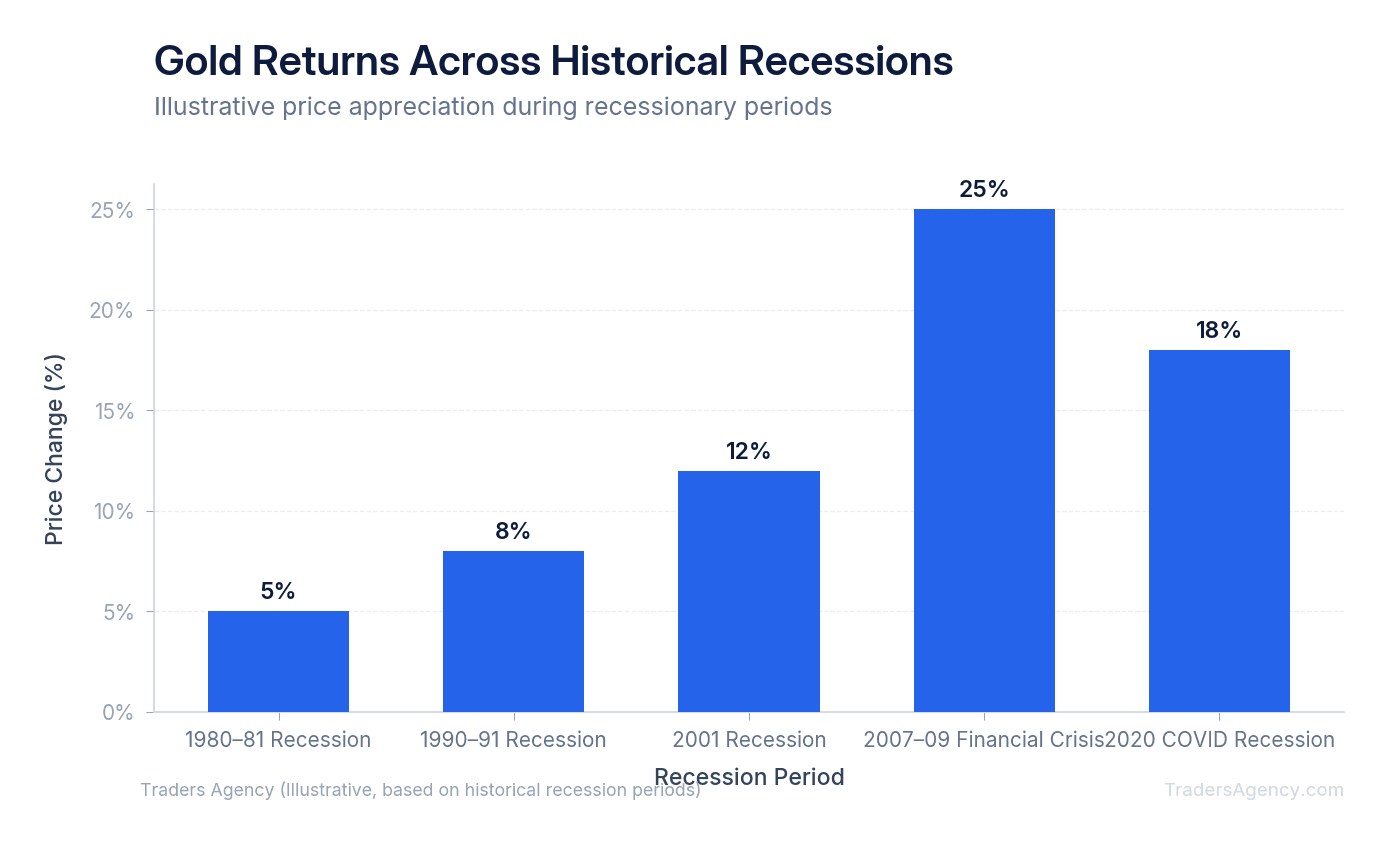
Key Concept: Gold is not a growth asset. It's financial insurance. Its value in a portfolio comes from its low correlation to equities, meaning it tends to hold steady or rise when stocks are falling.
How Much of Your Portfolio Should Be in Precious Metals During a Recession?
Many intermediate traders struggle with position sizing when adding defensive assets. Our team recommends a 5-15% precious metals allocation for most recession-proof investment strategies. This specific range provides a mathematical advantage to your overall portfolio structure.
This percentage is large enough to provide meaningful downside protection but small enough that it won't severely drag down your overall returns during a bull market. Gold has a low correlation to the S&P 500. When stocks drop, gold tends to rise or hold its value.
A 10% allocation to gold acts as a portfolio shock absorber. It reduces overall volatility without requiring you to move entirely into cash. This is one of the core reasons gold in a recession portfolio works so effectively for intermediate traders.
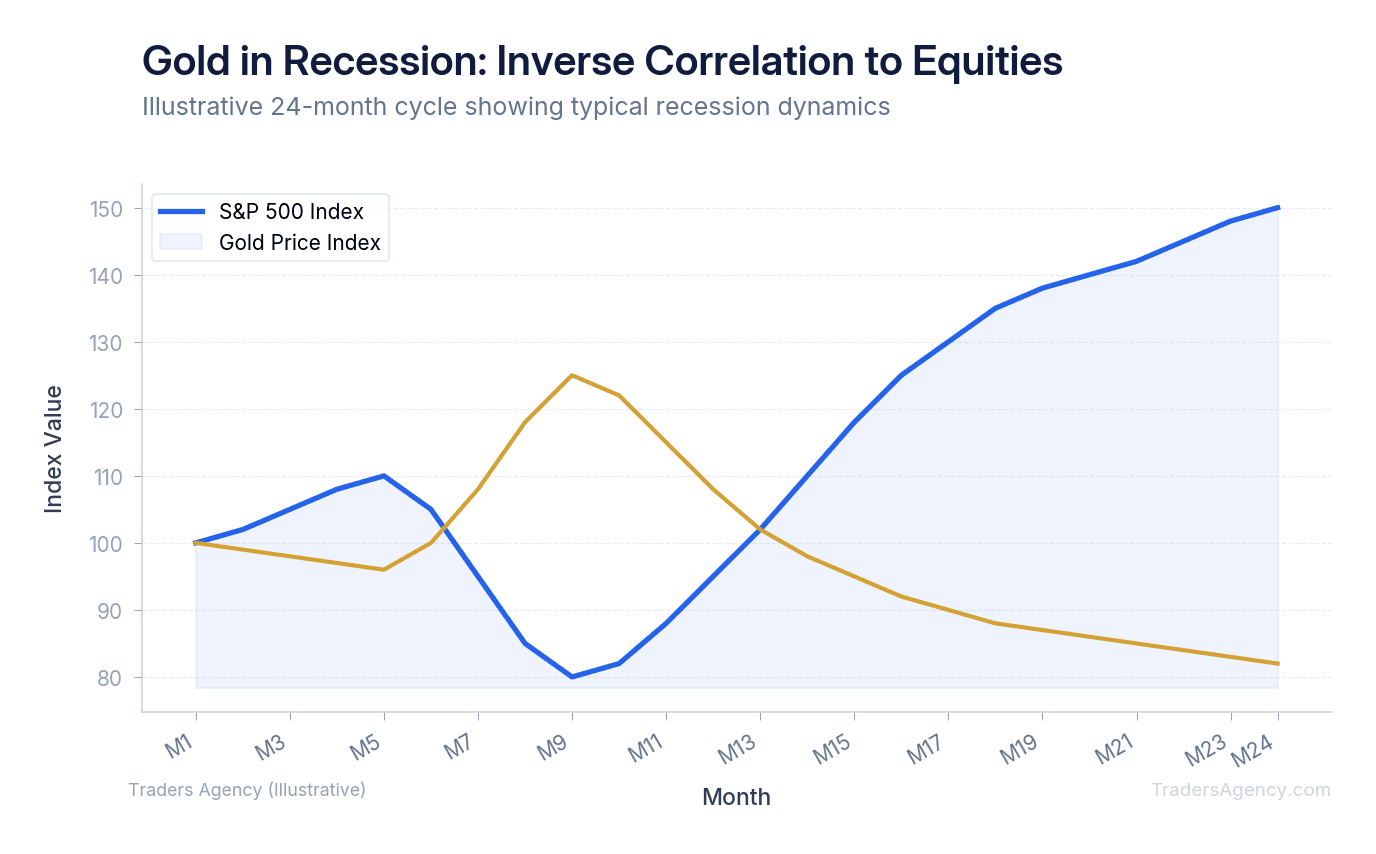
If you allocate 50% of your capital to gold, you'll miss out on dividend yields and compound equity growth. By keeping the allocation between 5% and 15%, you maintain your core growth engine while carrying a dedicated insurance policy.
Should You Buy Physical Gold, ETFs, or Mining Stocks in a Recession?
You have three primary ways to gain exposure to gold. Each vehicle behaves differently during an economic contraction, and you need to choose the right tool for your specific strategy.
Physical Gold (Coins and Bars)
Buying physical coins or bars gives you direct ownership with zero counterparty risk. However, you'll pay dealer premiums and secure storage costs. The IRS taxes physical gold as a collectible at a maximum rate of 28%, which can eat into your profits when you finally sell.
Gold ETFs (GLD, IAU)
Funds like GLD or IAU offer highly liquid exposure to spot gold prices. You can buy and sell them instantly in your brokerage account just like a regular stock. The SEC regulates these funds, making a gold ETF recession strategy a transparent way to track the metal without the hassle of a physical safe. One important tax note: because GLD and IAU hold physical gold, the IRS treats long-term gains on these ETFs as collectible gains, taxed at the same 28% maximum rate as physical gold.
Gold Mining Stocks
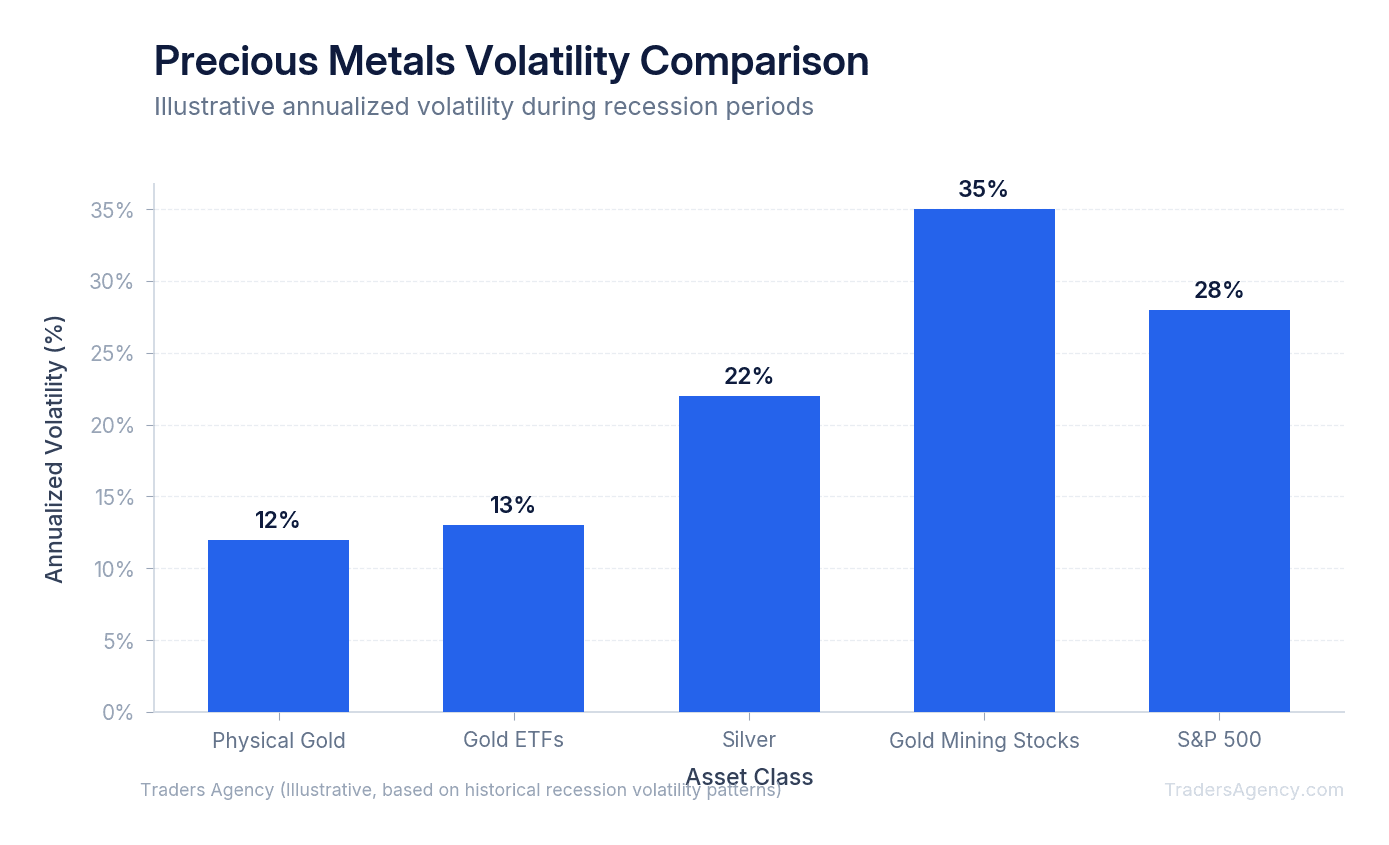
Companies that mine gold offer amplified returns relative to the metal's price. If gold rises 10%, a mining stock like NEM might rise 20%. But mining stocks are equities first and foremost. During a severe market crash, they often fall initially with the broader stock market before rebounding.
| Vehicle | Liquidity | Counterparty Risk | Tax Treatment | Recession Correlation to Gold Spot |
|---|---|---|---|---|
| Physical Gold | Low | None | 28% collectible rate | Direct |
| Gold ETFs (GLD, IAU) | High | Fund issuer | 28% collectible rate (physical gold trusts) | Very high |
| Mining Stocks (NEM, GDX) | High | Company-specific | Standard capital gains | Moderate (amplified moves) |
Why Does Silver Underperform Gold During a Recession?
Traders often ask us for a gold vs. silver recession comparison. We strongly prefer gold when preparing for an economic slowdown. Silver behaves very differently because of its dual nature as both a monetary metal and an industrial commodity.
Roughly 50% of global silver demand comes from industrial applications like electronics, medical devices, and solar panels. During a recession, global manufacturing slows down. This causes the industrial demand for silver to drop sharply.
Watch Out: Silver carries an industrial anchor that drags on its price during economic contractions. While silver might rally eventually, it experiences much higher volatility and deeper drawdowns during the initial phases of a market crash. For pure recession protection, gold is the superior choice.
Gold relies almost entirely on its monetary premium and safe-haven status. That single-purpose demand profile is what makes it more reliable as a defensive holding when the economy contracts.
Want expert trading insights delivered daily?
Join thousands of traders who rely on Traders Agency for market analysis and trade ideas.
Join Traders AgencyBuilding a Recession-Resistant Portfolio with Precious Metals
Let's walk through a concrete example of how to implement this strategy. Assume you have a $100,000 portfolio currently allocated 80% to stocks and 20% to bonds. You want to add portfolio diversification gold to protect against an upcoming recession.
Here is the step-by-step execution we teach our members:
- Identify the target allocation: You decide to allocate 10% to gold for downside protection.
- Fund the position: You sell $5,000 of your most vulnerable, high-beta tech stocks and $5,000 from your bond allocation.
- Select the vehicle: You purchase $10,000 of a highly liquid gold ETF to avoid storage fees and high dealer premiums.
- Set rebalancing triggers: You set a strict rule to rebalance if your gold allocation drifts above 15% or below 5%.
Six months later, a severe recession hits. Here's how the math plays out:
| Scenario | Starting Value | Change | Ending Value |
|---|---|---|---|
| Stock Portfolio | $75,000 | -25% | $56,250 |
| Gold ETF Position | $10,000 | +20% | $12,000 |
| Bond Allocation | $15,000 | Flat | $15,000 |
| Total Portfolio | $100,000 | -16.75% | $83,250 |
| All-Stock Portfolio (no gold) | $100,000 | -25% | $75,000 |
Instead of a $25,000 total loss on an all-stock portfolio, your diversified portfolio only lost $16,750. Your gold allocation has now grown to roughly 14.4% of your total portfolio ($12,000 out of $83,250). You're approaching your rebalancing trigger. You can now sell a portion of gold at a profit and buy heavily discounted stocks at the market bottom.
Key Concept: The real power of a gold allocation isn't just loss reduction. It's the ability to rebalance into cheap equities at the bottom of a crash. Gold gives you dry powder when everyone else is out of ammunition.
What Percentage of Your Portfolio Should Be in Gold?
You should keep between 5% and 15% of your total portfolio in gold depending on your risk tolerance and market outlook. A 5% allocation provides baseline diversification, while a 15% allocation offers aggressive protection for investors who expect a severe and prolonged economic downturn.
We teach our members to adjust this dial based on macroeconomic indicators. If the yield curve inverts and unemployment begins to rise, we prefer moving closer to the 15% upper limit. If the economy is expanding rapidly, we scale back to the 5% baseline.
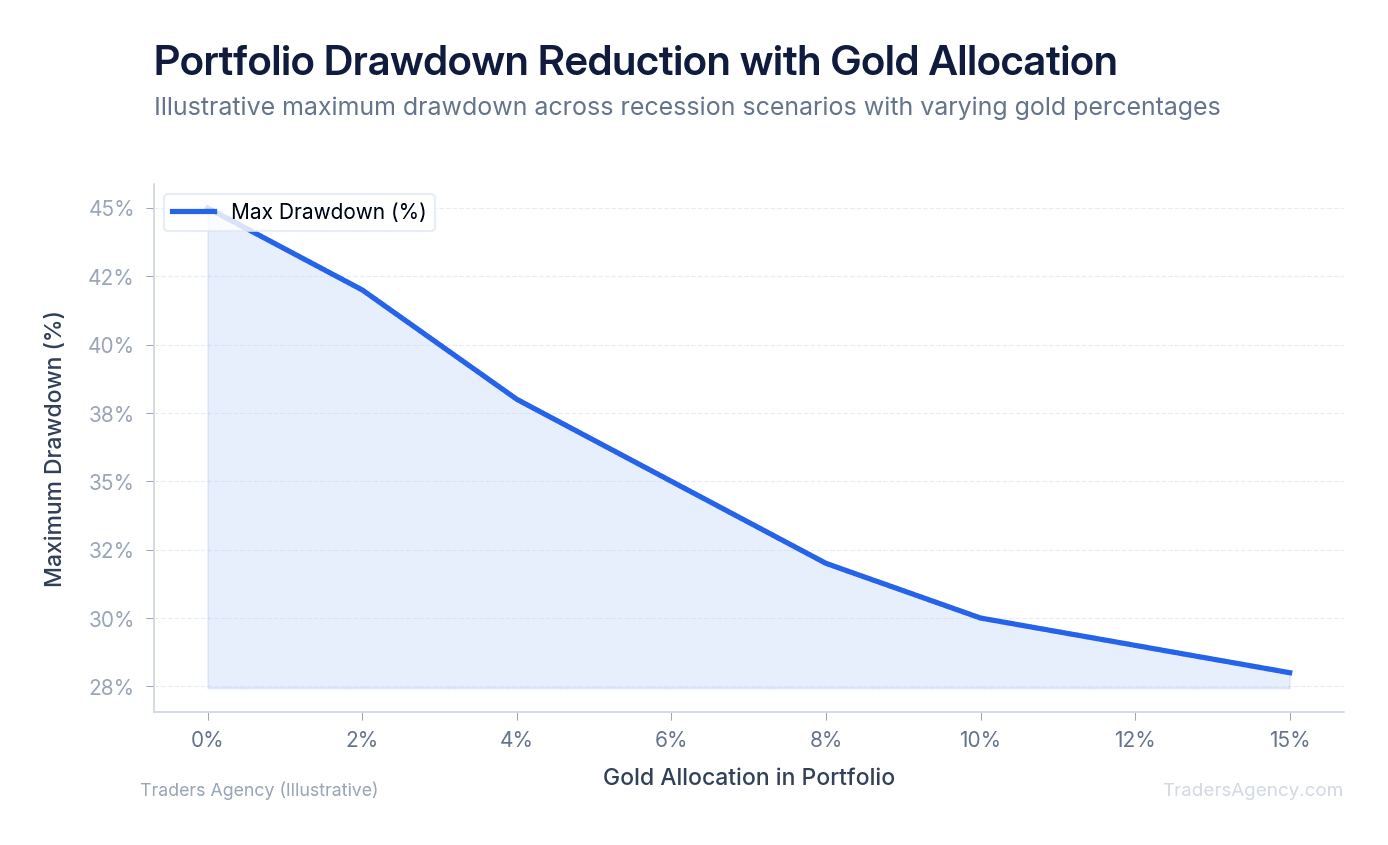
Allocating more than 20% to precious metals transforms your portfolio from a diversified growth engine into a speculative bet on economic disaster. Keep your allocation within the 5-15% sweet spot to balance risk and reward.
Common Mistakes When Adding Metals to a Defensive Portfolio
Even experienced traders make errors when managing a defensive portfolio. Holding gold in a recession requires discipline and an understanding of market mechanics. Here are the most common mistakes you need to avoid.
1. Buying After the Panic Begins
The worst time to buy gold is after a recession is already dominating the news cycle. You want to build your position while the economy is still strong and gold prices are relatively flat. If you wait until the stock market has already crashed, you'll pay a massive premium for your safe-haven assets.
2. Confusing Mining Stocks with Physical Gold
As we covered earlier, gold mining stocks recession performance can be highly erratic. Don't treat a mining ETF like GDX as a pure safe-haven asset. Mining companies carry operational risks, management risks, and heavy equity market correlation. If the stock market crashes, margin calls will force funds to liquidate mining stocks alongside tech stocks.
3. Failing to Take Profits
Gold is a tool to preserve capital so you can deploy it when other assets are cheap. If gold spikes and becomes 25% of your portfolio, you must take profits. Sell the excess gold and buy high-quality equities while they're trading at a steep discount.
Watch Out: The biggest mistake we see is traders falling in love with their gold position after it rallies. Precious metals are a strategic reserve: you accumulate them during the good times, hold them through the panic, and redeploy the capital when the market offers generational buying opportunities in equities. Stick to your rebalancing triggers and let the math work in your favor.
Want expert trading insights delivered daily?
Join thousands of traders who rely on Traders Agency for market analysis and trade ideas.
Join Traders AgencyKey Takeaways
- Gold posted positive returns in five of the last seven major U.S. recessions, making it a historically reliable hedge rather than a speculative bet.
- The article recommends a 5-15% precious metals allocation for intermediate traders, not a majority position, treating gold as financial insurance rather than a growth asset.
- When gold rallies during a recession, the correct move is to sell the excess position and rotate into high-quality equities trading at a discount, not hold indefinitely.
- Physical metals, ETFs, and mining stocks each behave differently in a downturn, and choosing the wrong vehicle for your goals is one of the most common portfolio mistakes.
- Silver underperforms gold in recessions due to its industrial demand component, which contracts alongside the broader economy, making gold the cleaner defensive play.
DISCLAIMER: Traders Agency does not offer financial advice. The information provided is for educational purposes only and should not be considered financial advice. Traders Agency is not responsible for any financial losses or consequences resulting from the use of the information provided. Trading carries inherent risks and may not be suitable for all individuals. You are advised to conduct your own research and seek personalized advice before making any investment decisions, recognizing the potential risks and rewards involved.
See more from Traders Agency on Google
Make us a preferred source and our market analysis will appear more prominently in your Google Search, Top Stories, and AI results.
Add to Preferred Sources