
You've probably seen this happen before. A new trader funds their brokerage account, rushes into their first live trade, and immediately loses money because they clicked the wrong button. Maybe they accidentally bought 1,000 shares instead of 100, or they placed a market order when they meant to use a limit order. These mistakes are completely avoidable, and we're going to show you exactly how to practice risk-free before you ever put real capital on the line.
What Is a Paper Trading Account and How Does It Work?
Bottom Line: A paper trading account removes the financial cost of the learning curve by letting you practice real market mechanics with fake money until the process becomes second nature. The key insight is that the transition to live trading should be gradual: master the simulator first, then start live with a small account to manage the psychological shift. Skipping this step is one of the most common and most expensive mistakes new traders make.
A paper trading account is a simulated trading environment provided by brokers or charting platforms. It functions exactly like a real brokerage account, complete with live or delayed market data, order tickets, and portfolio tracking. The only difference is that you trade with virtual funds instead of real capital.
Think of this tool like a flight simulator for aspiring pilots. You get to sit in the cockpit, look at the real instruments, and practice taking off and landing. If you crash in the simulator, you just hit the reset button and try again.
Key Concept: A paper trading account is a virtual stock market simulator that lets you practice buying and selling assets using fake money. It is the absolute best way to learn the mechanics of the market without putting your hard-earned cash on the line.
The SEC's investor education resources recommend using virtual trading simulators to test your strategies before risking actual capital. This allows you to build muscle memory. You learn how to read charts, enter ticker symbols, and manage open positions without the stress of financial loss.
The mechanics behind these simulators are straightforward. When you place a buy order for 100 shares of Apple (AAPL), the platform checks the current market price and deducts the virtual cost from your fake cash balance. Your account then tracks the simulated profit or loss as the real-world stock price moves up and down.
Which Paper Trading Account Is Best for Your Strategy?
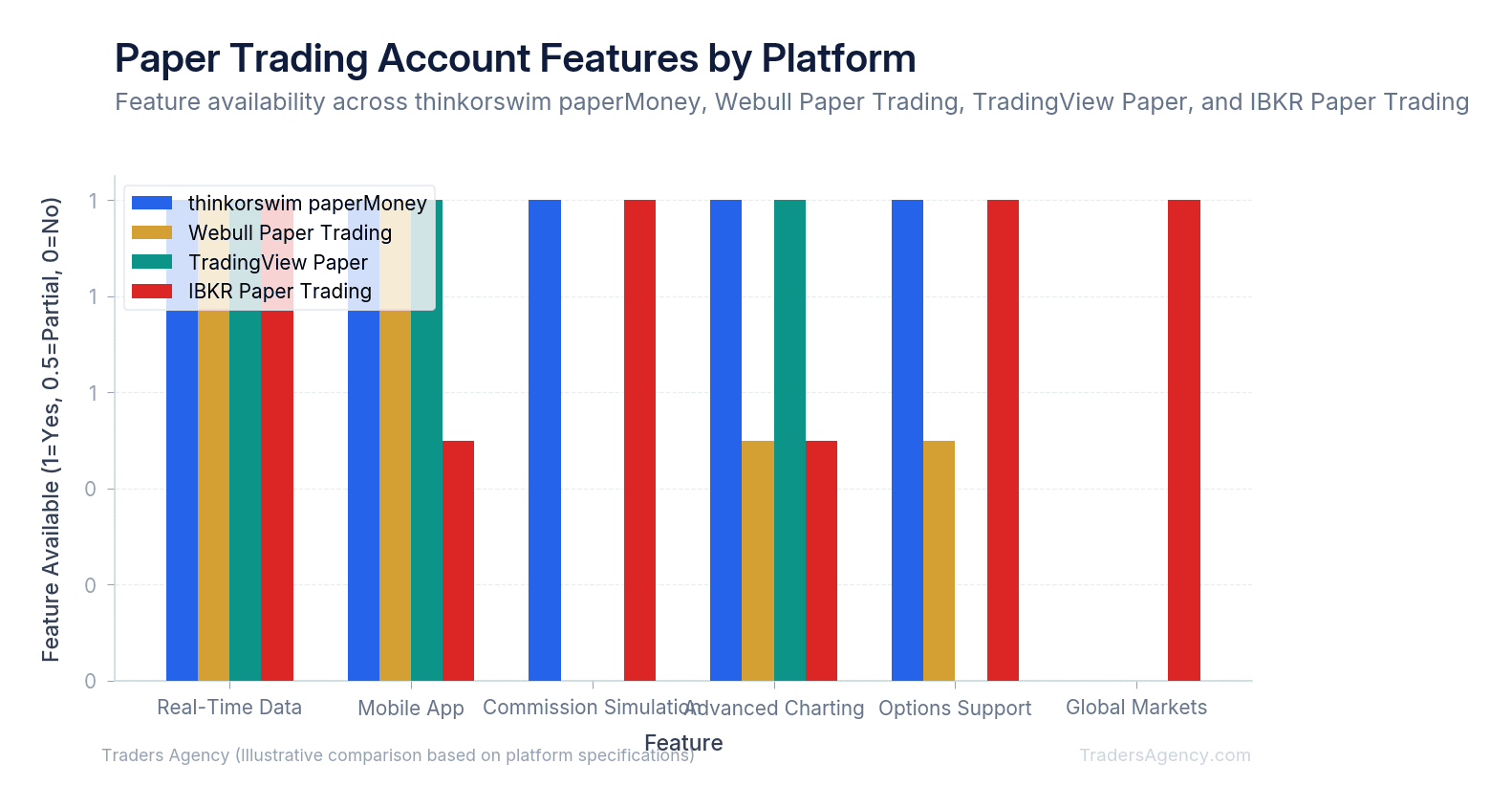
The best paper trading account depends on your specific goals as a trader. Our team has tested all the major platforms extensively, and here's how we break them down by use case:
| Platform | Best For | Starting Virtual Balance | Key Strength |
|---|---|---|---|
| Thinkorswim paperMoney | Options traders | $100,000 | Advanced options chains and customizable layouts |
| Webull | Mobile-first beginners | $1,000,000 | Clean mobile interface with visual order entry |
| TradingView | Technical analysis traders | $100,000 | Execute trades directly from charts, web-based |
| Interactive Brokers (IBKR) | Realistic day trading prep | $1,000,000 | Simulated slippage and market friction |
1. Thinkorswim paperMoney
We consider thinkorswim paperMoney to be the gold standard for traders who want to learn options trading. It offers advanced charting, complex options chains, and highly customizable layouts. The platform gives you $100,000 in virtual buying power to start.
The main drawback is the learning curve. The interface is incredibly detailed, which can overwhelm complete beginners. However, mastering this platform in simulation mode makes the transition to live trading much easier.
2. Webull Paper Trading
If you prefer trading from your phone, Webull offers an outstanding mobile simulator. The interface is clean, modern, and highly intuitive for new users. They frequently run paper trading competitions where you can test your skills against other users.
We love teaching beginners on Webull because the order entry screen is very visual. You can easily see your stop-loss and take-profit levels directly on the chart before you submit the trade.
3. TradingView Paper Trading
TradingView is primarily a charting platform, but it includes a built-in paper trading feature. This is perfect for traders who focus heavily on technical analysis and drawing chart patterns. You can execute trades directly from the charts you are already analyzing.
The platform connects to various brokerages, but you can simply select their native "Paper Trading" broker to start immediately. It is entirely web-based, meaning you do not need to download heavy desktop software.
4. Interactive Brokers (IBKR) Paper Trading
For traders who want the most realistic simulation possible, IBKR is the top choice. Their simulator actively mimics real-world market friction. This means you will experience simulated slippage, which is the difference between your expected price and the actual fill price.
This platform is best suited for intermediate traders preparing for active day trading. It forces you to respect the realities of market liquidity and order execution speeds.
How Do You Set Up a Paper Trading Account?
Setting up a paper trading account requires just a few simple steps. Here are the exact steps we teach our members to follow:
- Register for an account: Go to the broker's website and sign up. Most brokers allow you to access their simulator with just an email address, though some require you to open a live account first.
- Download the software: Install the desktop platform or mobile app. Web-based platforms like TradingView only require you to log in through your browser.
- Toggle to simulation mode: Look for a switch labeled "Paper Trading" or "Simulated Account." On thinkorswim, you select "paperMoney" directly on the login screen.
- Adjust your starting balance: This is the step most people skip, and it's the most important one. If you plan to start live trading with $5,000, change your virtual balance from the default $100,000 down to $5,000.
Watch Out: Trading with an unrealistic account size is one of the biggest mistakes beginners make. If you practice with $100,000, a $500 loss feels insignificant. If you practice with $5,000, that same $500 loss represents 10% of your entire portfolio, which forces you to take risk management seriously.
Trading with a realistic account size teaches you proper position sizing from day one. Our team cannot stress this enough: match your simulator balance to your planned live trading capital.
Want expert trading insights delivered daily?
Join thousands of traders who rely on Traders Agency for market analysis and trade ideas.
Join Traders AgencyHow Do You Execute Your First Practice Trade?
Executing your first practice trade involves selecting a stock, choosing your order type, and defining your risk. We recommend starting with a highly liquid asset like the SPDR S&P 500 ETF (SPY) because it has tight spreads and predictable behavior.
Here's how we walk our members through their very first simulated trade:
- Open the order ticket: Search for SPY in your platform's ticker search bar and select it. Click "Trade" or "Buy" to open the order entry window.
- Select your order type: Choose a limit order instead of a market order. A limit order tells the broker the maximum price you are willing to pay. Set your limit price at or near the current ask price.
- Enter your quantity: Type in 10 shares. At a price of $500.00 per share, this represents a $5,000 position.
- Set your stop-loss: Place a stop-loss order at $490.00. This means if the price drops to $490.00, the simulator will automatically sell your shares to prevent further losses.
- Submit the trade: Review all parameters and click "Submit." Watch the position appear in your portfolio.
| Trade Parameter | Value |
|---|---|
| Asset | SPY at $500.00 |
| Order Type | Limit Order |
| Quantity | 10 shares |
| Total Position Size | $5,000 |
| Stop-Loss | $490.00 |
| Maximum Risk | $100 (10 shares × $10 loss per share) |
Once you click submit, you can watch the position fluctuate in your simulated portfolio. You have successfully executed a complete trade setup without risking real capital. Practice this process at least 10 times before moving on to more complex strategies.
What Are Common Paper Trading Mistakes to Avoid?
The most common paper trading mistake is treating the simulator like a video game. Traders often take massive position sizes they would never attempt with real money. They also ignore real-world friction like slippage, partial fills, and commission drag, which creates unrealistic profit expectations.
When you trade with fake money, you do not feel the emotional pain of a loss. This emotional disconnect leads many beginners to hold onto losing trades much longer than they should. They hope the virtual stock will bounce back, completely ignoring their original stop-loss plans.
Watch Out: In a simulator, you might successfully buy 5,000 shares of a tiny penny stock and sell them for a quick profit. In the real market, trying to sell 5,000 shares of an illiquid stock would crash the price, resulting in a massive loss. Always check average daily volume before trading any asset, even in simulation.
To get the most out of your simulator, you must track specific performance metrics. Here's what we recommend recording in your trading journal:
- Win rate: The percentage of trades that end in profit
- Average profit per winning trade: How much you make when you're right
- Average loss per losing trade: How much you lose when you're wrong
- Risk-to-reward ratio: Your average win divided by your average loss
- Maximum drawdown: The largest peak-to-trough decline in your account
Treat every single virtual dollar as if you had worked 40 hours a week to earn it. That mindset shift is what separates traders who succeed in simulation and then fail live from those who carry their discipline into real markets.
When Should You Switch from Paper Trading to Real Money?
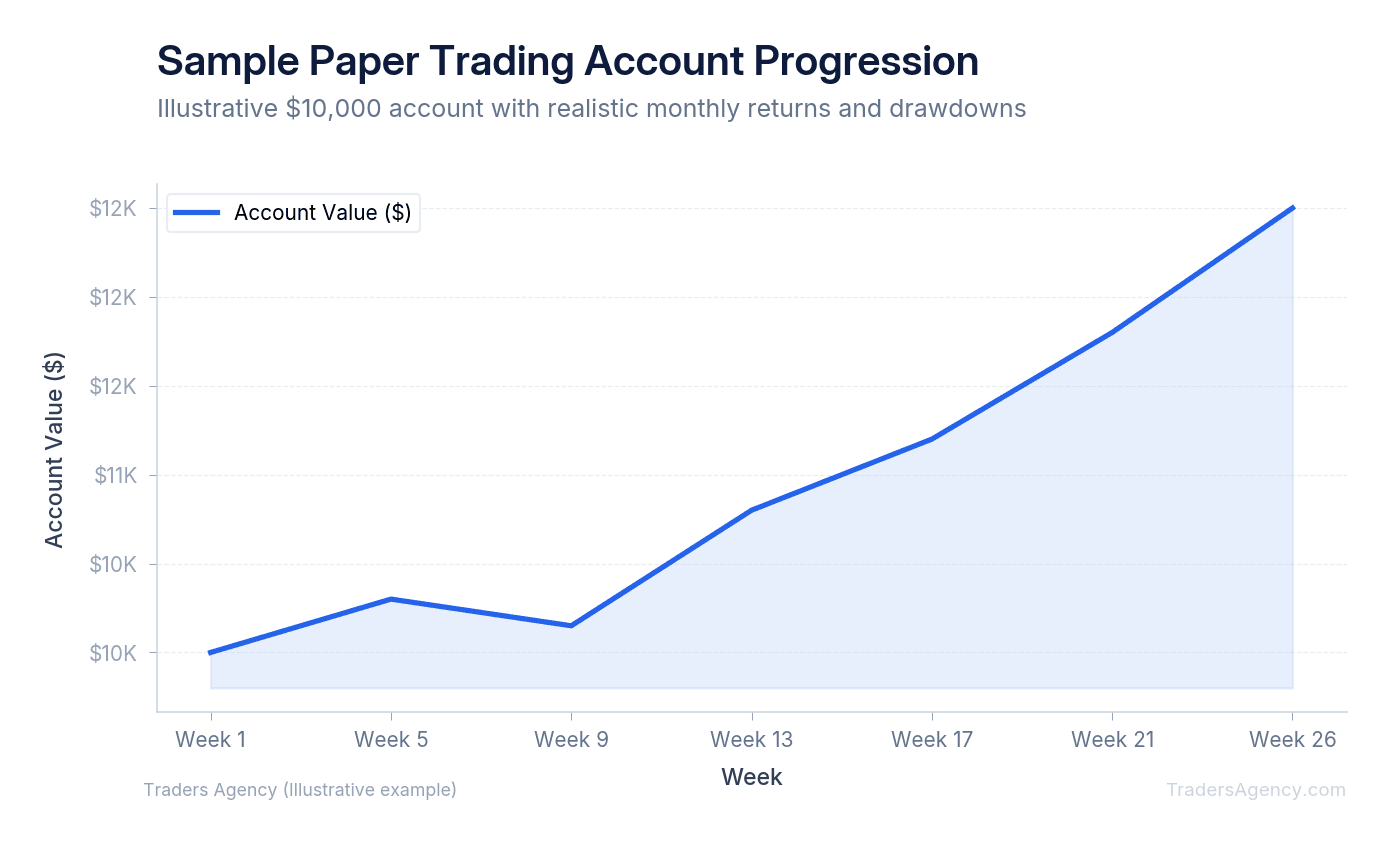
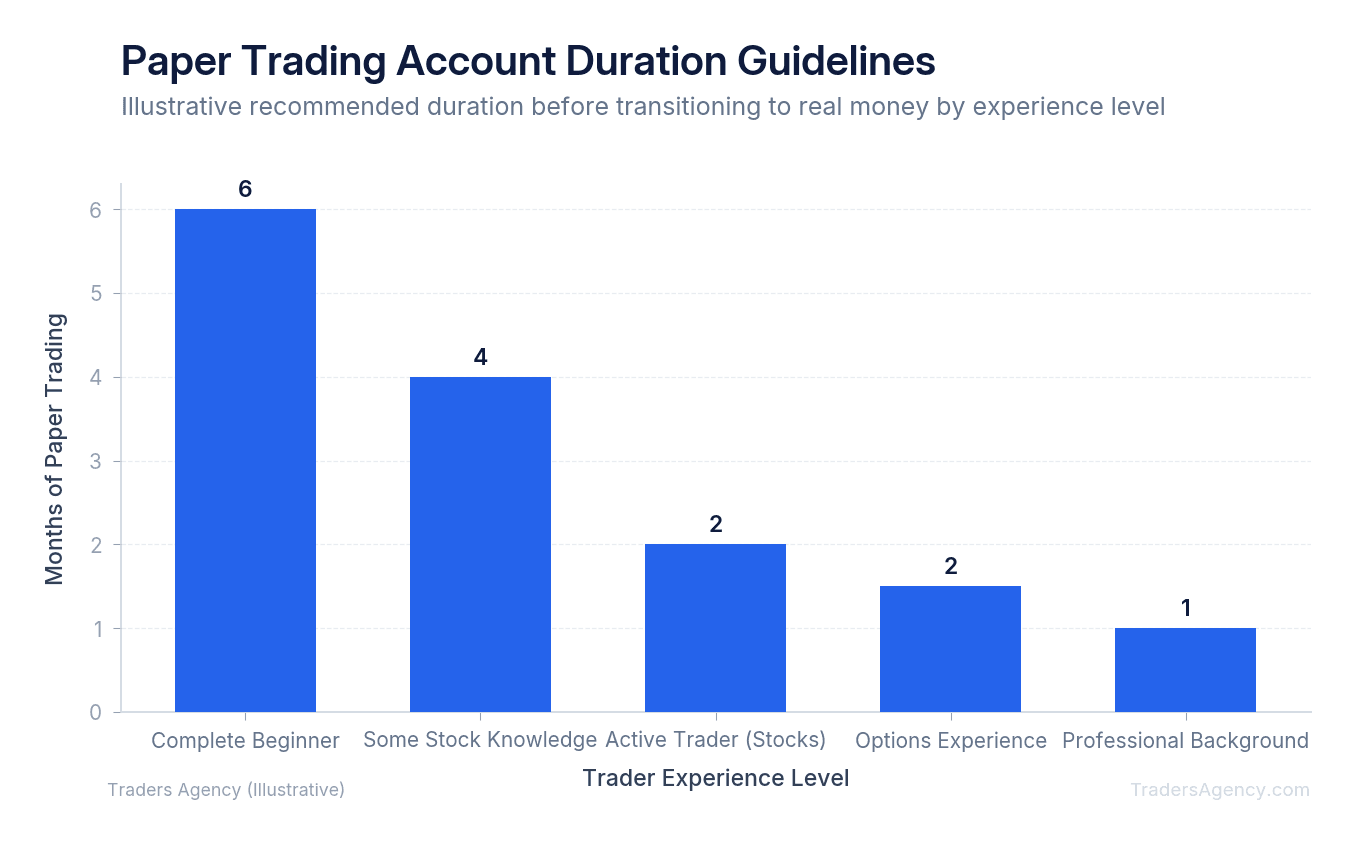
You should switch from a paper trading account to real money only after achieving consistent profitability over a specific timeframe. Our recommendation: beginners should practice for three to six months, while experienced traders testing a new strategy might only need one to two months of forward testing.
We tell our students to look for three specific milestones before funding a live account:
- Milestone 1: 50+ trades with consistent rules. You have executed at least 50 practice trades following a strict set of rules. No random guesses, no "gut feeling" trades. Every entry and exit follows your written plan.
- Milestone 2: Net profit over 90 days. Your virtual portfolio shows a net profit at the end of a 90-day period. One good week doesn't count. You need sustained, repeatable results.
- Milestone 3: Platform mastery. You can navigate your trading platform flawlessly. You know exactly how to cancel an order, adjust a stop-loss, and close a position quickly under pressure.
Key Concept: Do not rush the transition to live trading. The market will always be there waiting for you. When you do finally switch to real money, start with a very small account size. The psychological pressure of trading real capital is intense, and your performance will likely dip during your first few weeks of live trading.
By taking the time to master a paper trading account first, you protect your capital while building the foundational skills required for long-term success. Our team has seen this approach work hundreds of times: disciplined simulation practice translates directly into confident, profitable live trading.
Want expert trading insights delivered daily?
Join thousands of traders who rely on Traders Agency for market analysis and trade ideas.
Join Traders AgencyKey Takeaways
- A paper trading account uses virtual funds inside a real brokerage interface, complete with live or delayed market data, order tickets, and portfolio tracking, so the only variable missing is actual risk.
- Common beginner mistakes like buying 1,000 shares instead of 100 or placing a market order instead of a limit order are entirely avoidable with simulator practice before going live.
- The SEC's investor education resources specifically recommend virtual trading simulators as a way to test strategies before committing real capital.
- Switching to live trading should start with a very small account size, because the psychological pressure of real capital typically causes a performance dip during the first few weeks.
- Disciplined simulation practice builds the mechanical muscle memory and decision-making habits that carry over directly into confident live trading.
DISCLAIMER: Traders Agency does not offer financial advice. The information provided is for educational purposes only and should not be considered financial advice. Traders Agency is not responsible for any financial losses or consequences resulting from the use of the information provided. Trading carries inherent risks and may not be suitable for all individuals. You are advised to conduct your own research and seek personalized advice before making any investment decisions, recognizing the potential risks and rewards involved.
See more from Traders Agency on Google
Make us a preferred source and our market analysis will appear more prominently in your Google Search, Top Stories, and AI results.
Add to Preferred Sources