
You've probably watched a stock you own climb steadily for months, only to see those gains vanish in a single bad week. Market drops are stressful, but selling your shares every time things get choppy is a guaranteed way to miss out on long-term growth. We're going to walk you through exactly how to protect your hard-earned profits without selling a single share.
By the end of this guide, you'll know how to apply protective hedging techniques to your own portfolio. Our team recommends learning these basics before a market correction actually begins. We'll cover the mechanics, the math, and the exact steps you need to take to build a safety net for your investments.
Key Concept: An options hedging strategy is a method used to protect your stock investments from potential market losses. It involves buying or selling options contracts, which give you the right to buy or sell an asset at a specific price before a set expiration date, limiting your total downside risk.
Can You Hedge Using Options?
Bottom Line: Options hedging is not a permanent portfolio feature but a targeted tool you deploy when the cost of protection is justified by what you stand to lose. The core skill is knowing when to use it, how much to spend, and which structure fits your situation. Master the mechanics on a small position first, and you will have a repeatable process for protecting gains without abandoning your long-term holdings.
Yes, and it works like an insurance policy for your stock portfolio. By purchasing specific options contracts, you establish a guaranteed floor price for your shares. This approach lets you participate in upward price movement while strictly capping your maximum potential loss during market downturns.
We teach our members to think of this concept exactly like buying car insurance. You pay a small premium to protect a highly valuable asset. If you never get into a crash, you lose the premium you paid, but you keep your car. If a crash does happen, the insurance policy steps in to cover the heavy financial losses.
Large financial institutions use this exact logic every single day. They rarely leave their massive stock portfolios completely exposed to sudden market crashes. Instead, they buy options contracts to create a mathematical boundary on their risk.
As a retail trader, you have access to the exact same tools. You don't need a Wall Street background to use them. You just need to understand the basic mechanics of how an options contract interacts with the shares you already own.
How Does a Protective Put Work as Portfolio Insurance?
To build a basic options hedging strategy, you need to understand the put option. A put option gives you the right to sell 100 shares of a stock at a chosen price before a specific date. The price you choose to sell at is called the strike price. The date the contract ends is the expiration date.
When you already own the underlying stock and you buy a put option to protect it, this specific setup is known as a protective put. The logic behind the trade is straightforward: if the stock price falls below your strike price, the put option gains value. This increase in the option's value directly offsets the money you're losing on your stock position.
One standard options contract controls exactly 100 shares of stock. This means you need to buy one put option for every 100 shares you want to protect. If you own 300 shares, you need three contracts. You can learn more about options contract specifications at the Cboe Options Exchange.
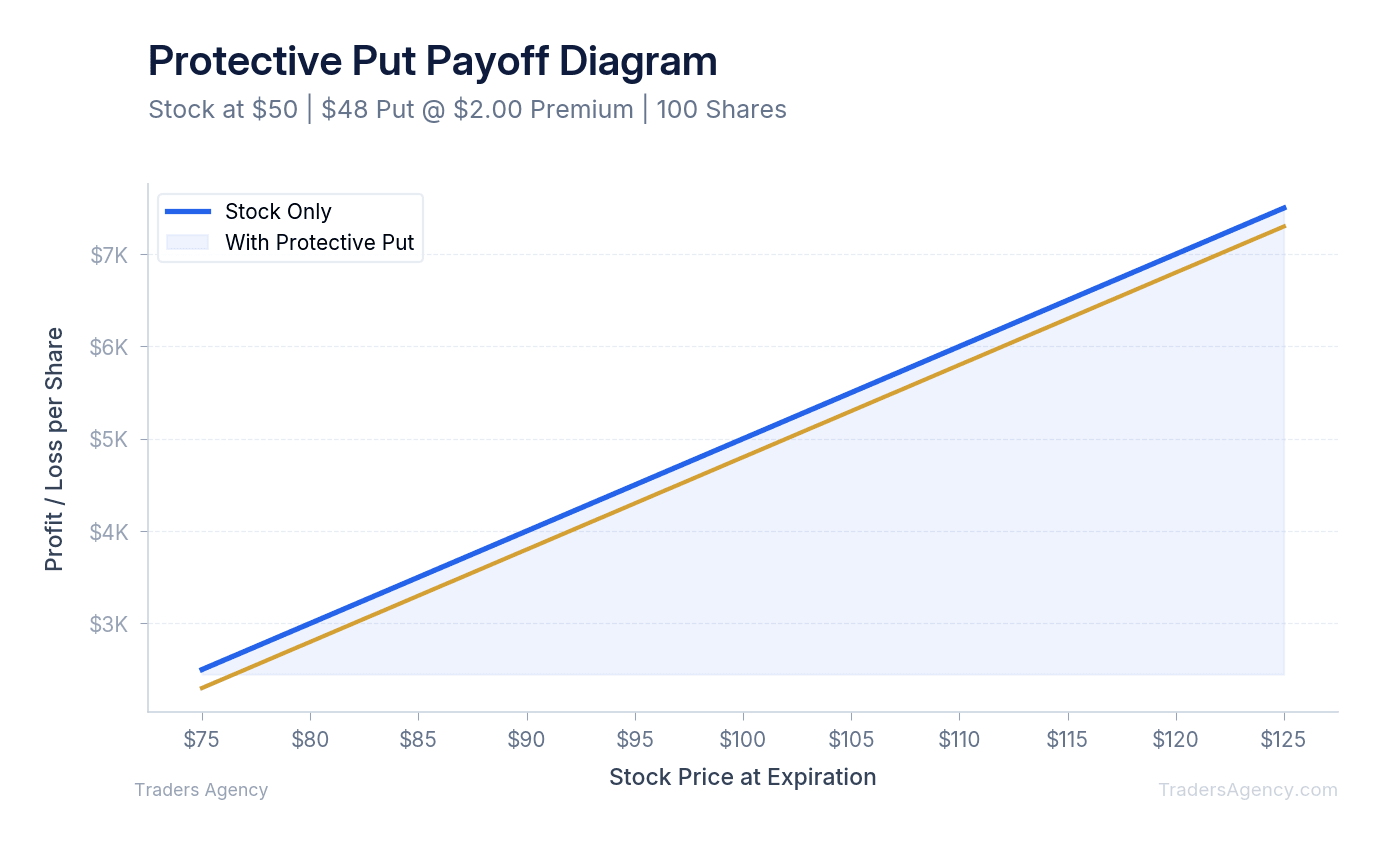
When selecting your strike price, you'll generally look at out-of-the-money options. This means the strike price is below the current stock price. For example, if a stock is trading at $50, you might buy a put with a $45 strike price. You're essentially agreeing to absorb the first $5 of risk yourself, just like an insurance deductible.
How Do You Execute an Options Hedging Strategy Step by Step?
Here's a concrete example with real numbers. Imagine you own 100 shares of Apple (AAPL), currently trading at $150 per share. Your total position value is $15,000. You're worried about an upcoming earnings report and want to protect your capital.
- Identify the Setup: You decide to buy one AAPL put option with a $145 strike price expiring in 30 days. The cost of this option is known as the premium. In this example, the premium is $2.00 per share. Since one contract covers 100 shares, your total cost to enter the trade is $200.
- Execute the Trade: Log into your brokerage account and buy to open one contract of the AAPL $145 put. You pay the $200 premium upfront from your cash balance. Your total investment is now $15,200 (the $15,000 stock value plus the $200 put). Your absolute worst-case scenario is now mathematically locked in. You have the guaranteed right to sell your shares for $14,500, no matter how far the stock falls over the next 30 days.
- Evaluate the Outcome Scenarios: Review the three possible results at expiration to understand the full risk-reward profile of your hedge.
| Scenario | AAPL Price at Expiration | Outcome | Net Profit/Loss |
|---|---|---|---|
| Best Case | $170 | Put expires worthless; stock gains $2,000 | +$1,800 (after $200 premium) |
| Flat / Most Likely | $150 | Put expires worthless; stock unchanged | -$200 (premium cost only) |
| Worst Case | $100 | Exercise put at $145; loss capped | -$700 ($500 stock loss to strike + $200 premium) |
Notice the power of this setup. Without protection, a crash to $100 would cost you $5,000. With the protective put, your maximum loss is strictly capped at $700. That's the value of a well-placed hedge.
Want expert trading insights delivered daily?
Join thousands of traders who rely on Traders Agency for market analysis and trade ideas.
Join Traders AgencyWhat Is the Cost of Hedging with Options?
The cost of hedging with options is the premium you pay to purchase the contract. This price is determined by three main factors: the implied volatility of the market, the time remaining until expiration, and the distance between the current stock price and your chosen strike price. Higher perceived risk means higher premiums.
Market conditions heavily influence this cost. When the market is calm, options premiums are generally cheap. When the market is panicking, premiums skyrocket because everyone is rushing to buy protection at the exact same time.
Time is also a major factor. If you buy a put option that expires in one week, it will be much cheaper than a put option that expires in one year. However, the one-week option requires you to be right about the exact timing of a market drop. We prefer to buy protection 30 to 60 days out to give the trade enough time to work.
Watch Out: Buying protection during an active market crash is like buying fire insurance while your house is already burning. Premiums spike when fear is highest. The best time to hedge is before volatility surges, when options are still reasonably priced.
What Are the Lower-Cost Alternatives to Buying a Protective Put?
Buying protective puts can get expensive if you do it constantly. If you want to lower your costs, our team recommends exploring a collar strategy. A collar involves buying a protective put while simultaneously selling a call option on the exact same stock.
A call option gives the buyer the right to purchase your shares at a specific price. By selling a call, you collect a premium in cash. You then use that cash to pay for your protective put option.
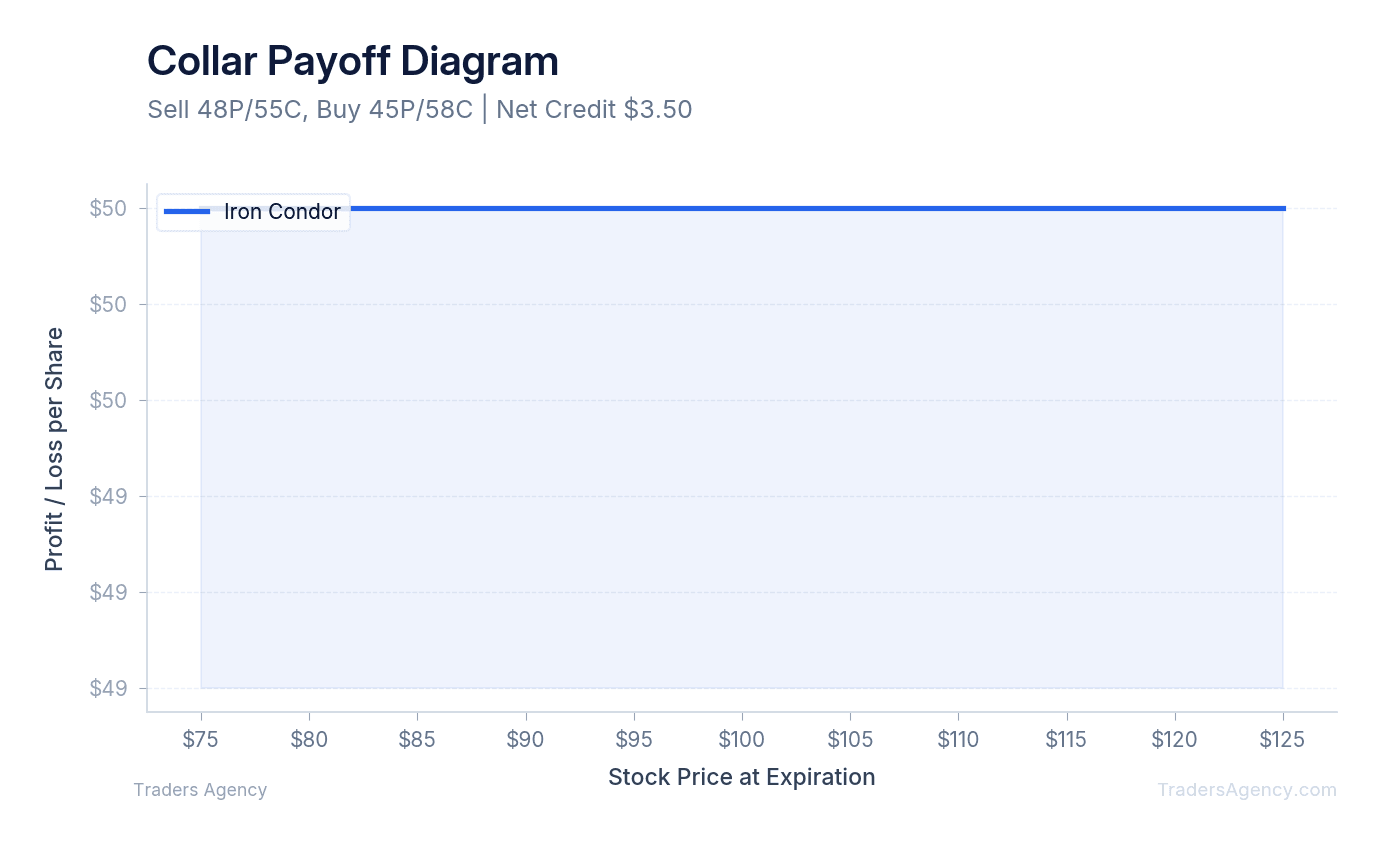
Here's how a collar works using our AAPL example at $150:
| Parameter | Value |
|---|---|
| Stock Position | AAPL at $150 (100 shares) |
| Put Purchased | $145 strike, cost $200 |
| Call Sold | $160 strike, premium collected $150 |
| Net Hedge Cost | $50 out of pocket |
| Downside Protection | Losses capped below $145 |
| Upside Cap | Gains capped at $160 |
The trade-off is clear: your maximum gain is capped at the $160 strike price. If AAPL goes to $170, you're obligated to sell your shares at $160. You get nearly free downside protection, but you sacrifice unlimited upside potential.
Another alternative is the bear put spread. Instead of just buying one put, you buy a put near the current stock price and sell another put further down. This lowers your upfront cost, but it only protects you down to the lower strike price. If the stock falls past that lower strike, you're exposed to losses again.
How to Hedge a Stock Position Using Delta
Sometimes you want to protect your entire portfolio rather than individual stocks. To do this, you can use index options like puts on the S&P 500 ETF (SPY). This requires understanding a mathematical concept called delta.
Delta measures how much an option's price will change for every $1 move in the underlying asset. A put option always has a negative delta, ranging from 0 to -1.00. If an option has a delta of -0.50, its price will increase by $0.50 for every $1 the stock drops.
If you have a $100,000 portfolio that closely tracks the broader market, you can buy SPY puts to offset potential losses. You don't need to buy puts on every single stock you own.
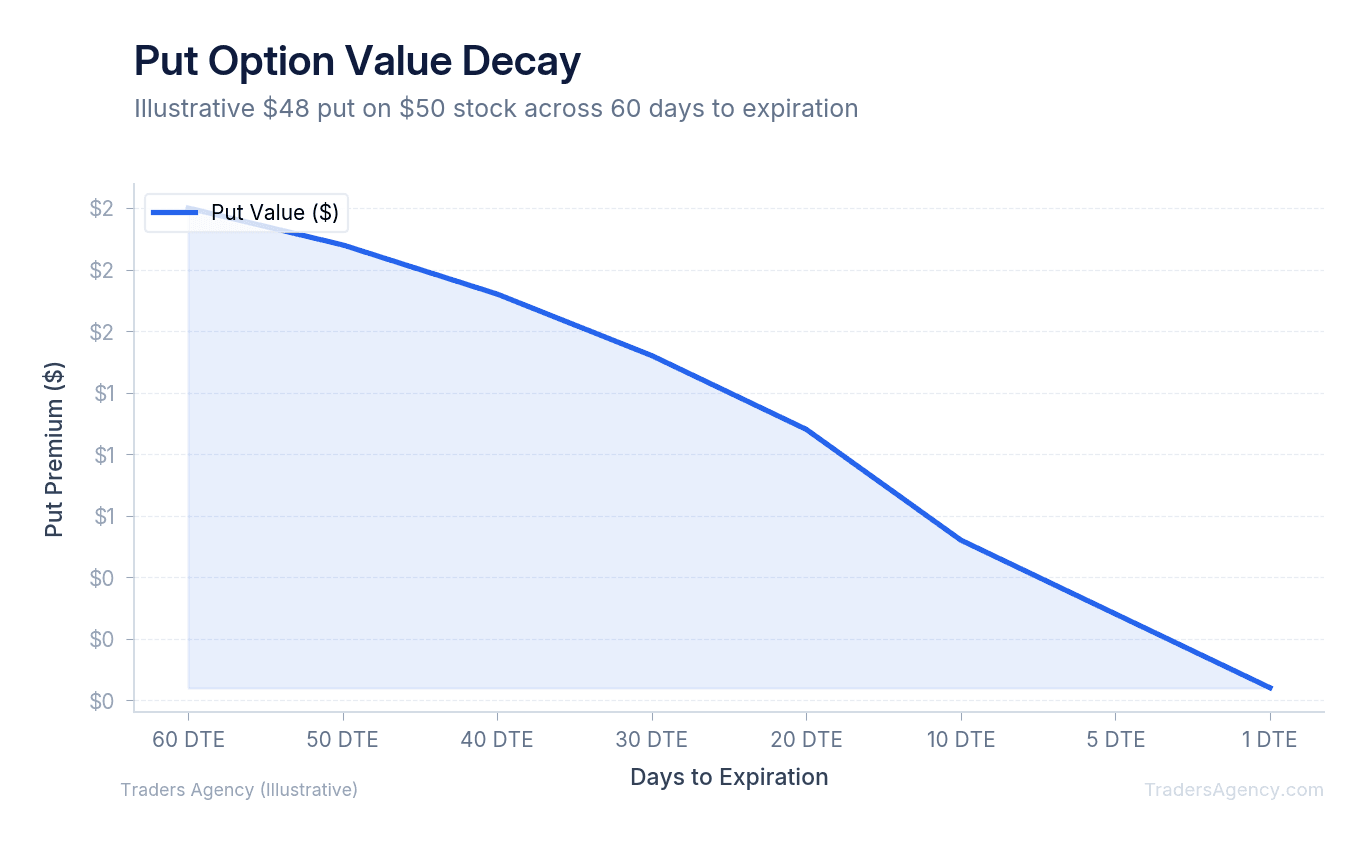
Keep in mind that options lose value over time even if the stock price never moves. This process is called theta decay. Your existing protection loses value as the expiration date approaches, meaning you must actively manage and replace your contracts if you want continuous coverage.
To calculate a basic delta hedge, divide your total portfolio value by the value of the index you're using. Then adjust for the delta of the specific options you plan to buy. This ensures your protection matches the actual dollar risk in your account.
When Should You Hedge Instead of Reducing Your Position?
You should hedge instead of selling when you want to defer capital gains taxes or maintain long-term dividend payouts. Hedging lets you keep your shares while surviving short-term volatility. If your long-term outlook remains positive, buying protection is often better than selling the asset outright.
Selling shares triggers taxable events. Realizing short-term capital gains can result in heavy tax burdens, sometimes eating into profits far more than a hedging premium would. The SEC provides educational resources on how capital gains taxation works for investors. By using an options hedging strategy, you avoid triggering a sale of your underlying stock.
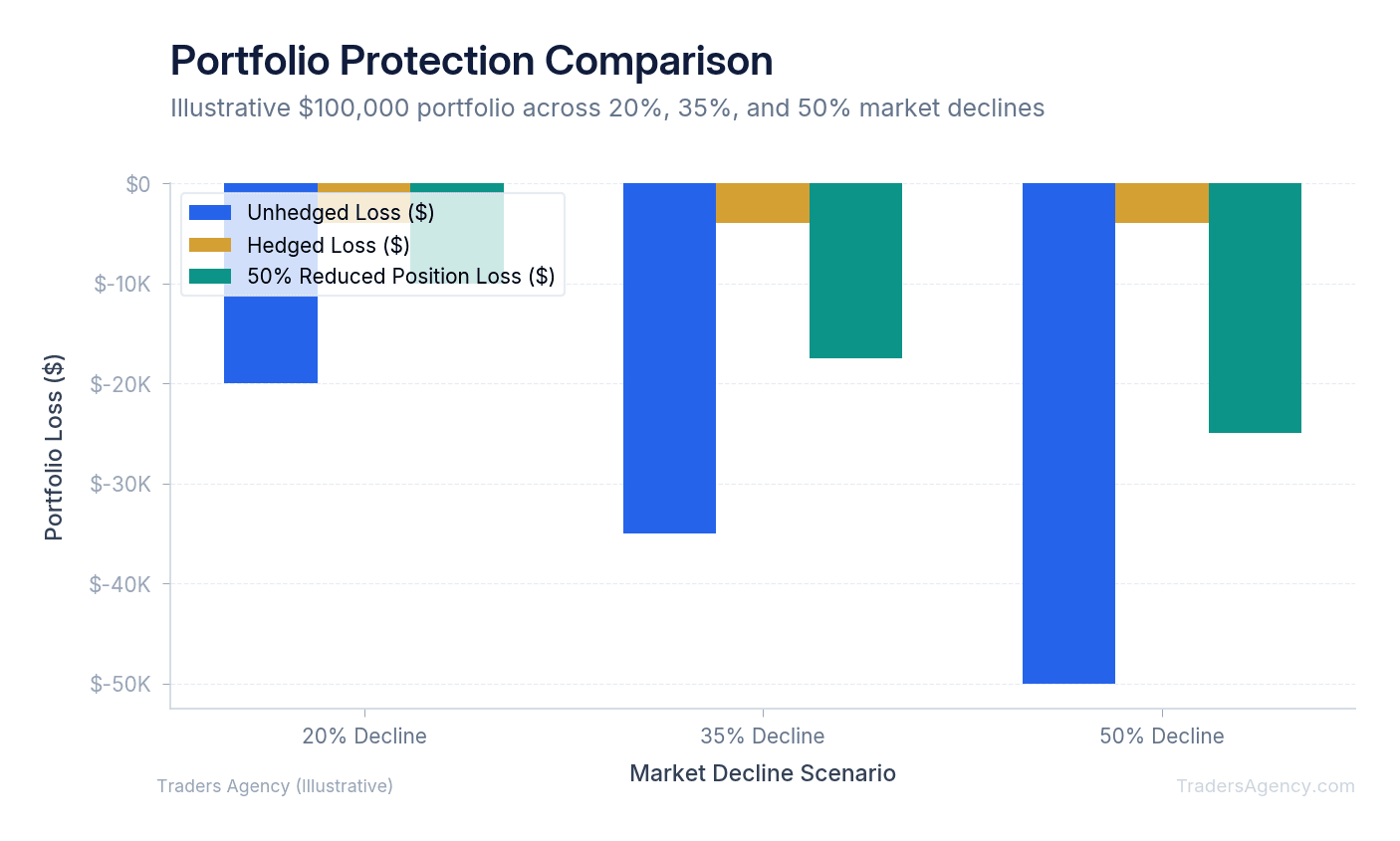
However, hedging is not a magic solution for every market environment. There are specific times when simply selling your shares is the better mathematical choice. Here are three rules our team follows for strict risk management:
- Don't hedge a broken thesis. If the fundamental reasons you bought the stock have changed, just sell the shares. Don't waste money on options premiums trying to save a bad investment.
- Watch the implied volatility. When the market is panicking, put options become incredibly expensive. Buying protection during an active crash rarely offers good value.
- Mind your position sizing. Never spend more than 2% to 5% of your total portfolio value on hedging premiums annually. If you spend too much on insurance, you'll slowly drain your account through a thousand tiny cuts.
Remember This: An options hedging strategy is a tool, not a requirement. Use it when you have significant profits to protect, an upcoming binary event like earnings, or a tax situation that makes selling undesirable. Master the basics on a small scale first, and you'll have a powerful method for managing risk in any market condition.
Want expert trading insights delivered daily?
Join thousands of traders who rely on Traders Agency for market analysis and trade ideas.
Join Traders AgencyKey Takeaways
- Buying a protective put establishes a guaranteed floor price for your shares, letting you keep upside exposure while capping your maximum downside loss during a market downturn.
- Limit annual hedging costs to 2% to 5% of your total portfolio value. Spending more than that slowly erodes returns through premium decay even when the market cooperates.
- Collars and put spreads are lower-cost alternatives to straight protective puts, useful when you want protection but are unwilling to pay full single-leg option premiums.
- An options hedging strategy makes the most sense in three specific situations: when you have significant unrealized profits to protect, ahead of a binary event like earnings, or when a tax situation makes outright selling undesirable.
- Delta is a key metric for sizing a hedge correctly. Understanding your position's delta tells you how many options contracts you need to offset a given move in the underlying stock.
DISCLAIMER: Traders Agency does not offer financial advice. The information provided is for educational purposes only and should not be considered financial advice. Traders Agency is not responsible for any financial losses or consequences resulting from the use of the information provided. Trading carries inherent risks and may not be suitable for all individuals. You are advised to conduct your own research and seek personalized advice before making any investment decisions, recognizing the potential risks and rewards involved.
See more from Traders Agency on Google
Make us a preferred source and our market analysis will appear more prominently in your Google Search, Top Stories, and AI results.
Add to Preferred Sources