
You've probably seen a stock gap up 15% before the opening bell rings. Our team receives questions about this daily from new traders. Many people assume the stock market completely shuts down at four o'clock. They wake up the next morning, check their portfolios, and see drastically different prices. That invisible price action happens entirely in the extended trading sessions. Understanding premarket and after-hours trading is essential for any active trader. We're going to walk you through exactly how it works, how to place trades outside normal hours, how to manage the unique risks involved, and how to execute a specific earnings reaction strategy using these sessions.
What Is Premarket and After-Hours Trading?
Bottom Line: Pre-market and after-hours trading gives active traders a real edge when reacting to earnings and news, but that access comes with serious liquidity risks that can punish undisciplined execution. The core lesson is simple: use limit orders, avoid thinly traded stocks, and treat extended sessions as a precision tool rather than a free-for-all. Respecting those boundaries is what separates traders who profit from the gap-up from those who get caught chasing it.
Pre-market and after-hours trading refers to the extended sessions occurring before and after regular market hours. Regular trading runs from 9:30 a.m. to 4:00 p.m. Eastern Time. Extended sessions allow traders to react immediately to news, earnings reports, and global events outside of that standard window.
Think of regular market hours like a busy retail store during the day. The store is packed with buyers and sellers, making transactions quick and easy. Extended hours are like a private VIP shopping event at night. There are fewer people at this event. Prices might fluctuate more wildly because fewer participants are available. If only one person is selling a specific item, they can demand a much higher price.
During the standard day, trades route through major physical exchanges like the New York Stock Exchange. Outside of those hours, trades match up directly between buyers and sellers through Electronic Communication Networks (ECNs).
Key Concept: An ECN is a computerized system that automatically matches buy and sell orders for securities. It bypasses the traditional middleman, connecting buyers and sellers directly during extended hours.
One structural difference you need to understand: your broker does not guarantee your extended hours order will execute. It only executes if another trader on the exact same ECN agrees to your exact price. The SEC's investor education resources outline these structural differences in detail, and we encourage every trader to review them.
When Do Extended Trading Sessions Run?
Extended trading sessions run on a strict daily schedule. The pre-market session typically opens at 4:00 a.m. and closes at 9:30 a.m. Eastern Time. The after-hours session begins immediately at 4:00 p.m. and concludes at 8:00 p.m. Eastern Time.
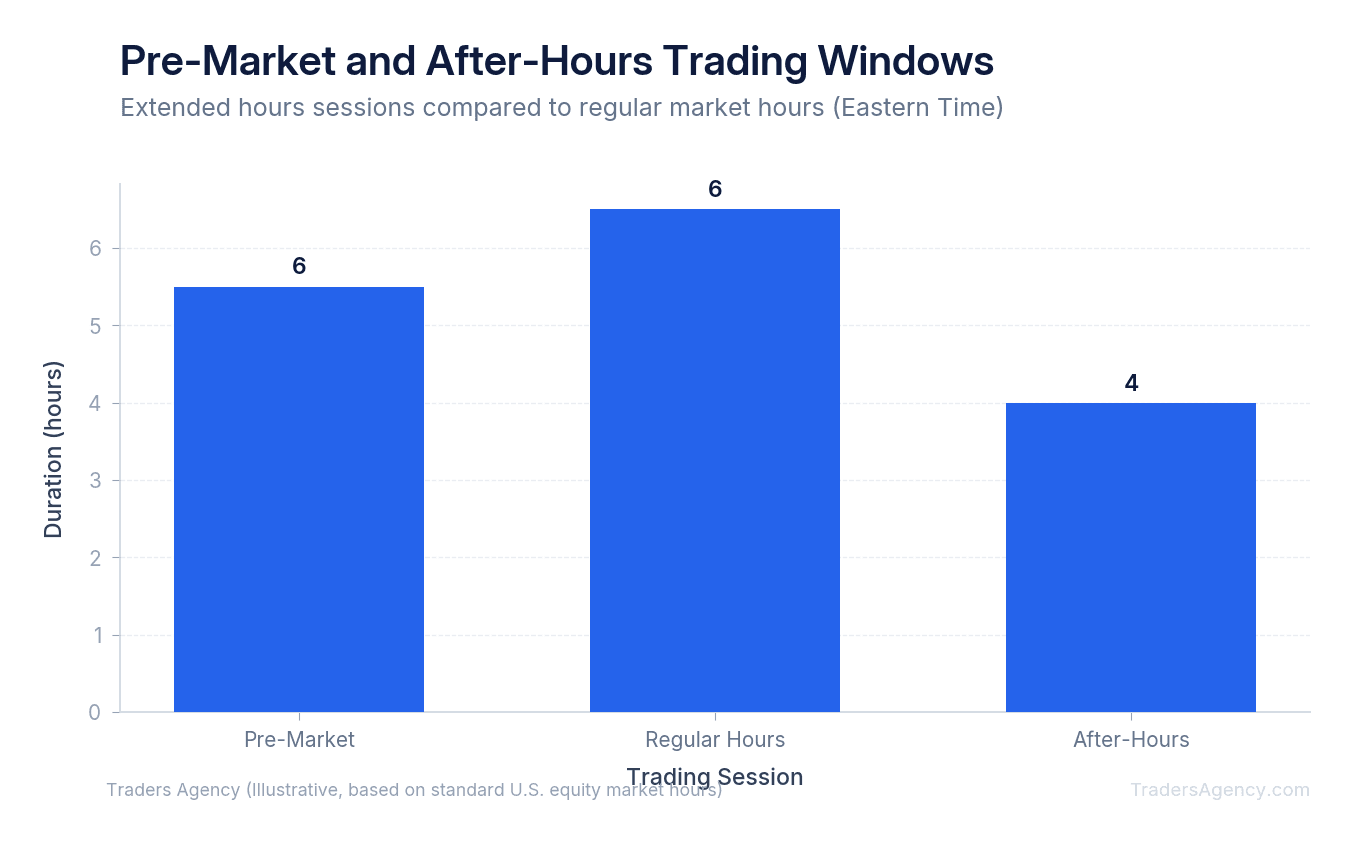
Not all brokers offer the full window. Some retail brokers only open their pre-market access at 7:00 a.m. or 8:00 a.m. ET. You must check your specific platform settings to see your exact access times.
The heaviest volume during these sessions usually happens right near the regular market open and close. The window between 8:00 a.m. and 9:30 a.m. ET sees intense activity, as companies release morning press releases and economic data is published. Similarly, the window between 4:00 p.m. and 5:00 p.m. ET is highly active because many major publicly traded companies release their quarterly earnings reports during this window.
Trading volume drops significantly in the middle of the night. If you try to trade at 5:00 a.m. ET, you might find zero buyers or sellers for your chosen stock.
What Should Beginners Know About After-Hours Trading?
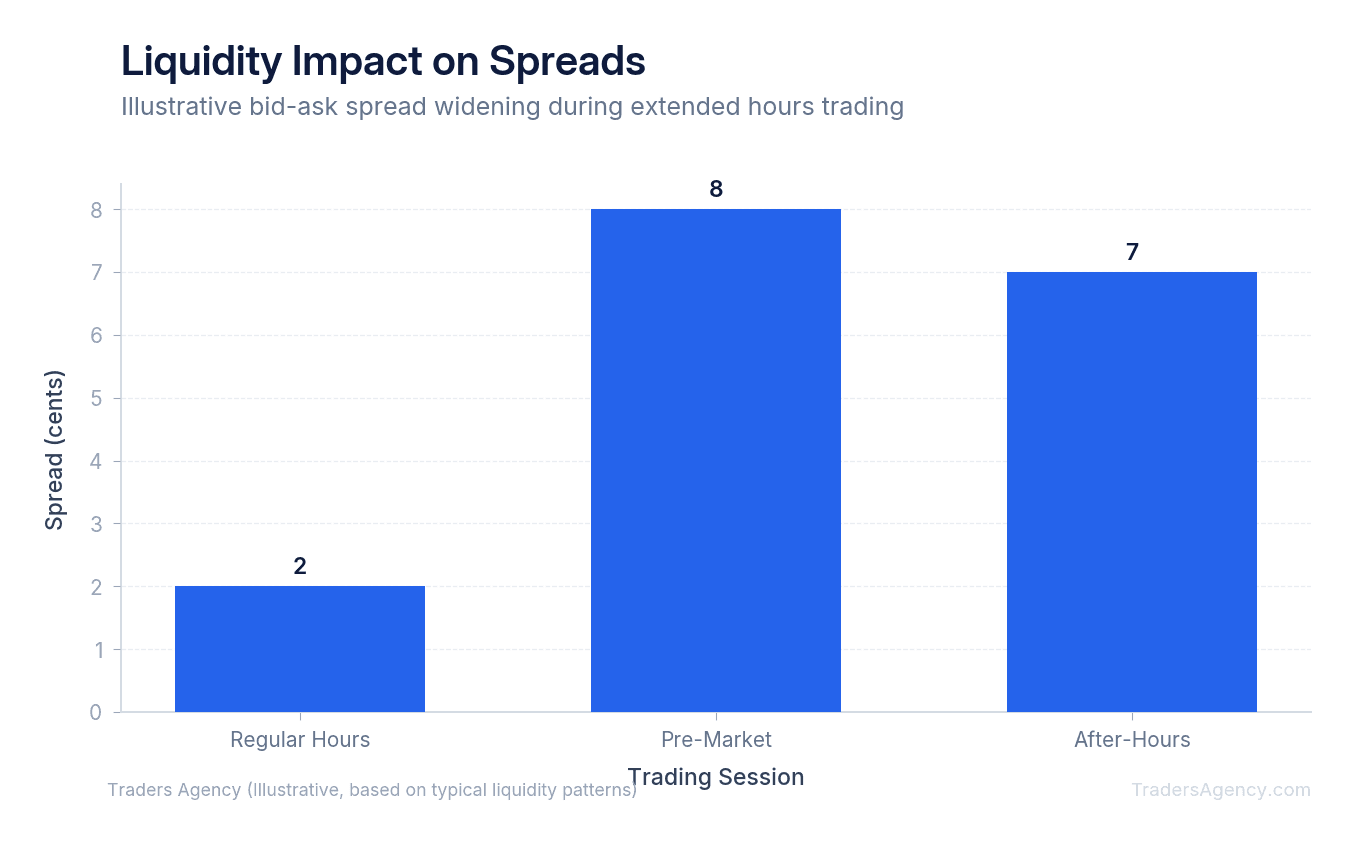
Beginners should know that after-hours trading carries significantly lower liquidity and much wider bid-ask spreads than regular sessions. You are trading with fewer participants, which means prices can swing violently. We teach our students to prioritize strict risk management during these volatile evening hours.
Key Concept: Liquidity refers to how easily you can buy or sell a stock without affecting its price. High liquidity means many buyers and sellers are active, keeping spreads tight and fills reliable.
During regular hours, a popular stock like Apple (AAPL) has massive liquidity. The bid-ask spread might be just one penny. You could see a bid of $150.00 and an ask of $150.01.
In the after-hours session, that liquidity dries up. That same Apple spread might widen to a bid of $149.80 and an ask of $150.20. If you buy at the ask price and immediately sell at the bid price, you instantly lose $0.40 per share. This wide spread is the primary danger for beginners.
Another major risk is price volatility. A single large order can push the stock price drastically. If a mutual fund decides to dump shares at 6:00 p.m., there might not be enough retail buyers to absorb the supply. The price will plummet. We prefer to wait for clear price trends rather than jumping at the first sign of movement. Patience saves capital.
How Does Extended Hours Trading Work on Your Broker Platform?
Extended hours trading works by routing your orders through electronic communication networks instead of traditional exchanges. To participate, you must explicitly select an extended hours trading session on your broker platform and use a strict limit order to define your exact purchase or sale price.
Our team recommends setting up your trading platform before you actually need to place a trade. The worst time to figure out your broker's interface is when a stock is moving fast.
Here is the step-by-step process we teach our members for placing these trades:
- Enable Extended Hours Access. Most brokers require you to sign a special electronic agreement before you can trade outside regular hours. This document simply states that you understand the risks of low liquidity and high volatility. Log into your account settings and look for a section labeled "Trading Permissions" or "Account Features." Check the box to enable extended hours. Approval is usually instant.
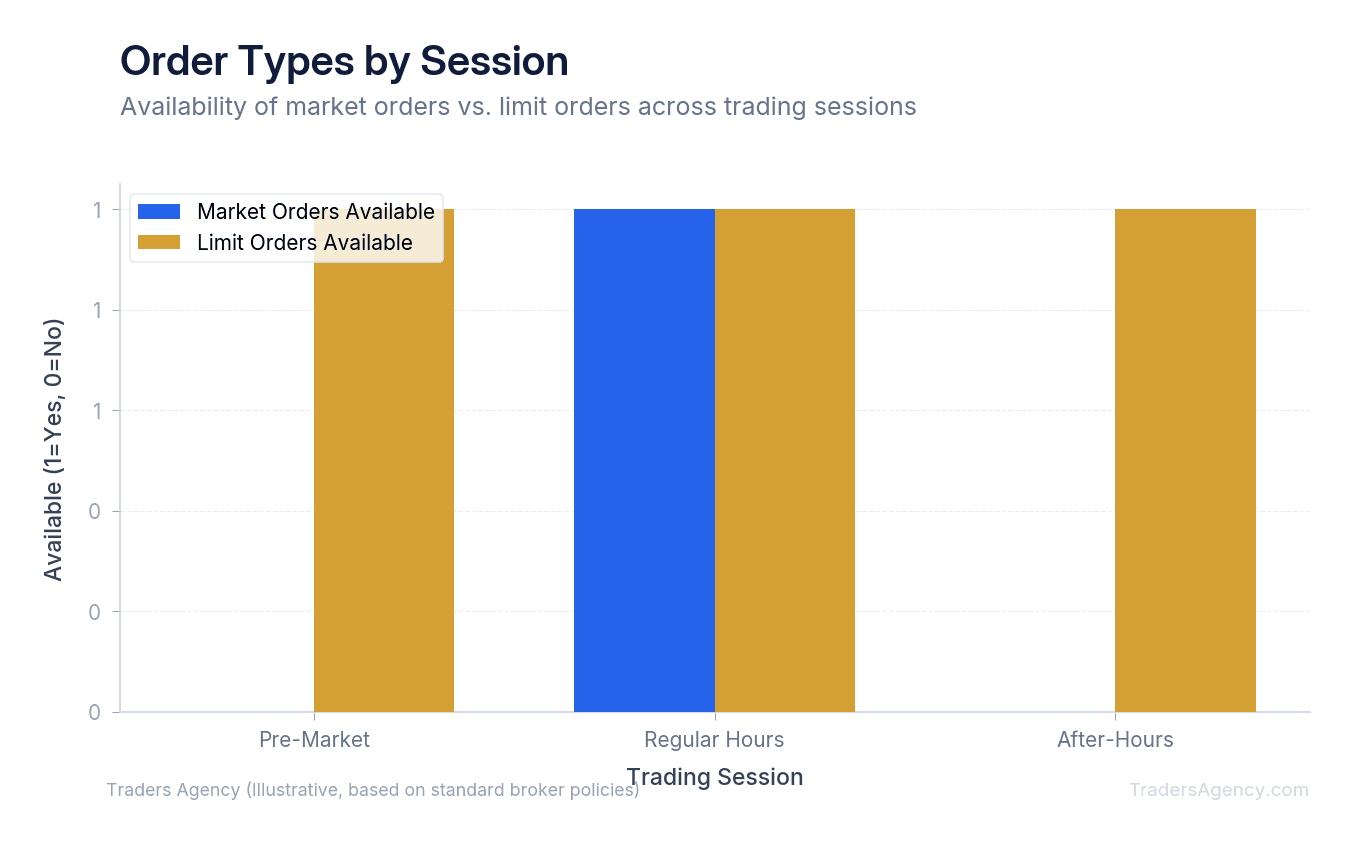
- Select the Correct Order Type. You cannot use a market order during extended sessions. A market order tells your broker to buy or sell immediately at the best available price. Because the bid-ask spreads are so wide, a market order could result in a terrible fill price. Instead, you must use a limit order. A limit order specifies the exact maximum price you will pay or the exact minimum price you will accept. If you want to buy shares, you set your limit price, and the broker will only execute the trade at your price or lower.
- Choose the Correct Time in Force (TIF). When you fill out your order ticket, you will see a dropdown menu called Time in Force. The default setting is usually "Day," which means the order expires at 4:00 p.m. ET. To trade in the evening or early morning, you must change this setting. Look for options labeled EXT (Extended), GTC+EXT (Good Till Canceled plus Extended), or Day+EXT. Selecting this ensures your broker keeps the order active during the pre-market and after-hours windows.
- Monitor for Partial Fills. Because liquidity is low, your order might not fill entirely. If you try to buy 500 shares, you might only get 100 shares at your limit price. Watch your order status closely. If you only get a partial fill, you have to decide whether to keep the remaining order open or cancel it.
Want expert trading insights delivered daily?
Join thousands of traders who rely on Traders Agency for market analysis and trade ideas.
Join Traders AgencyHow Do You Trade Earnings Reactions Pre-Market and After-Hours?
Trading earnings announcements is one of the most common reasons traders use extended sessions. Companies rarely release earnings during regular market hours. They release them before the market opens or after it closes.
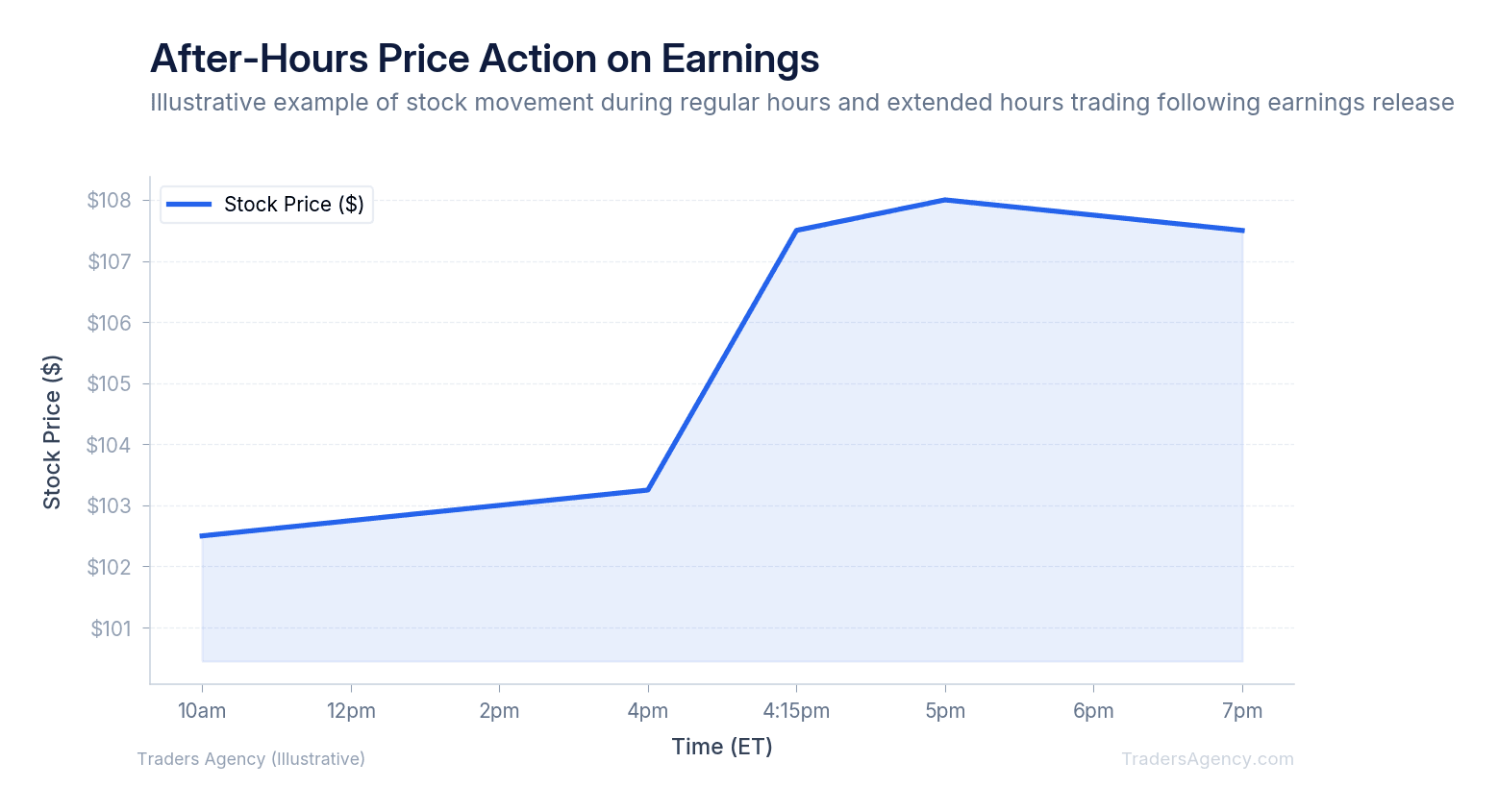
Here is a concrete example using a hypothetical earnings report. Imagine Microsoft (MSFT) is scheduled to report earnings after the closing bell. The stock closes the regular session at $300.00. At 4:05 p.m. ET, the company releases its report announcing record profits. The stock immediately spikes in the after-hours session.
The Setup
We look for a stock that has just released a major news event. We want to see heavy volume entering the after-hours tape. In our Microsoft example, we watch the price jump from $300.00 to $310.00 in a matter of minutes. We decide we want to buy, but we refuse to chase the absolute top price.
Remember: standard equity options do not trade during these extended hours. They only trade during the regular daytime session. If you want to trade this earnings reaction immediately, you must buy or sell the actual equity shares.
The Execution
We open our broker order ticket. We select a limit order to buy 100 shares. We set our limit price at $308.00, hoping the stock will dip slightly before continuing its upward run. We change our Time in Force to EXT so the order works in the after-hours session. We click submit.
The Outcome
There are three possible outcomes here:
| Scenario | What Happens | Result |
|---|---|---|
| Best Case | Stock dips to $308.00, our limit fills, stock rallies to $315.00 | +$700 profit (100 shares × $7.00) |
| Missed Opportunity | Stock never dips, runs straight to $320.00, order at $308 never fills | $0 (no money made, no money lost) |
| Worst Case | Stock dips to $308.00, order fills, price crashes to $295.00 | -$1,300 loss (100 shares × $13.00) |
The missed-opportunity scenario is a perfectly acceptable outcome. This is why we always plan our exit strategy before we enter the trade.
How Do You Manage Risk When Trading Outside Regular Market Hours?
Knowing how to trade in extended sessions is only half the battle. Knowing when to actually use this feature dictates your long-term success. We prefer to use premarket and after-hours trading only when there is a specific, identifiable news driver. This includes earnings reports, FDA announcements, or major macroeconomic data releases.
You should avoid trading during these hours if the stock has no news. Trading quiet stocks in the pre-market is a recipe for getting trapped in a wide bid-ask spread.
Position Sizing Rules
Because of the added volatility, we teach our members to reduce their position sizes. If you normally buy $1,000 worth of a stock during the day, consider buying only $500 worth during extended hours. This smaller size protects your account from sudden, aggressive price swings. It keeps your emotions in check when the bid-ask spread jumps around.
Stop-Loss Limitations
Watch Out: Standard stop-loss orders do not work during extended sessions. If you hold a stock overnight and bad news breaks at 6:00 a.m., your regular stop-loss will not trigger until the market opens at 9:30 a.m. By that time, the stock might have already gapped down significantly, resulting in a much larger loss than you planned.
To manage this risk, you must actively monitor your positions if you hold them outside regular hours. If a trade goes against you in the pre-market, you have to manually execute a limit order to exit the position.
Avoiding Penny Stocks
We strongly advise against trading low-priced penny stocks during extended hours. These stocks are already highly volatile during the day. In the pre-market, a penny stock can double in price on a single trade of 100 shares. This creates a false illusion of demand. When the regular market opens, the price often collapses instantly. Stick to large, well-known companies with high daily trading volume.
Extended hours trading provides incredible access to market-moving events. Treat it with respect, use strict limit orders, and always prioritize protecting your capital. Our team publishes new strategy guides and market analysis every week to help you sharpen your edge.
Want expert trading insights delivered daily?
Join thousands of traders who rely on Traders Agency for market analysis and trade ideas.
Join Traders AgencyKey Takeaways
- Extended trading sessions run outside the standard 9:30 a.m. to 4:00 p.m. Eastern Time window, allowing traders to react immediately to earnings reports and breaking news before the regular market opens.
- Liquidity is significantly thinner during extended hours, which means a single trade of 100 shares can move a penny stock's price dramatically, creating false signals that collapse once regular trading begins.
- Limit orders are essential during pre-market and after-hours sessions. Market orders in low-liquidity conditions can result in fills far outside the expected price.
- Sticking to large, high-volume companies during extended hours reduces the risk of being caught in manipulated or illiquid price moves.
- Earnings reactions are a primary use case for extended hours trading, since companies frequently report results outside regular market hours and prices can gap significantly before the opening bell.
DISCLAIMER: Traders Agency does not offer financial advice. The information provided is for educational purposes only and should not be considered financial advice. Traders Agency is not responsible for any financial losses or consequences resulting from the use of the information provided. Trading carries inherent risks and may not be suitable for all individuals. You are advised to conduct your own research and seek personalized advice before making any investment decisions, recognizing the potential risks and rewards involved.
See more from Traders Agency on Google
Make us a preferred source and our market analysis will appear more prominently in your Google Search, Top Stories, and AI results.
Add to Preferred Sources