
A surge in energy costs combined with falling bond prices is creating a challenging environment for unprotected equities. Building an oil price risk portfolio is now an urgent priority for traders. Our team is watching a major shift in the market as risks build for stocks, and less-protected investors need to pivot toward all-weather outperforming stocks immediately.
The data we're tracking shows a severe divergence between energy markets and fixed income. Traders holding standard equity allocations are entirely exposed to simultaneous shocks in both oil and interest rates.
What Are the Immediate Market Impacts?
The immediate market impacts reveal a severe divergence between energy and bonds. Over the past 90 days, the United States Oil Fund (USO) surged 78.89%, while the iShares 20+ Year Treasury Bond ETF (TLT) dropped 5.28%. Meanwhile, the SPDR S&P 500 ETF Trust (SPY) gained 8.16%.
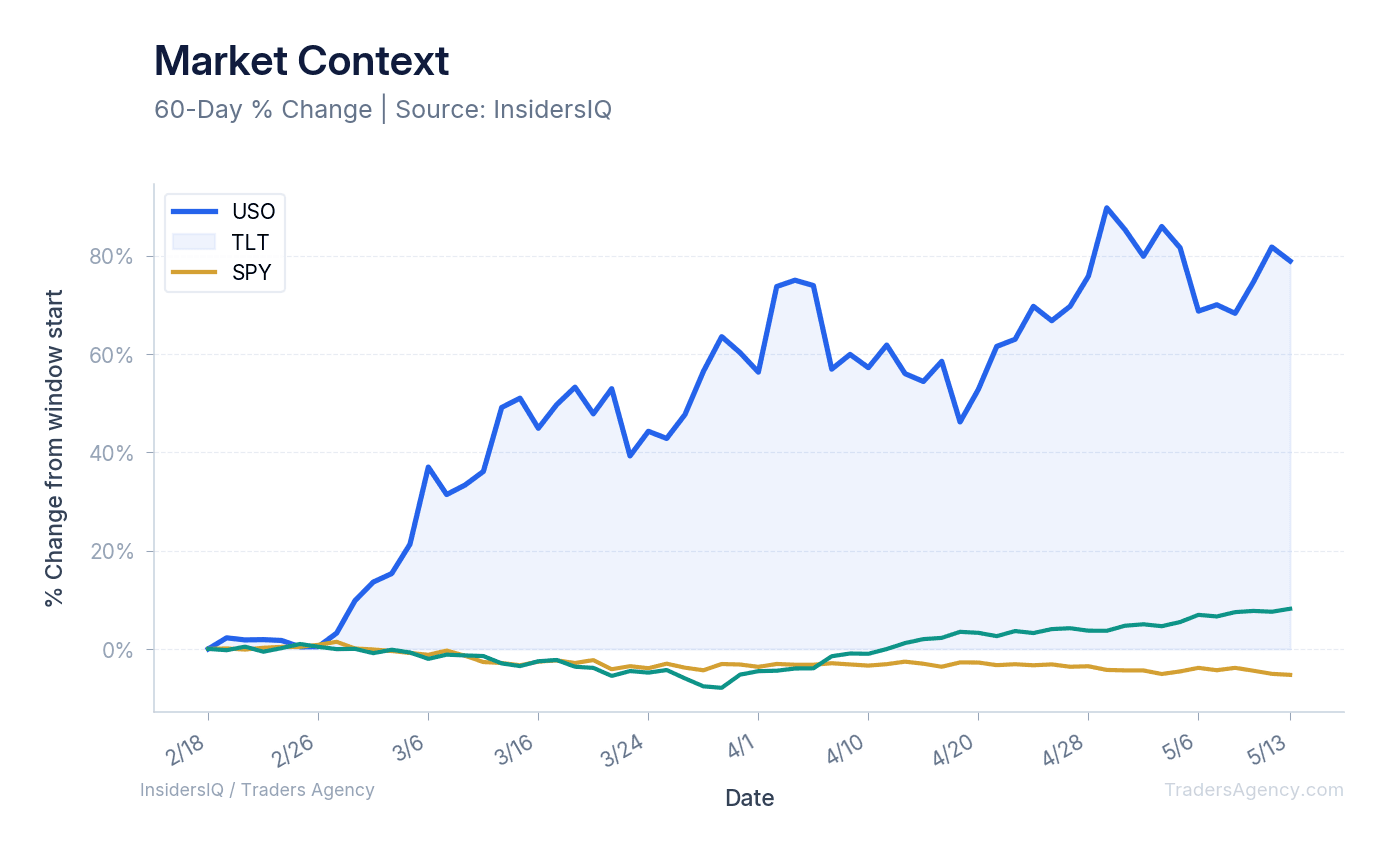
This data tells a clear story. Energy prices are skyrocketing. Long-term bond yields are rising, which directly pushes bond prices lower. The broader market remains positive for now, but the underlying stress is building rapidly.
The Key Divergence: USO has surged 78.89% in 90 days while TLT has dropped 5.28% over the same period. This dual shift in energy and yields is a setup that most portfolios are not positioned for.
The 5.28% drop in TLT is not a minor fluctuation. It represents a significant repricing of long-term debt. At the same time, the 78.89% surge in USO over just 90 days is a significant move that demands attention from equity holders.
What Does Surging Oil Mean for the Real Economy?
While retail traders frequently ask about the downstream effects of surging crude, our research team focuses squarely on positioning and ETF data. The exact price at the pump depends on refining margins, but the market impact of surging oil is already visible in the 78.89% spike in USO.
We're tracking market sentiment closely to gauge retail complacency. The data paints a picture of extreme confidence despite rising risks:
- Fear and Greed Index: Currently sits at 68, indicating high greed.
- WallStreetBets Sentiment: Measures at a positive 0.03, showing mild bullishness.
- WallStreetBets Mentions: Total 2,748, reflecting active retail participation in the current rally.
This high greed reading suggests that many retail traders are completely unprotected against sudden energy or yield shocks.
Why Are Investors So Exposed Right Now?
Investors are exposed to oil and yield shocks right now because broader market indices like SPY (up 8.16%) are masking the underlying volatility in energy and bond markets. Many portfolios lack all-weather outperforming stocks, leaving them vulnerable if the current trend in USO and TLT accelerates.
Our analysis shows that complacency is high. With the Fear and Greed Index at 68, traders are chasing the broader market rally. They are completely ignoring the massive 78.89% 90-day move in USO.
When the broader market catches up to the reality of rising yields and soaring energy costs, standard portfolios will suffer. The 8.16% gain in SPY is providing a false sense of security for less-protected investors.
Want expert trading insights delivered daily?
Join thousands of traders who rely on Traders Agency for market analysis and trade ideas.
Join Traders AgencyHow Strategists Are Positioning for Rising Risks
The data we're watching aligns with what Evercore strategists are saying. As risks build for stocks, less-protected investors need more all-weather outperforming stocks. Our team agrees entirely with this assessment.
Traders cannot afford to hold equities that are highly sensitive to rising interest rates or energy input costs. The 5.28% decline in TLT over the last 90 days shows that yield shocks are already happening. You must adjust your holdings to handle this environment.
An effective oil price risk portfolio requires immediate action. You cannot wait for the broader market to price in these dual threats. All-weather stocks are the required allocation for this specific market setup.
How Do You Build an Oil Price Risk Portfolio That Holds Up?
To build a resilient oil price risk portfolio, traders must identify and accumulate all-weather outperforming stocks. You must reduce exposure to rate-sensitive equities that suffer when TLT falls, and hedge against energy inflation by acknowledging the 78.89% surge in USO.
Here are the specific steps our team is taking to manage this environment:
- Monitor the TLT decline: The 5.28% drop in long-term bonds signals rising yields. We're avoiding stocks with high debt loads that rely on cheap borrowing.
- Track the USO rally: The massive 78.89% gain in oil over 90 days means energy costs are a growing concern for equities. We're screening for companies that can pass these costs to consumers.
- Watch market sentiment: With the Fear and Greed Index at 68, contrarian traders should prepare for sudden volatility. We're using this greed reading as a signal to tighten risk management.
- Target all-weather stocks: We're focusing on equities that outperform regardless of macroeconomic shocks, specifically those with pricing power and low rate sensitivity.
Sentiment Warning: The Fear and Greed Index at 68 combined with 2,748 WallStreetBets mentions and a positive 0.03 sentiment score tells us retail traders are complacent. This is the kind of setup that warrants caution.
What Should Traders Watch Next as Oil and Bond Yields Diverge?
The setup we see requires strict attention to the divergence between the broader market and these specific shock indicators. The 8.16% gain in SPY over the last 90 days gives a false sense of security.
We're watching the Fear and Greed Index closely. A sustained reading of 68 while USO continues to climb suggests traders should be cautious. We're also monitoring the 2,748 mentions on WallStreetBets to see if retail sentiment begins to shift from greed to fear.
If the 0.03 sentiment score on WallStreetBets turns negative, it will signal that retail traders are finally waking up to the yield and oil shocks. By then, the window to buy all-weather outperforming stocks at a discount will have closed.
The Bottom Line
The divergence between a 78.89% gain in USO and a 5.28% drop in TLT is a major warning sign. Our research team believes that an optimized oil price risk portfolio is the best way to handle the coming volatility. Less-protected investors must rotate into all-weather stocks before the broader market reacts to these underlying shocks.
Stay ahead of the market with analysis from the Traders Agency research team.
Want expert trading insights delivered daily?
Join thousands of traders who rely on Traders Agency for market analysis and trade ideas.
Join Traders AgencyKey Takeaways
- USO surged 78.89% over the past 90 days while TLT dropped 5.28% in the same period, signaling a rare simultaneous shock across energy and fixed income markets.
- SPY gained 8.16% over the same 90-day window, suggesting the broader equity market has not yet priced in the stress building beneath the surface.
- The 5.28% drop in TLT reflects a meaningful repricing of long-term debt, not a routine fluctuation, as the 30-year Treasury yield has topped 5.1%.
- Traders holding standard equity allocations face exposure to both oil price spikes and rising interest rates at the same time, a combination most portfolios are not built to handle.
- The research team's core recommendation is to rotate into all-weather outperforming stocks before the broader market reacts, arguing the discount window for those positions will close quickly.
DISCLAIMER: Traders Agency does not offer financial advice. The information provided is for educational purposes only and should not be considered financial advice. Traders Agency is not responsible for any financial losses or consequences resulting from the use of the information provided. Trading carries inherent risks and may not be suitable for all individuals. You are advised to conduct your own research and seek personalized advice before making any investment decisions, recognizing the potential risks and rewards involved.
See more from Traders Agency on Google
Make us a preferred source and our market analysis will appear more prominently in your Google Search, Top Stories, and AI results.
Add to Preferred Sources