
What separates crypto from traditional markets? It comes down to structure, access, and risk. You've probably watched Bitcoin drop 10% on a Sunday afternoon while the stock market sits closed and silent. We're going to walk you through exactly why that happens, how these two financial worlds compare, and how to think about allocating digital assets alongside a standard stock portfolio.
What Makes Crypto vs Traditional Markets Different?
Bottom Line: Crypto and traditional markets are built on fundamentally different structures, rules, and risk profiles, and treating them the same is a costly mistake. The edge comes from understanding those differences and sizing positions accordingly: use crypto for aggressive growth, keep stop losses loose enough to survive volatility, and never allocate money you may need within 12 months.
The primary difference lies in market structure, trading hours, and regulatory oversight. Traditional markets operate on centralized exchanges with strict schedules, circuit breakers, and government-backed protections. Crypto markets run 24 hours a day on decentralized networks with higher volatility and varying levels of liquidity.
We teach our members to think of traditional markets like a regulated public transit system. Trains run on a strict schedule, and there are safety guards at every station. Cryptocurrency is more like an open highway. You can drive at any time of day or night, but you are entirely responsible for your own safety and vehicle maintenance.
Strict rules govern standard equities. Stocks represent legal ownership in a registered company. Cryptocurrencies represent digital tokens on a distributed blockchain network. These are fundamentally different instruments, and understanding that distinction is the first step toward trading them effectively.
Key Concept: Stocks are ownership shares in a regulated company. Cryptocurrencies are digital tokens on a decentralized blockchain. They share some trading mechanics, but the underlying structure, protections, and risks are very different.
Why Does Crypto Trade 24/7 When Stock Markets Have Set Hours?
Traditional stock exchanges like the New York Stock Exchange (NYSE) are open Monday through Friday from 9:30 AM to 4:00 PM Eastern Time. They also use automated pauses called circuit breakers. If the S&P 500 drops 7% in a single day, trading stops for 15 minutes to prevent panic selling.
Crypto markets never close. You can trade Bitcoin (BTC) at 3:00 AM on a Saturday or during a major national holiday. This constant access creates unique opportunities and risks. A major news event on a Sunday will immediately impact crypto prices. Stock investors must wait until Monday morning to react, often resulting in massive price gaps at the opening bell.
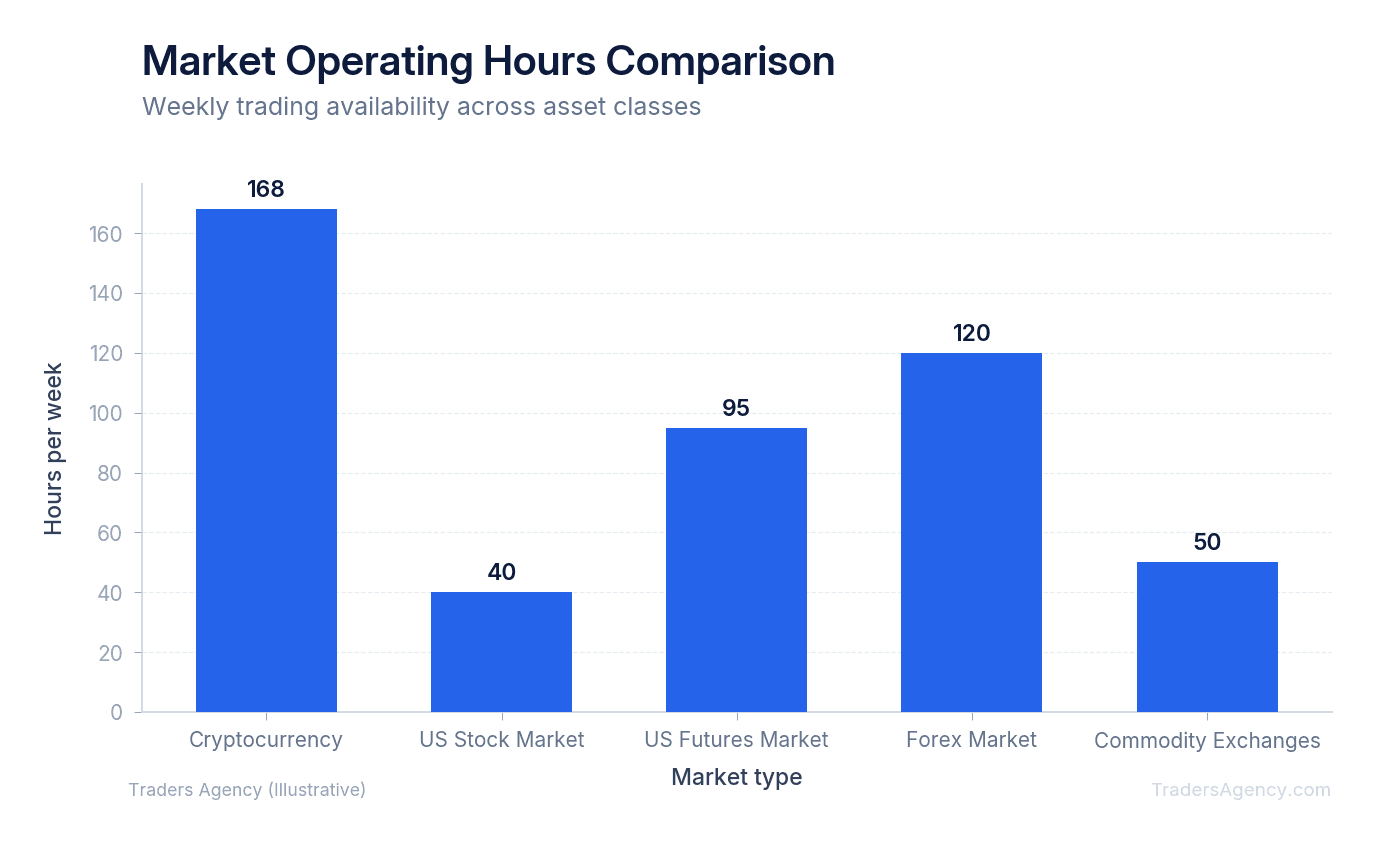
| Feature | Traditional Markets | Crypto Markets |
|---|---|---|
| Trading Hours | Mon-Fri, 9:30 AM - 4:00 PM ET | 24/7/365 |
| Circuit Breakers | Yes (7%, 13%, 20% thresholds) | No automatic halts |
| Weekend Access | Closed | Fully open |
| Holiday Closures | Multiple per year | None |
Why Is Crypto More Volatile Than Stocks?
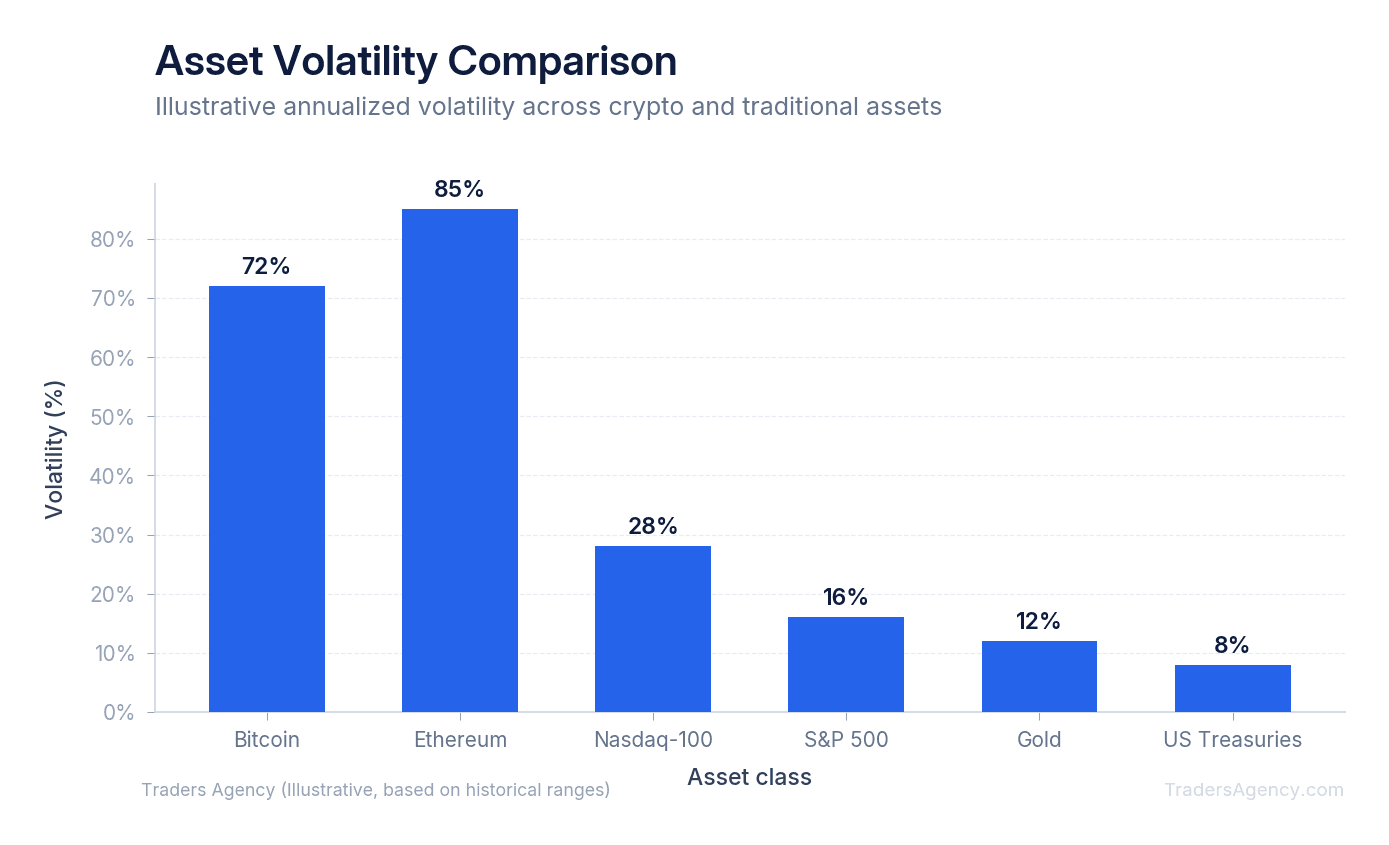
Cryptocurrency experiences higher volatility because it has smaller total market capitalizations, lacks institutional circuit breakers, and relies heavily on speculative demand. Digital assets also have fixed supply mechanisms that create sudden supply shocks, leading to rapid price swings in short periods.
Consider the supply dynamics. Traditional companies can issue new shares of stock at any time to raise capital. Central banks can print more fiat currency to stimulate the economy. Many cryptocurrencies have hard-coded supply limits. Bitcoin has a maximum supply of exactly 21 million coins, and that number will never change.
We also track halving cycles in the crypto space. Roughly every four years, the reward given to Bitcoin miners is cut in half. This reduces the new supply entering the market by 50%. When demand stays the same but new supply drops, prices often react violently. This programmed scarcity is a core driver of crypto market volatility.
How Liquidity and Order Books Differ Across Exchanges
Liquidity refers to how easily you can buy or sell an asset without changing its price. In traditional markets, major stocks like Apple (AAPL) trade millions of shares daily on a primary exchange. You can buy $100,000 worth of AAPL stock instantly without moving the market price by a single penny.
Crypto liquidity is highly fragmented. Instead of one central exchange, digital assets trade across dozens of different platforms simultaneously. If you place a large market order on a smaller crypto exchange, you might experience slippage. Slippage happens when there aren't enough sellers at your target price, forcing your order to fill at progressively worse prices.
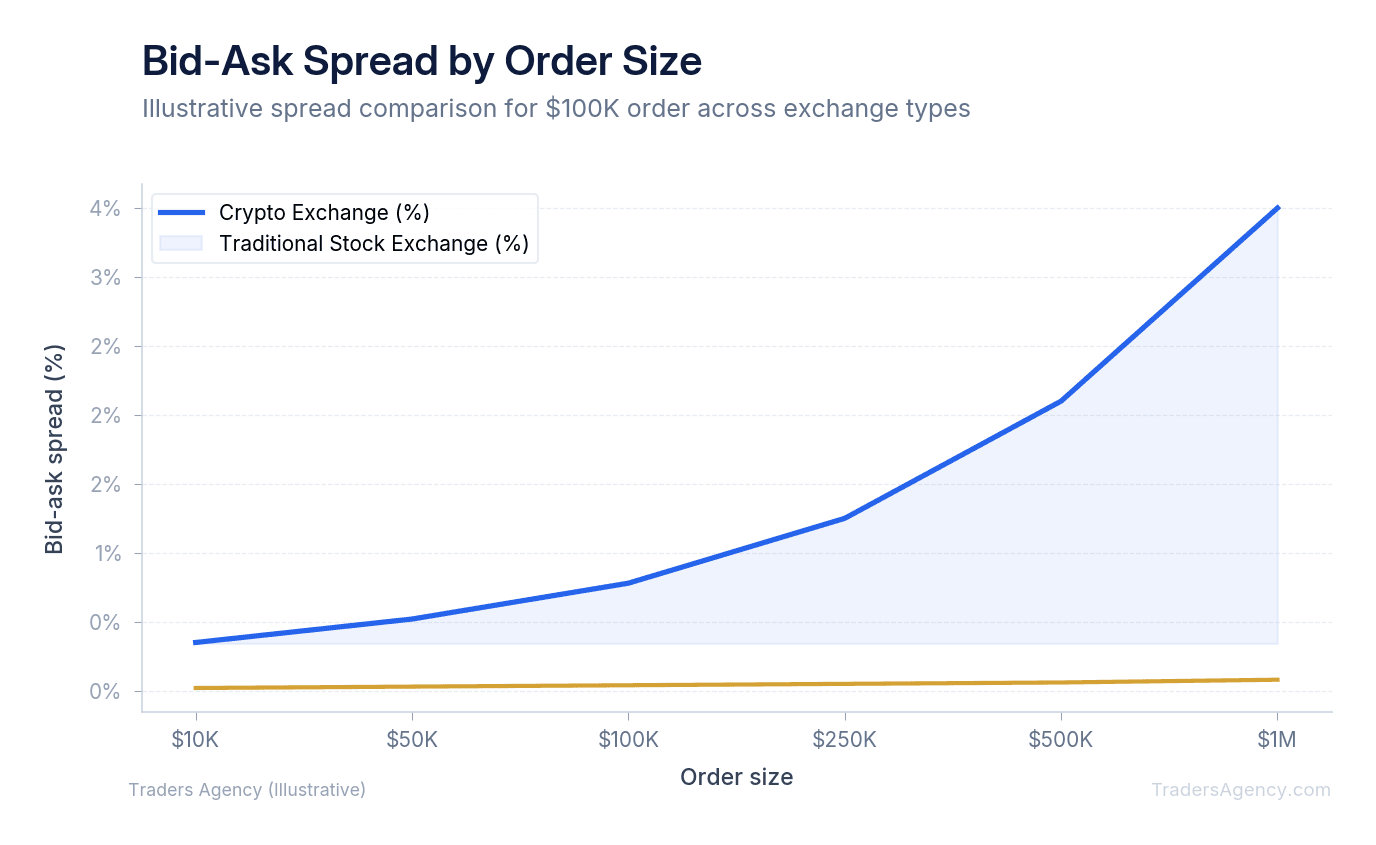
Our Recommendation: We prefer to use limit orders when trading digital assets. A limit order guarantees your entry price and protects your capital from thin order books. This one habit can save you hundreds of dollars over time.
Want expert trading insights delivered daily?
Join thousands of traders who rely on Traders Agency for market analysis and trade ideas.
Join Traders AgencyDoes Crypto Correlate with Tech Stocks and Traditional Assets?
Yes, cryptocurrencies have increasingly shown a strong positive correlation with technology stocks and the Nasdaq index. While originally designed as an uncorrelated alternative asset, Bitcoin now frequently moves in tandem with high-growth equities during periods of changing interest rates.
Early crypto investors viewed digital assets as "digital gold." They expected prices to rise when traditional markets fell. Our team has observed a clear shift in recent years. When the Federal Reserve raises interest rates, both tech stocks and cryptocurrencies tend to fall. When money is cheap to borrow, both asset classes tend to rally.
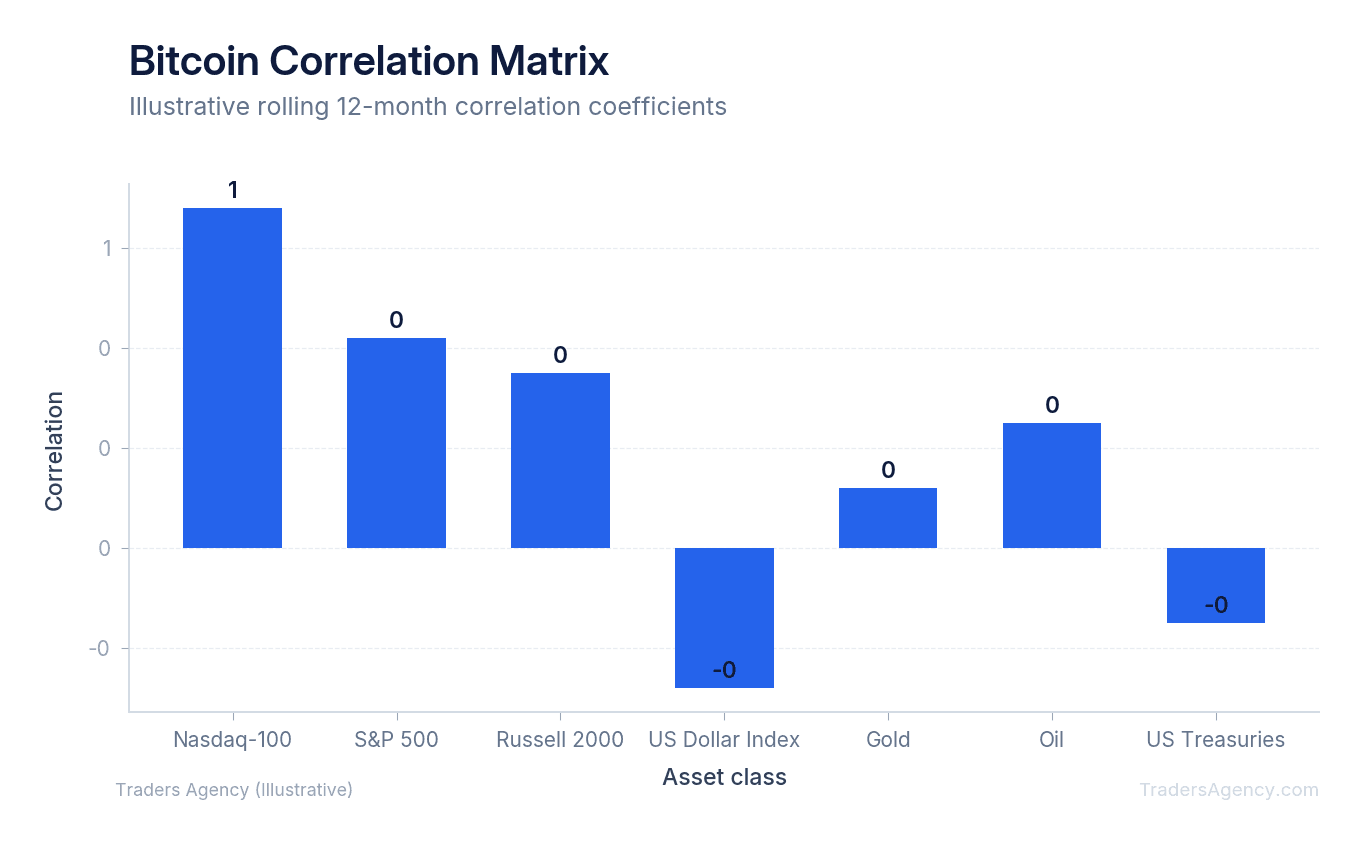
Watch Out: Buying crypto does not automatically diversify your risk if you already hold a heavy allocation of tech stocks. You must account for this growing correlation when building your portfolio.
How Does Crypto Regulation Compare to Traditional Market Oversight?
Traditional markets offer significant safety nets. If your standard brokerage goes bankrupt, the Securities Investor Protection Corporation (SIPC) protects your securities up to $500,000. The SEC enforces strict rules around disclosure, fraud, and market manipulation.
Crypto markets operate largely outside these traditional safety nets. If a centralized crypto exchange fails, you could lose your entire deposit. We always remind our traders: higher freedom comes with higher responsibility. The lack of central authority means transactions cannot be reversed. If you send funds to the wrong wallet address, there is no fraud department to call.
Where Do You Find Your Crypto Key?
You find your crypto key inside the digital wallet software or hardware device you used to generate it. When you create a self-custody wallet, the system provides a private key, usually represented as a 12-word or 24-word recovery phrase.
This brings us to a massive difference in ownership. When you buy stock through a traditional broker, the broker holds the assets on your behalf. If you forget your password, you simply click a reset link. With direct crypto ownership, you act as your own bank. Your private key is the only way to access your funds on the blockchain.
If you lose your recovery phrase, your funds are gone forever. There is no customer service hotline to call. We teach our members to write their keys on physical paper and store them in a fireproof safe, separate from any digital device.
How to Gain Crypto Exposure: Step-by-Step Examples
You have three main vehicles for adding cryptocurrency to your portfolio. We'll walk you through a practical example of allocating $5,000 to Bitcoin using each method.
Route 1: The ETF Approach
- Identify the Setup: You want exposure to Bitcoin price movements without the stress of managing private keys. A spot Bitcoin ETF through your standard brokerage account is the simplest path.
- Execute the Trade: Log into your traditional broker on a Tuesday at 10:30 AM. Search for a Bitcoin ETF ticker symbol. Place a buy order for 100 shares at $50.00 per share.
- Manage the Position: You now own $5,000 worth of the ETF. The fund managers handle the actual Bitcoin storage. You pay a small annual expense ratio, typically around 0.25%. You can only sell these shares during standard market hours.
Route 2: Direct Ownership
- Identify the Setup: You want to own the actual asset and have the ability to transfer it anywhere in the world at any time.
- Execute the Trade: Open an account on a major crypto exchange. Deposit $5,000 via bank transfer. Buy 0.08 BTC at a market price of $62,500. Withdraw that Bitcoin to your personal hardware wallet.
- Manage the Position: You hold the private keys. You pay zero annual management fees. You can sell or transfer your Bitcoin at 2:00 AM on a Sunday. However, you bear 100% of the security responsibility.
Route 3: The Futures Market
- Identify the Setup: You want to trade Bitcoin's price action using margin, and you already have an approved futures trading account.
- Execute the Trade: Log into your futures broker. Look up the CME Micro Bitcoin Futures (MBT). Each contract represents 0.1 BTC. Buy one contract at a price of $62,500.
- Manage the Position: You control a larger notional position with a smaller margin deposit, typically around $2,500. You never touch the actual crypto. Profits and losses settle in cash every single day. This is strictly for short-term trading, not long-term investing.
| Method | Ownership | Trading Hours | Annual Fees | Security Responsibility |
|---|---|---|---|---|
| Bitcoin ETF | Fund shares (indirect) | Standard market hours | ~0.25% | Broker/fund manager |
| Direct Ownership | Actual BTC (direct) | 24/7 | None | 100% on you |
| Futures | Cash-settled contract | CME futures hours | Commission per trade | Broker |
How Should You Allocate Crypto Alongside a Traditional Stock Portfolio?
How does crypto fit alongside equities, metals, and commodities? Our team approaches digital assets as a high-risk, high-reward allocation within a broader strategy. Here are our core risk management rules for crypto vs traditional markets:
- Cap your allocation: Keep digital assets to a small percentage of your total portfolio, typically between 1% and 5% for beginners.
- Use wider stop losses: Because crypto is highly volatile, a tight stop loss will get triggered by normal daily noise. Give your trades more room to breathe.
- Scale in slowly: Use dollar-cost averaging to build your position over weeks or months rather than buying all at once.
Risk Warning: Never use money you might need for living expenses in the next 12 months. The volatility that creates massive trading opportunities can also trigger steep drawdowns. Treat crypto as an aggressive growth allocation, and pair it with stable, dividend-paying stocks and physical commodities like gold for balance.
Want expert trading insights delivered daily?
Join thousands of traders who rely on Traders Agency for market analysis and trade ideas.
Join Traders AgencyKey Takeaways
- Crypto markets run 24/7 on decentralized networks, meaning a 10% drop can happen on a Sunday afternoon while stock exchanges are completely closed.
- Stocks represent legal ownership in a registered company with government-backed protections; crypto tokens exist on a distributed blockchain with no equivalent safety net.
- Tight stop losses often backfire in crypto because normal daily price noise can trigger them before a trade has room to develop.
- Dollar-cost averaging over weeks or months reduces the risk of buying a full position at the wrong time in a highly volatile asset class.
- Treat crypto as an aggressive growth allocation and balance it with dividend-paying stocks and physical commodities like gold to manage drawdown risk.
DISCLAIMER: Traders Agency does not offer financial advice. The information provided is for educational purposes only and should not be considered financial advice. Traders Agency is not responsible for any financial losses or consequences resulting from the use of the information provided. Trading carries inherent risks and may not be suitable for all individuals. You are advised to conduct your own research and seek personalized advice before making any investment decisions, recognizing the potential risks and rewards involved.
See more from Traders Agency on Google
Make us a preferred source and our market analysis will appear more prominently in your Google Search, Top Stories, and AI results.
Add to Preferred Sources