
You've probably watched a stock trade completely flat for weeks, slowly draining the value of your long options. It's one of the most frustrating experiences in options trading. But what if you could turn that sideways price action into a distinct advantage? That's exactly what a calendar spread does. This strategy capitalizes on the passage of time and shifts in implied volatility by buying and selling options at the same strike price but with different expiration dates. We're going to walk you through how to construct these trades, manage the Greeks, and avoid the most common traps. By the end of this guide, you'll know exactly how to apply a calendar spread (time spread) strategy in your own trading account.
What Is the Calendar Spread Rule?
Bottom Line: Calendar spreads turn the slow grind of sideways price action into a structured, limited-risk opportunity by exploiting the difference in how fast near-term and longer-term options decay. The strategy only works consistently when traders respect stop losses, avoid holding short options through volatility events, and stay disciplined about entry conditions. Patience and an understanding of how time and volatility interact are what separate profitable calendar spread traders from those who fight the market.
The calendar spread rule is straightforward: sell a near-term option and buy a longer-term option of the same type and strike price. This creates a position that profits from rapid time decay in the front-month option while the back-month option retains its value.
We teach our members to think of this as a race between two expiration dates. The short option decays faster because it has less time remaining. The long option decays slower. That difference in decay rates is what creates your profit window.
You pay a net debit to enter the trade, and your maximum risk is strictly limited to this initial debit. You cannot lose more than what you paid to open the position.
Key Concept: A calendar spread profits from the difference in time decay rates between a short-term option (which loses value quickly) and a longer-term option (which loses value slowly). Your maximum loss is always limited to the net debit you pay to enter the trade.
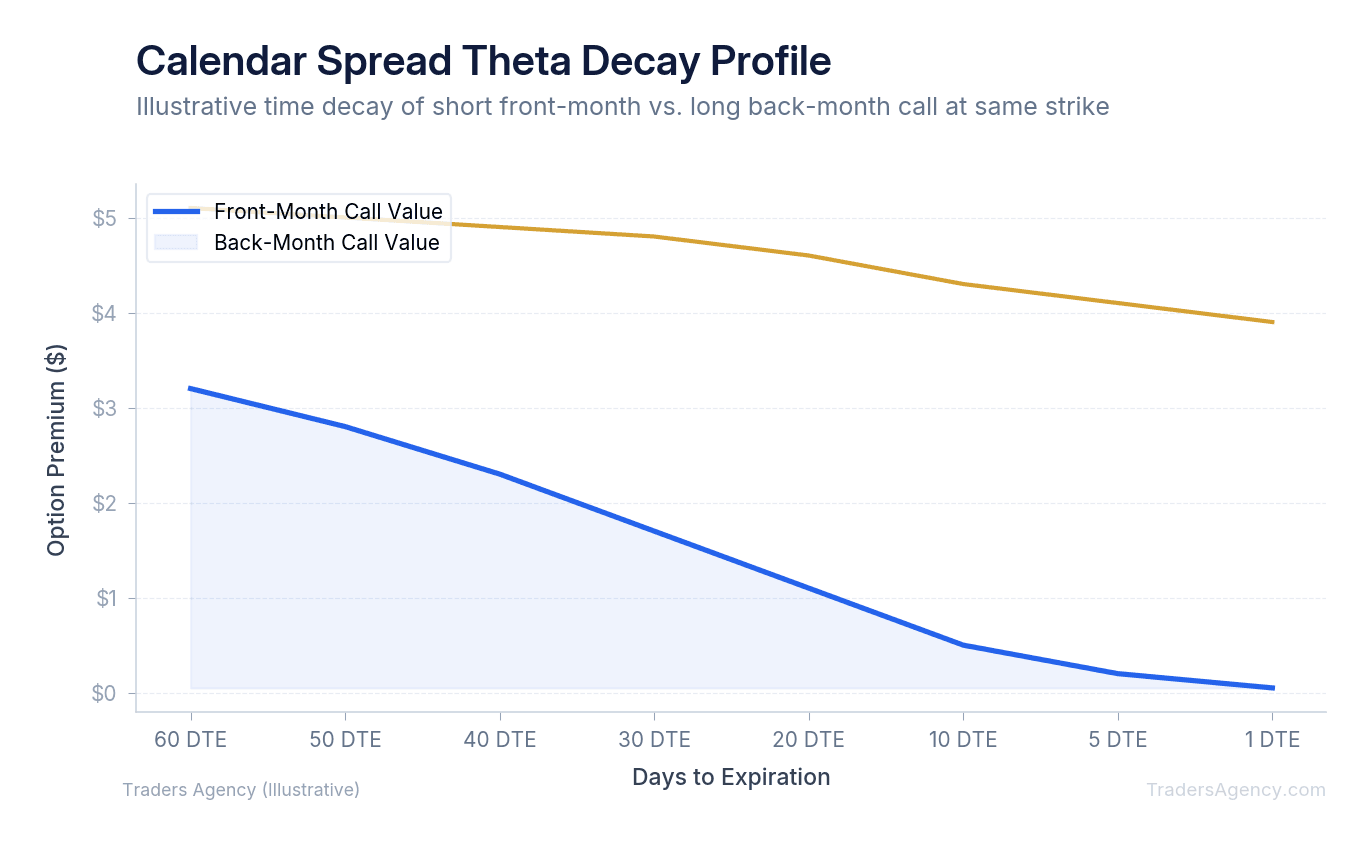
This strategy requires patience. You're relying on the mathematical reality that options lose value exponentially in their final 30 days of life. That accelerating decay is the engine behind your profit.
How Do Theta and Vega Affect Calendar Spread Profits?
Theta and vega act as the primary engines for calendar spread profitability. Positive theta generates daily income as the short option loses value faster than the long option. Positive vega means the overall position gains value if implied volatility rises across both expiration cycles.
Understanding the Greeks is mandatory for intermediate options traders. Calendar spreads are highly sensitive to volatility shifts, and the Cboe publishes extensive educational resources on this topic. You're essentially trading time and volatility, not just stock direction.
When you open a calendar spread, you want implied volatility to remain stable or increase. If volatility drops sharply, the longer-term option loses significant value. This phenomenon is known as volatility crush.
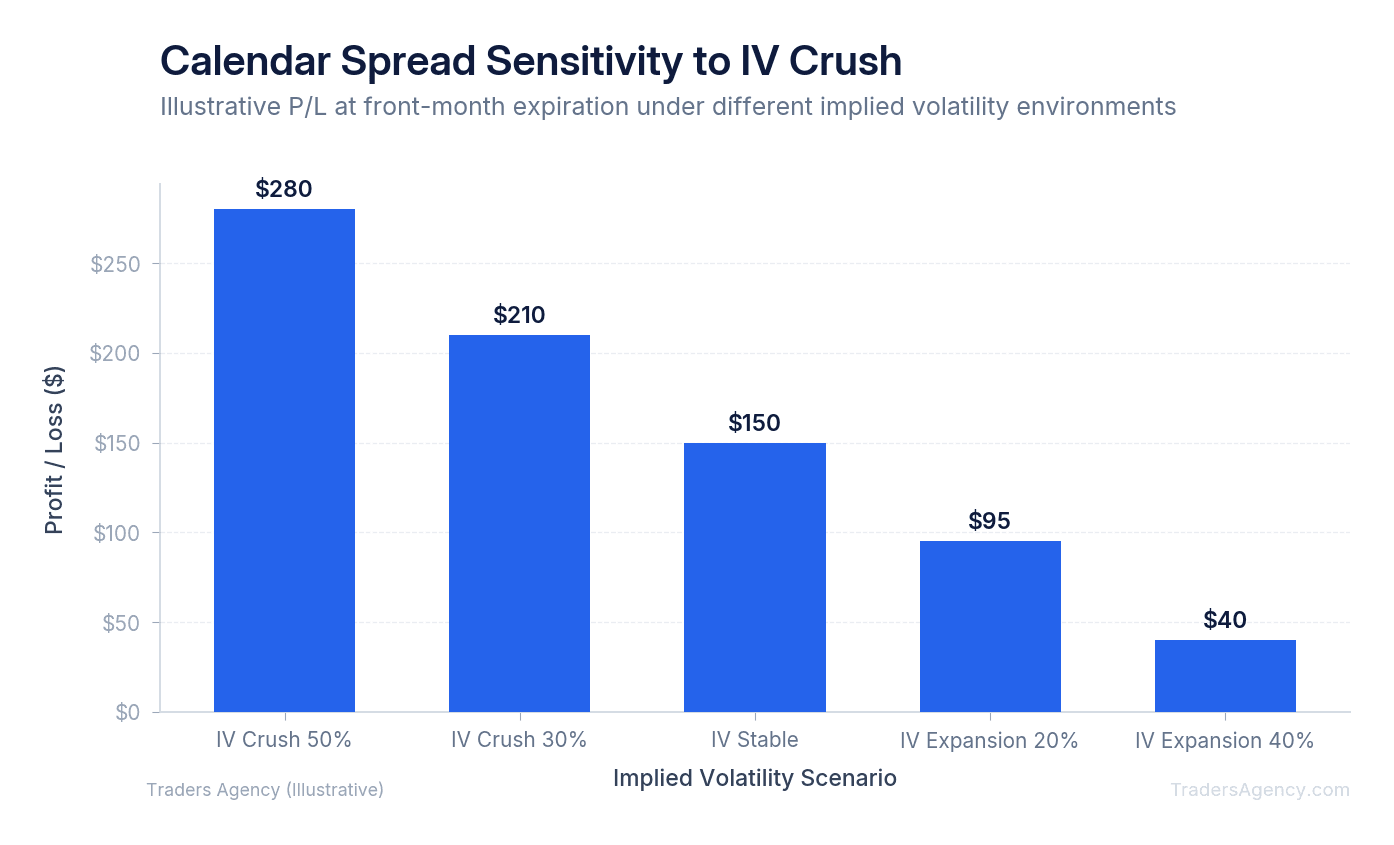
Because the back-month option has more time until expiration, it carries a higher vega value. A drop in overall market volatility will hurt your long option more than it helps your short option. Our team always checks the current volatility environment before placing this trade.
Watch Out: If you enter a calendar spread when implied volatility is already elevated, a subsequent volatility crush can wipe out your theta gains entirely. Always assess the IV environment before opening the position.
Calendar Spread Example: Step-by-Step Setup
A practical calendar spread example involves selecting a neutral stock, selling a near-term option, and buying a longer-term option at the same strike. Your ideal outcome is for the stock price to pin exactly at your chosen strike price on the front-month expiration date.
Here's a concrete example using a hypothetical stock, Ticker: XYZ, currently trading at $100 per share. We expect the stock to trade sideways for the next 30 days.
- Execute the Short Leg: Sell to open one 30-day expiration $100 strike call for a $2.00 premium. This immediately credits $200 to your account. This short call is your income engine.
- Execute the Long Leg: Buy to open one 60-day expiration $100 strike call for a $3.50 premium. This costs you $350. This long call defines your risk and gives you positive vega exposure.
- Calculate Risk and Reward: You pay a net debit of $1.50, or $150 total per contract. This $150 is your absolute maximum loss. Your maximum gain occurs if XYZ closes exactly at $100 on day 30.
| Parameter | Value |
|---|---|
| Underlying Stock | XYZ at $100 |
| Short Call (Front-Month) | $100 strike, 30 DTE, $2.00 premium collected |
| Long Call (Back-Month) | $100 strike, 60 DTE, $3.50 premium paid |
| Net Debit (Max Loss) | $1.50 ($150 per contract) |
| Max Profit Zone | XYZ at $100 on day 30 |
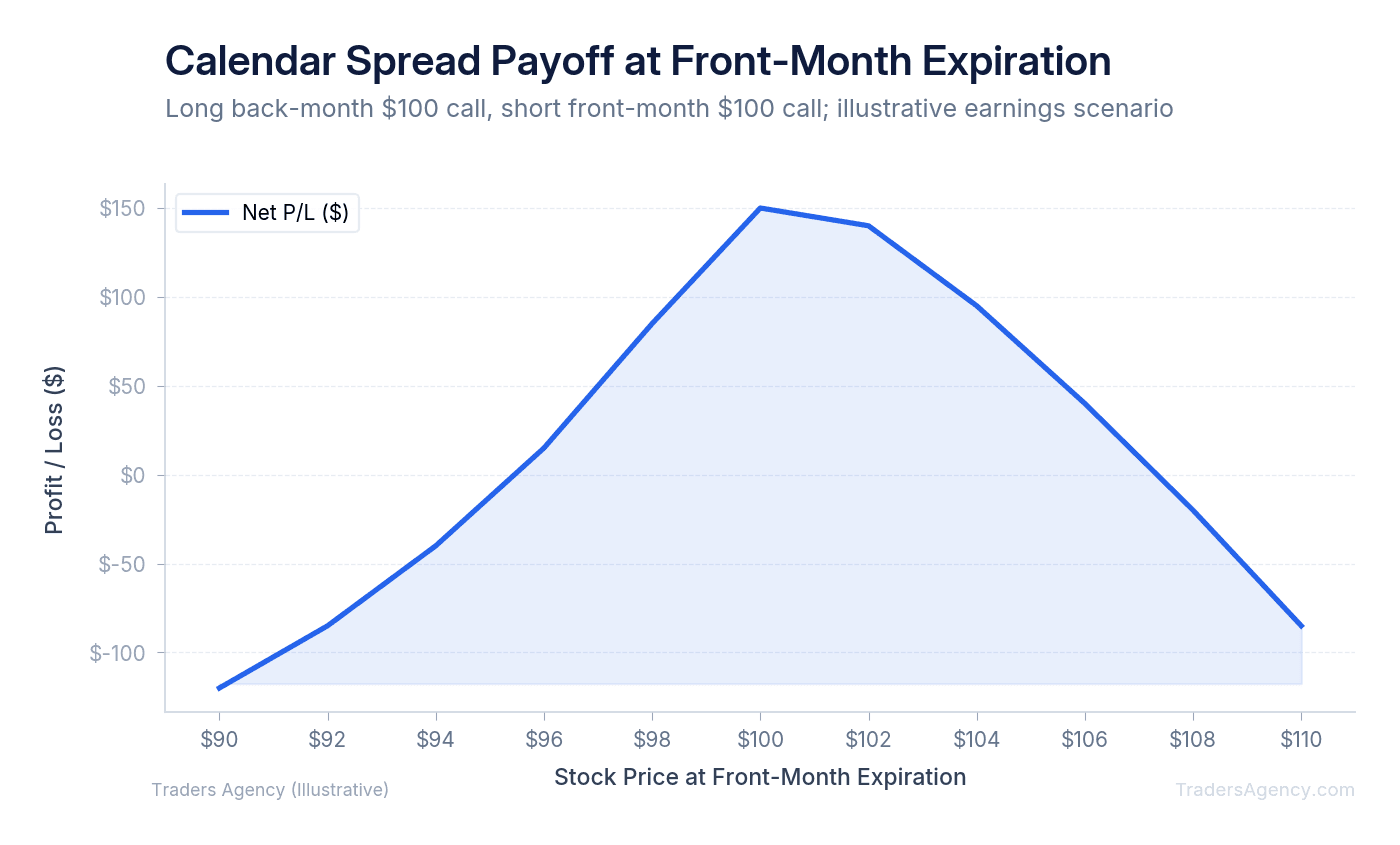
If the stock closes at $100 on day 30, the short call expires worthless. You keep the entire $2.00 premium. The 60-day call still holds significant time value. You can then sell the long call back to the market to close the trade for a net profit.
Want expert trading insights delivered daily?
Join thousands of traders who rely on Traders Agency for market analysis and trade ideas.
Join Traders AgencyWhen Is the Best Time to Use a Calendar Spread?
The best time to use a calendar spread is during periods of low implied volatility when you expect volatility to expand, or when you anticipate a stock will remain neutral. Traders often deploy them before earnings announcements to capture the rising volatility leading up to the event.
We prefer to enter these trades when options are generally cheap. If you buy a calendar spread when volatility is already extremely high, you risk suffering from a severe volatility crush after an event passes.
Earnings setups require precise timing. You might sell the front-month option expiring just before the earnings date and buy the back-month option expiring after the announcement. This allows you to capitalize on the pre-earnings volatility buildup.
Always check the economic calendar. Major announcements from the Federal Reserve or sudden macroeconomic shifts can derail a perfectly structured time spread.
Which Calendar Spread Strategy Is Most Profitable?
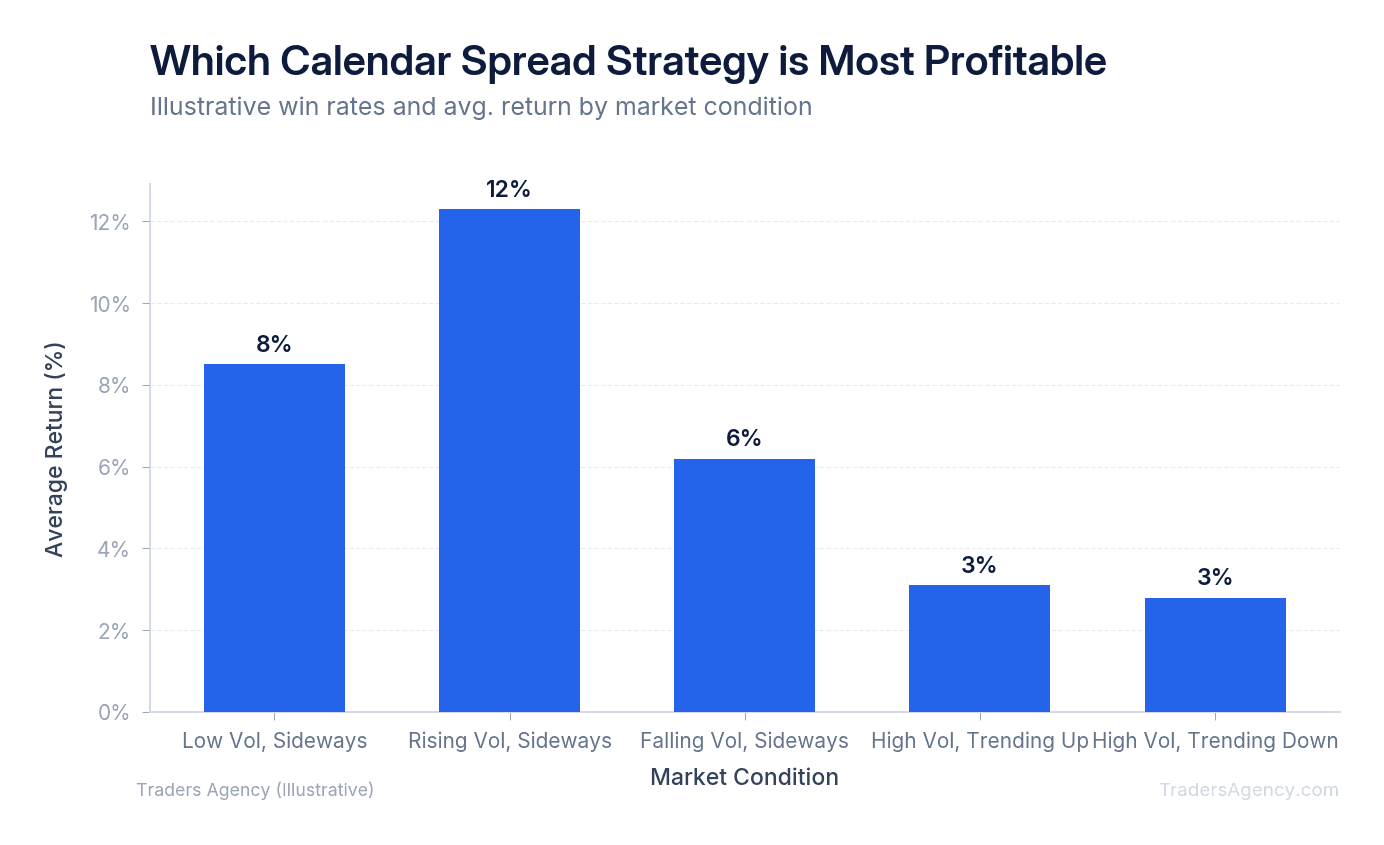
The most profitable calendar spread strategy typically involves placing the strike price exactly at the money (ATM). ATM options contain the highest amount of extrinsic value, which maximizes the time decay differential between the short and long legs of your trade.
While out-of-the-money (OTM) directional calendars cost less to enter, they require the stock to move to your strike price to achieve maximum profit. We find that ATM setups offer a higher probability of success because the stock is already where it needs to be.
Looking at a calendar spread P/L chart, you'll notice the profit tent is highest right at the chosen strike. If the stock drifts too far in either direction, the trade loses money.
You can also build these spreads using put options. A put calendar spread operates on the exact same mathematical principles as a call calendar spread. We generally use calls for neutral-to-bullish assumptions and puts for neutral-to-bearish assumptions.
What Are the Most Common Mistakes When Trading Time Spreads?
The most common mistake when trading time spreads is ignoring the impact of implied volatility crush. Traders also frequently fail by holding the position too close to expiration, exposing themselves to assignment risk on the short leg.
We see many intermediate traders focus entirely on time decay while forgetting about vega. If you buy a calendar spread when options are expensive, the subsequent drop in premium will wipe out your theta gains.
Here are the mistakes we see most often:
- Ignoring the volatility environment: Entering when IV is already elevated sets you up for a crush.
- Improper strike selection: Choosing a strike price too far out of the money drastically reduces your probability of profit. The stock must make a specific directional move just to reach your profit zone.
- Holding too long: Letting the short option get too close to expiration increases assignment risk.
- Forgetting about early assignment: If your short call goes deep in the money, the buyer might exercise it early. We teach our members to close or roll the position well before the front-month expiration week to avoid this headache.
Watch Out: Early assignment is a real threat with calendar spreads. If your short call moves deep in the money, close or roll the position before expiration week. Don't wait until the last minute.
Are Calendar Spreads Profitable?
Yes, calendar spreads are profitable when managed with strict risk controls and deployed in the correct volatility environment. They can generate consistent losses, however, if a trader ignores implied volatility changes or holds the position during a strong directional move.
To keep these trades profitable, you need to know when to avoid them. Avoid trading a standard ATM calendar spread in a highly directional market. If a stock is breaking out to new highs, the delta of the trade will overpower your positive theta, resulting in a loss.
Our team follows strict risk management rules for every time spread:
- Keep position sizing small. Risk no more than 2% to 3% of your total account equity per trade.
- Close the trade immediately if the stock price breaches your upper or lower breakeven points.
- Take profits early. We target 20% to 30% of the initial debit paid.
- Never hold the short option through an earnings announcement unless the long option also covers the same event.
Key Concept: The calendar spread rule is not just about entry mechanics. It requires active monitoring of both time decay and volatility shifts. Stick to the plan, respect your stop losses, and don't force the trade if market conditions are unfavorable.
Calendar spreads reward patience, discipline, and a solid understanding of how time and volatility interact. When you combine the right setup with proper risk management, this strategy becomes a reliable tool in your options trading toolkit.
Want expert trading insights delivered daily?
Join thousands of traders who rely on Traders Agency for market analysis and trade ideas.
Join Traders AgencyKey Takeaways
- The calendar spread rule requires selling a near-term option and buying a longer-term option at the same strike price, creating a net debit trade where your maximum loss is strictly limited to what you paid to enter.
- Profit comes from the difference in decay rates: the short front-month option loses value faster than the long back-month option, and that gap is your profit window.
- Never hold the short option through an earnings announcement unless the long option covers the same event, since a volatility spike can destroy the spread's structure.
- Active monitoring of both theta (time decay) and vega (volatility sensitivity) is required throughout the trade, not just at entry.
- Calendar spreads are designed to exploit sideways price action, making them most effective when a stock is expected to stay near the strike price through the front-month expiration.
DISCLAIMER: Traders Agency does not offer financial advice. The information provided is for educational purposes only and should not be considered financial advice. Traders Agency is not responsible for any financial losses or consequences resulting from the use of the information provided. Trading carries inherent risks and may not be suitable for all individuals. You are advised to conduct your own research and seek personalized advice before making any investment decisions, recognizing the potential risks and rewards involved.
See more from Traders Agency on Google
Make us a preferred source and our market analysis will appear more prominently in your Google Search, Top Stories, and AI results.
Add to Preferred Sources