
A LEAPS options strategy is a long-term approach using Long-Term Equity Anticipation Securities: options contracts with expiration dates longer than one year. We use these contracts to control 100 shares of stock for a fraction of the outright purchase price, and it's one of the most powerful capital efficiency tools we teach.
You've probably experienced this in your own trading account. You find a stock you love for the long haul, but buying 100 shares ties up a massive chunk of your available capital. You want the long-term exposure, but you also want to keep cash free for other opportunities.
By the end of this guide, we'll show you exactly how to execute this strategy. You'll learn how to select the right strike prices, manage your risk, and maximize your capital efficiency without tying up your entire portfolio.
What Are LEAPS Options and How Do They Work?
Bottom Line: LEAPS give long-term investors a way to maintain meaningful stock exposure without locking up the capital that a full share purchase would require. The strategy only works when paired with disciplined position sizing: keeping each trade within 2% to 5% of total account equity is what separates a sustainable approach from an overexposed one. Master strike selection, respect your risk limits, and LEAPS become one of the more practical tools for building long-term exposure efficiently.
What is a LEAP option? A LEAP option is simply a standard call or put option contract that expires in more than 12 months. It functions exactly like a short-term option, giving you the right to buy or sell 100 shares at a specific strike price before the expiration date.
The main difference when comparing LEAPS vs. options with shorter expirations is time. That extra time gives your investment room to grow without the immediate pressure of rapid time decay.
Think of it like putting a long-term deposit on a piece of real estate. You secure the purchase price today, but you have two years to decide if you actually want to buy the property outright.
Key Concept: LEAPS are standard options contracts with expirations beyond one year. They give you the right to buy (call) or sell (put) 100 shares at a fixed strike price, providing long-term market exposure at a fraction of the cost of owning shares outright.
These long-dated contracts provide flexibility for investors looking to participate in price movements without committing full capital upfront. This makes them an excellent tool for intermediate traders looking to scale their buying power. You can learn more about how standardized options contracts work on the CBOE website.
What Is the Best LEAPS Options Strategy for Stock Replacement?
The most effective LEAPS options strategy for stock replacement involves buying deep in-the-money (ITM) call options with a delta of 0.80 or higher. This setup closely mimics stock ownership, meaning the option price moves almost dollar-for-dollar with the underlying stock while requiring significantly less upfront capital.
When we teach our members how to buy LEAPS options, we emphasize the importance of buying deep ITM calls. A high delta means the contract acts like a synthetic stock position. You get the benefits of a stock rally without paying full price.
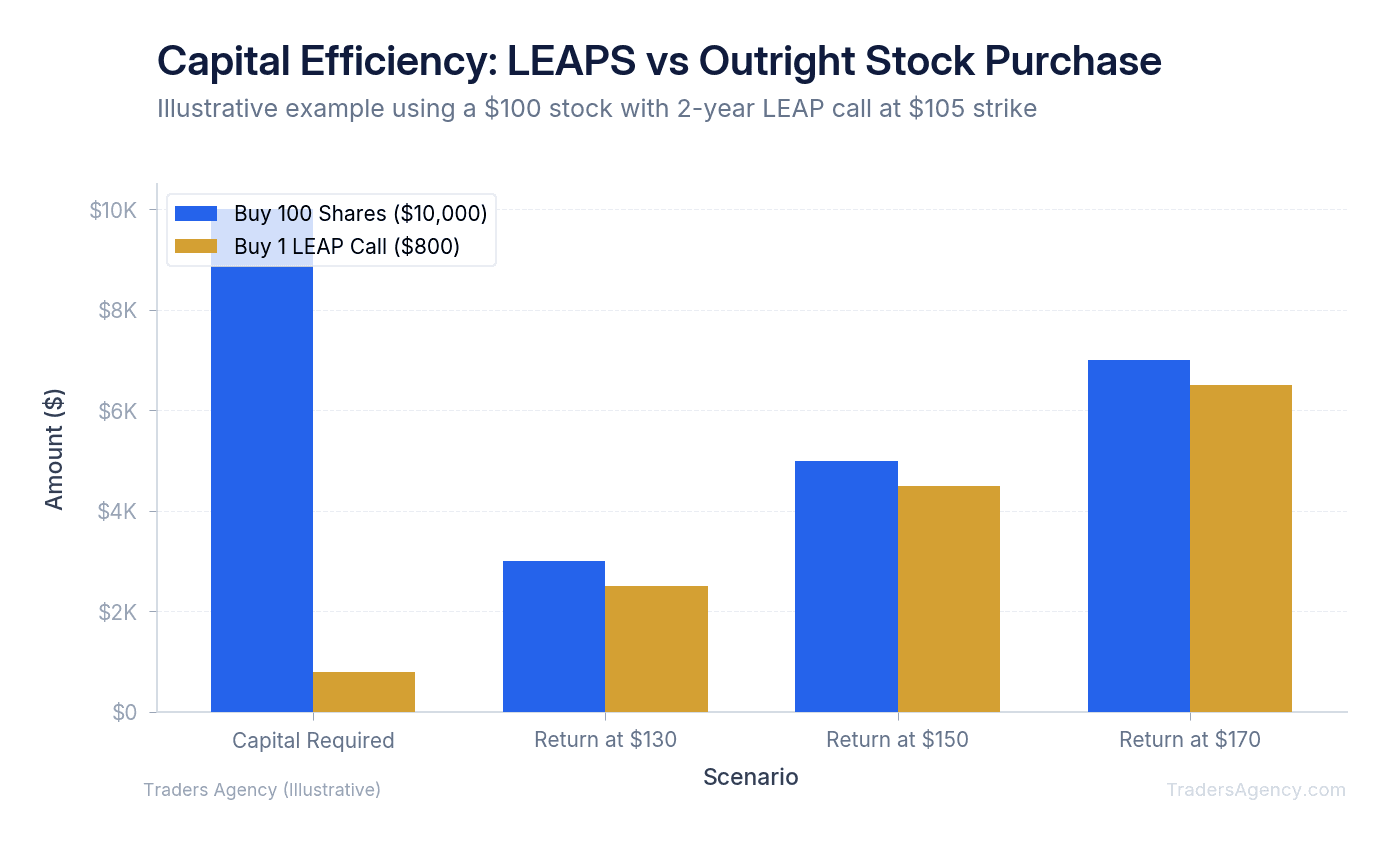
For example, if a stock trades at $150, buying 100 shares costs $15,000. Alternatively, a deep ITM LEAP call might cost $3,500. You control the same 100 shares but keep $11,500 in cash for other trades.
| Approach | Capital Required | Shares Controlled | Capital Freed Up |
|---|---|---|---|
| Buy 100 Shares | $15,000 | 100 | $0 |
| Buy 1 Deep ITM LEAP Call | $3,500 | 100 | $11,500 |
How Do the Greeks Affect Long-Term Options?
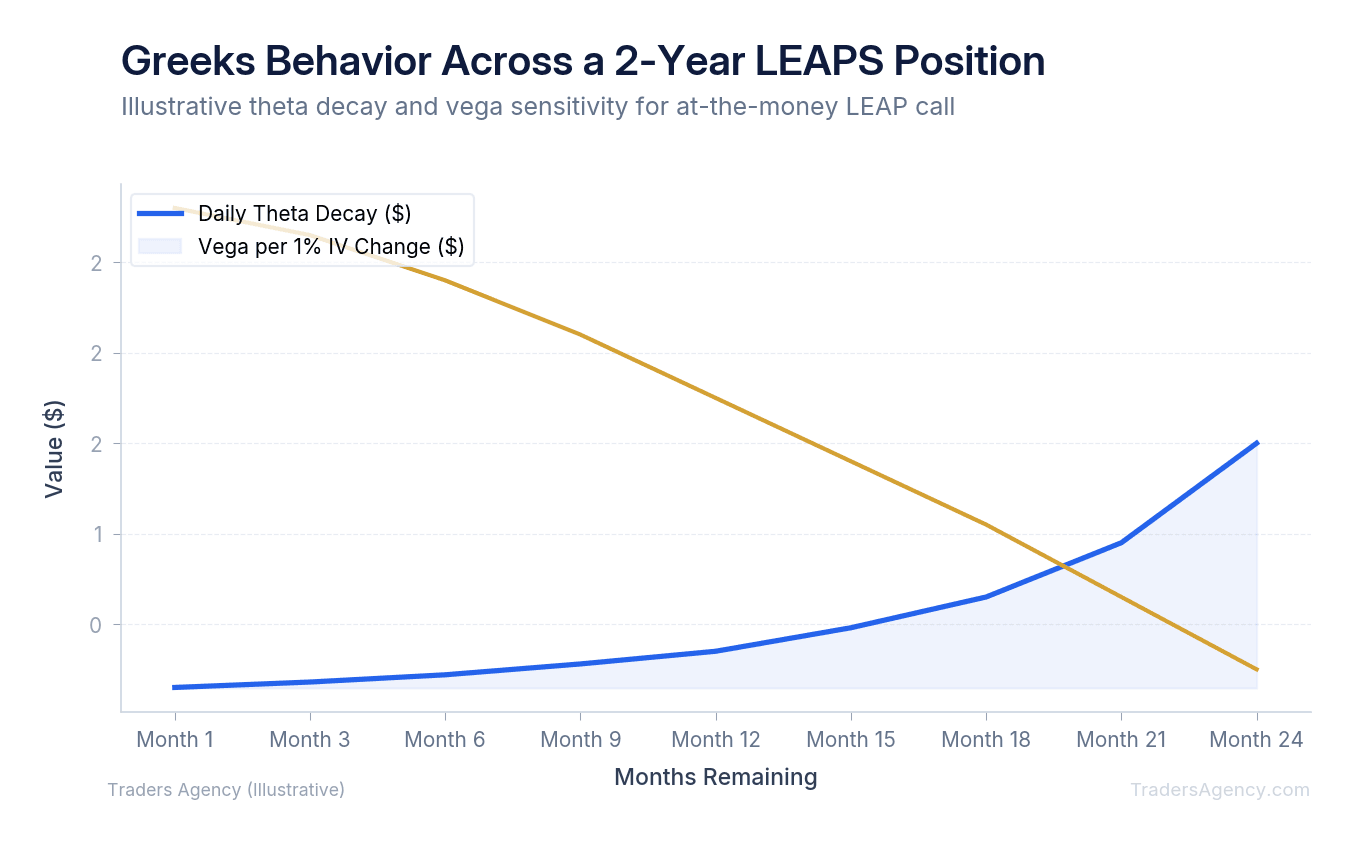
Options Greeks behave differently on long-term contracts. Delta remains highly stable on deep ITM LEAPS, while theta (time decay) is minimal in the first year but accelerates significantly in the final 60 to 90 days. Vega (implied volatility sensitivity) has a heavier impact on LEAPS because of the extended time horizon.
Here's how this plays out in practice for a stock replacement trade:
Delta: We prefer a delta of 0.80 to 0.90. This means if the stock goes up by $1.00, your option value increases by $0.80 to $0.90. It provides a highly predictable correlation to the stock price.
Theta: Time decay is usually your enemy in options trading. However, with a two-year expiration, theta barely affects your premium during the first 12 months. You're paying for time, and that time decays very slowly at first.
Vega: Because there is so much time until expiration, long-dated options are highly sensitive to changes in implied volatility. If you buy a contract when volatility is extremely high, a sudden drop in volatility will reduce the value of your premium, even if the stock price stays the same.
Watch Out: Buying LEAPS when implied volatility is elevated is one of the most common mistakes we see. A volatility crush can erode your premium even while the stock moves in your favor. We prefer to enter these positions during periods of low implied volatility.
Want expert trading insights delivered daily?
Join thousands of traders who rely on Traders Agency for market analysis and trade ideas.
Join Traders AgencyHow Do You Execute a LEAP Call Options Trade Step by Step?
We'll walk through a concrete LEAP call options example using a hypothetical trade on Apple (AAPL). This will show you exactly how the mechanics work from entry to exit.
Assume AAPL is trading at $180 per share. You're bullish on the company over the next two years, but you don't want to spend $18,000 to buy 100 shares.
- Identify the Setup: Instead of buying shares, look at the options chain for an expiration date 24 months out. Select the $130 strike price call option. This strike is deep ITM and has a delta of 0.85, making it an ideal candidate for stock replacement.
- Execute the Trade: The premium for this contract is $55.00. Since each options contract controls 100 shares, your total out-of-pocket cost is $5,500. Your breakeven price at expiration is $185 (the $130 strike price plus the $55 premium paid).
- Evaluate the Outcome Scenarios: Review the table below to understand the range of results based on where AAPL lands at or before expiration.
| Scenario | AAPL Price | Option Value (Intrinsic) | Profit / Loss | Return on Capital |
|---|---|---|---|---|
| Best Case | $230 | $100.00 ($10,000) | +$4,500 | +82% |
| Most Likely Case | $200 | $70.00 ($7,000) | +$1,500 | +27% |
| Breakeven | $185 | $55.00 ($5,500) | $0 | 0% |
| Worst Case | Below $130 | $0 | -$5,500 | -100% |
Best Case: AAPL rallies to $230 over the next year. Your option is now worth at least $100.00 in intrinsic value. You turn your $5,500 investment into $10,000, resulting in an 82% return on capital.
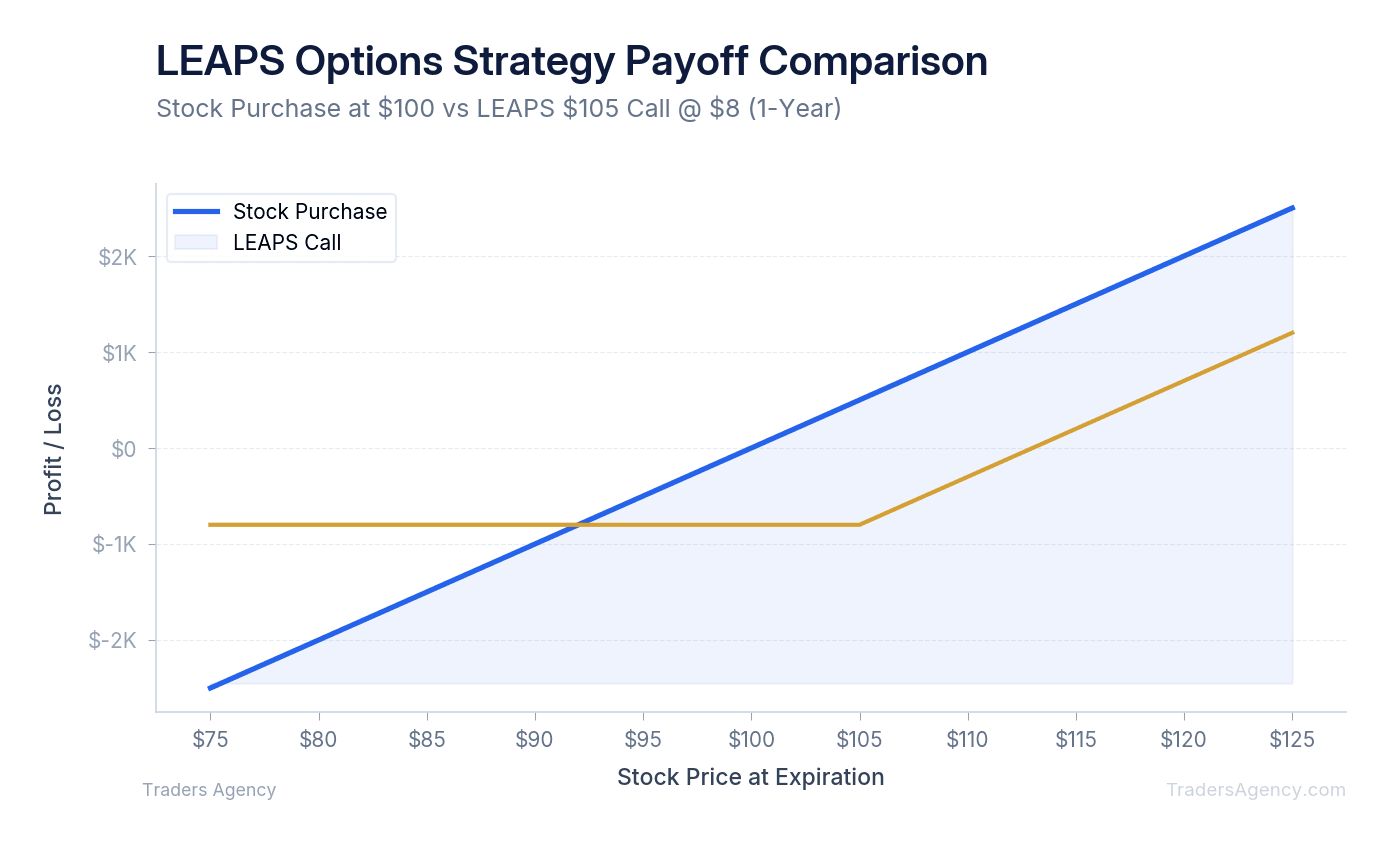
Worst Case: AAPL drops below $130 and stays there until the expiration date. Your maximum loss is strictly capped at the $5,500 premium you paid. If you had bought the stock at $180 and it fell below $130, your unrealized loss on shares would be $5,000 or more, though you would still hold shares with the potential to recover. With the expired LEAPS contract, the loss is permanent.
Most Likely Case: The stock drifts moderately higher to $200. You can sell the contract for a solid profit well before the expiration date, freeing up your capital for the next trade.
What Is the Downside of Buying LEAPS?
The primary downside of buying LEAPS is the potential for a 100% loss of your invested capital. Unlike owning shares of stock, options expire. If the underlying stock price falls below your strike price at expiration, your entire premium becomes worthless and you lose your initial investment.
You also give up dividend payments. When you hold a call option, you do not receive the quarterly dividends that regular shareholders collect. For high-yield dividend stocks, this missed income can be significant over a two-year period.
Another risk is implied volatility crush. If you buy a contract right before an earnings report when volatility is high, the subsequent drop in volatility will negatively impact your option's price. We prefer to enter these positions during periods of low implied volatility.
Many new traders ask about taxation and wonder: "Can LEAPS options long-term gain rules apply?" The answer is yes. If you hold the contract for more than one year before selling it, your profits typically qualify for long-term capital gains tax rates. Always consult a tax professional for specific guidance regarding your personal situation. The SEC's investor education resources also offer helpful background on investment taxation basics.
Risk Warning: LEAPS can expire completely worthless, resulting in a 100% loss of your premium. You also forfeit dividends and face implied volatility risk. Never allocate more than 2% to 5% of your total account equity to a single options trade.
Which Stocks Are Good for LEAPS?
The best stocks for a LEAPS strategy are highly liquid, large-cap companies with a proven history of steady upward momentum. Look for blue-chip stocks or major market exchange-traded funds like the SPY or QQQ. Avoid highly volatile penny stocks or companies facing imminent bankruptcy risks.
Liquidity is a major factor when trading long-dated options. You need tight bid-ask spreads. If a stock is illiquid, the spread between the buying and selling price will eat up your profits immediately upon entry.
Since you're buying two years of time, you want an underlying asset that reliably trends higher over long periods. Tech giants, major retailers, and broad market indices are typically the most reliable vehicles for this specific strategy.
When Should You Manage or Exit a LEAPS Position?
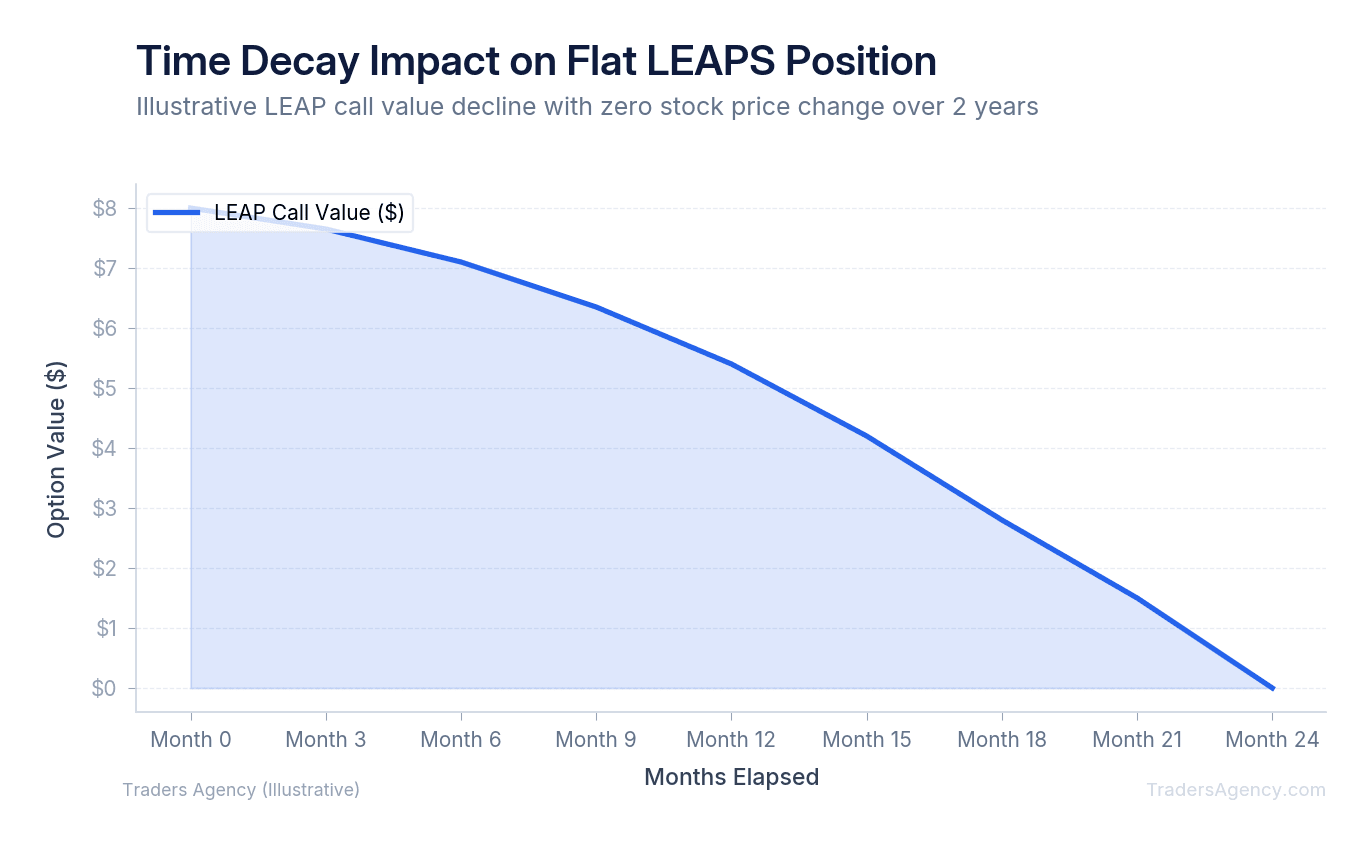
Managing a LEAPS position requires strict rules for taking profits and cutting losses. We recommend closing the position or rolling it to a later date when the contract reaches 60 to 90 days before expiration. This prevents the rapid acceleration of time decay from eroding your remaining premium.
Our team recommends a proactive approach to risk management. Do not hold these contracts until the final week of expiration. Once theta decay accelerates, it will aggressively eat away at your position's value.
Here are the exact rules we teach our members for managing this trade:
- Take profits early: If your contract doubles in value within the first six months, sell half your position to lock in gains. You can let the remaining contracts run risk-free.
- Roll before decay hits: When you reach the 90-day mark before expiration, sell the contract. If you're still bullish on the stock, use the proceeds to buy a new contract expiring in two years.
- Use hard stop losses: We prefer to cut our losses if the option loses 50% of its value. Never let a single options trade wipe out a large portion of your account.
Key Concept: Position sizing is your best defense against market downturns. Never allocate more than 2% to 5% of your total account equity into a single options trade. By keeping your position sizes small, you ensure that a worst-case scenario will not derail your long-term trading goals.
The Traders Agency education team publishes new strategy guides and market analysis every week. LEAPS are one of the most effective tools we teach for building long-term exposure while preserving capital. Apply the rules above, respect your risk limits, and you'll be well-positioned to make this strategy work in your own portfolio.
Want expert trading insights delivered daily?
Join thousands of traders who rely on Traders Agency for market analysis and trade ideas.
Join Traders AgencyKey Takeaways
- LEAPS are options contracts with expiration dates longer than 12 months, giving you control of 100 shares at a fraction of the outright purchase price.
- The extended time horizon reduces the pressure of rapid time decay compared to short-term options, giving your position room to develop without constant monitoring.
- Never allocate more than 2% to 5% of your total account equity into a single options trade. Position sizing is the primary defense against a single loss derailing your portfolio.
- LEAPS function identically to standard call or put options mechanically. The only structural difference is the expiration timeline, which changes the risk and capital efficiency profile significantly.
- Keeping cash free while maintaining long-term stock exposure is the core use case: you secure the price today and retain flexibility for other opportunities while the position matures.
DISCLAIMER: Traders Agency does not offer financial advice. The information provided is for educational purposes only and should not be considered financial advice. Traders Agency is not responsible for any financial losses or consequences resulting from the use of the information provided. Trading carries inherent risks and may not be suitable for all individuals. You are advised to conduct your own research and seek personalized advice before making any investment decisions, recognizing the potential risks and rewards involved.
See more from Traders Agency on Google
Make us a preferred source and our market analysis will appear more prominently in your Google Search, Top Stories, and AI results.
Add to Preferred Sources