
You've probably watched a perfectly planned options trade turn against you. The stock gaps the wrong way, your P/L turns red, and suddenly you're faced with a decision that separates professionals from amateurs. Adjusting losing options positions is the process of modifying an existing options trade to reduce risk, lower the break-even point, or salvage capital when the market moves against your initial thesis. Our team teaches that professional trading is less about predicting direction and more about managing exposure. By the end of this guide, you'll know how to execute advanced multi-leg repairs, analyze the Greeks during an adjustment, and determine exactly when to cut a loss versus when to fight for the trade.
What Is Adjusting Losing Options Positions?
Bottom Line: Adjusting losing options positions is a defensive skill built on precise math and disciplined decision-making, not on hope or doubling down. The core lesson is that every adjustment must stand on its own as a justifiable trade, not just a reaction to a loss. Traders who master this process keep individual losses small and protect their account from the kind of damage that one bad trade can cause.
Adjusting losing options positions involves adding, closing, or rolling specific option legs to alter the payoff profile of an active trade. We view this process like reinforcing a building during a storm. Instead of letting the structure collapse, you shift the weight and add support beams to withstand the pressure.
Adjustments require a careful evaluation of remaining time value and implied volatility. You are essentially closing one trade and opening a new one. Every adjustment must justify the additional capital and transaction costs. You cannot simply throw more money at a bad idea.
Key Concept: An options adjustment is not a "fix." It's a brand-new trade built on top of an existing position. Treat it with the same rigor you'd apply to any fresh entry: defined risk, clear thesis, and a realistic profit target.
We'll walk you through a complete adjusting and repairing losing options example using specific strike prices and premiums. Our goal is to show you how institutional traders manage repair costs relative to portfolio-level risk exposure. This requires a deep understanding of market mechanics, margin requirements, and probability.
When Should You Adjust vs. Accept the Loss?
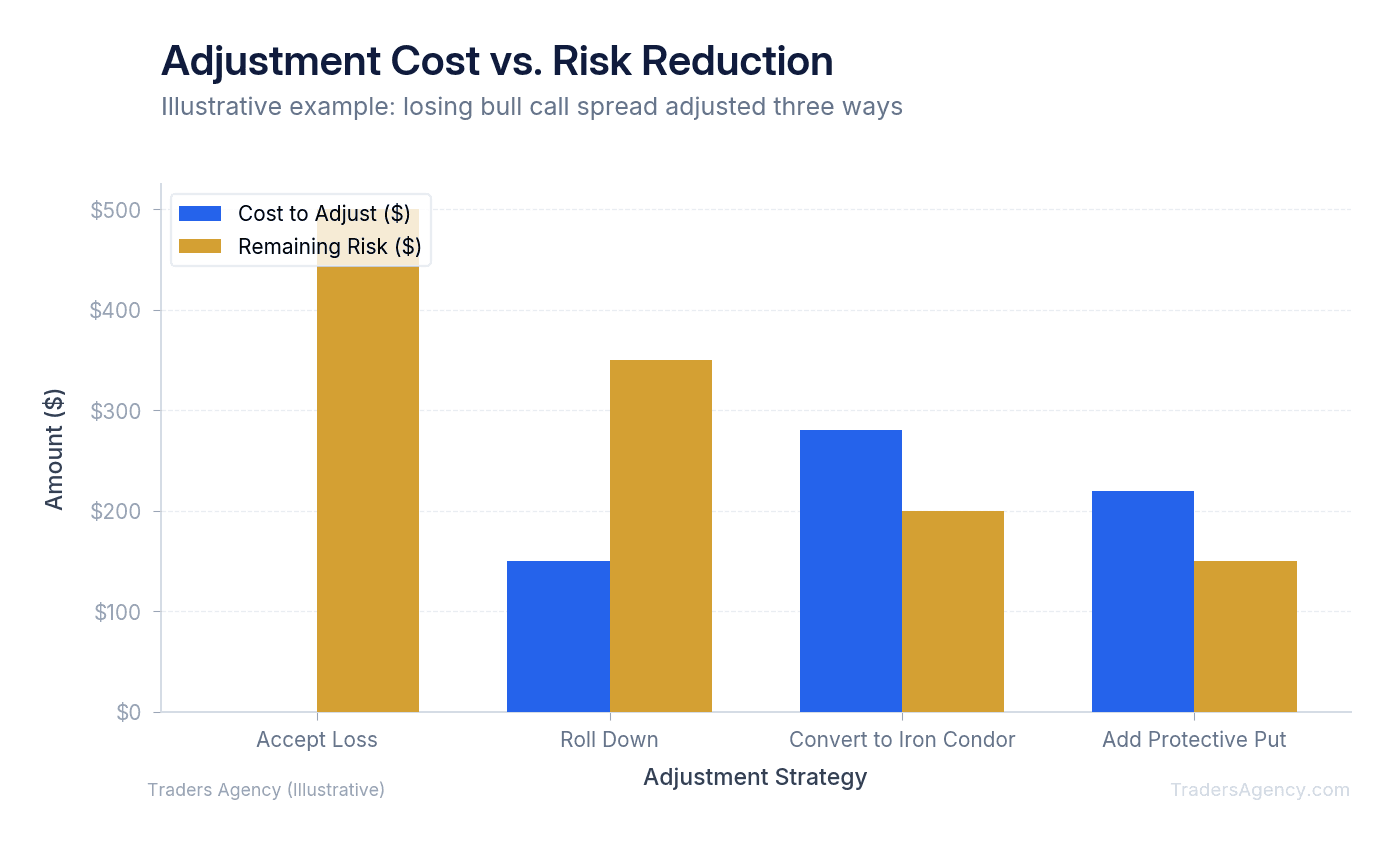
You should adjust a losing options position only when your original market thesis remains valid but the timing or magnitude of the move was incorrect. If the fundamental reason for the trade has completely changed, you should accept the loss and close the position immediately to preserve capital.
We teach our members to run a strict cost-benefit analysis before deploying any options trading repair techniques. You must weigh the adjustment premium against the remaining position risk. If defending the trade requires tying up too much buying power, the opportunity cost becomes too high.
Here are the criteria we use to decide:
- Capital allocation: Will the adjustment require more than 5% of your total account equity?
- Time to expiration: Do you have at least 21 days left to allow the new Greeks to work in your favor?
- Volatility environment: Is implied volatility high enough to collect meaningful premium on short strikes?
- Gamma risk: Is the position too close to expiration, where price swings will cause violent fluctuations in your portfolio?
If the answer to any of these is no, we take the loss. Capital preservation always comes first.
How Does Rolling Options Help You Extend Time and Shift Strikes?
Rolling an option means closing your current position and simultaneously opening a new position in the same underlying asset with a different expiration date, strike price, or both. This technique extends your time horizon and shifts your delta exposure to match new market conditions.
When we roll a trade, we are highly focused on the Greeks. If you are defending a short put, rolling out in time extends your theta collection window while giving the underlying more time to move in your favor. You are buying yourself more time to be right.
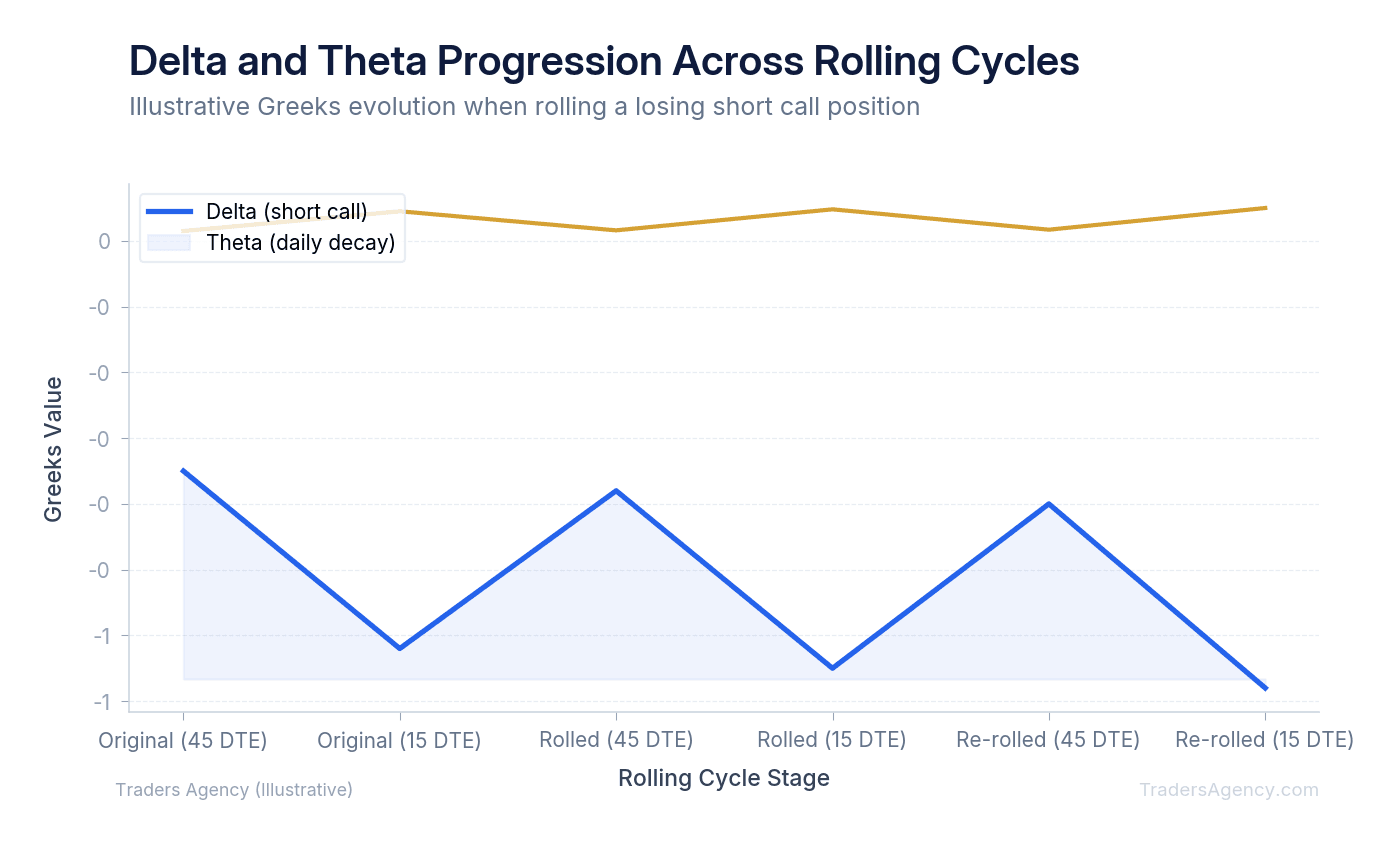
Rolling is not a magic fix, though. You are realizing a loss on the front month and taking on new risk in the back month. We prefer to roll for a net credit. If you have to pay a large debit to roll, you are just throwing good money after bad.
Watch Out: Rolling a losing position for a debit is one of the most common mistakes we see. If you can't roll for at least a small net credit, the adjustment is likely not worth the additional risk. Reassess your thesis before committing more capital.
1. Rolling Out
Rolling out means keeping the same strike price but moving to a later expiration date. We use this when the stock is hovering near our strike and we just need a few more weeks for the trade to materialize.
2. Rolling Down and Out
If you are defending a short put that is deep in the money, you might roll down and out. You close the current put for a loss, then sell a lower strike put in a further expiration cycle. The goal is to collect enough premium on the new put to cover the loss on the old one, while giving the stock room to breathe.
How Does the Stock Repair Strategy Work?
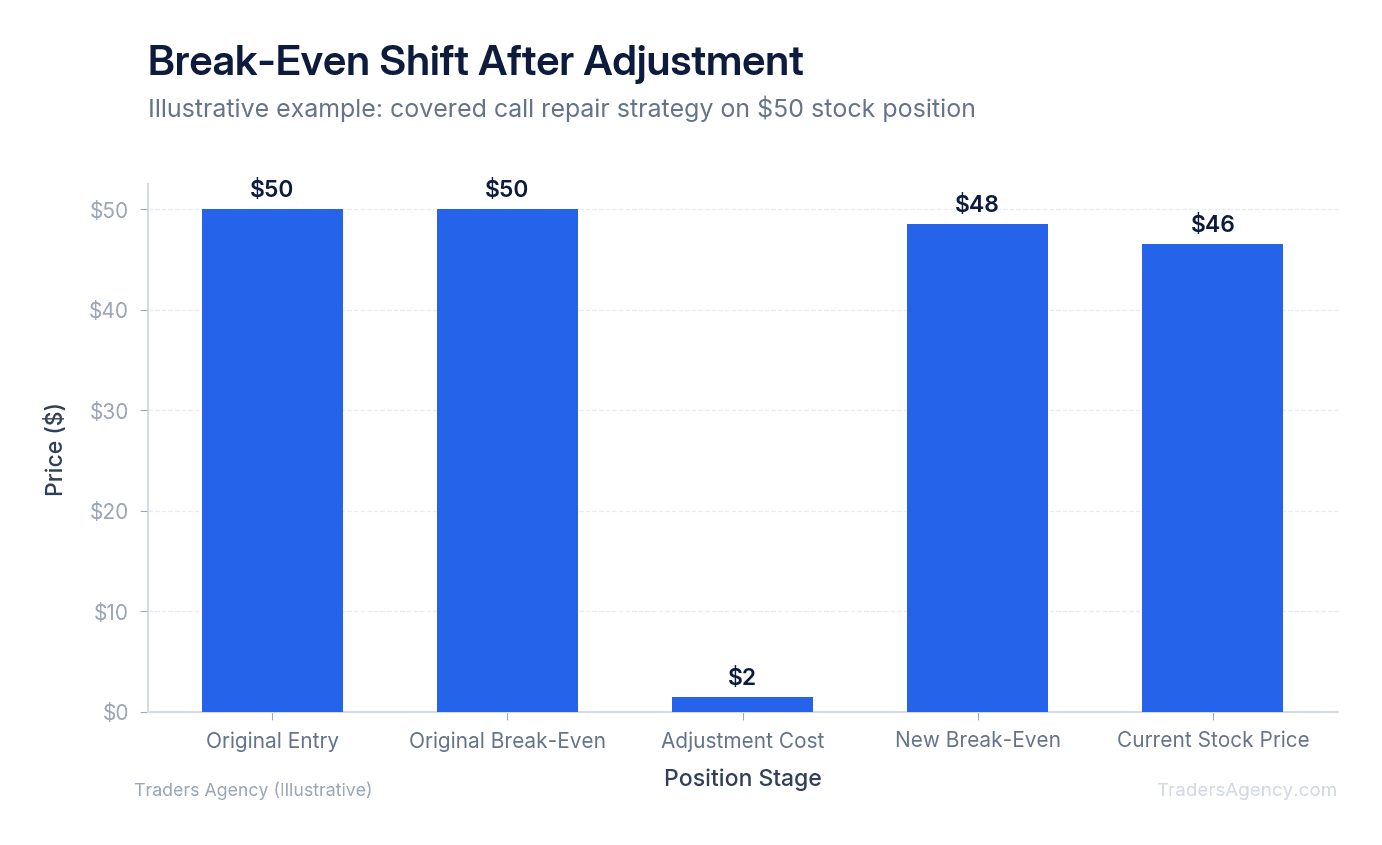
The stock repair strategy works by purchasing one call option at the current stock price and selling two call options at a higher strike price to finance the purchase. This creates an option ratio spread that lowers your break-even point on a losing long stock position without requiring additional capital.
This is essentially a covered call repair strategy on steroids. Say you bought 100 shares of XYZ stock at $100, but it has dropped to $80. You are down $2,000. You want to get your money back, but waiting for the stock to climb all the way back to $100 might take years.
Here is how we execute the repair:
- Buy the At-The-Money Call: You buy one $80 strike call expiring in 60 days. This costs you $4.00 in premium, or $400. You now have the right to buy another 100 shares at $80, giving you double the upside participation.
- Sell the Out-Of-The-Money Calls: You sell two $90 strike calls with the same expiration. These might trade for $2.00 each. By selling two, you collect $400 in premium.
- Calculate the New Break-Even: The net cost of this option ratio spread is zero. If you use a stock repair strategy calculator, you will see your new break-even point is now $90 instead of $100. If the stock rallies to $90 at expiration, your long call is worth $10 ($1,000), offsetting the remaining $10 per share loss on your stock. The two short $90 calls expire at the money with no intrinsic value. You exit the entire position at break-even, even though the stock is still $10 below your original purchase price.
| Parameter | Value |
|---|---|
| Stock Purchase Price | $100 |
| Current Stock Price | $80 |
| Unrealized Loss | -$2,000 |
| Long Call Purchased | $80 strike, $4.00 premium ($400) |
| Short Calls Sold (x2) | $90 strike, $2.00 each ($400 total) |
| Net Adjustment Cost | $0 |
| Original Break-Even | $100 |
| New Break-Even | $90 |
Want expert trading insights delivered daily?
Join thousands of traders who rely on Traders Agency for market analysis and trade ideas.
Join Traders AgencyConverting a Losing Vertical Spread into an Iron Condor
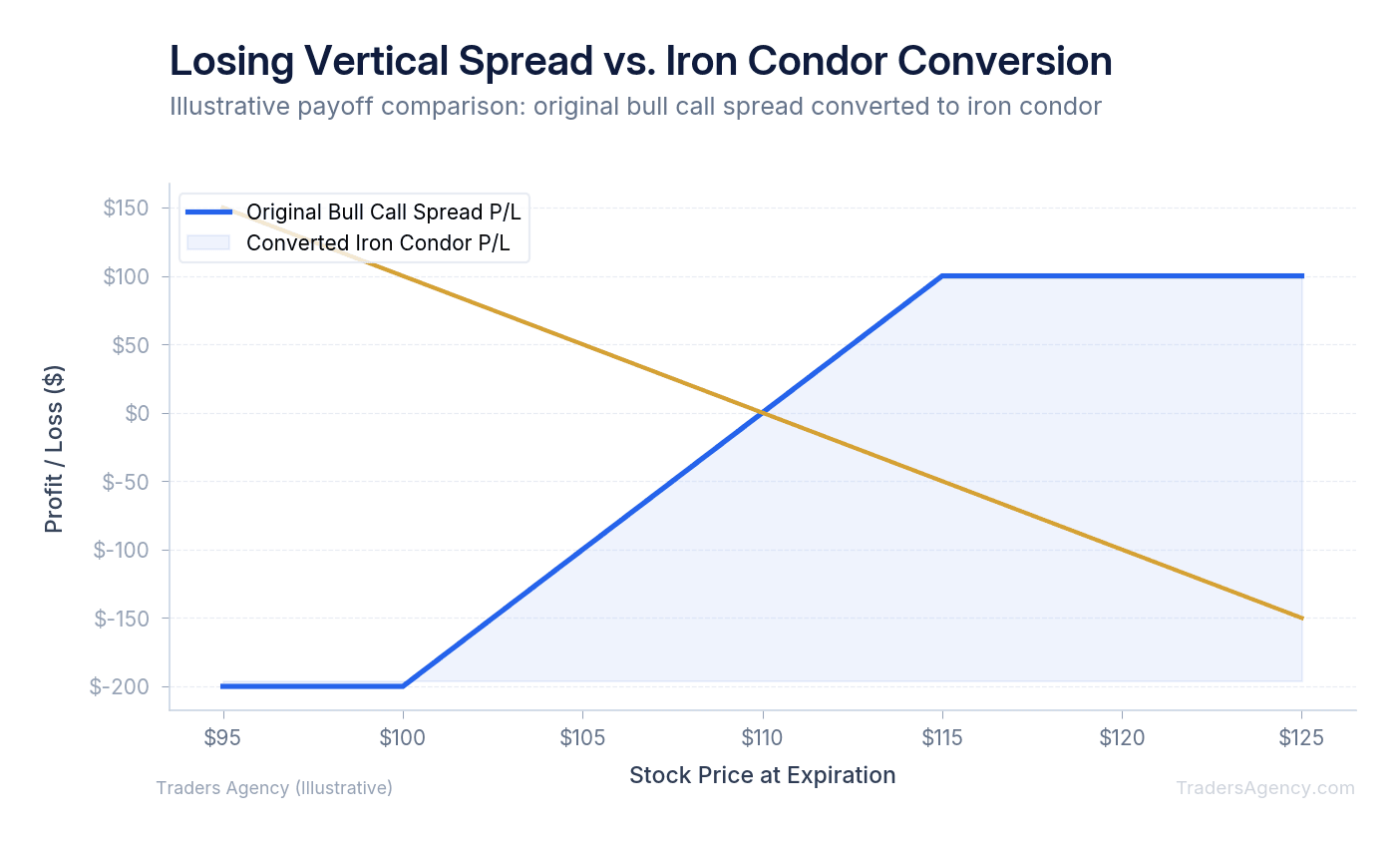
Converting a losing vertical spread into an iron condor involves selling an opposing credit spread on the other side of the market to collect additional premium. This strategy reduces your maximum potential loss by widening your break-even zone when the underlying asset moves against your initial spread.
This is one of our favorite advanced tactics. Here's a specific example using the S&P 500 Index (SPX).
- The Initial Losing Setup: Assume you sold an SPX bull put spread. You sold the 4,000 put and bought the 3,950 put for a net credit of $15.00 ($1,500 total). Your max risk is $35.00 ($3,500). Suddenly, SPX drops to 4,010. Your put spread is under severe pressure. Delta is expanding rapidly against you, and vega is hurting you as volatility spikes.
- The Iron Condor Conversion: To defend this, we sell a bear call spread above the current market price. We sell the 4,100 call and buy the 4,150 call for a net credit of $12.00 ($1,200). You now have an iron condor with defined risk on both sides of the market.
- The Outcome and Greeks Impact: You originally collected $15.00. You just collected another $12.00. Your total credit is now $27.00. Since SPX can only expire on one side of the iron condor, your margin requirement does not increase. Your maximum risk drops from $35.00 to just $23.00 (the 50-point spread width minus the $27.00 total credit). You have slashed your risk by nearly 35 percent without adding any new capital to the trade.
| Metric | Before Adjustment | After Iron Condor Conversion |
|---|---|---|
| Total Credit Collected | $15.00 ($1,500) | $27.00 ($2,700) |
| Maximum Risk | $35.00 ($3,500) | $23.00 ($2,300) |
| Risk Reduction | N/A | ~35% |
| Additional Capital Required | N/A | $0 |
Why Do 90% of Options Traders Lose Money?
Ninety percent of options traders lose money because they lack strict risk management rules and often double down on losing positions instead of cutting them. They trade illiquid options, ignore the impact of implied volatility, and fail to understand how time decay accelerates near expiration.
The SEC frequently warns retail investors about the complexities of derivatives. We see traders try to fix a simple mistake by opening a highly complex strap option strategy or an unbalanced ratio spread. They think adding more legs will magically erase their deficit.
Complexity does not equal profitability. When you add legs to a trade, you increase transaction costs and widen your bid-ask spread exposure. If you do not understand how your portfolio delta changes with every adjustment, you are gambling, not trading. Over-adjusting is a form of revenge trading. You become so obsessed with not losing money on one specific ticker that you blind yourself to better opportunities elsewhere in the market.
What Risk Management Rules Apply to Multi-Leg Options Adjustments?
Every time you adjust a trade, you tie up capital that could be deployed elsewhere. We teach our members to view adjustments as entirely new positions. You must evaluate the new risk profile objectively, ignoring the sunk cost of your original trade.
If you are managing a large stock portfolio, you might use a collar option strategy adjustment. This involves rolling your protective put down and your covered call down to lock in a new floor when the market drops. But even here, you must respect position sizing. A collar protects against downside, but adjusting it frequently can eat away at your long-term returns through constant premium payments.
Our team recommends keeping your total options allocation under 20% of your liquid net worth. Within that, no single trade should risk more than 2% to 3%.
When applying options trading repair techniques, follow these final rules:
- Never increase your maximum risk just to lower your break-even point.
- Always account for slippage and commissions in your break-even math.
- If an adjustment requires a margin expansion you cannot comfortably afford, take the initial loss.
- Do not adjust positions with fewer than 14 days to expiration. Gamma risk makes the underlying price movements too unpredictable.
Watch Out: Over-adjusting is one of the most expensive habits in options trading. If you find yourself making a third or fourth adjustment to the same position, stop. The trade is telling you something. Take the loss, free up the capital, and look for a cleaner setup. The best traders in the world take losses constantly. Their edge is that they keep those losses small and never let a single bad trade wipe out their account.
Adjusting losing options positions is a defensive skill. It requires patience, precise math, and the discipline to walk away when a trade is beyond repair. Master these techniques, and you will handle drawdowns with the confidence of a professional. For more on options education and risk management, the Cboe Options Institute offers additional learning resources worth exploring.
Want expert trading insights delivered daily?
Join thousands of traders who rely on Traders Agency for market analysis and trade ideas.
Join Traders AgencyKey Takeaways
- An options adjustment is not a repair of the original trade. It is an entirely new trade layered onto an existing position and must be evaluated on its own merits, including additional capital requirements and transaction costs.
- Rolling an options position means closing the current leg and reopening it at a different strike, expiration, or both. This can lower your break-even point or buy more time, but it also resets your risk profile.
- Converting a losing vertical spread into an iron condor adds a second spread on the opposite side, collecting additional premium to offset the loss on the original position without adding directional risk.
- Greeks analysis is essential before any adjustment. Changes in implied volatility and remaining time value directly affect whether an adjustment improves or worsens your position.
- Knowing when to walk away is as important as knowing how to adjust. If the cost of the adjustment exceeds the realistic recovery potential, cutting the loss and finding a cleaner setup is the professional move.
DISCLAIMER: Traders Agency does not offer financial advice. The information provided is for educational purposes only and should not be considered financial advice. Traders Agency is not responsible for any financial losses or consequences resulting from the use of the information provided. Trading carries inherent risks and may not be suitable for all individuals. You are advised to conduct your own research and seek personalized advice before making any investment decisions, recognizing the potential risks and rewards involved.
See more from Traders Agency on Google
Make us a preferred source and our market analysis will appear more prominently in your Google Search, Top Stories, and AI results.
Add to Preferred Sources