
You hold a stock that has doubled over the last year. You want to protect those massive gains, but you also don't want to sell your shares and trigger a hefty tax bill. Watching a winning position evaporate during a market pullback is one of the most frustrating experiences in trading. A protective collar strategy is an options trading technique that defends a stock position against significant downside risk while capping the upside potential. We're going to show you exactly how to build this setup to defend your portfolio. Our team frequently uses this approach when market volatility spikes and we want to build a safety net under a profitable stock position. By the end of this guide, you'll know how to construct these trades, calculate your exact risk, and apply them to your own brokerage accounts.
What Is a Protective Collar Strategy?
Bottom Line: A protective collar lets you hold a winning stock position through volatile markets without selling shares or absorbing an unlimited loss. The tradeoff is real: you give up upside beyond the short call strike in exchange for a defined floor below the long put strike. Traders who understand that tradeoff and size the strikes deliberately will get the most out of this structure.
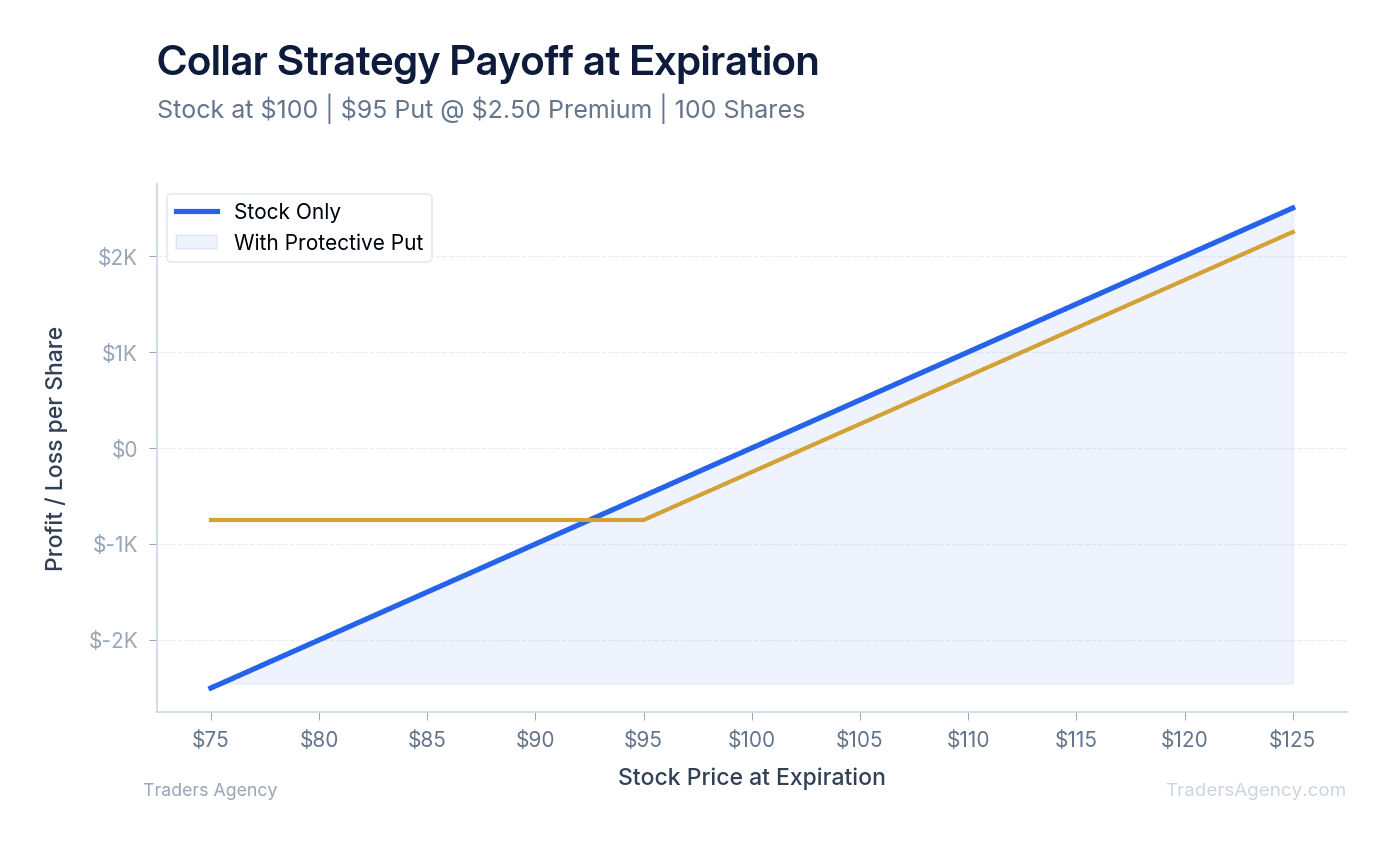
A protective collar strategy is a multi-leg options trade created by holding shares of an underlying stock, buying an out-of-the-money put option for downside protection, and simultaneously selling an out-of-the-money call option to finance the put. This structure limits both your maximum potential loss and your maximum potential profit.
The strategy consists of three distinct legs that work together. First, you must own 100 shares of stock for every options contract you intend to trade. The stock serves as the anchor for the entire position. Second, you purchase a protective put option at a strike price below the current stock price. This put acts as an insurance policy, guaranteeing you can sell your shares at the strike price regardless of how far the stock falls.
Third, you sell a covered call option at a strike price above the current stock price. The premium income generated from selling the call helps pay for the cost of the put. This reduces your out-of-pocket expense for the portfolio insurance. If the stock rallies above the call strike, you are obligated to sell your shares at that capped price.
Key Concept: A collar combines three elements: 100 shares of stock + 1 long put (downside insurance) + 1 short call (finances the put). Together, they create a defined-risk, defined-reward position that protects your gains.
How Does a Zero-Cost Collar Strategy Work?
You build a zero-cost collar strategy by selecting a call option to sell and a put option to buy that have identical premium prices. Because the credit received from the short call exactly matches the debit paid for the long put, the net cost to establish the options hedge is zero.
Finding a perfect zero-cost setup requires patience and precise strike selection. You'll typically look at options expiring in 30 to 60 days. The goal is to find a balance where the market is willing to pay you enough for your upside potential to completely fund your downside protection.
Here's a quick example. If a stock trades at $100 per share, you might buy a $90 strike put for $2.00. To offset this cost, you sell a $110 strike call for exactly $2.00. The net premium paid is $0.00. Your only risk is the $10 drop from the current price down to your put strike.
| Parameter | Value |
|---|---|
| Stock Price | $100 |
| Put Purchased | $90 strike, $2.00 premium paid |
| Call Sold | $110 strike, $2.00 premium received |
| Net Cost | $0.00 |
| Max Downside Risk | $1,000 ($100 to $90 × 100 shares) |
| Max Upside Gain | $1,000 ($100 to $110 × 100 shares) |
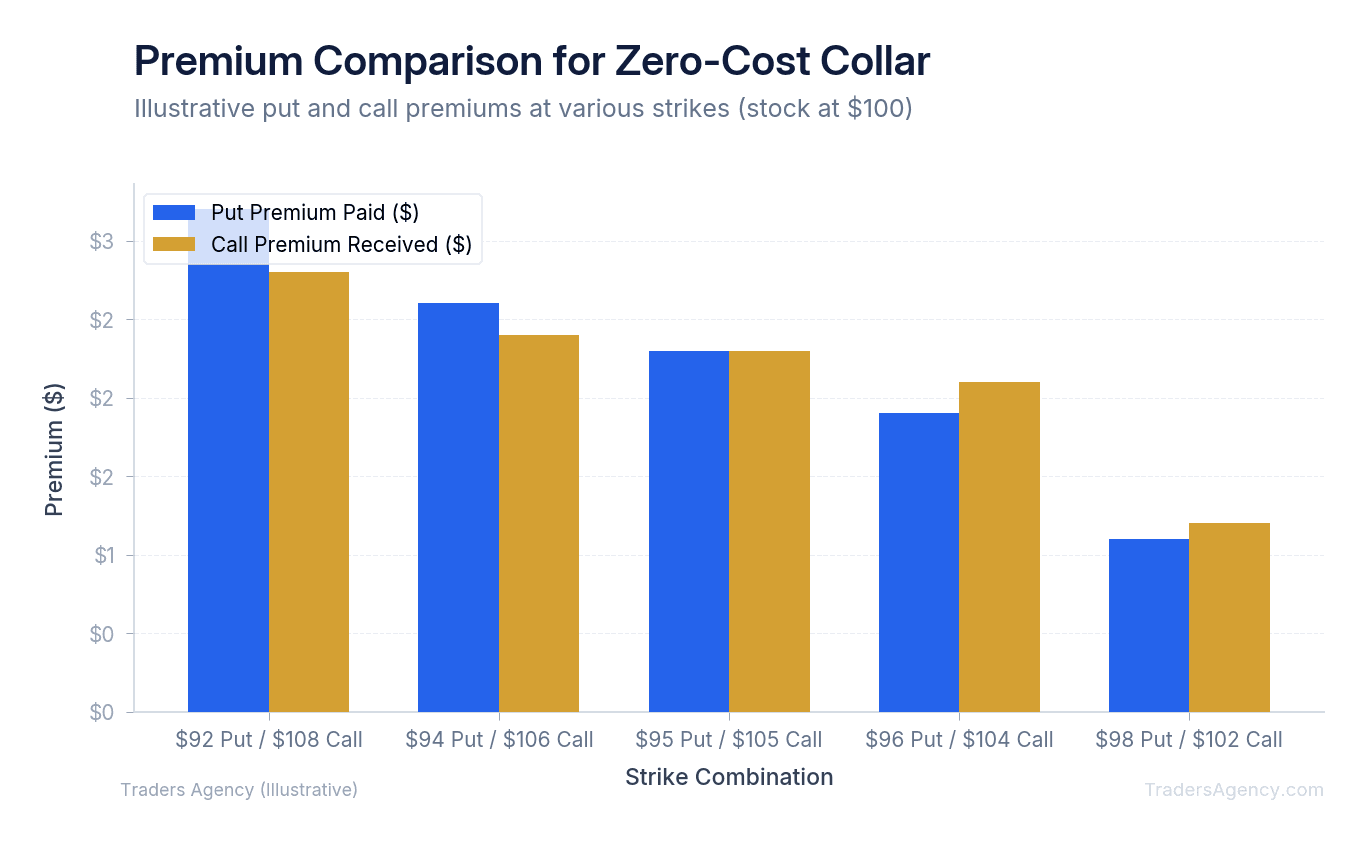
Keep in mind that trading fees and bid-ask spreads still apply in the real world. You must always factor in transaction costs when calculating your true breakeven points. We prefer to use a collar option strategy calculator to map out these premium offsets quickly. This tool helps visualize the exact credit or debit before entering the order, ensuring you don't accidentally pay too much for the hedge. The Cboe Options Exchange offers educational resources on options pricing that can help you understand how premiums are determined.
Example: Collar Option Strategy on AAPL
Let's walk through a concrete scenario using specific numbers. We'll assume you want to protect a tech stock heading into an unpredictable earnings season. You want to keep the stock long-term, but you can't afford a 20% drawdown right now.
- Identify the Stock Position: You currently own 100 shares of AAPL trading at $150 per share. Your total position value is $15,000. You've held this stock for years and have significant unrealized gains.
- Buy the Protective Put: You purchase one AAPL $140 put option expiring in 45 days. This contract costs $3.00 per share, or $300 total. This guarantees you can sell your shares for at least $14,000. Even if the company reports terrible earnings and the stock drops to $100, your shares are protected at the $140 level.
- Sell the Covered Call: You sell one AAPL $165 call option with the same 45-day expiration. This contract pays you $3.00 per share, or $300 total. You are now obligated to sell your shares at $165 if the stock rallies. The $300 credit from this sale perfectly covers the $300 debit from the put purchase.
The collar strategy payoff diagram for this trade shows a perfectly flat line below $140 and above $165. Here's how the three most common outcomes play out:
| Scenario | Stock Price at Expiration | Outcome | Profit / Loss |
|---|---|---|---|
| Worst Case | $130 | Exercise put, sell shares at $140 | -$1,000 |
| Between Strikes | $140 – $150 | Both options expire worthless, keep shares | -$1,000 to $0 |
| Neutral / Gain | $150 – $165 | Both options expire worthless, keep shares | $0 to +$1,500 |
| Best Case | $175 | Shares called away at $165 | +$1,500 |
Key Concept: In the most likely scenario, the stock stays between your two strikes. Both options expire worthless, you keep your shares, and you can set up a new collar for the following month. This is the outcome we plan for most often.
Want expert trading insights delivered daily?
Join thousands of traders who rely on Traders Agency for market analysis and trade ideas.
Join Traders AgencyHow Do Delta, Theta, and Vega Affect a Collar Position?
The options Greeks measure how a collar position reacts to market changes. Delta remains positive but is reduced by the short call. Theta decay has a minimal net impact because the long put and short call offset each other. Vega exposure is also largely neutralized by holding opposing option positions.
Many intermediate traders ignore the Greeks when hedging. We teach our members to monitor these metrics closely to understand their true market exposure. You can't manage a trade effectively if you don't understand how time and volatility affect your pricing.
Because you own the stock, your starting position delta is +100. Buying the put reduces your delta slightly, and selling the call reduces it further. Your net delta will typically sit between +40 and +60. This means your overall position moves slower than the underlying stock. If the stock drops by $1.00, your account value might only drop by $0.50.
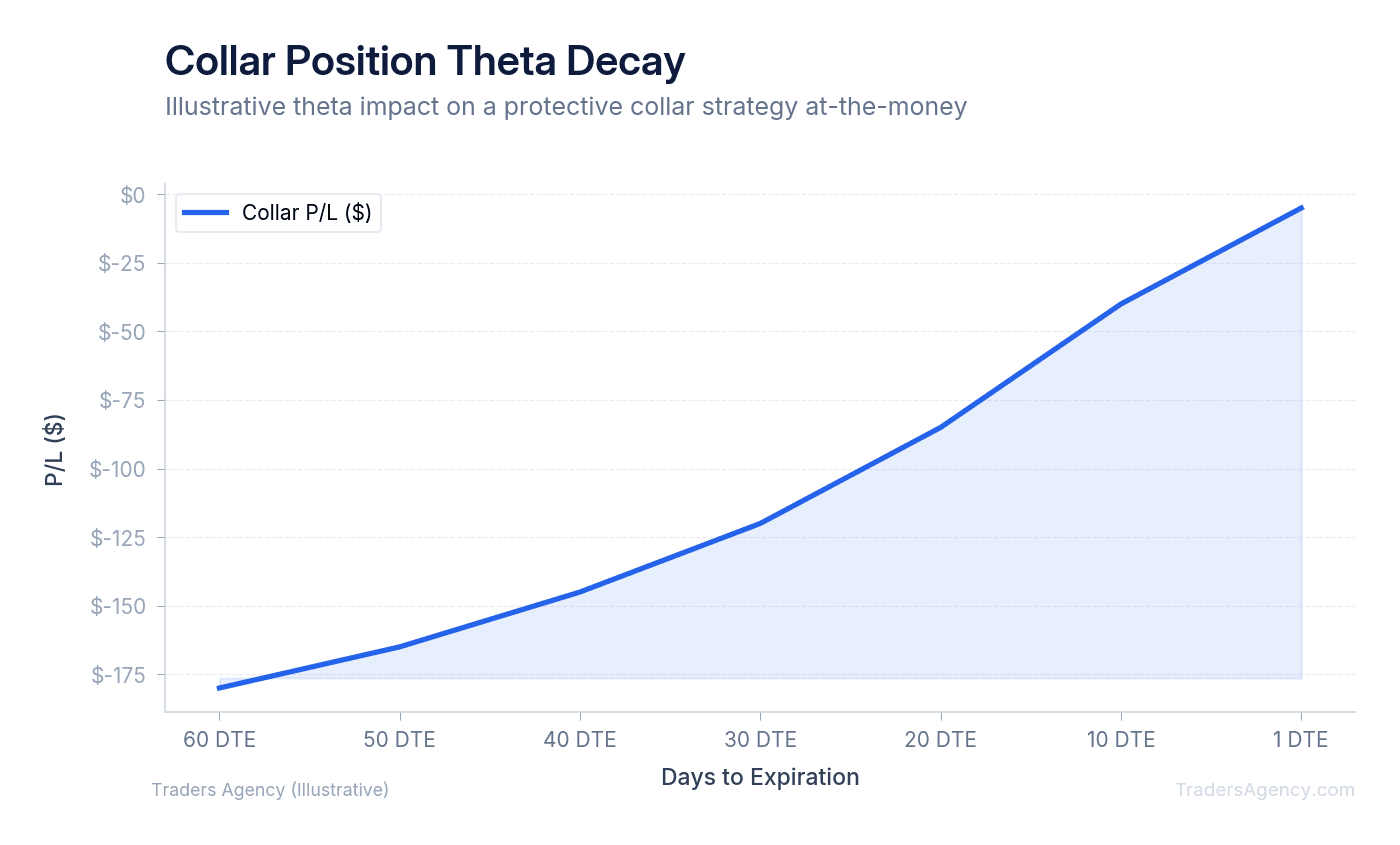
Time decay, measured by theta, works in your favor on the short call but against you on the long put. Since you hold one short and one long contract, the daily time decay effectively cancels out. You don't have to worry about losing money simply because time is passing.
Implied volatility, measured by vega, follows a similar pattern. A spike in volatility increases the value of your protective put, but it also increases the value of your short call, making it more expensive to buy back. This makes the collar an excellent choice when you expect volatility to expand but don't want to predict its exact direction.
Comparing Collar Variants: Long, Short, and Synthetic
Collar variants allow traders to adjust their market bias. A standard long collar protects owned stock. A short collar protects a short stock position. A synthetic collar mimics a standard collar using only options without owning shares.
The standard setup is just the beginning. Advanced traders modify the basic structure to fit different portfolio requirements and margin limitations.
A short collar strategy is the exact inverse of the standard approach. You short 100 shares of stock, buy a call to protect against a massive rally, and sell a put to finance the call. We use this to defend bearish positions during unexpected market bounces. The mechanics are identical, but the directional bias is flipped.
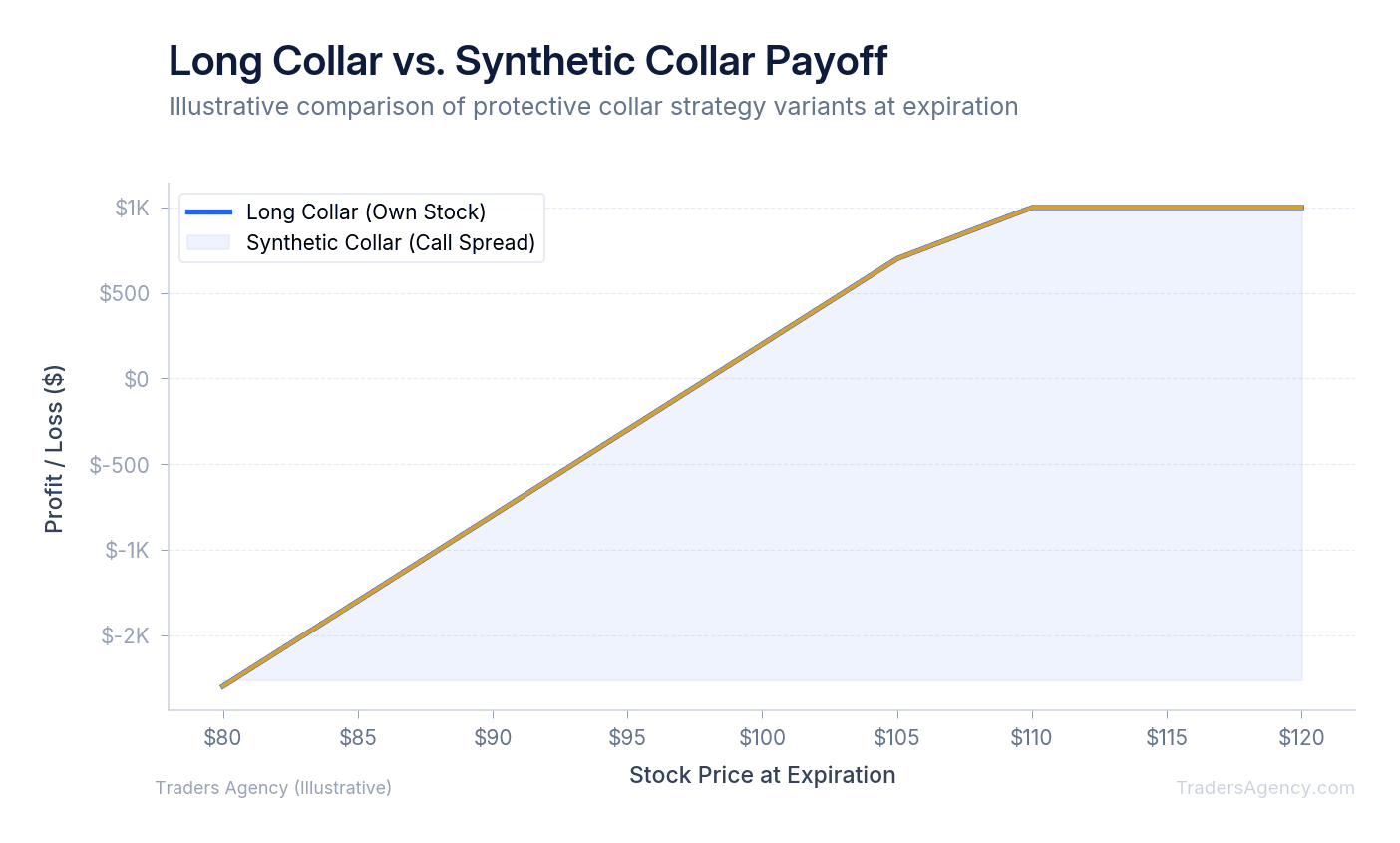
A synthetic collar option strategy requires no stock ownership at all. You buy an at-the-money call option to simulate the long stock position and sell an out-of-the-money put option below the current price. This combination replicates the risk profile of a traditional collar using a fraction of the capital, with defined upside from the long call and capped downside from the short put obligation.
Watch Out: Synthetic positions carry unique assignment risks. You must have the margin capacity in your account to buy the stock if the short put is exercised against you. We only recommend synthetic variations for traders with high-level options approval and strict risk management rules. The SEC's investor education resources provide additional guidance on understanding options assignment risk.
When Should You Use This Strategy?
You should use a collar strategy when you have significant unrealized gains in a stock and want to protect them without triggering a taxable event. It's highly effective during periods of high market uncertainty, ahead of earnings reports, or when approaching year-end tax planning deadlines.
Tax planning is one of the most practical applications for this setup. Selling a highly appreciated stock triggers capital gains taxes immediately. This can create a massive tax burden, especially if you've held the stock for less than a year and face short-term capital gains rates.
By applying a collar, you lock in your equity value without selling the underlying shares. This allows you to defer taxes into the following calendar year while sleeping soundly through market turbulence. Once the new year begins, you can remove the options hedge and sell the stock on your own terms.
Here are the specific criteria we look for before entering this trade:
- You own at least 100 shares of a single stock.
- The stock has experienced a massive run-up in price and you fear a correction.
- You're willing to cap your upside potential for the next 30 to 60 days.
- You want to avoid the immediate tax consequences of selling your shares.
- The options market offers enough premium on the call side to fund your put.
Do not use this strategy on a stock you just purchased if you're highly bullish. If you expect the stock to break out and run another 20%, capping your upside with a short call will only cause frustration.
What Are the Most Common Mistakes Traders Make With Collar Options?
The most common mistake traders make with collars is selecting a call strike that is too close to the current stock price. This chokes off all upside potential and frequently leads to early assignment. Traders also fail to account for upcoming dividend dates, which can trigger early exercise.
We see traders build these positions incorrectly all the time. The desire for a large credit often leads to poor strike selection. If you sell a call too close to the money just to collect more premium, a minor stock rally will force you to sell your shares. You must give the stock room to breathe. We prefer to set the short call strike at least 10% to 15% above the current price.
Another frequent error is ignoring earnings dates. Volatility crush after an earnings report can dramatically alter the pricing of your options. The put you bought for protection will lose value rapidly once the earnings uncertainty passes. Always check the corporate calendar before placing your trades.
Dividend dates present a hidden danger for the short call leg. If the dividend payout is larger than the remaining time value on your short call, an institutional trader might exercise the call early to capture the dividend. This strips you of your shares unexpectedly.
Watch Out: Never execute the options legs separately. Always use a multi-leg order ticket to route the put and the call simultaneously. This prevents the stock from moving against you while you're trying to fill the second half of the trade. Professional platforms allow you to route the entire package as a single order, ensuring you get the exact net debit or credit you calculated.
The Traders Agency education team publishes new strategy guides and market analysis every week. If the collar strategy fits your portfolio needs, start by paper trading a few setups to get comfortable with the mechanics before committing real capital.
Want expert trading insights delivered daily?
Join thousands of traders who rely on Traders Agency for market analysis and trade ideas.
Join Traders AgencyKey Takeaways
- A protective collar requires three components working together: 100 shares of stock per contract, a purchased out-of-the-money put for downside protection, and a sold out-of-the-money call to offset the put's cost.
- The sold call finances the put purchase, which means the strategy can be structured for zero net cost or even a small credit, making it a practical hedge for traders who want protection without paying a large premium.
- Both maximum loss and maximum gain are capped by the strike prices you choose, so selecting those strikes is the most consequential decision when building the trade.
- Routing the put and call as a single multi-leg order prevents the stock from moving against you while you fill each leg separately, a critical execution detail on professional platforms.
- The strategy is particularly useful when you hold a stock with large unrealized gains and want to avoid triggering a taxable sale while still protecting against a market pullback.
DISCLAIMER: Traders Agency does not offer financial advice. The information provided is for educational purposes only and should not be considered financial advice. Traders Agency is not responsible for any financial losses or consequences resulting from the use of the information provided. Trading carries inherent risks and may not be suitable for all individuals. You are advised to conduct your own research and seek personalized advice before making any investment decisions, recognizing the potential risks and rewards involved.
See more from Traders Agency on Google
Make us a preferred source and our market analysis will appear more prominently in your Google Search, Top Stories, and AI results.
Add to Preferred Sources