
You've found a stock you believe in, but buying 100 shares would tie up a massive chunk of your account. Sound familiar? A LEAPS options strategy solves this problem by letting you control shares of stock with far less capital while giving your investment thesis the time it needs to play out. Our team regularly uses this approach to gain exposure to high-priced stocks without committing an entire portfolio to a single position. By the end of this guide, you'll know exactly how to structure these trades, select the right strikes, manage your risk, and understand the specific math and market conditions where this approach shines.
What Are LEAPS in Long-Term Options?
Bottom Line: A LEAPS options strategy works best when you have a high-conviction, long-term view on a stock but want to limit your capital commitment and define your maximum risk upfront. The combination of deep ITM strike selection, disciplined position sizing, and proactive trade management before time decay accelerates is what separates a well-structured LEAPS trade from a speculative bet. Used correctly, this approach can replicate the economic exposure of stock ownership at a fraction of the cost.
LEAPS (Long-Term Equity Anticipation Securities) are standard call or put contracts that expire between one and three years from the purchase date. They function exactly like short-term options but provide an extended timeline. This extra time reduces the daily impact of time decay, making them ideal for long-term market forecasts.
Despite the complex name, the mechanics are straightforward. When you buy a standard call option, you purchase the right to buy 100 shares of a stock at a specific price before a specific date. A long-dated contract simply pushes that expiration date much further into the future.
Key Concept: Think of LEAPS like renting a house with a three-year lease versus a one-month lease. You pay a higher premium upfront for the longer lease, but you secure your position and lock in your rate for years. In the stock market, buying time gives your investment thesis room to play out. Market corrections, temporary earnings misses, and short-term volatility matter much less when you have 800 days until expiration.
How Does a LEAPS Options Strategy Compare to Buying Stock?
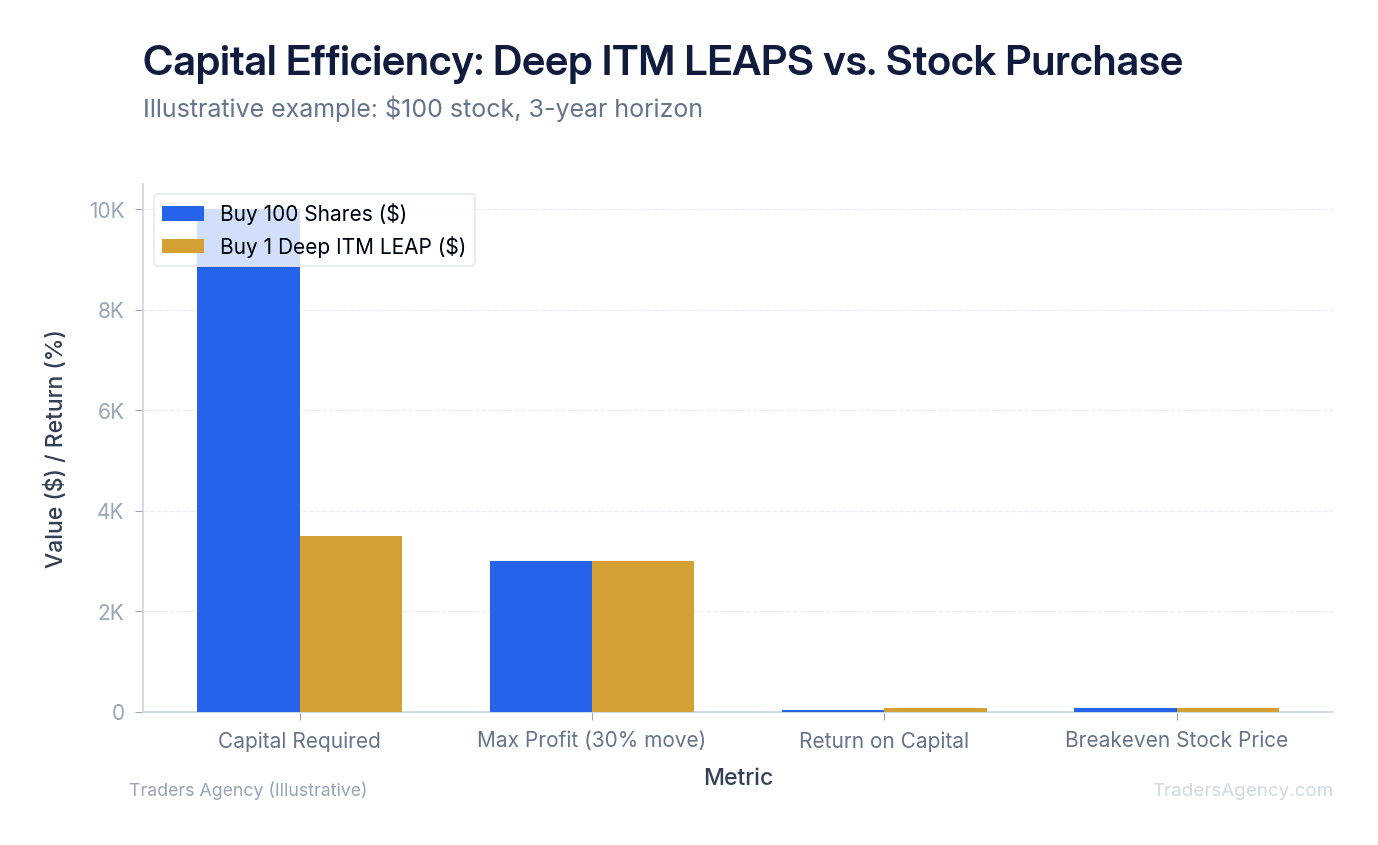
A LEAPS options strategy requires significantly less capital than buying 100 shares of stock outright, while offering similar profit potential. Because you only pay the options premium rather than the full share price, your return on investment can be substantially higher if the stock moves in your anticipated direction.
When you buy 100 shares of a $150 stock, you must invest $15,000. If the stock drops to $100, you lose $5,000. Your capital is tied up, and your downside risk is the entire $15,000 if the company goes bankrupt.
Our team prefers using a deep in-the-money (ITM) call option as a stock replacement. Instead of spending $15,000, you might spend $5,500 on a contract that behaves very similarly to the stock. This frees up $9,500 in capital that you can hold in cash, earn interest on, or use for other trades. Your maximum possible loss is strictly capped at the $5,500 you paid for the contract.
| Metric | Buying 100 Shares | LEAPS Call Option |
|---|---|---|
| Capital Required | $15,000 | $5,500 |
| Capital Freed Up | $0 | $9,500 |
| Maximum Loss | $15,000 (stock to $0) | $5,500 (premium paid) |
| Upside Participation | 100% | ~80% (delta of 0.80) |
How Do the Greeks Behave in Long-Dated Options?
The Greeks behave differently in a LEAPS options strategy compared to short-dated contracts. Theta (time decay) moves very slowly during the first year and accelerates rapidly in the final months. Vega (volatility sensitivity) is exceptionally high because the long timeline amplifies the impact of implied volatility changes.
To trade this strategy successfully, you need to understand three specific options Greeks:
- Delta: This measures how much the option price changes for every $1 move in the stock. A deep ITM long-dated call often has a delta of 0.80. This means if the stock goes up by $1, your option gains $0.80 in value. It mimics owning 80 shares of the stock.
- Theta: This measures time decay. Short-term options lose value rapidly every single day. Long-dated options lose value at a microscopic rate during their first year. You can hold the contract for months without seeing significant erosion from time alone.
- Vega: This measures sensitivity to implied volatility. Because there is so much time until expiration, long-dated options are highly sensitive to volatility changes. If market fear spikes, the premium of your contract will inflate. If the market goes completely flat, the premium will deflate.
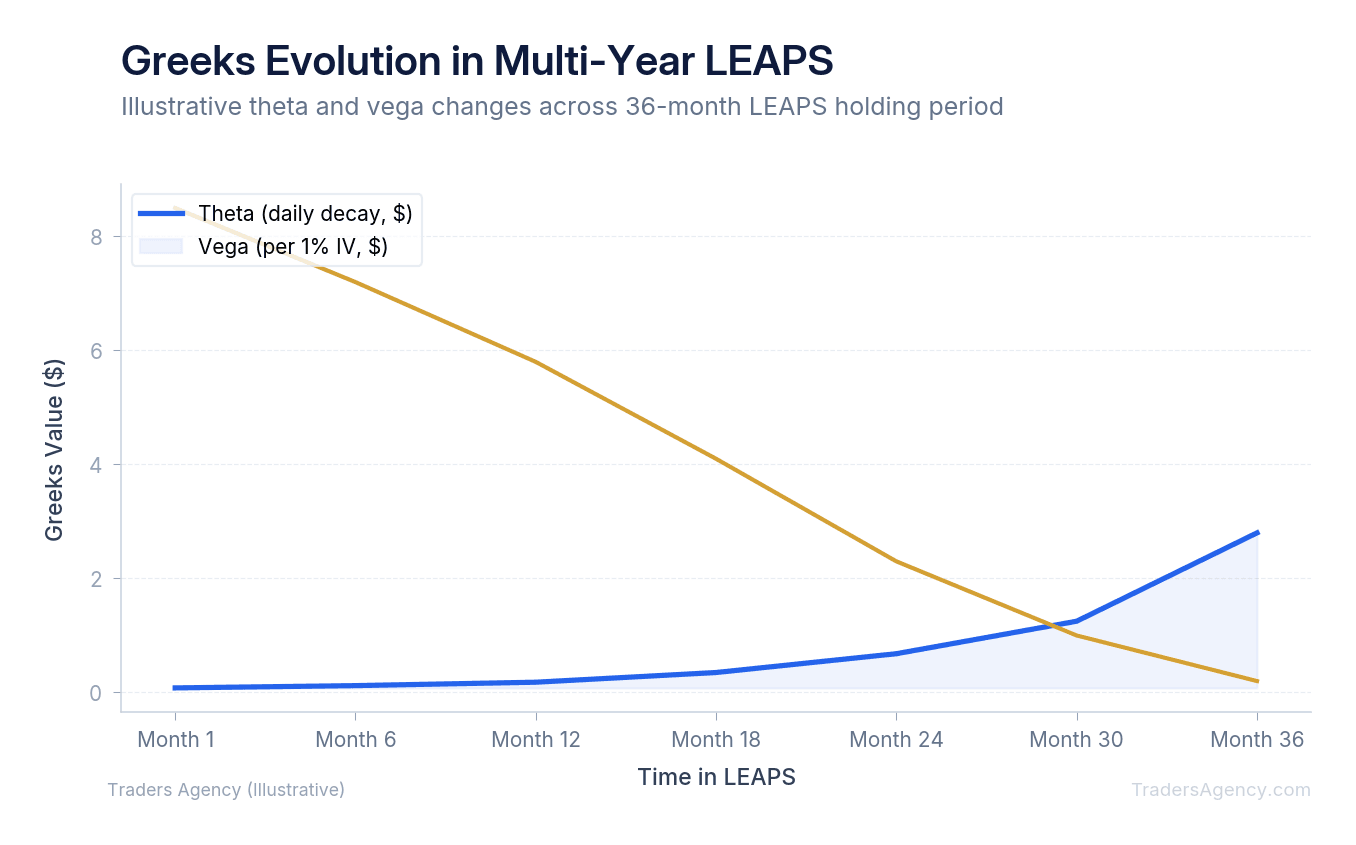
Key Concept: When buying LEAPS, vega is your friend if volatility is low at entry. Purchase your contracts when implied volatility is relatively compressed, and any subsequent volatility expansion will add value to your position on top of any directional move.
How Do You Select the Right Strike and Expiration for LEAPS?
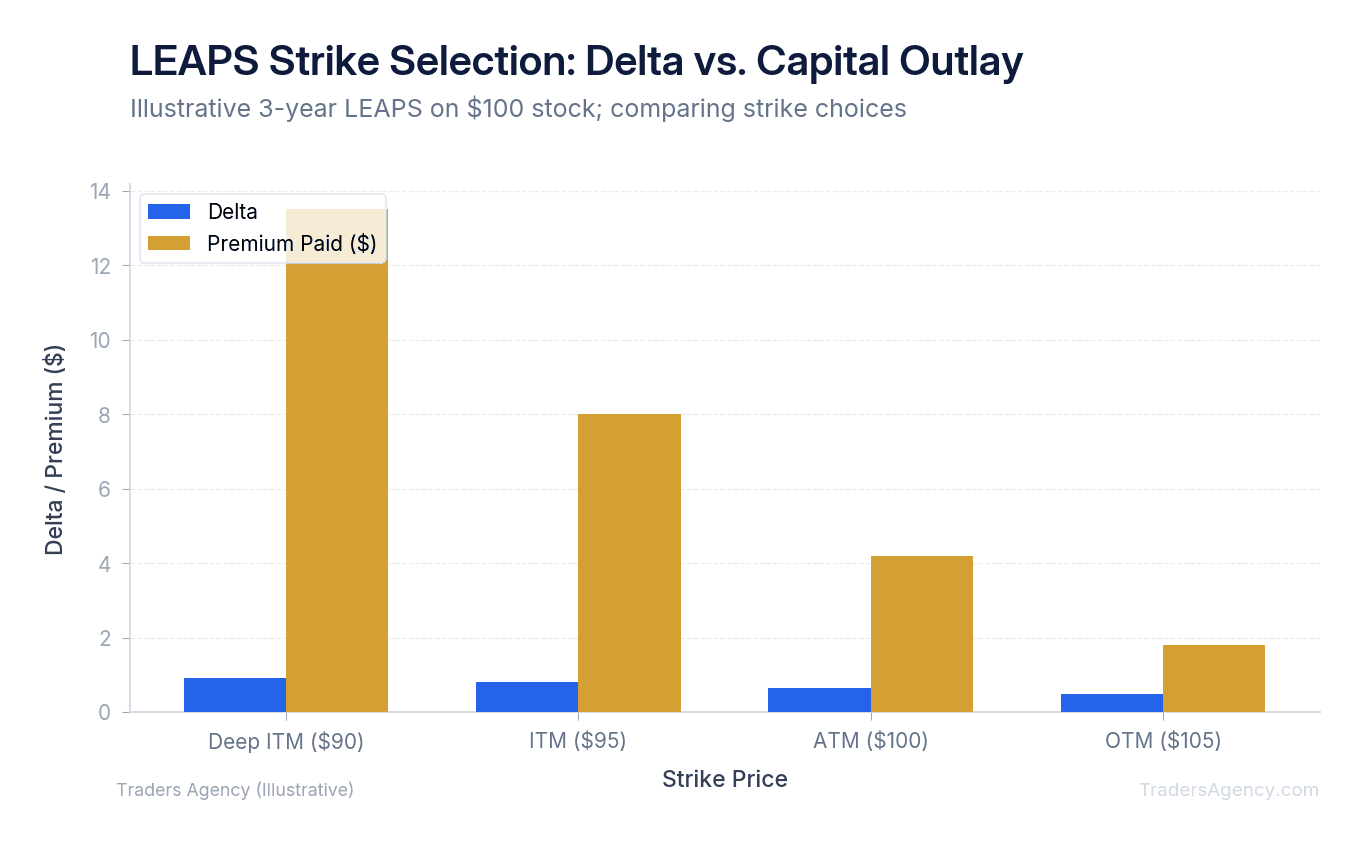
Choosing the correct strike price and expiration date determines your probability of success. We teach our members to avoid cheap, out-of-the-money (OTM) lottery tickets. Instead, you should buy deep ITM contracts that provide intrinsic value and high delta.
Here is the exact process our team uses to set up a stock replacement trade:
- Pick an Expiration Date Far in the Future: We look for expirations that are at least 365 days out, but ideally 500 to 800 days out. This provides maximum protection against short-term market corrections. The longer the timeline, the less you have to worry about perfectly timing your entry.
- Target a 0.80 Delta Strike: We scroll through the options chain and locate the strike price that has a delta of approximately 0.80. This strike will be deep in the money. By choosing a 0.80 delta, we ensure the option price moves almost in lockstep with the underlying stock.
- Calculate the Extrinsic Value: Extrinsic value is the premium you pay purely for time and volatility. You want this number to be as low as possible. Deep ITM options consist mostly of intrinsic value (real, tangible value based on the stock price). We verify that the extrinsic value makes up a small percentage of the total contract cost.
Want expert trading insights delivered daily?
Join thousands of traders who rely on Traders Agency for market analysis and trade ideas.
Join Traders AgencyWhat Do Real-World LEAPS Profit and Loss Scenarios Look Like?
To understand how this works in practice, we'll walk through a concrete example with specific numbers. We'll compare buying 100 shares of a fictional company, XYZ, to buying a single long-dated call option.
The Setup
Imagine XYZ is currently trading at $150 per share. You're bullish on the company over the next two years.
| Parameter | Stock Purchase | LEAPS Call Option |
|---|---|---|
| Position | Buy 100 shares | Buy one $100 strike call, 700 days to expiration |
| Total Cost | $15,000 | $5,500 ($55.00 premium x 100) |
| Breakeven Price | $150 | $155 ($100 strike + $55 premium) |
Scenario 1: The Stock Rallies to $200
Two years pass, and XYZ rallies to $200 per share.
| Metric | Stock Position | LEAPS Position |
|---|---|---|
| Ending Value | $20,000 | $10,000 ($200 - $100 strike x 100) |
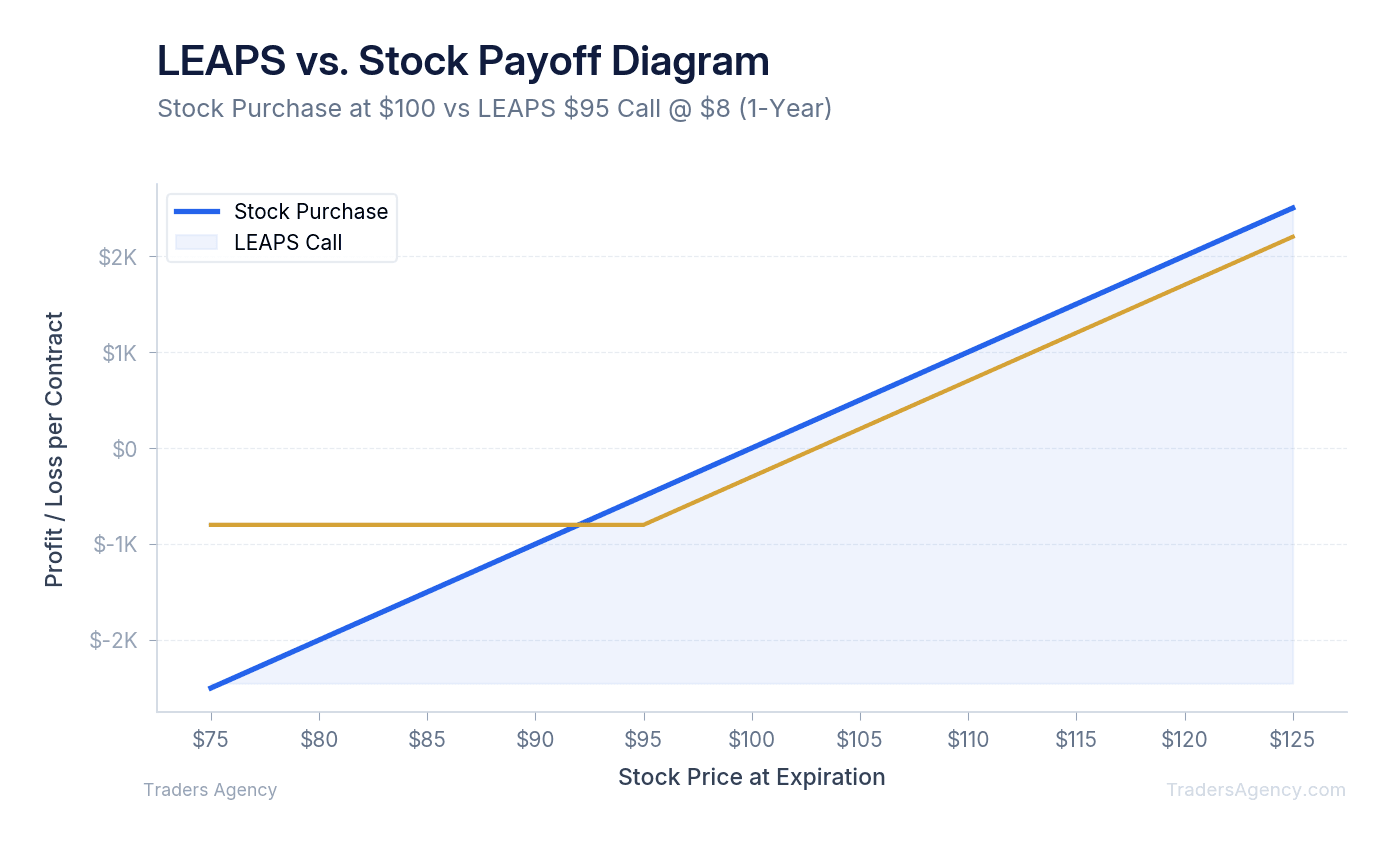
| Dollar Profit | +$5,000 | +$4,500 |
| Percentage Return | 33% | 82% |
You made slightly less in raw dollar profit with the LEAPS position, but your percentage return was substantially higher because you risked far less capital.
Scenario 2: The Stock Crashes to $80
Two years pass, and XYZ faces a major scandal. The stock drops to $80 per share.
| Metric | Stock Position | LEAPS Position |
|---|---|---|
| Ending Value | $8,000 | $0 (expires worthless) |
| Dollar Loss | -$7,000 | -$5,500 |
In the worst-case scenario, the options trader actually loses less money than the stock trader because the maximum risk is strictly capped at the initial premium paid.
Can LEAPS Be Treated as Long-Term Capital Gains?
Yes. LEAPS can qualify for long-term capital gains tax treatment if you hold the options contract itself for more than one year before selling it. The holding period must exceed 12 months to qualify for the lower long-term capital gains tax rates.
Tax treatment is a major reason why long-term investors favor this strategy. If you buy a contract with 800 days until expiration, you can easily hold it for 14 or 15 months. When you sell the contract to close your position, any profit is taxed at the favorable long-term rate.
However, you must understand the difference between selling the contract and exercising the contract. If you choose to exercise your call option to take physical delivery of the 100 shares, your holding period for the options contract ends. A brand new holding period begins for the stock shares on the day you exercise. To get long-term capital gains on the stock, you would need to hold those physical shares for another full year.
Watch Out: Because of this rule, our team almost always prefers to sell the contract to close the trade rather than exercising it. Selling captures the profit immediately and preserves the long-term capital gains status. We always advise checking with a certified tax professional, as individual tax situations vary. You can review the holding period mechanics through the Cboe Options Exchange educational resources.
When Should Long-Term Investors Use This Approach?
This strategy is highly effective, but it's not meant for every market environment or every stock. You must apply it selectively based on specific criteria.
We use this approach when we have a strong bullish conviction on a large, stable company. It works beautifully for blue-chip stocks, major tech companies, and broad market ETFs like the SPY or QQQ. These assets have a historical upward drift over multi-year periods. By buying a deep ITM call, we participate in that upward drift while keeping our capital requirements low.
You should also consider this strategy when implied volatility is relatively low. Because long-dated options are highly sensitive to vega, buying them when volatility is already compressed means you pay less extrinsic value. If volatility expands later, your contract gains value.
Common Mistakes to Avoid
We see traders make a few specific errors when attempting this strategy. Avoid these traps to protect your capital:
- Buying Out-of-the-Money Strikes: Buying a $200 strike call on a $150 stock just because it's cheap is a major mistake. OTM options have low deltas and consist entirely of extrinsic value. If the stock stays flat, you lose 100% of your investment. Always stick to deep ITM strikes for stock replacement.
- Holding Until Expiration: We never hold these contracts all the way to expiration. During the final 60 days, theta decay accelerates aggressively. We prefer to sell the contract or roll it out to a new expiration date when there are still 3 to 6 months left on the clock.
- Over-Allocating Capital: Because these options are cheaper than stock, traders often buy too many contracts. If you normally buy 100 shares of a stock, you should only buy one contract. Do not buy three contracts just because you have the cash. That dramatically increases your risk profile.
Risk Warning: LEAPS options can expire completely worthless, resulting in a 100% loss of the premium paid. Keep your position sizes disciplined, select deep ITM strikes, and manage your trades before time decay accelerates. Options trading involves significant risk and is not suitable for all investors.
By keeping your position sizes small, selecting deep ITM strikes, and managing your trades before time decay kicks in, you can effectively replicate stock ownership with a fraction of the capital. Our team has found this to be one of the most capital-efficient ways to build long-term exposure to high-conviction positions.
Want expert trading insights delivered daily?
Join thousands of traders who rely on Traders Agency for market analysis and trade ideas.
Join Traders AgencyKey Takeaways
- LEAPS contracts expire between one and three years out, giving your investment thesis significantly more time to play out compared to standard short-term options.
- Buying deep in-the-money LEAPS lets you control 100 shares of a high-priced stock with far less capital than an outright stock purchase, making them a capital-efficient alternative to direct ownership.
- Time decay has less daily impact on LEAPS than on short-term options, but it accelerates as expiration approaches, so managing your position before that window matters.
- The maximum loss on a LEAPS position is capped at 100% of the premium paid, which makes position sizing discipline critical to protecting your overall portfolio.
- Selecting deep ITM strikes is a core part of the strategy because it increases the option's sensitivity to stock price movement and reduces the risk of the contract expiring worthless.
DISCLAIMER: Traders Agency does not offer financial advice. The information provided is for educational purposes only and should not be considered financial advice. Traders Agency is not responsible for any financial losses or consequences resulting from the use of the information provided. Trading carries inherent risks and may not be suitable for all individuals. You are advised to conduct your own research and seek personalized advice before making any investment decisions, recognizing the potential risks and rewards involved.
See more from Traders Agency on Google
Make us a preferred source and our market analysis will appear more prominently in your Google Search, Top Stories, and AI results.
Add to Preferred Sources