A pump and dump scheme is one of the oldest and most destructive frauds in the stock market. Promoters artificially inflate a stock's price through false or misleading hype, sell their shares at the top, and leave everyday investors holding worthless positions. We're going to show you exactly how to spot these setups before the crash happens, so you can protect your trading account and focus on legitimate opportunities.
You've probably seen this play out on your social media feeds. A completely unknown company suddenly trends everywhere, and anonymous accounts claim the stock is going to the moon. New traders often fall for these traps, hoping to double their money overnight.
We'll walk you through exactly how these market manipulations operate. By the time you finish reading, you'll know how to identify the warning signs, read the chart patterns, and keep your capital safe from these devastating setups.
What Is a Pump and Dump Scheme and How Does It Work?
Bottom Line: Pump and dump schemes are built on manufactured demand, and the retail trader is always the last one holding the bag. Recognizing the chart patterns, volume spikes, and promotional red flags before they peak is the only reliable way to stay protected. The core lesson here is simple: legitimate opportunities exist every day, and no suspicious setup is worth chasing.
A pump and dump scheme works by targeting low-priced, thinly traded stocks. Fraudsters accumulate shares cheaply, then launch aggressive marketing campaigns to attract retail buyers. This sudden influx of buying demand drives the share price up rapidly. The organizers then sell their positions, draining the buying pressure and collapsing the price.
The mechanics behind this fraud rely entirely on basic supply and demand. When a stock has very few active buyers and sellers, even a small amount of new buying volume can force the price significantly higher. Promoters take full advantage of this structural market reality.
They use email newsletters, private chat rooms, and public social media platforms to spread fake news about a target company. They might claim the company just discovered a massive gold deposit, secured a secret government contract, or invented a cure for a disease.
Innocent traders see the price moving on their screens and jump in out of fear of missing out. This creates a self-fulfilling cycle of aggressive buying. The price continues to surge until the promoters dump their massive, pre-acquired holdings onto the open market.
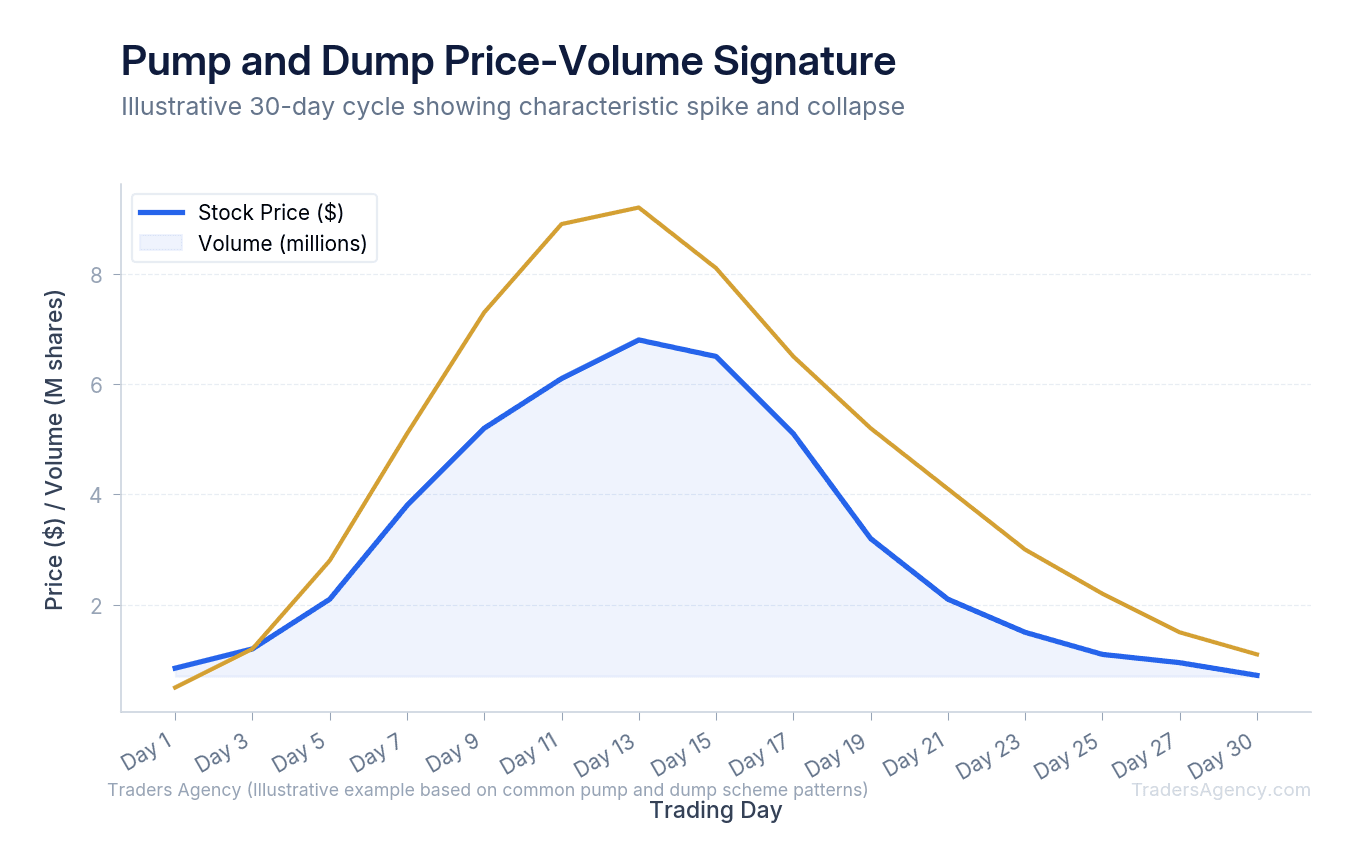
Once the promoters hit the sell button, the artificial demand vanishes instantly. The stock price plummets, and the late buyers are left holding shares that are essentially worthless. In the trading world, we call these trapped investors "bag holders."
Key Concept: A pump and dump scheme exploits low-volume stocks by manufacturing fake demand through misleading promotions. The promoters profit on the way up and leave retail traders holding the losses on the way down.
What Types of Stocks Are Most Vulnerable to Pump and Dump Manipulation?
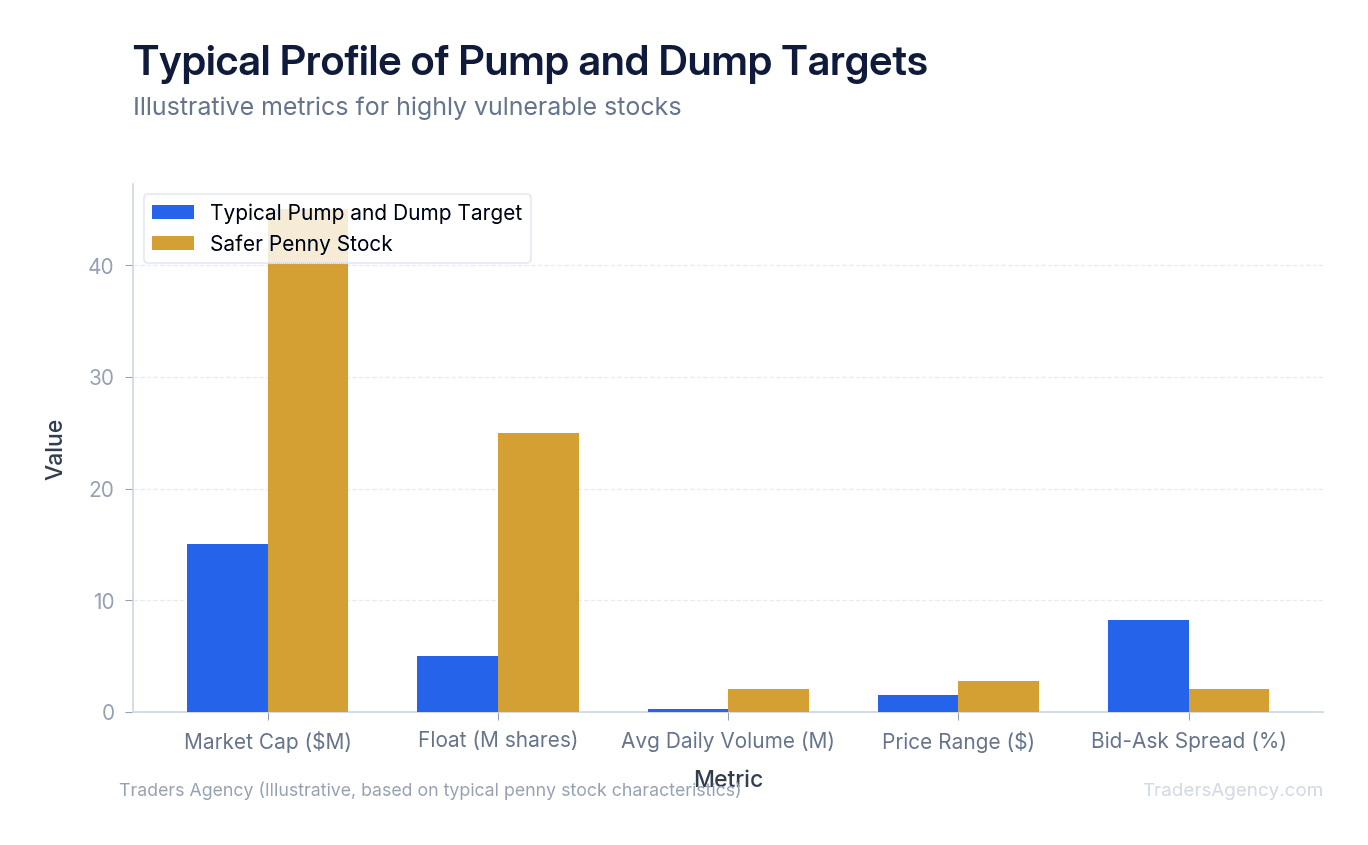
The stocks most vulnerable to a pump and dump scheme are typically penny stocks trading over-the-counter or on smaller exchanges. These companies usually have tiny market capitalizations, very few shares available for public trading, and low average daily trading volume. That combination makes them incredibly easy for bad actors to manipulate.
We teach our members to pay close attention to the public float. The float represents the actual number of shares available for regular traders to buy and sell on the open market. When a company has a low float (typically under 10 million shares), it takes very little capital to move the stock price aggressively.
Fraudsters also specifically target Over-The-Counter (OTC) stocks. These are equities that don't trade on major, highly regulated exchanges like the NYSE or NASDAQ. OTC companies face far less strict financial reporting requirements. This lack of transparency makes it easy for promoters to spread false financial information without immediate regulatory pushback.
Finally, these targeted companies almost always have a micro-cap valuation. Market capitalization is simply the total value of all the company's shares combined. A company with a total market value of $5 million is easily manipulated by a coordinated group. In contrast, massive corporations like Apple or Microsoft require billions of dollars in buying pressure to move the price, making them practically immune to this specific type of fraud.
| Characteristic | Pump and Dump Target | Legitimate Large-Cap Stock |
|---|---|---|
| Market Cap | Under $50 million (micro-cap) | $10 billion+ |
| Public Float | Under 10 million shares | Hundreds of millions to billions |
| Average Daily Volume | Under 50,000 shares | Millions of shares |
| Exchange | OTC / Pink Sheets | NYSE / NASDAQ |
| Financial Reporting | Minimal or delinquent | Full SEC compliance |
How Do You Tell the Difference Between a Real Breakout and a Pump?
To spot stocks before they skyrocket organically, you need to look for genuine business growth rather than artificial hype. We teach our members to identify companies with strong earnings reports, new product launches, or major contract wins. A legitimate breakout always has a real, verifiable business reason driving the sudden volume.
Our team prefers to use real-time stock screeners to find these legitimate trading opportunities. We program our scanners to look for stocks breaking out of long-term consolidation patterns on higher-than-average volume. We typically filter for stocks priced above $5.00 with a daily trading volume exceeding 1 million shares.
The key difference between a real breakout and a manipulated pump is the source of the information. Real breakouts are driven by official press releases filed directly with regulatory bodies. Fake pumps are driven by anonymous social media accounts, paid promotional emails, and unverified rumors.
Key Concept: Legitimate breakouts are backed by verifiable news: SEC filings, earnings reports, or official press releases. If you can't find a credible source for why a stock is moving, treat it as a red flag.
What Are the Red Flags to Watch Before You Buy?
The biggest red flags of a pump and dump scheme include sudden social media promotion without fundamental news, massive unexplained volume spikes, and aggressive insider selling. If a company has no revenue but thousands of online accounts are suddenly predicting massive price targets, you're likely looking at a scam.
Before you enter any trade, our team recommends running through a strict safety checklist. You need to know exactly what you're buying and why the stock is moving on that specific day.
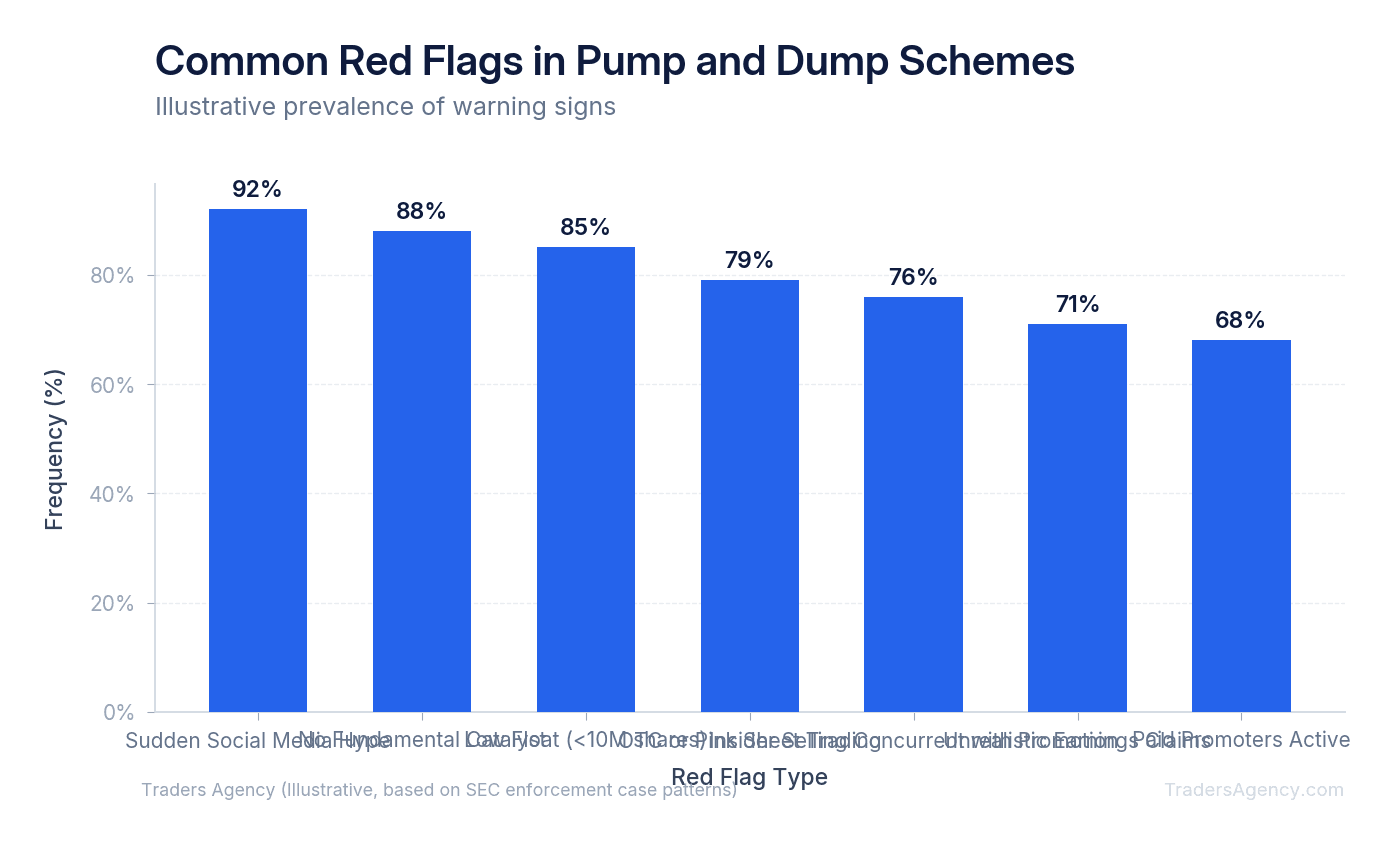
Here are the primary warning signs we tell our traders to watch for before risking their capital:
- Unsolicited investment advice: You receive random emails or see aggressive social media campaigns telling you to buy a specific ticker symbol immediately before you "miss out."
- No verifiable news: The stock price is up 200% on the day, but there are no official press releases, earnings reports, or SEC filings to explain the sudden massive interest.
- Suspicious company details: The company frequently changes its name, business model, or ticker symbol to match whatever industry is currently trending in the news.
- Dormant shell companies: The company has reported zero revenue for years, has no actual employees, and suddenly claims to be an industry leader in a highly complex field.
Watch Out: If you can't find a single official SEC filing or press release explaining why a penny stock is surging, walk away. The absence of verifiable information is one of the strongest indicators of manipulation.
Want expert trading insights delivered daily?
Join thousands of traders who rely on Traders Agency for market analysis and trade ideas.
Join Traders AgencyStep-by-Step: How to Read the Volume Spike Pattern
Let's walk through a concrete example of how this manipulation looks on a trading chart. Understanding this specific price and volume pattern is the best way to protect your trading capital.
Imagine a fictional penny stock called Fake Tech Corp (Ticker: FKTC).
- The Quiet Accumulation Phase: For several months, FKTC trades flat at exactly $0.10 per share. The average daily volume is a mere 5,000 shares. The chart looks completely dead. During this quiet period, the promoters are slowly buying up hundreds of thousands of shares at rock-bottom prices, being careful not to trigger any price spikes.
- The Promotional Pump: Suddenly, the promoters launch their coordinated campaign. They blast out millions of emails claiming FKTC has invented a revolutionary new microchip. The daily trading volume explodes from 5,000 shares to 5 million shares in a single morning session. Retail traders rush in to buy, driving the price from $0.10 to $1.50 in just a few hours. This creates a massive, unnatural green candle on the daily chart. The volume bars at the bottom of the screen will look like skyscrapers compared to the previous months of flat trading.
- The Devastating Dump: Once the price hits $1.50, the promoters begin aggressively selling their massive position. Because they bought their shares at $0.10, they're locking in a 1,400% profit. Their heavy selling completely overwhelms the retail buyers. The bid/ask spread widens dramatically, and the price crashes back down to $0.15 before the market even closes. The retail traders who bought at the top are now trapped in a massive losing position with no buyers left to take the shares off their hands.
| Phase | Price | Daily Volume | Who's Buying | Who's Selling |
|---|---|---|---|---|
| Accumulation | $0.10 | 5,000 shares | Promoters (quietly) | Unaware holders |
| Pump | $0.10 → $1.50 | 5,000,000 shares | Retail traders (FOMO) | Nobody yet |
| Dump | $1.50 → $0.15 | Elevated | Nobody left | Promoters (massive selling) |
What Does the SEC Say About Pump and Dump Fraud?
The Securities and Exchange Commission (SEC) classifies a pump and dump scheme as illegal market manipulation. The agency's investor education resources explicitly warn investors to avoid unsolicited investment advice on social media. The SEC actively monitors trading data to detect unusual volume and prosecutes promoters who intentionally deceive the public for personal gain.
The SEC has strict rules against spreading false information to manipulate stock prices. They frequently halt trading on suspicious stocks to protect the public from ongoing fraud.
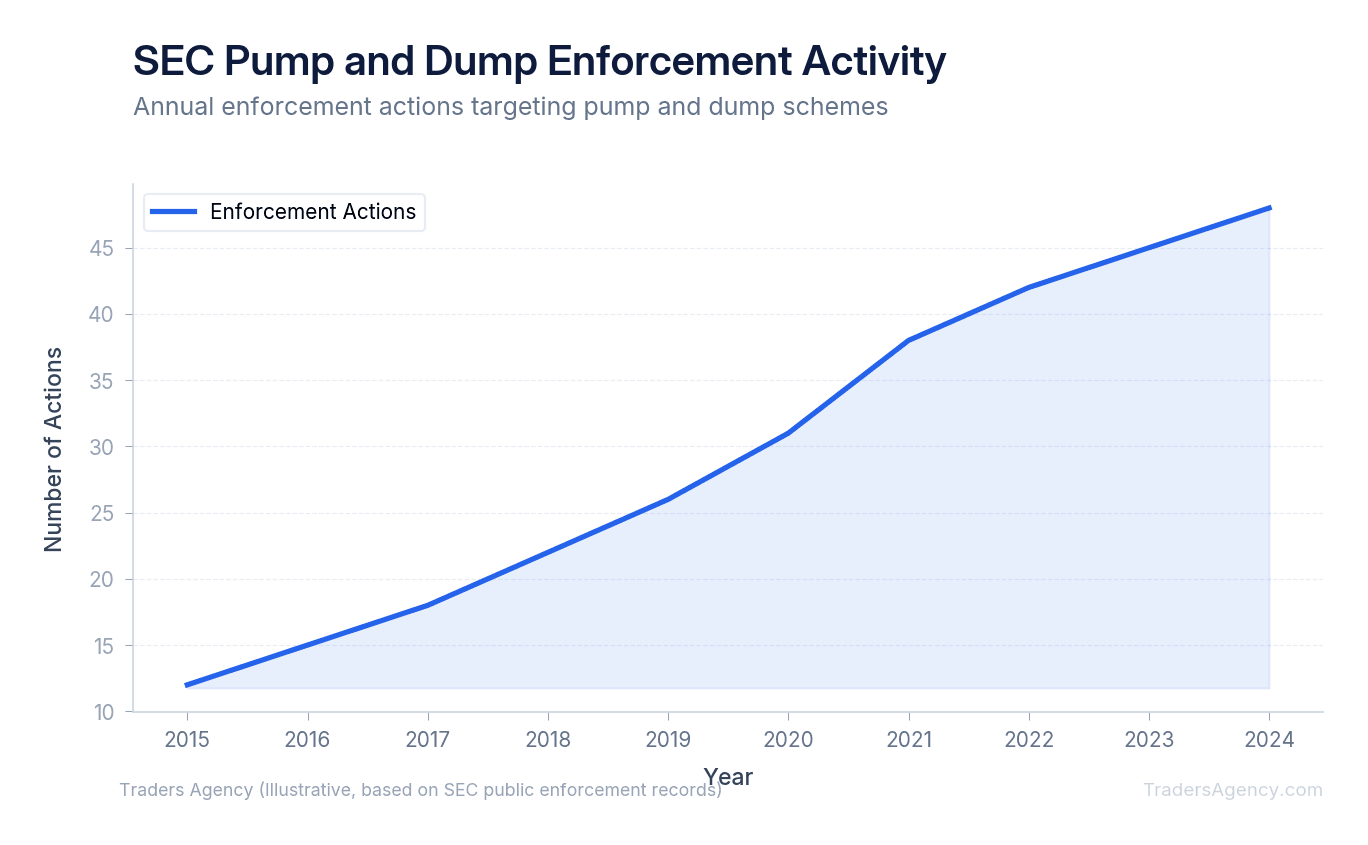
When the SEC halts a stock, it can remain frozen for up to ten business days, and sometimes much longer. If you're holding shares when a regulatory halt occurs, your money is completely trapped. You cannot sell your position at any price.
This is exactly why we teach our members to avoid these questionable setups entirely. You can always check the official SEC website for lists of recent trading suspensions. If a stock you're watching is heavily promoted by unregulated newsletters and has a history of questionable filings, it's a prime candidate for regulatory action.
How Can You Protect Yourself From Getting Caught in the Dump?
The absolute best way to handle a manipulated stock is to simply refuse to play the game. However, if you're actively trading low-priced, highly volatile stocks, you need strict risk management rules in place.
- Use strict stop-loss orders on every single trade. If you buy a breakout stock at $2.00, you might place a hard stop-loss at $1.80. If a dump begins unexpectedly, your broker will automatically sell your shares, limiting your total loss to a manageable amount.
- Practice proper position sizing. We recommend never risking more than 1% to 2% of your total account equity on a single penny stock trade. If you have a $10,000 account, you should not be risking more than $100 to $200 on these highly speculative setups.
- Act decisively if you realize you're caught mid-trade. Do not wait for the price to bounce back. Hit the bid price immediately and exit your position. The key feature of a dump phase is that the price rarely recovers, because the fundamental value of the company was entirely fake to begin with.
Risk Warning: Penny stocks and OTC securities carry extreme risk, including the possibility of total loss. Even with proper stop-loss orders, fast-moving dumps can gap through your stop price, resulting in larger losses than planned. Never trade with money you can't afford to lose.
Our team's approach is simple: if a stock fails even one item on our red flag checklist, we skip the trade entirely. There are always legitimate opportunities in the market. You never need to chase a suspicious setup to make money as a trader.
Want expert trading insights delivered daily?
Join thousands of traders who rely on Traders Agency for market analysis and trade ideas.
Join Traders AgencyKey Takeaways
- Pump and dump schemes target low-priced, thinly traded stocks because minimal buying volume is enough to force a rapid price spike in illiquid markets.
- Fraudsters accumulate shares cheaply before launching coordinated marketing campaigns, meaning by the time retail traders see the hype, insiders are already positioned to sell.
- If a stock fails even one item on a red flag checklist, the trade should be skipped entirely. There is no version of this setup worth the risk.
- Even a properly placed stop-loss order cannot guarantee protection, because fast-moving dumps can gap through your stop price and produce larger losses than planned.
- Anonymous social media promotion of an unknown company is one of the earliest and most reliable warning signs that a pump is already underway.
DISCLAIMER: Traders Agency does not offer financial advice. The information provided is for educational purposes only and should not be considered financial advice. Traders Agency is not responsible for any financial losses or consequences resulting from the use of the information provided. Trading carries inherent risks and may not be suitable for all individuals. You are advised to conduct your own research and seek personalized advice before making any investment decisions, recognizing the potential risks and rewards involved.
See more from Traders Agency on Google
Make us a preferred source and our market analysis will appear more prominently in your Google Search, Top Stories, and AI results.
Add to Preferred Sources