
You've probably experienced this firsthand. You wake up on a Saturday morning, check your phone, and discover a digital asset dropped 15% overnight while the stock market sits safely closed for the weekend. If you're used to traditional market hours, that kind of shock can rattle your confidence fast. We're going to walk you through exactly how crypto vs traditional markets differ, what those differences mean for your trading, and how to manage the unique risks that come with each. By the end of this guide, you'll understand the mechanics of digital assets, how they fit into a broader portfolio, and how to protect your capital in both worlds.
What Is the Key Difference Between Cryptocurrencies and Traditional Currencies?
Bottom Line: Crypto and traditional markets operate under fundamentally different rules around hours, volatility, supply mechanics, and investor protections. Understanding those structural differences is what separates traders who get blindsided from those who size positions and manage risk appropriately in each market. The goal is not to pick one over the other, but to use both with a clear-eyed view of what each one actually is.
The core difference comes down to one word: centralization. Traditional currencies like the US Dollar are issued and controlled by central banks. Governments back them, regulate them, and manage their supply. Cryptocurrencies operate on decentralized networks using blockchain technology. They rely on math and code, not government authority, to verify transactions and control supply.
Traditional markets also depend on intermediaries. Banks, brokers, and clearinghouses all sit between you and your trade, settling transactions and providing consumer protections. Crypto markets use automated smart contracts and decentralized ledgers to process transactions directly between buyers and sellers. This peer-to-peer structure removes the middleman, but it also removes the safety nets that traditional financial institutions provide.
Key Concept: Traditional finance is built on trusted intermediaries (banks, regulators, clearinghouses). Crypto is built on trustless verification, where the code itself enforces the rules. Both approaches carry distinct advantages and risks.
The modern crypto ecosystem includes thousands of decentralized coins and tokens operating without a central authority. That's a fundamentally different model from the regulated securities you'll find on the NYSE or Nasdaq, and it demands a different approach to risk management.
What Happens When Crypto Trades Around the Clock With No Circuit Breakers?
The traditional stock market operates on a strict schedule. Exchanges like the NYSE and Nasdaq are open from 9:30 AM to 4:00 PM ET, Monday through Friday. They close for weekends and major holidays. That gives traders built-in breathing room.
Crypto markets never close. They trade 24 hours a day, 7 days a week, 365 days a year.
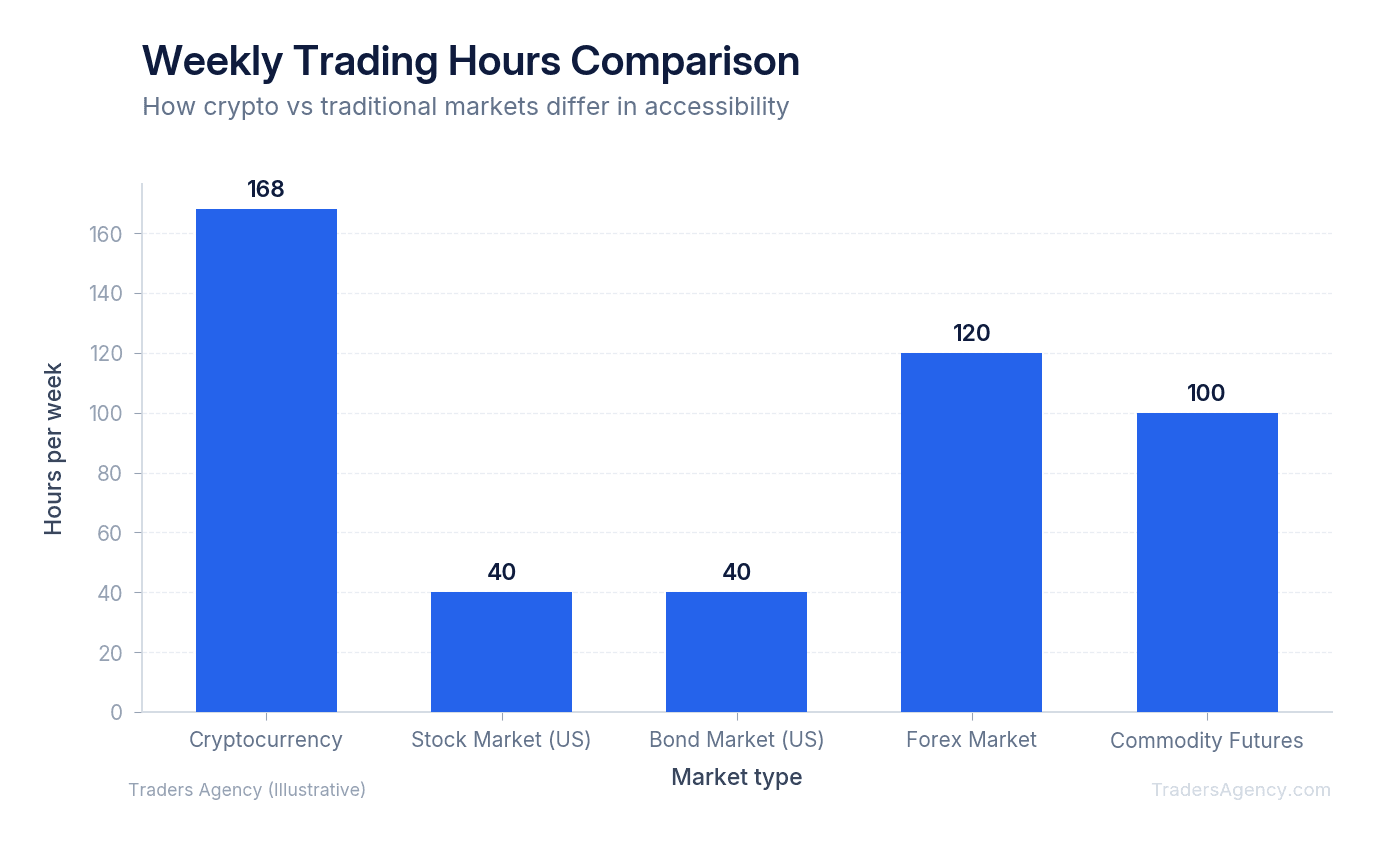
That's 168 hours of live trading per week compared to roughly 32.5 hours for stocks. The difference is staggering, and it changes everything about how you manage positions.
The other major factor is circuit breakers. In the stock market, exchanges automatically halt trading if the S&P 500 drops by 7%, 13%, or 20% in a single day. These pauses give investors time to process information and prevent panic selling.
Crypto has no circuit breakers. If a digital asset drops 40% in an hour, trading continues without interruption. You cannot rely on the closing bell to save you from a rapid sell-off. This continuous environment means your risk management plan has to be airtight before you enter a position.
Volatility and Liquidity: Why Crypto Swings Harder
Volatility measures the speed and magnitude of price changes. The real market value of cryptocurrencies like Bitcoin can fluctuate wildly based on network adoption, macroeconomic news, and market sentiment. Compared to traditional assets, the swings are dramatically larger.
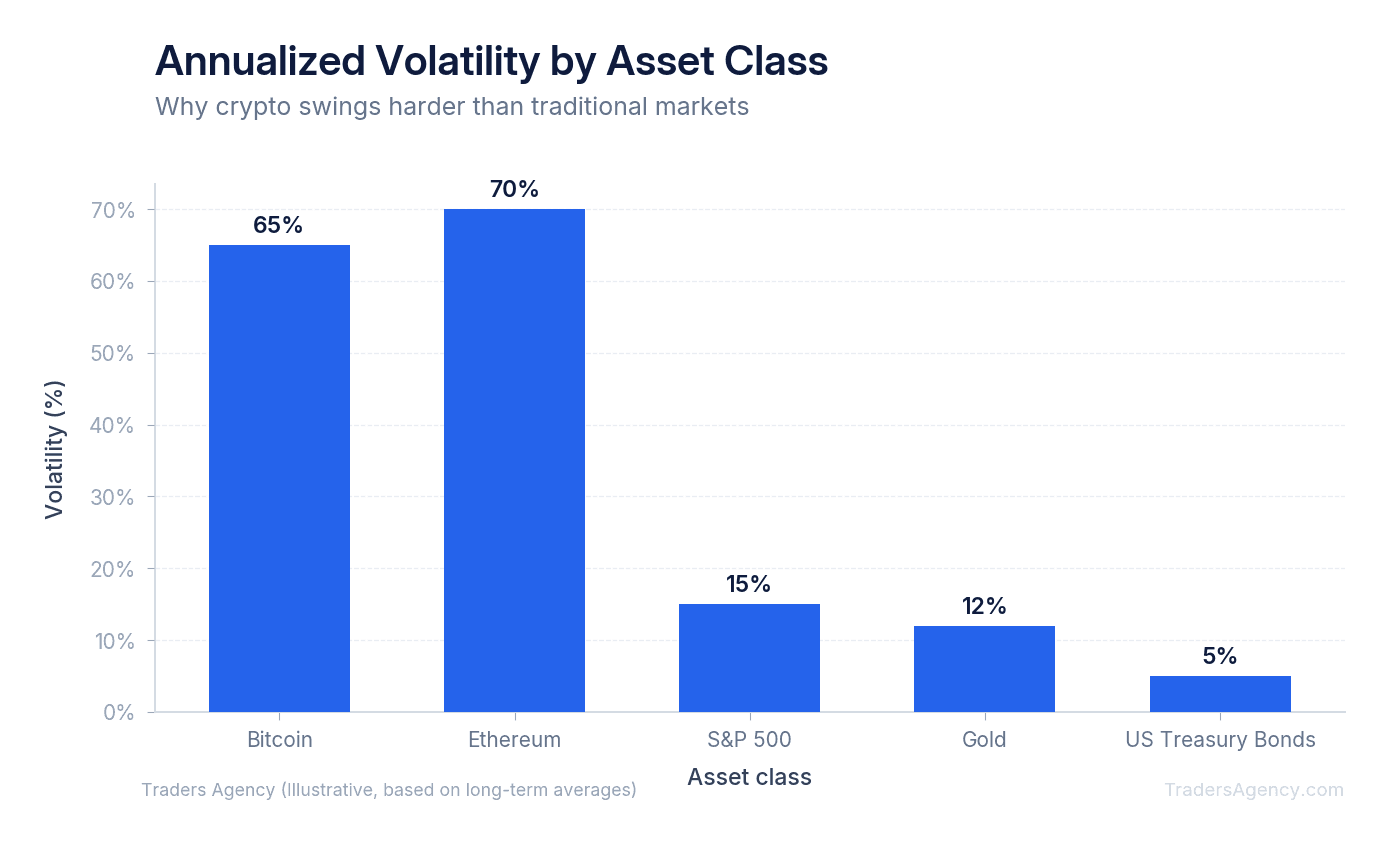
| Asset | Annualized Volatility (Approx.) | Typical Daily Move |
|---|---|---|
| Bitcoin (BTC) | 65% | 3-5% |
| Ethereum (ETH) | 70% | 4-6% |
| S&P 500 | 15% | 0.5-1% |
| Gold | 12% | 0.3-0.8% |
| US Bonds | 5% | 0.1-0.3% |
Liquidity is the other piece of the puzzle. Liquidity refers to how easily you can buy or sell an asset without affecting its price. In traditional markets, a stock like Apple (AAPL) has massive liquidity. You can move millions of dollars worth of shares instantly with minimal price impact.
In the digital asset space, liquidity is fragmented across dozens of different exchanges. A large sell order on a smaller exchange can cause a sudden price crash that wouldn't happen on a more liquid platform. We teach our members to stick to high-liquidity assets like Bitcoin (BTC) and Ethereum (ETH) when first starting out to avoid these liquidity traps.
Watch Out: Low-liquidity tokens can experience extreme price swings from a single large order. If you can't exit a position quickly at a fair price, you're taking on hidden risk that doesn't show up on any chart.
What Are Bitcoin Halving Cycles and How Do They Affect Supply?
Traditional companies can issue new shares whenever they want, diluting the value of existing shares. Central banks can print more money to stimulate the economy. These supply decisions are made by people in boardrooms and government offices.
Crypto supply dynamics are hardcoded into the software. Bitcoin, for example, has a strict maximum supply of 21 million coins. No central authority can change this rule. It's enforced by the network itself.
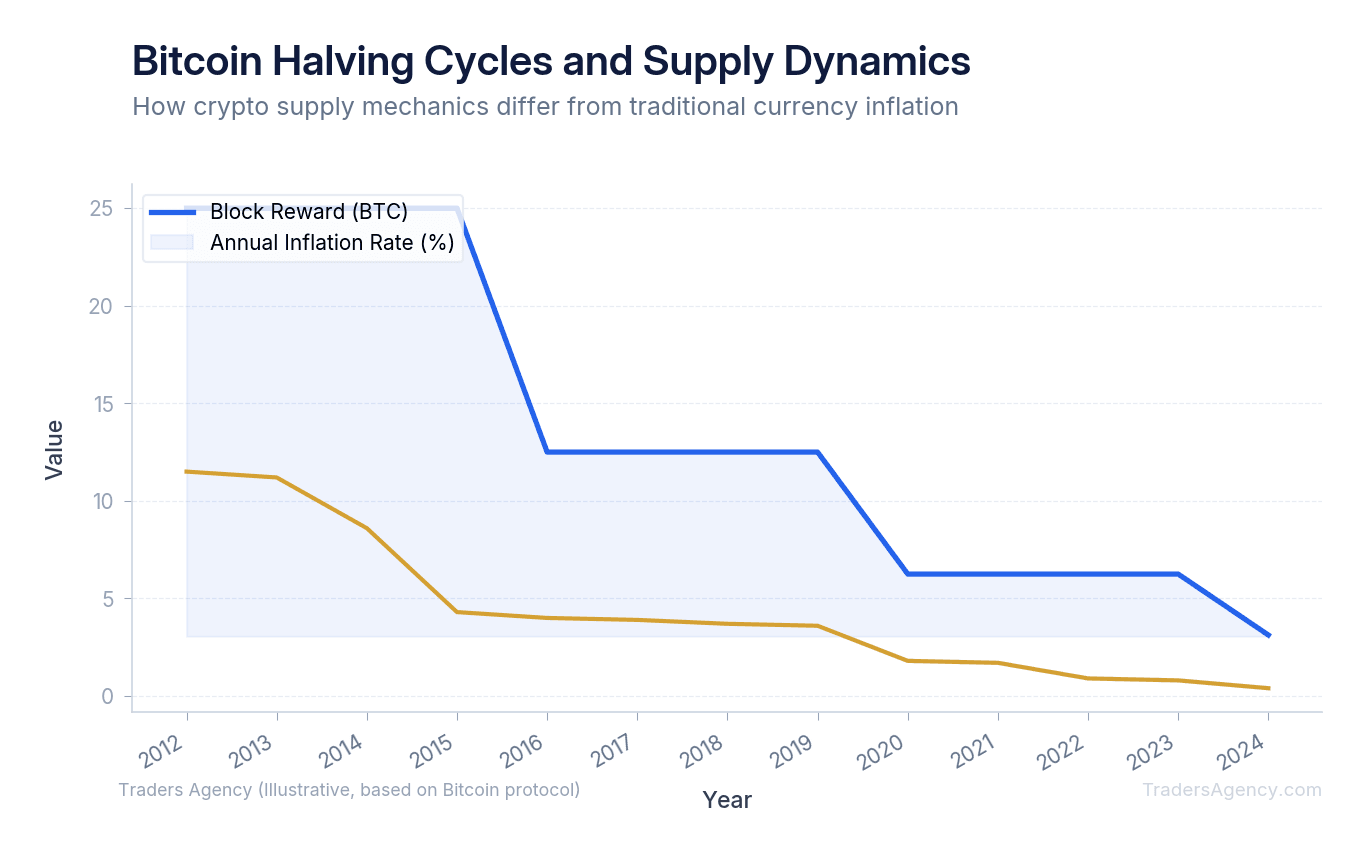
Every four years, the Bitcoin network undergoes a "halving" event. The reward given to miners for securing the network is cut in half. In 2024, the reward dropped from 6.25 BTC to 3.125 BTC per block. This built-in scarcity creates a predictable inflation rate that decreases over time, which is very different from traditional fiat currencies that typically lose purchasing power year after year.
Understanding this supply schedule is essential for any trader looking at digital assets. The halving cycle has historically influenced long-term price trends, and it's one of the most important structural differences between crypto and traditional markets.
Want expert trading insights delivered daily?
Join thousands of traders who rely on Traders Agency for market analysis and trade ideas.
Join Traders AgencyHow Do You Gain Exposure to Crypto vs Traditional Assets?
You can gain exposure to traditional assets through standard brokerage accounts by purchasing stocks, bonds, or ETFs. To invest in crypto, you have several options today, and the barrier to entry is much lower than it was a decade ago.
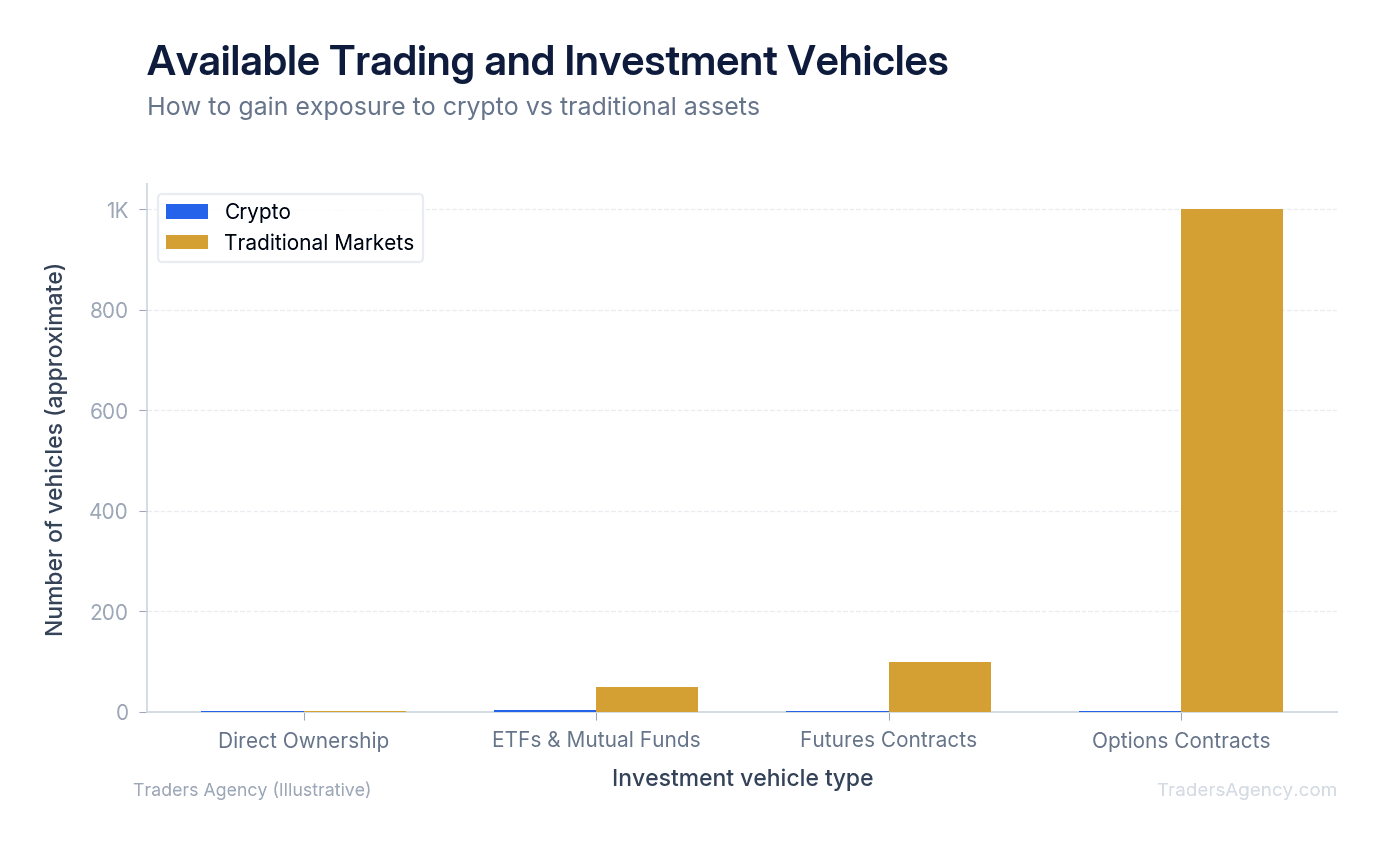
Here are the three main methods we see traders using to gain exposure:
- Direct Ownership: You buy the actual coins on an exchange and hold them in a digital wallet. This gives you complete control but requires technical knowledge of self-custody and security.
- Spot ETFs: You can buy a spot Bitcoin ETF (like IBIT or FBTC) directly in your traditional brokerage account. This is the easiest method for beginners because it feels exactly like buying a stock.
- Futures Contracts: Advanced traders use futures contracts on the Chicago Mercantile Exchange (CME) to trade price action without holding the underlying asset. This allows for short selling and the use of margin.
For most people just getting started, we recommend the spot ETF route. It keeps your assets under the familiar protection of traditional brokerage rules while still giving you exposure to crypto price movements.
What Is the 1% Rule in Crypto?
The 1% rule is a risk management strategy stating you should never risk more than 1% of your total trading capital on a single trade. If you have a $10,000 portfolio, your maximum acceptable loss on any individual crypto position should be capped at $100.
Key Concept: The 1% rule keeps you in the game. You can lose ten trades in a row and still have roughly 90% of your capital intact. In a market where 40% drawdowns can happen overnight, this kind of discipline is non-negotiable.
We prefer to use hard stop-loss orders to enforce this rule. If a trade goes against you, the system automatically exits the position before the loss exceeds your 1% threshold. Digital assets can drop rapidly, and without a plan, a single bad trade can wipe out weeks of progress. The 2022 drawdowns across the crypto market proved exactly why strict risk management is mandatory.
Step-by-Step: Building a Blended Portfolio
How do you actually combine these two worlds? Our team recommends a structured approach to portfolio allocation. Over the past few years, digital assets have shown an increasing correlation with tech stocks, meaning they often move in the same direction during macroeconomic shifts. Here is exactly what we teach our members when they want to build a blended portfolio.
- Define Your Core Traditional Holdings: Start with a foundation of traditional assets. This might include an S&P 500 index fund, physical gold, and blue-chip dividend stocks. These assets provide stability, income, and consistent long-term growth. We never recommend abandoning traditional markets entirely.
- Determine Your Crypto Allocation: For most beginners, we suggest allocating only 1% to 5% of your total portfolio to digital assets. If you have a $100,000 portfolio, a 3% allocation means you dedicate $3,000 to crypto. This gives you exposure to high upside potential while strictly limiting your downside risk.
- Select High-Liquidity Digital Assets: Do not chase obscure tokens or meme coins. Stick to the top two or three assets by market capitalization. Bitcoin (BTC) and Ethereum (ETH) should make up the vast majority of your digital asset allocation. They have the longest track records and the deepest liquidity.
- Rebalance Regularly: Because digital assets are highly volatile, your 3% allocation might quickly grow to 8% of your portfolio during a bull run. When this happens, sell the excess crypto and reinvest the profits back into your traditional assets. This forces you to take profits when prices are high and maintains your target risk level.
| Portfolio Component | Suggested Allocation | Purpose |
|---|---|---|
| S&P 500 Index Fund | 50-60% | Core growth and diversification |
| Bonds / Fixed Income | 20-30% | Stability and income |
| Gold / Commodities | 5-10% | Inflation hedge |
| Crypto (BTC/ETH) | 1-5% | High-growth asymmetric upside |
What Are the Most Common Mistakes Traders Make When Switching Between Crypto and Traditional Markets?
The most common mistake traders make is applying traditional market expectations to digital assets. Here's what we see go wrong most often:
- Ignoring weekend price gaps: Crypto doesn't stop on Friday afternoon. Major moves can happen on Saturday night when you're not paying attention. If you hold positions over the weekend without stop-losses, you're exposed to risk you can't monitor in real time.
- Using stock-market position sizing: In the stock market, a 5% move in a single day is a major event. In the crypto market, a 5% move is just a normal Tuesday. If you trade digital assets with the same position sizing you use for slow-moving dividend stocks, you're taking on far too much risk.
- Ignoring security responsibilities: When you buy a stock, your broker secures the shares. When you buy crypto directly, you are responsible for your own private keys. If you lose your passwords or send funds to the wrong address, there is no customer service department to reverse the transaction.
- Overlooking regulatory differences: Traditional markets operate under strict SEC oversight with investor protections like SIPC insurance. Crypto exchanges operate with far fewer safeguards, and the regulatory framework is still evolving.
Watch Out: We strongly suggest beginners start with regulated ETFs before attempting self-custody of digital assets. It allows you to participate in the price action while keeping your assets under the familiar protection of traditional brokerage rules. Master the market dynamics first, then graduate to direct ownership when you're ready.
Here's what it comes down to: crypto and traditional markets are both powerful tools, but they play by different rules. When you understand those differences and adjust your approach accordingly, you can use both to build a stronger, more diversified portfolio. The key is respecting the risk profile of each market and never assuming that what works in one will automatically work in the other.
Want expert trading insights delivered daily?
Join thousands of traders who rely on Traders Agency for market analysis and trade ideas.
Join Traders AgencyKey Takeaways
- Crypto markets run 24/7 with no circuit breakers, meaning a 15% drop can happen overnight on a Saturday while traditional stock markets are closed.
- Traditional currencies are backed by central banks and government authority; cryptocurrencies rely on decentralized blockchain networks and mathematical consensus instead of institutional oversight.
- Removing intermediaries like banks and brokers eliminates consumer protections, so crypto traders carry more direct counterparty and custody risk than traditional market participants.
- Bitcoin halving cycles reduce new supply issuance on a predictable schedule, creating a supply dynamic that has no equivalent in equities or forex markets.
- Traders new to crypto can access price exposure through ETFs and regulated products before moving to direct ownership, keeping assets under traditional brokerage protections while learning the market.
DISCLAIMER: Traders Agency does not offer financial advice. The information provided is for educational purposes only and should not be considered financial advice. Traders Agency is not responsible for any financial losses or consequences resulting from the use of the information provided. Trading carries inherent risks and may not be suitable for all individuals. You are advised to conduct your own research and seek personalized advice before making any investment decisions, recognizing the potential risks and rewards involved.
See more from Traders Agency on Google
Make us a preferred source and our market analysis will appear more prominently in your Google Search, Top Stories, and AI results.
Add to Preferred Sources