A broad sell-off is hitting equities as spiking oil prices and hawkish Federal Reserve commentary have stoking inflation fears. We're tracking this move closely. The Dow Jones Industrial Average dropped 346.30 points to 53,210.80, while the S&P 500 and Nasdaq Composite also posted early losses. Traders asking why did the US stock market go down today can look to military clashes between the United States and Iran, which drove up oil prices, and hawkish Fed commentary that shifted interest rate expectations.
The losses could set the tone for September, typically a weak month for equities. Our team is monitoring how these macroeconomic shifts could ripple through specific sectors and retail portfolios in the days ahead.
Today's Damage: The Dow fell 346.30 points to 53,210.80. The S&P 500 lost 35.66 points to 7,676.10, and the Nasdaq shed 88.98 points to 26,312.74. Brent crude climbed 1.04% on geopolitical risk.
Why Did the U.S. Stock Market Go Down Today?
The U.S. stock market fell today as military clashes between the United States and Iran drove Brent crude prices up 1.04%, stoking inflation fears. Federal Reserve Chair Kevin Warsh also delivered hawkish remarks at the Jackson Hole symposium, increasing the perceived probability of a September interest rate hike.
Energy markets reacted swiftly to the geopolitical tension. Disruption in the Strait of Hormuz has impeded oil shipments, with the protracted impasse following U.S. President Donald Trump's implementation of costly economic sanctions. As the trading session opened, spiking oil prices dampened investor risk appetite and sent benchmark U.S. Treasury yields higher.
The protracted impasse is fueling fears that upward pressure on energy prices could spread into broader inflation that could force the Fed to hike interest rates. Financial markets are currently pricing in a 65.9% likelihood of a 25-basis-point rate hike at the conclusion of September's monetary policy meeting, according to CME's FedWatch tool.
Key Market Movers and Index Levels
Major indices are showing weakness across the board. As of 11:24 a.m. ET, the S&P 500 lost 35.66 points to hit 7,676.10, and the Nasdaq Composite shed 88.98 points to reach 26,312.74. Energy and semiconductor stocks provided rare patches of green during the broad sell-off.
Despite the daily drop, the 30-day trend shows resilience. Our data indicates the SPY 30-day price change sits at +1.24%, while the QQQ has gained +2.38% over the same period.
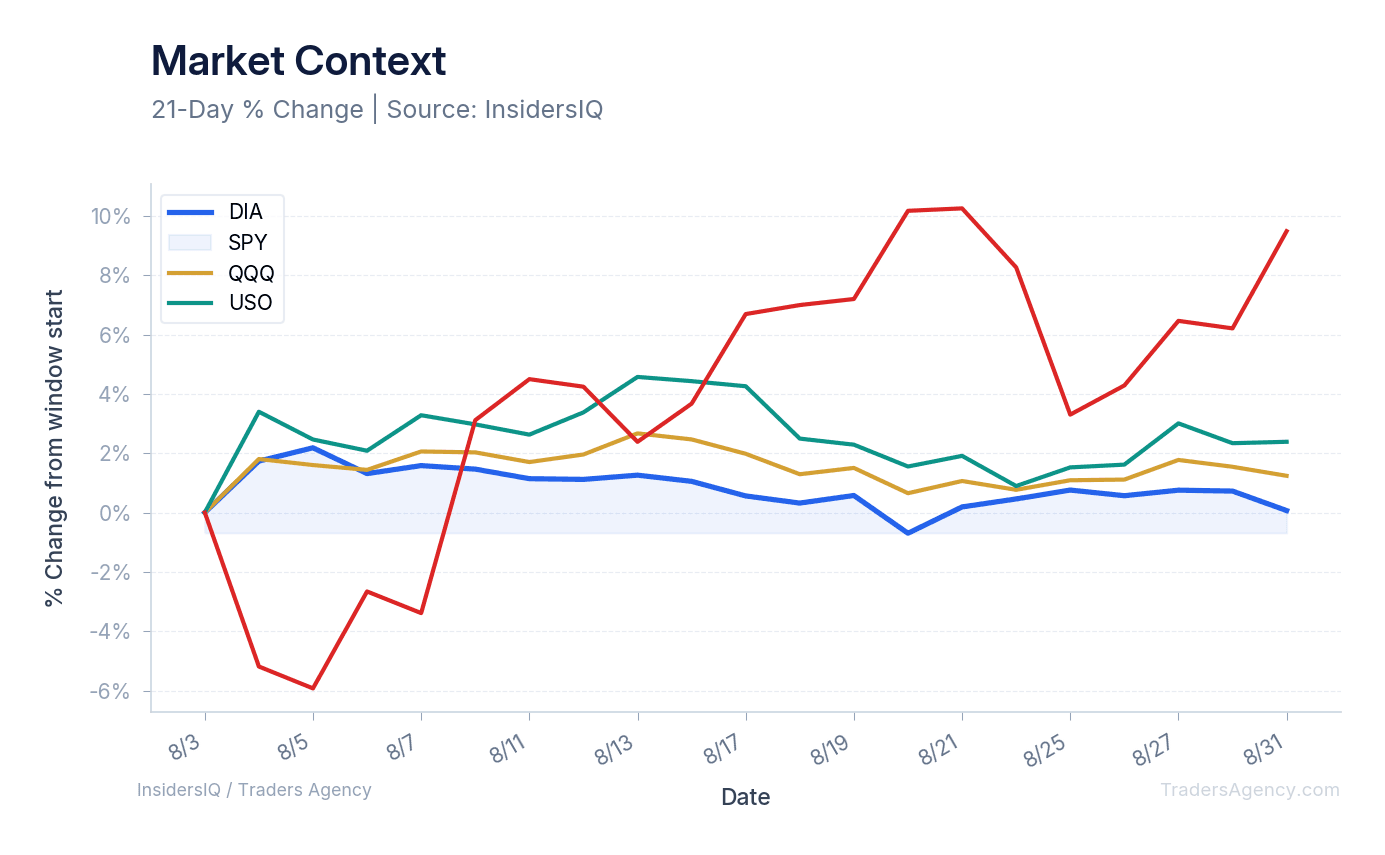
The DIA has remained relatively flat with a +0.07% change over 30 days. Meanwhile, the USO 30-day price change has surged +9.48%, directly reflecting the energy supply concerns driving equities lower.
How Could Fed Rate-Hike Fears Impact Traders?
Rising expectations for a September rate hike are forcing traders to reassess their risk exposure. Just a week ago, markets priced in a 41.4% chance of a hike, but that probability has spiked to over 60% after Warsh said policymakers may need to increase borrowing costs if inflation does not ease to the central bank's 2% target.
Analysts at BofA Global Research said, "Absent a material downside surprise, the onus is now on Warsh to deliver a September hike. Otherwise, he risks undermining some of the credibility he gained on Friday."
Paul Nolte, chief executive officer at Horizon Investment Services, said that if the Fed does not hike rates in September, "I think you will see a dramatic reaction in the markets because it's been prepped now for quite some time that they're going to raise rates." The monthly U.S. employment report, due on September 4, could raise the stakes further.
Rate Watch: CME FedWatch now shows a 65.9% probability of a 25-basis-point hike in September, up from 41.4% just one week ago. This shift is reshaping positioning across rate-sensitive sectors.
Want expert trading insights delivered daily?
Join thousands of traders who rely on Traders Agency for market analysis and trade ideas.
Join Traders AgencyWhich Sectors Are Gaining and Losing as Oil Prices Spike?
Today's action highlights a clear divergence between sectors. Energy stocks climbed 0.97% as oil prices spiked, making it one of the few areas of the market to post gains.
Conversely, rate-sensitive sectors are feeling the pressure. Utilities fell 1.19% during the morning session. We're seeing a clear rotation out of yield-dependent equities as Treasury yields rise.
Technology shares showed mixed results. While the Nasdaq experienced early weakness, semiconductors posted gains, keeping the AI trade active. Paul Nolte, chief executive officer at Horizon Investment Services, noted that over the last couple of months, tech has struggled to gain footing.
Is September Seasonality Adding to the Pressure?
Historical trends suggest September often brings elevated volatility. Ryan Detrick of the Carson Group has noted that the S&P 500 generates a positive return only 45% of the time during this month.
On average, the index drops 0.6% in September. Along with February, it is the only other month of the year with a negative average return. This year's midterm elections are also throwing another wrench into things.
However, seasonality alone does not dictate price action. LPL Financial chief technical strategist Adam Turnquist expects higher volatility but suggests a market drawdown could present buying opportunities before the next earnings reporting season.
What Should Traders Watch After Today's Sell-Off?
Our team is monitoring several developments that will likely shape where the market heads from here. Anyone watching a live chart today should keep these factors in focus:
- Brent crude and USO: Price action in oil remains the clearest gauge for inflation fears right now.
- Fed official commentary: Any statements regarding the 2% inflation target could move rate expectations further.
- Sector rotation: Watch for continued flows out of utilities and into energy or semiconductors.
1. Geopolitical Developments in the Middle East
Updates on the Strait of Hormuz are essential. Iran's President Masoud Pezeshkian has said Tehran is still seeking a negotiated solution, which could eventually ease the upward pressure on oil prices.
2. The U.S. Employment Report
The monthly jobs data is due on September 4. This release will provide important clues about the economy's strength and could heavily influence the Fed's interest rate decision.
3. Key Index Levels
We are tracking the Dow's ability to hold near the 53,210.80 level. The blue-chip index was on track for its fifth consecutive monthly advance before today's pullback.
The Bottom Line for Retail Portfolios
The combination of rising oil prices and hawkish Federal Reserve commentary has introduced fresh volatility into equities. Our analysis suggests that while the immediate reaction has been negative, the underlying U.S. economic strength may remain intact. Thomas Kikis, head of markets, U.S. and Americas, at Standard Chartered, said, "The dynamism of the U.S. economy and the corporate sector is incredible. The U.S. exceptionalism argument is pretty alive and well."
We are preparing for potential market swings leading up to the September monetary policy meeting. Traders should consider staying defensive in rate-sensitive sectors while watching for strategic entry points if the broader indices experience further drawdowns.
Want expert trading insights delivered daily?
Join thousands of traders who rely on Traders Agency for market analysis and trade ideas.
Join Traders AgencyKey Takeaways
- The Dow dropped 346.30 points to 53,210.80, the S&P 500 lost 35.66 points to 7,676.10, and the Nasdaq shed 88.98 points to 26,312.74 in early trading.
- Brent crude climbed 1.04% after military clashes between the U.S. and Iran raised concerns about oil supply disruptions, particularly through the Strait of Hormuz.
- Federal Reserve Chair Kevin Warsh delivered hawkish remarks at the Jackson Hole symposium, saying policymakers may need to increase borrowing costs if inflation does not ease to the 2% target.
- The Dow had been on track for a fifth consecutive monthly advance before today's pullback, making the 53,210.80 level a key area traders are watching for support.
- Rate-sensitive sectors face the most immediate pressure from the combined inflation and Fed commentary backdrop, while energy names may benefit from elevated crude prices.
DISCLAIMER: Traders Agency does not offer financial advice. The information provided is for educational purposes only and should not be considered financial advice. Traders Agency is not responsible for any financial losses or consequences resulting from the use of the information provided. Trading carries inherent risks and may not be suitable for all individuals. You are advised to conduct your own research and seek personalized advice before making any investment decisions, recognizing the potential risks and rewards involved.
See more from Traders Agency on Google
Make us a preferred source and our market analysis will appear more prominently in your Google Search, Top Stories, and AI results.
Add to Preferred Sources