A sudden escalation in the Strait of Hormuz is sending shockwaves through the energy market, and our team is tracking every development in real time. Two supertankers carrying Saudi oil were struck by unknown projectiles within minutes of each other on Monday while transiting the Strait of Hormuz, a direct hit on commercial shipping that immediately repriced risk across the entire crude complex. The oil price per barrel today reflects a sharp supply-disruption premium, and traders asking "will oil prices go up with the iran war" need to understand what comes next.
How Did Oil Markets React to the Strait of Hormuz Strikes?
The response was swift and decisive. The November Brent crude contract jumped 3.8% to $94.36 a barrel, a level not seen in nearly two weeks. At the same time, West Texas Intermediate (WTI) gained 4.3% to $89.46 a barrel for October delivery. These moves reflect a market that is rapidly repricing the probability of sustained supply disruptions through the world's most important oil chokepoint.
The Moves: Brent crude surged 3.8% to $94.36/bbl. WTI jumped 4.3% to $89.46/bbl.
Are Prices Likely to Keep Rising?
Prices are already moving higher, and analysts polled by Reuters in August expect oil to remain above $80 a barrel in 2026 as shipping disruptions continue. The brent crude oil price breaking past $94 following these strikes signals that the market is taking the supply threat seriously.
That said, the picture is not entirely one-directional. Saxo Bank analyst Ole Hansen noted that a lack of follow-through buying suggests the market may be betting that supply will not be disrupted beyond current levels. Traders are weighing the immediate shock against the actual volume of lost barrels. Our view: the risk remains skewed to the upside as long as the Strait stays contested.
How Much Global Supply Is Actually at Risk?
The physical supply bottleneck is severe. The Strait of Hormuz carried roughly a fifth of global oil supplies before the conflict erupted in late February. Now, visible commodity-vessel traffic through the Strait has dropped to about five ships per day, well below the 10-day average of around 14 ships. None of those five ships were liquid tankers.
Supply Crunch: The IEA cut its 2026 global oil supply forecast to 102 million barrels per day in August, a decline of 4.3 million barrels per day year-over-year. The agency cited the breakdown of the ceasefire and the renewed closure of the Strait for this downgrade.
What Does This Mean for Energy Stocks and ETFs?
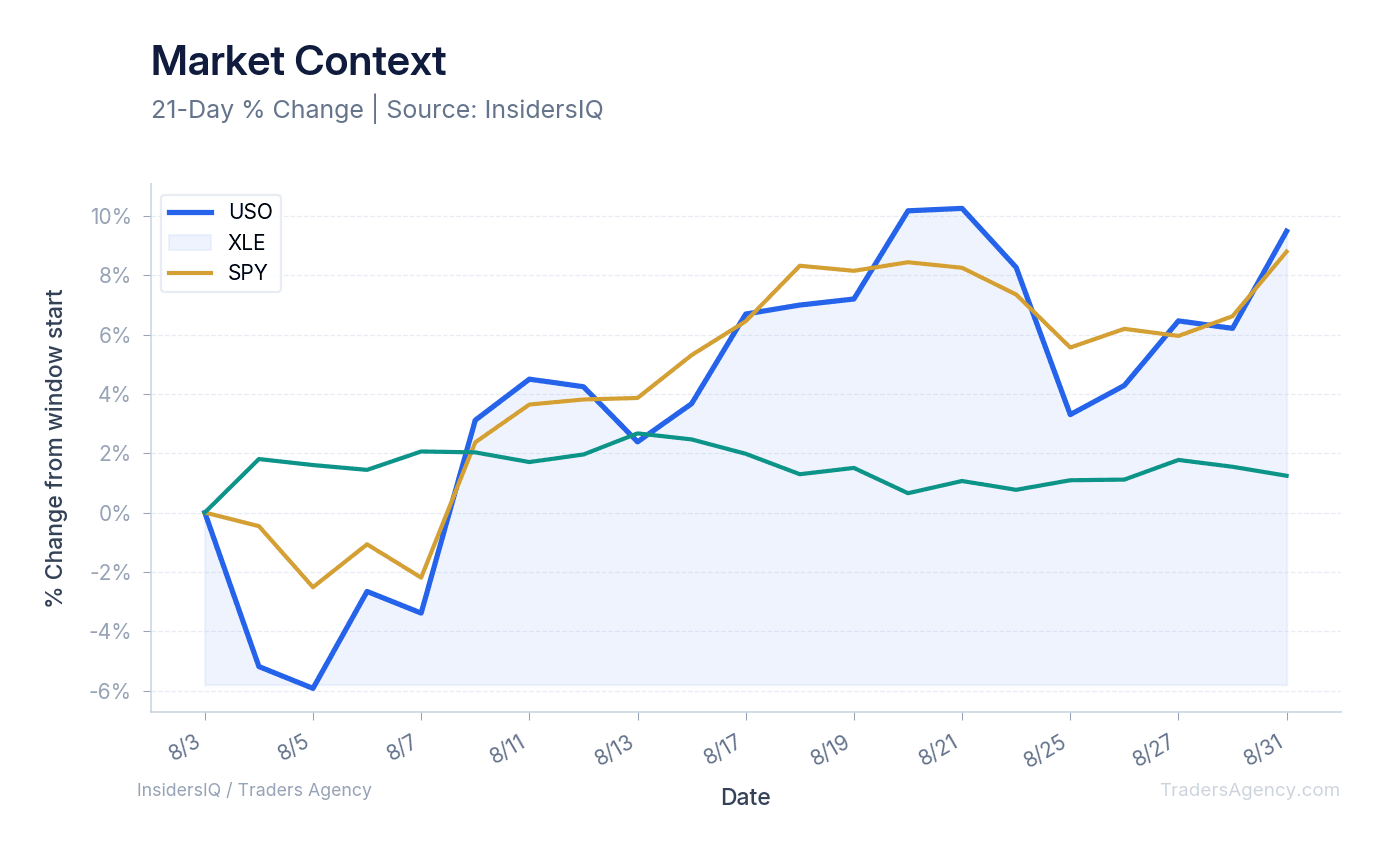
The equities market is moving in lockstep with the physical commodity. We are seeing significant outperformance in energy-specific instruments compared to the broader market. Over the last 30 days:
- United States Oil Fund (USO): +9.48% price change
- Energy Select Sector SPDR Fund (XLE): +8.79% price change
- SPDR S&P 500 ETF Trust (SPY): +1.24% price change
The gap between energy and the broader market tells the story clearly: this sector is absorbing the Middle Eastern supply shock directly, and the divergence could widen if the situation escalates further.
Want expert trading insights delivered daily?
Join thousands of traders who rely on Traders Agency for market analysis and trade ideas.
Join Traders AgencyWhat Price Levels and Supply Signals Are Traders Watching Now?
Our team is focused on the physical flow of oil out of the Middle East. Middle East oil loadings had briefly touched 20 million barrels per day in early July before retreating to roughly 12 million barrels per day as attacks on tankers and energy infrastructure resumed.
The ongoing blockade of Iranian ports is a key variable. As of August 30, CENTCOM reported the following disruptions:
- 83 commercial vessels redirected
- Three vessels disabled
- Two vessels boarded
Any increase in these numbers could push crude prices even higher. We are also tracking downstream effects on consumers. U.S. gasoline prices have remained above $4 a gallon for 103 days in 2026, and the national average for regular unleaded hit a record seasonal high of $4.03 on August 13.
1. The $94 Brent Level
The $94.36 mark is the immediate resistance zone established by the November contract. A sustained break above this level could signal the market is pricing in a prolonged disruption.
2. The $89 WTI Threshold
The $89.46 level for October WTI delivery serves as our baseline for domestic pricing strength. We want to see whether this holds on any pullback.
3. Shipping Traffic Averages
We are watching for any recovery toward the 10-day average of 14 ships per day in the Strait. Until traffic normalizes, the supply premium stays embedded in price.
The Bottom Line for Traders
The strikes in the Strait of Hormuz represent a material threat to global energy flows. Our analysis points to a market bracing for sustained deficits: the IEA projects a 1.8 million barrel per day shortfall in Q3 2026. Traders watching this conflict need to track these supply deficits closely, because the gap between available barrels and global demand is what ultimately sets the price floor.
We are positioning our focus on energy sector ETFs like USO and XLE as they directly absorb these shocks. The data is clear: as long as the Strait remains contested, energy could continue to outperform the broader market by a wide margin.
Want expert trading insights delivered daily?
Join thousands of traders who rely on Traders Agency for market analysis and trade ideas.
Join Traders AgencyKey Takeaways
- Two Saudi supertankers were struck by unknown projectiles in the Strait of Hormuz on Monday, triggering immediate repricing across crude markets.
- Brent crude jumped 3.8% to $94.36 a barrel and WTI gained 4.3% to $89.46 a barrel, with Brent reaching a level not seen in nearly two weeks.
- Strait of Hormuz tanker traffic has fallen below the 10-day average of 14 ships per day; analysts note the supply premium in prices could persist as long as traffic remains disrupted.
- The IEA projects a 1.8 million barrel per day supply shortfall in Q3 2026, a figure traders are watching as a potential price floor driver.
- Saxo Bank analyst Ole Hansen flagged a lack of follow-through buying as a factor that could limit further upside, meaning the move is not universally seen as one-directional.
DISCLAIMER: Traders Agency does not offer financial advice. The information provided is for educational purposes only and should not be considered financial advice. Traders Agency is not responsible for any financial losses or consequences resulting from the use of the information provided. Trading carries inherent risks and may not be suitable for all individuals. You are advised to conduct your own research and seek personalized advice before making any investment decisions, recognizing the potential risks and rewards involved.
- Yahoo Finance: Oil prices surge above $94 after U.S. strikes Iran in Hormuz · accessed Sep 1, 2026
- Reuters via Kitco: Oil up around 2% as renewed US-Iran strikes stoke supply fears · accessed Sep 1, 2026
- OilPrice.com: Oil Prices Surge as U.S. and Iran Exchange Strikes · accessed Sep 1, 2026
- Yahoo Finance: Oil prices surge on renewed fighting in US-Iran war · accessed Sep 1, 2026
See more from Traders Agency on Google
Make us a preferred source and our market analysis will appear more prominently in your Google Search, Top Stories, and AI results.
Add to Preferred Sources