
A sharp spike in oil prices and rising Treasury yields contributed to a broad selloff across equities. This price action leaves many retail traders asking why global markets are falling to close out a tough week. Our team is tracking a major shift in consumer sectors right now as inflation pressures resurface. The numbers suggest a clear story of defensive positioning taking over the tape, and the red across the board reflects how rising bond yields may be pressuring global equity valuations.
What Is Happening in the World Stock Market Today?
The world stock market is experiencing a significant downturn today, driven by surging Treasury yields and US crude oil climbing above US$87 per barrel. Major indexes closed lower, with the Dow Jones Industrial Average dropping 703.84 points and the Nasdaq Composite losing 263.92 points as inflation fears pressure consumer spending.
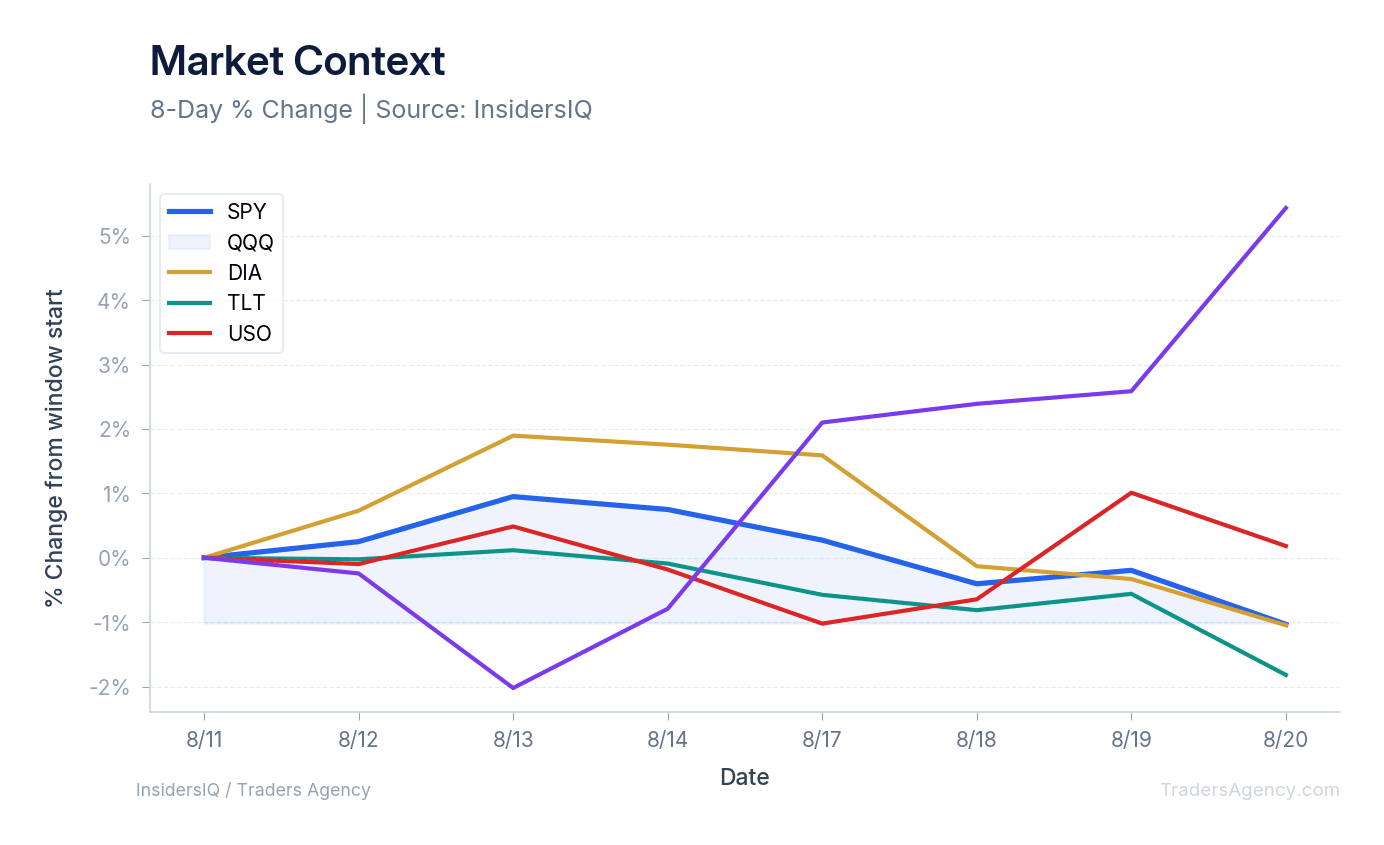
Key Market Data: SPY 10-day price change: -1.03%. QQQ 10-day price change: -1.05%. DIA 10-day price change: -1.82%. Oil (USO) surging +5.43% over the same period.
Our analysis of the SPY shows a 10-day price change of -1.03%. The technology-heavy Nasdaq is facing similar pressure, with the QQQ posting a 10-day price change of -1.05%.
Investors were already anxious after weaker-than-expected retail sales and labor market data for July. The recent surge in yields has only accelerated this trend.
Why Are Global Markets Falling This Week?
Global markets are falling this week because rising bond yields and elevated energy costs are directly threatening consumer resilience and corporate margins. Investors were already anxious after weaker-than-expected retail sales and labor market data for July, and the tone worsened when Walmart missed Wall Street expectations for quarterly comparable sales.
The most glaring signal came from Walmart. Shares of the world's largest traditional retailer tumbled 9.2% after missing Wall Street expectations for quarterly comparable sales. Shoppers are reining in spending due to rising gas prices.
This weakness is not isolated. Rival retailers followed Walmart lower:
- Costco saw significant losses
- Dollar Tree shares dropped
- Albertsons followed the downward trend
- Overall peer losses ranged between 1% and 2.6%
There is some question about how resilient the consumer can be with ongoing elevated gas prices and inflationary pressures. The increase in US crude oil compounds these concerns about the health of the US consumer.
How Will This Affect the US Stock Market Today?
The US stock market today is facing heavy technical damage across all major benchmarks as yields advance again. The S&P 500 lost 66.82 points, or 0.87%, dropping to 7,641.16. This close puts the index about 2% below its most recent record close reached last week.
Dow Takes the Hardest Hit: The Dow Jones Industrial Average fell 1.32% to 52,759.21, a drop of 703.84 points. The DIA 10-day price change now sits at -1.82%, the worst among major index ETFs.
The selloff in global stocks shows broad weakness in growth sectors. The Nasdaq Composite fell 1.00% to 26,067.17. The index is now more than 3% below its June 2 record finish.
Which Sectors Are Leading World Markets Today?
Defensive positioning is dominating world markets today. There is a stark divergence between energy commodities and retail equities.
The S&P 500 consumer staples and consumer discretionary sectors were among the weakest of the benchmark's 11 major industry indexes. The Walmart report dragged down these entire sectors.
Conversely, energy prices and bond market activity are taking center stage. The USO 10-day price change shows a massive +5.43% gain. The TLT 10-day price change sits at +0.18%.
The US Treasury Department said it would spend more than double the expected amount on buying back bonds in a bid to slow the recent surge in yields. Yields on the 30-year and 10-year bonds pared gains briefly after US Treasury Secretary Scott Bessent said he may again increase the volume of Treasury bonds the government will repurchase. However, yields quickly resumed their upward trend.
Want expert trading insights delivered daily?
Join thousands of traders who rely on Traders Agency for market analysis and trade ideas.
Join Traders AgencyWhat Does This Mean for Traders?
For traders, this means defensive positioning may be warranted as high-yield and high-oil environments pressure equity valuations. We are closely monitoring consumer staples and consumer discretionary sectors, which are currently showing the most weakness, along with the Jackson Hole symposium for potential market signals.
1. Track Consumer Discretionary Weakness
The 9.2% drop in Walmart suggests that high gas prices may be materially impacting consumer spending. Traders should watch for further downside in retail stocks if oil remains above US$87.
2. Monitor Treasury Yield Interventions
The bond market reversed very quickly, within 24 hours, after the Treasury's buyback move. We are watching for any additional comments from Treasury Secretary Scott Bessent regarding repurchase volumes.
3. Watch Jackson Hole
Treasury yields rose and equities slid as the Jackson Hole symposium came into view. This event may offer further signals on how policymakers are viewing the current environment of rising energy costs and shifting labor market conditions.
The Bottom Line on Global Equity Pressure
Our team believes the combination of surging oil and rising yields presents a difficult environment for equities. The pressure on the US consumer and the resulting retail sector selloff explain the broad weakness we are seeing across global markets. We are keeping a close eye on the USO and TLT as leading indicators for where the broader market may head next.
Want expert trading insights delivered daily?
Join thousands of traders who rely on Traders Agency for market analysis and trade ideas.
Join Traders AgencyKey Takeaways
- US crude oil climbed above $87 per barrel, with USO posting a +5.43% gain over the 10-day period tracked in the article.
- The Dow Jones Industrial Average dropped 703.84 points and the Nasdaq Composite lost 263.92 points in the session described.
- SPY, QQQ, and DIA posted 10-day price changes of -1.03%, -1.05%, and -1.82% respectively, with DIA showing the steepest decline.
- Weaker-than-expected retail sales and labor market data for July were already weighing on sentiment before the yield and oil spike accelerated the selloff.
- USO and TLT are flagged as leading indicators to watch for signals on where broader market pressure may head next.
DISCLAIMER: Traders Agency does not offer financial advice. The information provided is for educational purposes only and should not be considered financial advice. Traders Agency is not responsible for any financial losses or consequences resulting from the use of the information provided. Trading carries inherent risks and may not be suitable for all individuals. You are advised to conduct your own research and seek personalized advice before making any investment decisions, recognizing the potential risks and rewards involved.
See more from Traders Agency on Google
Make us a preferred source and our market analysis will appear more prominently in your Google Search, Top Stories, and AI results.
Add to Preferred Sources